

Chief Architect - AI Transformation @Microsoft https://teapawt.net/t.co/JAVYVd3M2R https://teapawt.net/t.co/jjfH1KydZp - views expressed are my own.
Northern Virginia
Joined January 2009
- Tweets2.2K
- Following311
- Followers199
- Likes2.9K





The Magician's Nephew is coming out in the movie theaters soon. One of the great quotes I remember from the book is this.
“But of course you must understand that rules of that sort, however excellent they may be for little boys—and servants—and women—and even people in general, can't possibly be expected to apply to profound students and great thinkers and sages. No, Digory. Men like me, who possess hidden wisdom, are freed from common rules just as we are cut off from common pleasures. Ours, my boy, is a high and lonely destiny.”
I'll just leave that there and let you think about it.
2
1
60
𝗠𝘆 𝗳𝗮𝗰𝘁𝗼𝗿𝘆. 𝗠𝘆 𝗿𝘂𝗹𝗲𝘀. 𝗠𝘆 𝗔𝗜.
I’ve built what I think of as a 𝘀𝗼𝗳𝘁𝘄𝗮𝗿𝗲 𝗳𝗮𝗰𝘁𝗼𝗿𝘆 around Codex: processes, principles, checks, conventions, agent instructions, testing approaches, and guardrails that let me build software very quickly.
I’m not a software engineer. I’m a business technologist with some software chops from many years ago.
What I bring today is mostly requirements, domain knowledge, judgment, taste, and an understanding of how things actually work in the real world.
And I’ve realized there are three very different ways I use AI.
𝟭. 𝗗𝗲𝗹𝗲𝗴𝗮𝘁𝗲.
Sometimes I just want the work done.
I’ve already put my principles, rules, processes, and standards into the factory. So I can describe the outcome I want and let Codex work.
I don’t need to supervise every decision because it is operating inside a system I already designed.
That is the whole point of the factory.
𝟮. 𝗖𝗼𝗹𝗹𝗮𝗯𝗼𝗿𝗮𝘁𝗲.
Here I want AI to think with me.
Stay within the architecture and principles we’ve established, but challenge the implementation.
Maybe there is a better design. A simpler architecture. A cleaner workflow. Maybe my first idea was wrong.
We go back and forth. I contribute what I know. The model contributes what it knows. And together we usually produce something better.
𝟯. 𝗗𝗲𝗰𝗶𝗱𝗲.
This is different.
Sometimes I know exactly what I want.
I’ve considered the alternatives. I understand the business process. I’ve made the judgment call.
At that point, I am no longer asking AI what it thinks.
I am telling it what to build.
Maybe it created a technically elegant UI that I know a real user will hate.
Maybe I don’t like the naming.
Maybe its approach is perfectly reasonable, but I understand something about the real-world workflow that it doesn’t.
Or maybe I simply want it done another way.
Then the instruction is simple:
𝗗𝗼 𝗶𝘁 𝘁𝗵𝗶𝘀 𝘄𝗮𝘆.
I don’t care what I told you yesterday.
I don’t care what our normal convention is.
I don’t care what AGENTS.md says.
𝗜 𝘄𝗿𝗼𝘁𝗲 𝗔𝗚𝗘𝗡𝗧𝗦.𝗺𝗱.
Those rules exist because I created them to make the AI effective. They are not there to overrule me.
That is where human judgment comes in.
In Mode 1, I trust the system.
In Mode 2, I improve the answer with the system.
In Mode 3, 𝗜 𝗺𝗮𝗸𝗲 𝘁𝗵𝗲 𝗱𝗲𝗰𝗶𝘀𝗶𝗼𝗻 𝗮𝗻𝗱 𝘁𝗵𝗲 𝘀𝘆𝘀𝘁𝗲𝗺 𝗲𝘅𝗲𝗰𝘂𝘁𝗲𝘀 𝗶𝘁.
Sometimes I want an autonomous worker.
Sometimes I want a brilliant collaborator.
And sometimes I want an extraordinarily capable implementation engine that stops arguing and does exactly what I told it to do.
Within the hard limits of the underlying model, the hierarchy is pretty simple:
𝗠𝘆 𝗳𝗮𝗰𝘁𝗼𝗿𝘆.
𝗠𝘆 𝗿𝘂𝗹𝗲𝘀.
𝗠𝘆 𝗔𝗜.
🤖 Made with AI

2
2
327
Mere mortals were not meant to have this much power.
I can wake up at two in the morning, look at my phone, and steer three or four AI agents that are building software and infrastructure while I lie in bed.
The power of AI isn’t that it makes a programmer more efficient.
I haven’t gone from being a 1X programmer to a 10X programmer.
I’ve gone from being a business technologist to having an entire fleet of software engineers available whenever I need them.
I don’t remember which AI lab said that software engineering has been “solved.” And I’m not sure it has been solved for the average person walking down the street.
But if you’ve spent years adjacent to software engineering—if you know the language, understand architecture and systems, and can reason conversationally about requirements and trade-offs—then something fundamental has changed.
For that person, software engineering is very close to solved.
Not because you suddenly became a great programmer.
Because you can now direct great programmers.
2
4
137
I really like 𝗚𝗣𝗧-𝟲 𝗔𝘀𝘁𝗿𝗮.
It is smart, capable, persistent, and very good at engineering work. It also appears to have absolutely no self-control. 😂
Give it a well-bounded task and, if you are not careful, it may decide you also need:
• a broader architecture
• extra hardening
• another abstraction
• more edge cases
• more tests
• another verification pass
The work can be excellent. The token usage can be brutal.
I tried fixing this in AGENTS.md with increasingly explicit instructions:
“Choose the smallest sufficient solution.”
“Do not add speculative hardening.”
“Add tests only for meaningful behavior.”
“Trust operation results.”
“Stop when the work is done.”
That helps. It does not solve the underlying behavior. So I stopped asking GPT-6 Astra to police itself.
𝗜 𝗴𝗮𝘃𝗲 𝗶𝘁 𝗮 𝗿𝗲𝘃𝗶𝗲𝘄𝗲𝗿.
Before consequential work begins, the primary agent must submit the proposed action to an independent reviewer.
The reviewer approves only if:
• the work is necessary
• the implementation is the smallest sufficient solution
• verification is meaningful
• new tests close a real gap
• speculative edge cases are not driving scope
• successful results are accepted and the work stops
I also explicitly banned these justifications:
“Best practice.”
“Extra confidence.”
“Something might go wrong.”
The reviewer returns only:
𝗔𝗣𝗣𝗥𝗢𝗩𝗘
𝗥𝗘𝗩𝗜𝗦𝗘
𝗦𝗧𝗢𝗣
And the primary agent cannot override it.
It is basically separation of powers for agentic software development. So far, this works much better than another paragraph telling Astra not to over-engineer.
The broader lesson:
As models get stronger, the problem is not always getting them to do more. It is getting them to know when they have done enough.
𝗜𝗻𝘁𝗲𝗹𝗹𝗶𝗴𝗲𝗻𝗰𝗲 𝗶𝘀 𝗲𝘅𝗽𝗲𝗻𝘀𝗶𝘃𝗲 𝘄𝗵𝗲𝗻 𝗶𝘁 𝗵𝗮𝘀 𝗻𝗼 𝘀𝘁𝗼𝗽𝗽𝗶𝗻𝗴 𝗰𝗼𝗻𝗱𝗶𝘁𝗶𝗼𝗻.
GPT-6 Astra is a terrific model. It just needs to wear this sign for a while:
“I cant help myself. I over engineer and over test.” 😄
---
@pvncher @thsottiaux - fixing this would probably reduce your load on the servers big time! We business technologists are running wild on token usage!
🤖 Made with AI

3
125
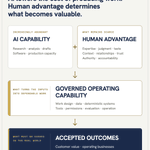
AI is rapidly making cognitive production abundant. That does not remove the 𝐡𝐮𝐦𝐚𝐧 𝐚𝐝𝐯𝐚𝐧𝐭𝐚𝐠𝐞. It increases its value.
The opportunity now is to combine AI capability with human expertise, judgment, taste, context, relationships, trust, authority, and accountability - and turn that combination into governed, real-world operating capability.
The real measure of success is not output. It is 𝐚𝐜𝐜𝐞𝐩𝐭𝐞𝐝 𝐨𝐮𝐭𝐜𝐨𝐦𝐞𝐬: customer value delivered and businesses that actually work in the real world.
That is the shift we are in.

2
105
That happened at while I was out. I didn't see it. I made the mistake of waking up at 2a and saw it then. Two hours later. I now have full control over a Linux workstation in the cloud...wait for it... Using my voice over my iPhone. It's a completely interactive experience and connected to my personal knowledge base (GBRAIN). What's next? Put in in droid form and I have a personal R2!
Thanks @thsottiaux and @garrytan

We did it, finally... Codex & ChatGPT desktop, now on Linux.
Thanks for waiting and you can cancel that MacBook order if you got impatient. It’s that good.
👀
2
3
87
Claude Code has taught me to be much more expressive... on-hire engineers get a thesaurus+RSUs. Smooshing... Gesticulating... Discombobulating... Reticulating... Perusing... Enchanting... Wandering... Mulling... Spelunking... Deciphering... Forging... Actualizing... Moseying...
1
78

Kevin Tupper retweeted

It may be time to prepare for the next level of support at 455. Market is not bouncing out of this hole and the fact that we are glued to the weekly 50 sma is the worst possible news. #SPY #StockMarketCrash

Kevin Tupper retweeted

OpenAI on Tuesday announced its biggest product launch since its enterprise rollout. It’s called ChatGPT Gov and was built specifically for U.S. government use.
More here: cnb.cx/4aIl872

Kevin Tupper retweeted

MSFT CEO up late tweeting a link to the Wikipedia article on Jevon’s Paradox. This is getting serious.

Jevons paradox strikes again! As AI gets more efficient and accessible, we will see its use skyrocket, turning it into a commodity we just can't get enough of. en.m.wikipedia.org/wiki/Jevo…
For DeepSeek R1 fans . . . do you feel that showing the <thinking> leads to explainability from a user perspective?
78
Kevin Tupper retweeted

Notice how it’s always “vote according to Biblical values!” until it comes to welcoming the immigrant, helping the poor, feeding the hungry, bringing healthcare to the sick, forgiving debts, caring for our planet, laying down our swords, or loving our neighbors.
Kevin Tupper retweeted

Steve Jobs email he sent himself 13 months before he died.
Whenever I re-read this, I regret waiting so long to have read it again.

Marking myself safe from today's carnage thanks to
@leadlagreport
and leadlagreport.substack.com.
46
Kevin Tupper retweeted

We're thrilled to partner with @GitHub to bring Azure AI's industry leading model selection to a community of more than 100 million devs. The latest Azure AI integration brings embedded safety features and simple APIs to unlock AI development. Learn more: msft.it/6019leVbz

The NVDA story reminds me of a quote I heard some time ago on a documentary about IBM vs APPLE in the early days and how MSFT made bank.
During the war for the PC between IBM and APPLE, MSFT sold bullets (software.)
During the AI war, NVDA sells bullets (chips.)
1
108
A lot of people jumped the gun, and some apologies are in order.
washingtonpost.com/technolog…

1
2
113