god helps those who help themselves
Joined December 2024
- Tweets605
- Following127
- Followers959
- Likes814





woods retweeted
❤️🩹🇵🇹 The end of a legendary era. Cristiano Ronaldo leaves Portugal with 146 goals in 234 games.
woods retweeted
❤️🇵🇹 Cristiano Ronaldo’s full letter to Portuguese fans.
“To the Portuguese people,
The day has come to hand back the shirt and the captain's armband of the national team that belongs to all of us.
I never felt that it was exclusively mine, but for 23 years, I had the privilege and responsibility of wearing it, defending it, and carrying it with me to stadiums all around the world.
Today, the moment has come to pass it on to the future.
It was not an easy decision, because some decisions are not made with the head alone. They are also made with the heart.
I am bringing to an end a journey that began in August 2003 and changed my life forever.
When I look back and think about everything I experienced with the national team, I don't just see matches, goals, records, or trophies. I see people.
I see immigrants who, for 90 minutes, felt a little closer to Portugal. I see millions of Portuguese people whom I never met personally, but who became part of my life.
Because, at the end of the day, football is much bigger than a game. Football is about people.
Throughout my entire career with the national team, I always tried to push beyond my limits. I wanted to win, I wanted to be the best, I wanted to make history.
I was always demanding of myself. I always wanted more. I always believed we could go further, and I gave everything I had for this shirt.
There were perfect afternoons and nights. There were victories I will never forget. There were defeats that still hurt to remember today.
I also failed. I also suffered. There were moments when I couldn't give the Portuguese people what they wanted so badly. But I never gave up.
And above all, I never stopped feeling proud to represent Portugal.
Over these years, I learned some very simple things: goals come and go, trophies end up in museums, records are eventually broken, but there is something that time can never erase.
The place I hold in people's hearts.
If I ever made you happy, if one of my goals ever made you hug someone, forget a worry, or feel proud of our country, then it was all worth it.
Because being Portuguese is also about that.
We suffer together. We get back up together. We believe again.
Portugal will always need young people who dream, players who never give up, and new generations who believe it is possible to reach places no one has reached before.
Because a country that continues to create new heroes is a country that never stops believing in itself.
To my national team teammates, I want to leave a special message.
Thank you for every run, every hug, every argument, every moment of silence before stepping onto the pitch, every victory we celebrated together, and every defeat that made us stronger.
I had the privilege of being your captain, but no captain walks alone, and you are all part of my story.
To all the coaches, directors, doctors, physiotherapists, kit managers, staff members, and the many people who worked with me throughout these years, thank you.
Many of you never appeared in the photographs, but without you, none of those photographs would have been possible.
To my family, thank you for sharing this dream with me.
Thank you for understanding the absences, the sacrifices, and the moments when the national team had to take up a space that also belonged to you.
If I made it this far, it was because we always walked hand in hand.
And to the Portuguese people, to every Portuguese person around the world, I want to tell you one last thing.
There is an image that I will always carry with me.
A moment when the national anthem begins.
I look around me. I see my teammates. I see the stands.
I see children, mothers, fathers, and grandparents. I see Portuguese people who travelled from so far away just to be there.
And during those moments, we stop being different.
There are no clubs. There are no colors. There are no classes. There are no professions. There are no opinions.
There is only one passion: Portugal”.

tired of these guys scamming people
so I’m letting u know from now:
this is ONLY applicable if you buy a yearly plan. there is no other way to redeem this.

if you’re interested in getting all the same models higgsfield provides but for a fraction of the cost check out revana.si
( it’s pay as you go and provides seedance as cheap as $0.06 )

2
8
962
you will not win on X by replying
instead quote tweet, its the only method to grow at an insane speed.
new account, old/dead account, struggling to get impressions, it doesn't matter.
it's so stupidly amazing.
when you QT a viral post, you're basically riding the attention that post has already attracted.
someone else has already done the hard part of getting thousands of people interested in a topic.
now you have an opportunity to put your own content in front of those same people.
but heres the catch.
you can't just quote a post saying "this is insane, or yes i agree" and expect to print impressions.
you need to ADD something worth reading.
for example:
-> someone posts an AI video that goes viral. quote it with a breakdown of exactly how to recreate it.
-> a founder shares insane growth numbers. reverse engineer the strategy behind them.
-> someone makes a controversial claim. challenge it with an argument people actually want to discuss.
and the timing matters.
find posts that are actively gaining traction, ideally in the same niche as your account. don't wait until the entire conversation has died. ideally the best time to QT is 2-5 hours into a post. after that its hard to take advantage of it.
the original post gives people a reason to stop scrolling. your commentary gives them a reason to read, engage and potentially follow you.
you can literally build an entire content strategy around finding good posts and adding valuable insights to them.
this article very nicely broke down how to use grokbot to print views with grokbot.
good read imo.


1
163

woods retweeted

The AEO / GEO playbook for 2026
┃
┣ 📁 Map the queries that matter
┃ ┣ List the problems your buyers ask AI about
┃ ┣ Add “best”, “alternatives”, “vs”, “cheapest”, and use-case queries
┃ ┣ Prioritize high-intent prompts over generic informational ones
┃ ┗ Track the same query set across ChatGPT, Claude, Gemini, and Perplexity
┃
┣ 📁 Audit your visibility
┃ ┣ See if your brand gets mentioned
┃ ┣ Track which competitors show up instead
┃ ┣ Check which sources AI is citing
┃ ┗ Flag outdated or incorrect information about your product
┃
┣ 📁 Create content AI can use
┃ ┣ Publish comparison pages for real buying decisions
┃ ┣ Build product-led pages around specific problems
┃ ┣ Keep API docs, SDKs, pricing, and feature pages current
┃ ┗ Remove thin, outdated, or conflicting content
┃
┣ 📁 Build authority off-site
┃ ┣ Get mentioned on trusted third-party sites
┃ ┣ Publish useful YouTube content
┃ ┣ Contribute to relevant Reddit discussions
┃ ┗ Make sure the internet consistently describes what your product actually does
┃
┣ 📁 Optimize for category visibility
┃ ┣ Don’t obsess over ranking #1 for one prompt
┃ ┣ Measure how often you appear across dozens of buyer queries
┃ ┣ Compare your visibility against direct competitors
┃ ┗ Focus on the prompts most likely to turn into revenue
┃
┗ 📁 Execution loop
┣ Monitor AI visibility every week
┣ Find the biggest citation + recommendation gaps
┣ Ship content to close those gaps
┗ Re-run the same prompts and measure what changed
this ENTIRE AI animation cost me $0. no this is not clickbait, it really was made for free.
making the same video normally would've cost $2–5.
i reverse engineered 32 animation videos frame by frame, studying everything from camera angles and lighting to the pacing and movements that make good animations feel so engaging.
after breaking all of that down, i turned what i learned into a reusable skill that can replicate his animation style.
here's the process:
-> pull reference frames from the videos you want to match. i turned his frames into shot files with the camera, lens, and lighting written out
-> build the story so there's a new image roughly every 1.2 seconds. that's his pacing
-> make a key frame for every motion. if a motion isn't drawn, the AI makes one up, and that's where the weird floating stuff comes from
-> turn those frames into clips and stitch them together
you can replicate this for pretty much any animation style as long as you have good references.
we're genuinely getting to the point where AI could replace a 90% of motion and 3D design work if you have taste.
the fact that you can make high-quality animations like this for practically nothing is insane, and it's only going to get cheaper.
RT + reply "pyramid" and i'll send you the exact skill + workflow i used.
(must follow so i can DM)
woods retweeted

i love writing. i never let agents write for me. whether it's docs, or tweets, or shitposts, or even prompts (okay maybe that one's harder as agents manage other agents)
there's a simple reason for that: i still strongly believe that writing is thinking. it's a skill i hope to never give up. it's also important to me that whatever i say is always authentic, mistakes and all. my favorite posts are the ones that i just full send without any editing
i suspect it also helps with prompting. being able to clearly express what i want, and knowing the vocabulary i need to be able to direct my agents does seem to make for more effective usage of agents. in the same way that engineers have an advantage when we prompt agents to write code, because we are intimately familiar with the words that make up the discipline
knowing the right word incantations to get an agent to produce a desired goal almost feels like spellcasting. as models get more capable, and that input box looks more and more like a magic box that can output anything, words become the interface between you and the genie
there may come a time when we give up the keyboard in exchange for brain-computer interfaces. but until then, i'm writing every word.
give claude this prompt and send your landing page
you'll get an insane video like this. $0, no after effects, all code.
steal the prompt ↓
<inputs>
Ask me for: my landing page link; my brand name; the official logo mark, the symbol on its own (an SVG or PNG I've put in this folder, or read it off my page); a two-part closing line (a statement, then a short italic tail); whether my page's product videos should play inside the film (default yes if the page has any); which sections to hide (default: pricing, FAQ, newsletter and anything that doesn't show the product); the sound for the overhead moment (default: a camera shutter if my product captures or records, a soft click if not); and a 15 second music track if I have one (if not, you make one, see step 8). After you look at my page, list the pieces you plan to lift and let me add or remove any before you capture them.
</inputs>
<direction>
A 14.5 second 3D fly-over of my landing page, 1440x1152 at 60fps, with its own music and sound design. The page lies flat on a bright studio floor (#f9fbfb in the middle, #f2f3f6 in the corners) with a soft wide shadow around it and 24px rounded corners. One continuous camera, never a cut: it starts low over the hero and glides backwards down the page at one steady speed while looking up it, rises straight overhead to show the whole page as one strip, dives into the hero and lands it as a card under a two-line title. Focus is razor thin in front of the subject and almost none behind it, so everything near the lens melts. Cards float a little above the page with soft shadows; photos, chips and the testimonial lift off and stand up toward the lens as the camera passes them. Any product video on my page keeps playing inside its card as the camera passes, so the film shows the product working. Four small tiles of my logo lift off beside the hero button and fly up past the top corners of the frame; three of them stay pinned to the page around the hero, so they come back in the overhead view and sit on the end card. The title is Geist 500, the italic tail Instrument Serif.
Every element on screen must come from my real page or my brand. Nothing is added for decoration.
Banned: cuts, crossfades, stops or surges in the glide, the camera turning or swinging sideways, zooming in and back out, glows, giant blurred blobs or tiles drifting near the lens, any text laid over the page before the end card, any constant hiss or noise bed in the audio, and a click or tick on every element that moves.
</direction>
<structure>
14.5 seconds: flight 0-8.2s, rise 7.75-9.25s, overhead 9.25-9.47s, dive 9.47-9.97s, title card 9.97-14.5s.
These times are for a page like ours. Keep the glide, the rise, the overhead, the dive and the title exactly as timed. Move each lift to where my real pieces sit. Where my page has nothing to match (two side icons, a testimonial, a grid of cards, a hero video), skip that move and tell me what you skipped.
The camera 56° off straight-down and 1360px from the point it looks at, centred on the top half of the hero, the hero product sharp and its video already playing, four 32px logo tiles beside the button → 0-0.6: the glide eases in from rest → 0.1-1.35: the button rises 34px, the tiles lift, grow to 90-150px and hang right outside the page's top corners, the hero's chips rise to 70px and stand up 30° → 1.25-1.6: the glide doubles to cruising speed as the hero falls behind → 1.45-2.75: the second section's two icons fly up to about 200px, stand up 54° and pass the left and right edges at about 2.4 → each section's main card or video lifts to 100-120px and stands up 46° as it crosses the frame, its tags rise 30px → 3.0-7.3: every following section passes at the same steady speed, sharp as it crosses the middle of the frame, soft below it; grids of cards lift in pairs → 5.45-6.3: the testimonial rises from 22 to 112px, stands up 30° and shows a 34px white edge → 7.3-8.2: the glide eases off as the footer arrives → 7.75-9.25: the rise, zooming out at an even rate while the tilt flattens (8.15-8.95), the page's bottom edge settling 42px above the frame bottom → 9.25-9.47: the whole page as one centred strip, creeping 3.5% closer → 9.47-9.97: the dive, top edge pinned to the frame top while it grows, everything below the hero fading out, the top dropping to y 283 so the hero lands as a 1018px card with 38px corners and a soft shadow, its video still playing; three crisp logo tiles sit on its corners and nothing else → 10.02: a white badge pill (logo + brand, 21px) at y 44 → 10.12: line 1 at 74px, one word every 0.06s → 10.36: the italic tail at 82px in grey #8b8b92, one word every 0.05s, each word rising 16px out of a 12px blur in 0.34s → 10.6-14.5: hold, the card creeping 2% closer, the tiles drifting a few px.
</structure>
<build>
1. Open my link in headless Chromium (Playwright) at 1440x900, device scale 2, and scroll to the bottom once so lazy images and scroll animations finish. Mark the pieces that lift (cards, product mockups, chips, feature photos, the testimonial, the hero button) with data-layer. Screenshot the full page with them hidden, then each piece alone on a transparent background with 28px padding, and save every piece's page position to a JSON. For every product video on the page, pause the page's own player, step it through the video and screenshot each frame inside its card, 30 frames for every second of video, so it plays inside its card in the film.
2. One WebGL2 film page, 1440x1152, every frame computed from time inside seek(t): no timers, no CSS transitions, video frames chosen by t. The page is a textured quad on the floor and each piece its own quad at its height, drawn lowest first with no depth buffer. Use mipmaps and 16x anisotropic filtering or the far text shimmers.
3. Drive the camera from one speed curve, never from a position key every half second. Focal length 1880px, 56° tilt, distance easing out from 1360 to 1700px and never back in, no turning. Speed down the page as a share of cruise (work cruise out from my page so the look point reaches the top of my footer at 8.0s; on a 9,160px page that came to about 1,090 page px/s): 0 at 0s, 0.5 by 0.6s, held at 0.5 to 1.25s, 1.0 by 1.6s, held at 1.0 to 7.3s, then easing to 0.12 by 8.3s. Integrate it into the page position. Each section's lift starts when the camera's look point is 1100-1250px above it and finishes 300-350px above it.
4. Depth of field per pixel: blur radius = 75 x (focus - depth) / depth in front of the focus and 6 x (depth - focus) / depth behind it, capped at 120px, 40 taps on a golden-angle disc, each tap read from a mip level matched to the blur. Keep the focus on whatever crosses the middle of the frame.
5. A lifted piece stands up by turning about its own middle, top edge rising toward the lens. Each casts a shadow on whatever is under it: the same picture in flat #1a2133, offset (0.10z, 4 + 0.36z), blurred 7 + 0.5z, 26% opacity.
6. Rise: zoom out in log scale with a smooth trapezoid speed (speeding up 7.75-8.35s, even 8.35-8.95s, slowing to a stop at 9.25s) and hand the glide over to a camera that holds the page's bottom edge at that 42px line from 8.0 to 8.5s. Dive: log scale on a quadratic ease in-out, then solve the look-at point from the pinned edge. A rounded-rect mask morphs from the full page to the hero, 24px to 38px corners.
7. Render with Playwright on the real GPU (Mac: --use-angle=metal; Windows: --use-angle=d3d11; plus --enable-gpu --ignore-gpu-blocklist): 60fps, 16 subframes across 0.7 of a frame for motion blur, H.264 MP4. Split the frames across 3-4 render processes to finish in minutes.
8. Sound: music carries the film and a few designed sounds punctuate it. Fewer, better sounds: at most 8 effects in the whole film, never one per element.
Music: a 15s minimal track (soft pulse, warm low end, no vocals, 110-124 BPM). Pick the tempo and start offset so the landing at 9.97s falls exactly on a downbeat, the track builds through the rise (7.75-9.25s), drops to near silence for the overhead (9.25-9.47s), and the full groove returns on the landing. If I gave you a track, fit it the same way (trim, never time-stretch more than 3%). If not, generate it with ElevenLabs music if I give you a key, otherwise pick a free licensed track (Mixkit) and write its link and licence in audio/SOURCES.md.
The only effects, each made for its moment (ElevenLabs sound effects with a key; otherwise the closest free Mixkit sound, softened): 0.15 one soft airy lift under the tiles popping off (not four clicks) → about 2.4 one wide swoosh as the two icons pass the edges, panned left then right → the testimonial settling: one warm soft tap → 8.66 the rise: let the music's build carry it, add only a quiet air layer → 9.30 the overhead: the one signature sound for my product → 9.84 the dive: a short dark whoosh → 9.97 the landing: a deep soft impact with a long tail, on the downbeat → 10.12 the title: one soft chime under the first line, nothing per word.
Every effect is soft and warm: low-mid weight, nothing sharp above 8kHz, no plastic UI clicks. Time each one from the picture's own timeline, its loudest point on its moment, panned to where the element sits on screen.
Mix: the music ducks 4dB under the dive and the landing and comes back over 0.6s. Effects share one soft dark reverb with the music (about 1.6s). Master to -14 LUFS integrated, true peak -1dBFS, low cut at 35Hz, a gentle high shelf down above 12kHz, 1.2s fade at the end. The first 0.4s starts quiet, never on a hit.
</build>
<gotchas>
If you can't run code on my computer, tell me straight away that you can only make a live preview here and that the MP4 needs Claude Code. This film is the one exception to the kit's engine rules: it doesn't use SHOT blocks, kf, engine/render.mjs, WEBGL=1 or engine/encode.py. Write capture.mjs, cam.js, film.html, render.mjs and the sound script in this film's folder, render on the real GPU as in step 7, and still never edit engine/. Phones or cards that fade out with transparency show whatever is behind them, so fade them into the haze colour first and only cut to transparent at the very end. Keep most lifts tiny (20-40px) and lock the page before timing anything, because any change in a section's height shifts everything after it. Logo tiles that come close to the lens turn into giant blurred blobs. Only the opening tiles beside the button may pass soft at the top corners, in the first 2.6 seconds; keep every tile far from the camera after that. Before any screenshot, close cookie banners, chat bubbles and pop-ups, and check that a sticky header appears only once, at the top of the page. Pause or seek the page's own videos before the full-page screenshot, or the capture catches a random frame. Before the final render, measure a quick 30fps preview with optical flow: the speed down the page must never dip and the zoom must never turn into a zoom-in during the flight. You can't listen to the mix, so plot its loudness against the cue times and check that every effect lands on its moment, the landing sits on a downbeat of the music, the loudest point is the landing, the integrated loudness reads -14 LUFS, and there is no hiss and no click on every element. Then tell me it's ready for me to listen; I judge the sound.
</gotchas>
<start>
Work in a new folder next to example-monkey/ called landing-film/. Ask me for the inputs. Capture my page, then show me the full-page screenshot and a sheet of every cut-out piece on a bright pink background, and wait for my OK. Build the film, then show me stills at 0, 1.6, 2.5, 5, 6.5, 9.3 and 11 seconds next to each other, and wait for my OK before you render. Render the picture first, then the sound, then mux them.
</start>
THIS IS F*CKING INSANE.
opus 5.5 generated this in ONE shot.
all I gave it was a reference. it made this in 20 minutes, with zero after effects, and cost me $0.
steal the prompt below:
<inputs>
Ask me for: a theme (or keep lorem ipsum), 4 short big-type words for the opening line, a 10-word question, 3 one-word cards (7 / 10 / 10 characters including the full stop), a 4-letter word to spell at the end, 12 everyday objects to draw as pixel icons, a profile-portrait clip and a raised-open-hand clip (both on plain dark or plain grey backdrops), and a music track. If I skip any, use these defaults:
- theme: lorem ipsum
- big line: "sed" "ut" "non" "quam"
- question: "sed ut non quam nisi elit magna dolor in tempor?"
- cards: "tempus." "excepteur." "laboriosa."
- end word: ENIM
- icons: speech bubble, magnifier, envelope, bell, bolt, mug, pin, paper plane, key, bulb, megaphone, hourglass
- footage: free Pexels clips 10141041 (man in profile, grey backdrop) and 11666242 (open hand on black)
- music: any track whose busiest stretch sits at 7.2–11.5 s, with a near-silence at 2.5–3.5 s and a peak at 15.5–17.5 s
</inputs>
<direction>
A 20.4 second 4:3 mixed-media type film, 2880x2160, 23.976 fps, frames f0–f488. Riso-print collage: paper sheets cut hard against near-black sheets, chunky dithered pixel icons, halftone-printed footage, hand-drawn ink and one warm accent. Everything snaps: cuts land on exact frames, moves start fast and settle soft, single-frame flashes punctuate the beats.
Palette:
- sheets: PAPER #F3F3F1 (with a scanned CC0 paper texture multiplied at 55%), INK #272725, NIGHT #161615
- accent: EMBER #D3602C
- secondary: GREY #74746F, BONE #E9E4DA
- icon materials only: BRASS #B8893A, SAGE #7D8B6A, SLATE #4A555D, CLAY #9C4A2F
- footage shadow: #3A444B
Type: Schibsted Grotesk 700, lowercase, tracking −2%.
Icons: 24x24 pixel grids (40x40 for the three heroes), 1-px INK outline, 3-tone ordered Bayer dithering in the material colours. Heroes are extruded: stacked side layers at 58% brightness, 7% of size deep, and the paper texture printed into the face at 25%.
Footage: two-ink riso grade. SLATE solid with a BONE halftone dot screen (45°, 16 px pitch, ±12% ink gain) offset 3 px. EMBER rim light only on the lit edge, at 60%. A soft slate falloff behind the subject. Matte holes filled.
Grain on every frame: soft-light noise at 22% plus a 6% normal pass.
Banned: crossfades, purple, rainbow gradients, clean vector "wifi" arcs, corner-bracket "AI scan" frames, flat clip-art rays, frozen holds, Math.random, anything that looks like a template.
</direction>
<structure>
Positions are fractions of the frame (x from the left, y from the top). Velocities are px/frame on the 2880 stage; negative = moving left.
Icon slot table: R1 hourglass · R2 bulb · R3 pin · R4 bell · R5 plane · R6 megaphone · R7 bubble · R8 bolt · R9 mug · R10 envelope · R11 magnifier · R12 key. Every later hit, card and callback derives from this table.
S01 f0
- PAPER. The first big word as a 3-pass hand scribble, centred, cap .30 H.
S02 f1–2 (flash pair)
- f1: NIGHT, giant BONE word squashed ×2.5 tall.
- f2: EMBER sheet with INK registration crosshairs in all four corners (60 px, 4 px stroke). The word sits off-centre at x .58: x-height .176 H, baseline .576.
S03 f3–47 (big line, then small sentence)
- f3–4: PAPER. Big word centred, cap .17 H, between two 35%-EMBER dashed rules at y .41 and .57.
- f5: word 2 lands at 45% grey.
- f6: line moves −78.
- f7: line moves −1014; word 2 inks and gets a hand-drawn box.
- f8–9: 2-frame INK bar (x .36→edge, then x .62–.92) revealing word 3 in grey.
- f10–12: whip −624, −420, −36. A caret appears after word 3 at f10.
- f13: pixelated bitmap letters with dots between the words; word 4 appears half-typed.
- f14: motion-blurred collapse into a dash line at y .5.
- f15–17: the dash pattern changes every frame.
- f18: the small sentence: the first 4 words at x .07 y .5, sized so the whole question spans .75 W. A dashed selection box (x .01–.53) is on f18–20, off f21, on f22, gone from f23.
- f22–34: the sentence drifts left, decaying: −12, −10, −10, −8, −6 … −2.
- Words land at f21, 31, 38, 42, 46 and 50, each grey for 2 frames, then INK.
- Hand-drawn INK pen strokes, our own shapes:
- f18–24: cursive under the line, .42 W wide
- f25–26: it retracts
- f27–28: a big U-loop, .22 W × .62 H
- f29–30: a tick
- f32: a zigzag through a word
- f33–35: an ellipse that opens to the right
- f36: an over-line with a left hook
- f37: a vertical drop
- f38: a tick
S04 f48–88 (burst + arcs)
- f48: EMBER full-bleed, the only one in the film. The last word huge, rotated 90°, squashed into a dashed bracket at x .92. A BONE spindle burst. A tiny plane icon at the sentence end.
- f49: BONE flash, sentence blurred in CLAY.
- f50: PAPER, everything blurred, with speed streaks; 4 icons fly in.
- f51–88: 5 concentric EMBER→CLAY stippled spray arcs centred off-frame left at y .5.
- Outer reach px: 498 · 750 (f53–54) · 654 556 502 446 418 398 378 · 330 (f62) · 286 (f69) · 281 hold · 304→314 (f85–88).
- Uneven weights; blurred inner-arc bloom.
- Vignette from f51.
- Rack focus: blur ramps to 20 px f63–68, sharp again by f75.
- Floats R1, R10, R4 and R2 (230 px) at (.50,.32) (.72,.33) (.66,.58) (.77,.79), drifting 0.4 px/frame. They pixel-dissolve in 2x2 blocks over f77–79.
- f84: word 3 turns BONE.
S05 f89–148 (head)
- f89–92: NIGHT. An EMBER halftone orb at x .30 collapses from .45 W to .15 W while a BONE ring draws around it. f92: the sentence is masked at x .5.
- f93: the graded head (facing right, centred x .64) slides in from +.08 W at 1.12×, blur 22→0, settling by f100. Then a slow push-in to 1.05× by f148, drifting −0.6 px/frame.
- Line at x .144, 91 px BONE: "non nulla." → f128 "non" → f130 "non sed" → f137 "non sed do" → f145 "non sed do est."
- Caret on f95–105 only.
- BONE 12 px orbit strokes:
- f106 small front arc · f107 full tilted ellipse · f108 top arc
- f115 top-left arc · f116 big diagonal sweep · f117 lower-right arc
- A sparkle dot drifts on the neck f108–114.
- Background eases from NIGHT toward light grey, f135→151 (power 1.6), with a step at f149.
- Text inverts BONE→INK over f142–146.
- f144–148: a dark contour band contracts through the head, wiping the riso grade to a natural grey photo.
S06 f149–157 (flash cuts)
- f149–151: natural grey silhouette, INK line.
- f152: BONE→GREY gradient.
- f153: NIGHT with a printed BONE halftone band (y .70–.90) and an EMBER plate misregistered (+4, −3).
- f154: an EMBER pill.
- f155–156: blurred duotone icon blobs.
- f157: grey with one EMBER triangle.
S07 f158–199 (carousel)
- PAPER. The 12 icons on an ellipse centred (.495, .50), radii .33 W / .23 H. Size 560 × (0.55 + 0.95 × front-ness).
- Spin in °/frame: 9 → 1.2 over f158–170, 0.9 to f186, then accelerating to 8. R4 sits at −70° at f172.
- Ink: blob f164 · comma swoosh f168–169 · arc f170–171 · a bouncing spray ball between hits.
- Hits, as stippled EMBER/CLAY heat blooms that char 30–40% of the icon's pixels into INK, with stipple rays:
- f172 the megaphone burns (no rays yet)
- f173 burn with rays
- f177–178 bubble
- f182–183 bolt
- f188–189 mug (glow only)
- f189–199: push-in to 1.94× (f198) and 2.16× (f199), pulling R4 to centre.
S08 f200–219 (card 1: bulb)
- f200: NIGHT, blurred bulb + a giant spray burst (stippled crescent + 3 rays, falloff to the tips, CLAY plate offset 3 px).
- f201: BONE scribble streaks, a wide caret block, the burst tail.
- The bulb slides x .46 → .394 → .356 → .334 (f200–203), soft-focus f203–205, then breathes.
- Typing: f202 "tempu▮" · f203 "tempus▮" · f204 "tempus." + a bar caret (.045 W gap, .08 H tall). Word at x .67, 150 px BONE, over a 10 px blurred copy at 25%.
- f209: re-pose to 1400 px, tilted −0.32 rad, burst on its top-right corner.
- f215: lies flat (skew −0.9, y-scale .42) with a spray streak.
- Exit −32 (f218), −179 (f219).
S09 f220–236 (conveyor 1)
- Icons 880 px, 900 apart, in the ring order unrolled anticlockwise from R12.
- Velocity: −130 −124 −104 −78 −72 −51 −63 −69 −63 −69 −99 −139 −212 −270 −296 −500 (f221–236).
- Scale +10% over the shot. EMBER speed streaks top and bottom.
S10 f237–252 (card 2: hourglass)
- f237: blurred hourglass + burst.
- Typing: f238 "e▮" · f239 "excepteur▮" · f240 "excepteur. ▮" · bar caret from f243.
- From f238, two CLAY stippled arcs from the hourglass neck.
- f243: an EMBER arc set is born, grows f244–247, and its outer radius snaps 420→1500 px at f248.
S11 f253–264 (conveyor 2, resumes the row)
- Velocity: −713 −568 −254 −98 −36 −16 −32 −74 −96 −348 (f254–263), blurred exit at f264.
S12 f265–285 (card 3: key)
- f265: dashed EMBER ring + blurred key.
- Key settles from x .50: .361 .325 .312 .304 .299 .296 .294 .293 .292 (f266–274), then drifts 0.5 px/frame.
- Typing: f266 "laborio▮" · f267 "laboriosa." · block caret → bar at f274.
- EMBER pixel sparkles (plus shapes, 2.6× scale) pop on the key at f268, 275 and 279, each with a 1-frame expanding stipple ring.
- Exit −38 (f283), −279 (f284).
- f285: 1-frame flash, three big greyscale icons on dark grey.
S13 f286–330 (ring → constellation)
- Ring centred (.514, .497), radii .259 W / .295 H.
- Spin 14 → 2.8 °/frame (f286–292, 6-step subframe trails at 22%), near-still to f296, then easing to 12 °/frame.
- f300–302: the ring breaks into 12 constellation slots along a blurred ink swipe. Icons grow 430 → 350 and drift 1–2 px/frame.
- Silhouettes, each after a fat tapered ink splash sweeping in over 3 frames: f303 bubble · f308 magnifier · f313 the bell becomes an ink blob growing to 190 px · f318 bolt.
- The pin walks out of the blob f324–329.
- f321–330: everything slides left-up, accelerating −18 → −96, while the vignette closes.
- Word: f326 INK bar → f327 "…que" → f329 "quisque".
S14 f331–381 (hand)
- f331: NIGHT, a lit cluster of 7 icons (380 px) + "quisque".
- f332–338: the graded hand whips up from the bottom, blurred, with BONE streaks.
- Lines: f334 "quisque nunc" at x .145 · f343 "est" / f349 "est aliquam" / f378 "est aliquam ut" at x .655.
- Defocus pulse f347–348.
- f340–375: the bubble falls into the palm. f374–379: the clip plays backwards so the fingers close over it. A CLAY wash ramps in.
- f379–381: whip −18, −60, −276, with horizontal blur.
S15–16 f382–412 (spelling)
- f382: PAPER, a small spinning bubble.
- f383: bubble at centre (620 px) + letter 1 at x .09.
- f387–389: dark vignette, bubble bigger.
- f390: NIGHT, the bulb edge-on. f391: bulb face-on + letter 2 at x .38. f395–396: EMBER glow.
- f397: bulb large.
- f398: the hourglass edge-on over a NIGHT sheet filled with an EMBER/CLAY 45° halftone dot field (dots grow toward the edges).
- f399: letter 3 at x .62. f402: dark halo. f403: hourglass darkened.
- f404–406: key edge-on → face-on. f405: letter 4 at x .91. The key keeps turning.
- f411–412: BONE glow expanding.
S17 f413–488 (letters)
- f413: PAPER, key + letters.
- f414–417: new blurred INK strokes every frame, fading out. The letters burst outward (ease-out) into a loose 2x2: (.23,.24) (.56,.24) (.31,.83) (.82,.81), plus 5 dots.
- f420–443: tumble, then drift −54 → −18 with a slight up-drift.
- From f460: EMBER hand-pen underline loops under each letter, redrawn every frame (1-frame boil). Cap grows .05 H → .071 H.
- f488: the letters converge into one INK 2x2 monogram held by three EMBER pen loops.
</structure>
<build>
1. One HTML canvas at 2880x2160. drawFrame(F) is a pure function of the frame number. No timers, no CSS transitions, no Math.random (a seeded mulberry32 only). Shots register as SHOT(f0, f1, fn).
2. Draw icons as small pixel grids from primitives (circles, rects, triangles, lines), auto-outline them, dither them, export 24 px and 40 px PNGs, and draw them with imageSmoothing off.
3. Grade footage offline in Python/numpy. Per frame: matte (threshold just above the backdrop, close the holes), the halftone plates, the lit-edge rim and the falloff. Save PNGs and draw them as the shot background.
4. Stipple, spray, ink splashes and pen strokes are seeded point clouds and jittered polylines. Boil = a new seed every frame.
5. Render with Playwright, one canvas screenshot per frame. Encode H.264 yuv420p at 24000/1001.
6. Also make a side-by-side comparison against your reference if you have one, and run a frozen-frame scan: no 2+ frame run with <40 changed pixels unless the design holds on purpose.
</build>
<gotchas>
Measure text only after the font loads. Don't let the 3D icon function reset ctx.filter, or soft-focus frames render sharp. A paper texture drawn with the wrong source rect leaves a visible seam; crop it 4:3. Use near-black backdrops for the footage, or the matte fails, and threshold just above pure black so shadowed palms stay attached. A box-shaped hole fill leaves square edges; blur then threshold instead. Under a strong vignette, draw the arcs after the vignette or they vanish. Keep every hold breathing (0.3–0.5 px/frame drift plus 0.1–0.2%/frame scale) or it reads as frozen.
</gotchas>
<start>
Ask me for the inputs. Then show me 8 stills (f2, f60, f116, f172, f210, f350, f400, f486) before you render the full film.
</start>
3
4
3,196
I'm giving away all the sauce ( skill + workflow ) here > fbfmotion.whop.site/

94
this is f*cking insane.
if you run any sort of YT channel, this could literally print cash for you.
this is all you have to do:
- connect your YT channel to inkome
- inkome scans your videos + comments to find digital products your audience would actually want to buy
- it creates the products using your own voice + branding
- builds an entire storefront for you, ready to start selling
imagine running a fitness channel and having it create workout plans based on what your viewers keep asking for.
or a finance channel selling guides, templates and spreadsheets around the topics your audience already watches you for.
you already have the audience. inkome helps you figure out what to sell them and actually builds it.
best part? it handles the product research, creation and store setup for you. all you have to do is spectate and print $$$.

Introducing inkome ⚡️
Launch products your viewers actually want. In minutes.
We find the ideas, create your product, build your store & help you scale.
Start Selling Today 👉 inkome.ai
1
6
556
being articulate is one of the most important skills you will EVER learn.
you’ll struggle to find a successful founder or entrepreneur who can’t communicate their ideas clearly and speak with conviction.
and this isn’t necessarily a skill you’re born with. some people are naturally better at it, but it can absolutely be developed through practice.

woods retweeted

HOLY SH*T...
i just built a full faceless youtube studio inside claude code
runs the exact pipeline behind my last video: 29 images, 12 animated clips, AI voice, AI music, a full edit
drop the skill into claude code, pick a niche, and it runs the whole channel with you
quick workflow:
- sets up the project, your API keys and a receipt that logs every cent
- finds your niche: your passion pointed at health, wealth, relationships or happiness, ranked by what advertisers pay
- researches the story and labels every claim verified, likely or cut
- writes the script + storyboard, then a rough cut with the real AI voice before you spend a dollar
- one character sheet so your faceless host looks identical in every shot, then the frames and motion
- opus 5.5 edits it in code: captions, charts, music, sound, YouTube-ready loudness
- QA watches the final cut for mistakes, then it builds the title + thumbnail pair made to get clicked
best for: faceless channels, AI content pages, anyone who wants a youtube channel without a camera or an editor
RT + reply 'STUDIO' and i'll send you the skill + guide
(must follow so i can DM)


this is LITERALLY bitcoin in 2008.
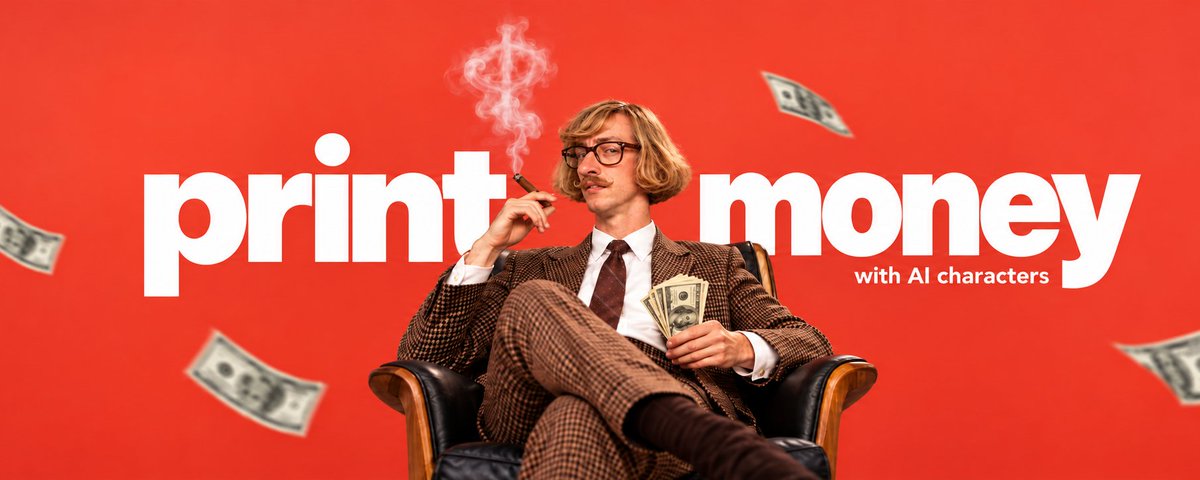
this AI character is pulling in 100M+ views per week & $200k JUST from brand deals and sponsorships.
and it makes sense. the internet runs on attention, and every product needs eyes on it.
these characters have 2 things going for them:
> obscure, bizarre characters you will NEVER forget
> videos that already proved they can go viral
that means you don’t have to come up with some genius video idea every day.
all you have to is find a viral video, swap your character into it, post it, then keep repeating the formats that hit.
one video can be boxing. the next can be dancing. you get the idea.
the videos are not limited by niche because the character is what people remember.
and once that character starts pulling attention, you can monetize it however you want:
> build your product into the videos
> send people to your offer through the profile
> take sponsorships
> sell the method
> promote something that fits the audience
the whole thing comes down to one thing:
make a character people remember, put it into content people already proved they want to watch, and keep repeating whatever hits.
seriously, infinite views and insane cash to be earned.