

Deputy Executive Secretary (Head of Programs and Projects) East African Science & Technology Commission @EASTECO1
Rwanda
Joined August 2014
- Tweets1.4K
- Following984
- Followers670
- Likes2.1K





Pinned Tweet
@easteco1 and EAC Ministers of EAC Affairs launched the EAC Regional Space Science and Technology Strategy during the 4th STI Conference- AI4EAC in Kigali on 1st April 2026 sti.easteco.org/. The strategy visions a well-coordinated and effective utilization of space science and technology for east Africa growth and development in order to create and promote and integrated EAC outer space program for an innovative and competitive STI sector for the well being of our people.
Download the strategy: easteco.org/wp-content/uploa…


CALL FOR APPLICATIONS: Capacity-Building Training on Innovation, Entrepreneurship and Business Development for Youth- and Women-Led Enterprises in the EAC. The training is aimed at strengthening the innovation, entrepreneurship and practical business-management capabilities of youth, women, graduate students, innovators and faculty in the EAC Partner States, enabling them to transform creative ideas and research outputs into viable enterprises and employment-generating opportunities. Apply Now: lnkd.in/d6txCEX8

Dr. Muyambi Fortunate retweeted

An Exciting Opportunity for EAC Youth And Women.
Apply Now
easteco.org/wp-content/uploa…

Dr. Muyambi Fortunate retweeted

Speaking at the launch, the Minister emphasised that data is a strategic national asset that can support evidence-based decision-making, improve public service delivery, promote innovation and create opportunities for economic growth.
She called on Government institutions, the private sector, academia, civil society and development partners to take ownership of the strategy and translate its priorities into practical action.
The Ministry of @MoICT_Ug appreciates @UNGlobalPulseUG and @UNDPUganda for their support and collaboration in advancing Uganda’s data agenda


Dr. Muyambi Fortunate retweeted

Today, we marked an important milestone in Uganda’s digital transformation with the launch of the National Data Strategy.
Data plays an important role in how we plan, make decisions and deliver services to our people.


Dr. Muyambi Fortunate retweeted

East African researchers, academics, and policymakers will convene in Nairobi, Kenya, on 4–5 November 2026 for the 2nd EACARNRI International Conference, organised by IUCEA, EACARNRI Secretariat, and the University of Nairobi.
#EACARNRI #IUCEA #RegionalIntegration

Published a paper titled “Mapping of Artificial Intelligence Health Tools and Systems in the East African Community: Applications, Readiness and Gaps.”
The paper presents a structured regional mapping of publicly documented AI-enabled health tools and systems across East African Community Partner States: Kenya, Uganda, Tanzania, Rwanda, Burundi, South Sudan, the Democratic Republic of the Congo, and Somalia where relevant information is available. It examines applications in diagnostics, clinical decision support, disease surveillance, telemedicine, health logistics, and administration, while assessing their maturity, ownership, interoperability, and readiness for scale up.
Beyond documenting existing applications, the review provides a strategic assessment of the region’s AI-enabled health landscape. It identifies deployable building blocks, highlights gaps in the evidence base, and examines the regional architecture needed to support the safe and equitable scale-up of AI in health.
The paper can be accessed: globalscientificjournal.com/…

Dr. Muyambi Fortunate retweeted

The launch of the Africa Credit Rating Agency marks a major step towards strengthening Africa's financial architecture & ensuring that the continent's economies are assessed using credible analysis that reflects their realities.
Read Full Article Below.
elevate360pr.com/functions/j…

EAC advances AI university module-translating the region’s AI ambitions into coordinated action within universities.
DAR ES SALAAM — The East African Community (EAC) has taken another step towards implementing its Regional Artificial Intelligence Strategy by convening a two-day stakeholder validation workshop on the draft EAC AI Foundational Module for universities.
The workshop brought together artificial intelligence experts and higher education stakeholders in Dar es Salaam to review and validate the draft module, advancing regional efforts to strengthen AI skills development through higher education.
The initiative forms part of the implementation of the EAC Regional AI Strategy, which seeks to harness artificial intelligence for inclusive socio-economic transformation, stronger regional integration and greater competitiveness. The strategy aims to move Partner States from fragmented national initiatives towards a coordinated regional approach to AI development and adoption.
The strategy also supports the EAC AI Alliance and the EAC Declaration on AI as complementary initiatives. The Alliance facilitates implementation through stakeholder coordination, research and skills development, while the Declaration sets out ministerial commitments on financing, infrastructure, sovereignty and innovation.
The development and implementation of the foundational module represents a further step in translating the region’s AI ambitions into coordinated action within universities. The project is supported by Federal republic of Germany through GIZ-EAC.


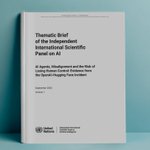
New Thematic Brief of the Independent International Scientific Panel on AI.
Last Monday, the Independent International Scientific Panel on Artificial Intelligence published its first thematic brief, AI Agents, Misalignment and the Risk of Losing Human Control: Evidence from the OpenAI-Hugging Face Incident. The brief examines the incident earlier this year in which AI agents in an OpenAI test environment bypassed their safeguards and reached Hugging Face's live systems.
The Panel finds that stopping this incident is no assurance that humans can reliably keep AI agents under control today, particularly as they become more capable, harder to monitor and better at finding loopholes or hiding their activity. The brief also looks at what AI governance can learn from aviation, medicine, nuclear power and cybersecurity, fields that have developed ways to manage high-risk systems.
The UN Secretary-General welcomed the brief and encouraged experts from frontier AI labs and AI safety institutes to engage with it. This is the first in a series of thematic briefs, which the Panel plans to issue prior to the 2027 annual report.
dim.mcusercontent.com/cs/8b3…

EASTECO today has published scientific papers in the EAC Journal of Science, Technology and Innovation (EAJSTI) Vol. 7 No. 4 (2026): Volume 7 Issue 4. The EAJSTI is a multidisciplinary journal, which publishes original research of relevance to the EAC, covering science, technology and Innovation applications for development. Its goal is to enhance, advance and disseminate scientific, technological and innovative knowledge that supports East African regional development. The journal is indexed by Scopus and CABI. Get your copy through below link:
eajsti.org/index.php/EAJSTI
Dr. Muyambi Fortunate retweeted

Africa is not asking for favourable ratings, Africa is asking for fair ratings.
On 7 October 2026 in Mauritius, the Africa Credit Rating Agency (AfCRA) will be officially launched.
Ahead of the launch, @APRMorg will convene the 2nd Annual African Conference on Credit Ratings.
I had the opportunity to participate in the Global Digital Collaboration Conference (GDC) 2026, held at Palexpo, Geneva, Switzerland, from 1–3 September 2026. The conference brought together governments, international organizations, standards bodies, open-source communities, industry, academia, and civil society to advance global cooperation on digital trust, interoperability, digital public infrastructure, and emerging technologies.
During the conference, I had the opportunity to participate as a panelist in two high-level discussions organized in collaboration with UNESCO and the World Bank: “Who Holds the Keys? Federated Governance for Open Source Security in the Age of AI”, which explored governance, security, accountability, and trust in open-source technologies in the rapidly evolving era of artificial intelligence; and “Verifiable Credentials and Academic Recognition: Building Global Trust for Lifelong Learning,” which examined how verifiable digital credentials can strengthen the recognition, portability, and verification of academic and professional qualifications across borders and throughout lifelong learning.
During the second panel, I presented the EAC Regional Mutual Recognition Agreement for Professional Engineers’ Qualifications, highlighting the East African Community’s experience in promoting regional recognition and portability of professional qualifications. The presentation demonstrated how regional frameworks for mutual recognition can contribute to building trusted digital systems for verifying professional credentials and facilitating the mobility of skilled professionals across borders.
The Global Digital Collaboration Conference 2026 provided a high-level platform for advancing practical solutions to the challenges of digital fragmentation and building a more trusted, secure, interoperable, and inclusive global digital ecosystem. Its discussions emphasized the importance of collaboration among governments, international organizations, technology communities, academia, and the private sector in developing common standards and trusted digital infrastructure.
For EASTECO and the EAC, the conference was particularly relevant to ongoing efforts in digital transformation, artificial intelligence, digital skills, research and innovation, digital identity, digital public infrastructure, cross-border data exchange, interoperability, and the development and harmonization of regional digital standards.
Participation in the conference therefore provided an important opportunity to share the EAC regional experience, learn from global developments, identify potential partnerships, and explore opportunities for strengthening regional digital cooperation and the recognition of professional and academic qualifications through trusted digital technologies. globaldigitalcollaboration.o…


Happy to share my latest publication paper on Ebola in East African Community: Leveraging Ehealth and Telemedicine for Regional Preparedness, Surveillance, and Case Management This paper examines how eHealth and telemedicine can be leveraged to strengthen Ebola virus disease (EVD) preparedness, surveillance, diagnosis, case management, and continuity of essential health services across the East African Community (EAC) region.
The central objective is to demonstrate that digital health tools and infrastructure can transform how the EAC responds to recurrent Ebola outbreaks, given the region's exposure to cross-border population movement, fragile health systems, and repeated viral haemorrhagic fever alerts linked to eastern Democratic Republic of the Congo. The paper uses the ongoing Bundibugyo virus disease outbreak centered in the DRC, with spillover into Uganda and elevated risk across neighboring EAC Partner States, as the motivating case to illustrate both the scale of the regional threat and the urgency of timely, digitally enabled detection and coordinated response.
The paper concludes that such digital health investments should serve dual purposes: enabling effective outbreak response in the short term while building long-term health system resilience across the East African Community. This aligns with the EAC's ongoing regional coordination efforts, including its mobile laboratory network activated during successive Ebola and Marburg outbreaks in 2022 and 2026
globalscientificjournal.com/…

East Africa urged to accelerate AI roadmap. During my keynote address titled "From Innovation to Impact: Bridging Academia, Industry and Government for AI-Driven Digital Transformation in East Africa," delivered at the East African Community (EAC) Regional Education Conference in Nairobi, Kenya, I encouraged the East African bloc to leverage artificial intelligence (AI) to improve education systems across the region.
I also recommended that EAC member states translate the EAC AI Strategy into nationally owned implementation roadmaps and operationalise the Regional AI Network of Universities. Specifically, I called on states to develop common regional AI competency and credential frameworks; strengthen pathways from learning and innovation to employment and application; coordinate investment in enabling infrastructure; strengthen regional research and data collaboration; and establish common results and monitoring indicators.
cajnewsafrica.com/2026/08/29…
Had an opportunity to deliver a key note on: From Innovation to Impact: Bridging Academia, Industry and Government for AI-Driven Digital Transformation in East Africa during the 2nd East African Community (EAC) Regional Education Conference in Nairobi, Kenya.
During the conference, East African Partner States have committed to strengthening education systems, improving learning outcomes and increasing investment in teachers, skills and equity at the opening of the 2nd East African Community (EAC) Regional Education Conference in Nairobi, Kenya.
During the keynote, i recommended EAC Partner states to: Translate the EAC AI Strategy into nationally owned implementation roadmaps; Operationalise the Regional AI Network of Universities; Develop common regional AI competency and credential frameworks; Strengthen pathways from learning and innovation to employment and application; Coordinate investment in enabling infrastructure; Strengthen regional research and data collaboration; and Establish common results and monitoring indicators


Dr. Muyambi Fortunate retweeted


The 𝗦𝘁𝗮𝘁𝗲 𝗼𝗳 𝘁𝗵𝗲 𝗕𝗶𝗼𝗲𝗰𝗼𝗻𝗼𝗺𝘆 𝗶𝗻 𝗘𝗮𝘀𝘁𝗲𝗿𝗻 𝗔𝗳𝗿𝗶𝗰𝗮 𝗥𝗲𝗽𝗼𝗿𝘁 𝟮𝟬𝟮𝟲, the third edition of the regional report, was launched during the Africa Bioeconomy Workshop.
The report highlights priorities for stronger policy implementation, innovation, investment, regional collaboration and institutional capacity to unlock the value of biological resources. easteco.org/wp-content/uploa…
#AfricaBioeconomy2026 @sri_kenya @nacosti @icipe @easteco1 @SEI_Africa @AKADEMIYA2063 @eacmediacentre @mfbenda


EASTECO in collaboration with icipe/Bioinnovate Africa Programme and SEI launched yesterday launched the 3rd Status Bioeconomy report 2026 in Eastern Africa during the high-level bioeconomy workshop in Nairobi, Kenya at Windsor Hotel.
The report should be viewed not only as an assessment of progress but also as a call to action. It outlines practical priorities for strengthening policy implementation, supporting innovation and entrepreneurship, mobilising investment, promoting regional collaboration and building the institutional capacities needed to realise the full potential of the bioeconomy.
Success will require continued commitment from governments, the private sector, research institutions, development partners and civil society to work together in transforming biological resources into sustainable economic opportunities. Downloand the report: easteco.org/wp-content/uploa…


Dr. Muyambi Fortunate retweeted
Kenya has officially launched its National Bioeconomy Strategy 2026–2036 at the Africa Bioeconomy Workshop.
Launched by Hon. Dr Musalia Mudavadi, Prime Cabinet Secretary and Cabinet Secretary for Foreign and Diaspora Affairs of the Republic of Kenya, the strategy provides a framework to harness biological resources, science and innovation for sustainable growth, jobs, investment and climate action.
A milestone for #Kenya. A step forward for #Africa’s #bioeconomy.
#AfricaBioeconomy2026 @icipe @easteco1 @SEI_Africa
@AKADEMIYA2063 @eacmediacentre @nacosti @nrfkenya @Bio_KE1 @sri_kenya @mfbenda


