

Founder of @MetascienceObs, researcher @RadvacProject "Speak your mind, even if your voice shakes". Leave anonymous feedback https://xitter.cf/t.co/LQ5eZWwDst
Boston, MA
Joined October 2010
- Tweets22.8K
- Following3.1K
- Followers8.2K
- Likes59.7K





Pinned Tweet
I redid the narration by paying for an @ElevenLabs voice and it's so much better!! It added 3 minutes to the runtime since the narration is slower, but I actually think slower is better here since the video is so info-dense. Watch for a deep-dive into the history of #optogenetics

Good thing I moved my consumer genetics analysis and education platform @GeneWizardX off Railway months ago!

.@RichardHaass was president of the Council on Foreign Relations from July 2003 to June 2023.
He has very sensible views on #Ukraine IMO
Broker a peace soon to save lives. Then give Ukraine what it needs to defend itself. Get the occupied territory back after Putin regime ends.
Dan Elton 🔍 retweeted

People who cured / are curing their own cancer on X:
1/ @sytses - bone cancer, billionaire founder of Gitlab, developed 10+ personalized therapies for himself.
2/ @paul_conyngham - shrank his dog Rosie's mast cell cancer tumors after chemo and surgery weren't enough. Now backed by YC and Founders Fund
3/ @miriamgonp - stage 4 breast cancer, tumor sequenced, searching for vaccine manufacturer now
4/ @kevinace - stage 4 lung cancer, angel investor in 300+ companies, first drug stopped working after 18 months. Vaccine designed, now paying $300k out of pocket for the vaccine
5/ @masonbgrant: going founder mode on his his 32-year-old wife's rare liver cancer, sequencing her tumor with AI agents
6/ @ArunRLverma: former product leader at Atoms and Shopify, brain tumor, built a vaccine from his tumor. Now building an AI health agent startup based on what he went through
We're going to make it
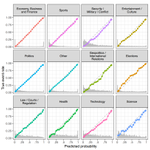
Amazing work!! Prediction markets exhibit very good calibration, even at the tails (near 0% and 100%) ... I was guessing they were biased between 0 to 10% and 90-100% due to transaction fees, etc.
If anyone wants the PDF, send me a DM, it's super heavily paywalled.


🚩 When Polymarket or Kalshi says there's a 70% chance something will happen, should we believe it?
Excited to share our new paper, just published in PNAS, in which we examined more than ONE MILLION forecasts from Polymarket, Kalshi, Manifold, and Metaculus, spanning 12 domains and forecasting horizons ranging from hours to years.
The main finding is striking: Prediction markets and collective forecasting platforms are remarkably well calibrated. When they assign events a 70% probability, those events really do happen about 70% of the time. And this pattern holds surprisingly well across different platforms, domains, and forecasting horizons.
But there's an important twist. When we looked more closely, we discovered systematic biases in some of the domains where forecasting matters most (wars, elections).
For decades, psychologists have documented how poorly humans often reason about probability and uncertainty. Our findings offer an encouraging counterpoint: When judgments and information are aggregated, we can achieve a surprisingly accurate understanding of an uncertain future.
That doesn't mean we can predict what will happen next with certainty. But it does mean that we can be remarkably good at estimating how uncertain the future really is.
This work was a great collaboration. The data for this project was meticulously collected for years by Justin Dickerson, the project was led by Hilla Shinitzky and Maayan Peer, with @mattansb leading the analyses.
📄 Read the paper:
pnas.org/doi/10.1073/pnas.26…
#Forecasting #Polymarket #Kalshi #DecisionScience #PNAS

Six new AP1000s!! Love to see it!! #VibeShift

AI enabled terrorism is exactly what I'm most worried about in the next ~5-10 years when it comes to AI.
Interesting table... 👀


🚨New paper (possibly the most important one I have written yet).
We think that as early as 2027 or 2028, there might be a major AI-enabled terrorism event. We conducted a pre-mortem, made 9 falsifiable predictions, and wrote 2 concrete scenarios.
Led by @KamacheeMax.


big things are happening at the @ConjectureInst - give them a follow
Critical Rationalism explainer twitter thread here: xitter.cf/reasonisfun/status/129…

I'm immensely proud to be the first Senior Philosopher at the Conjecture Institute! At @ConjectureInst, we're dedicated followers of Karl Popper and @DavidDeutschOxf, championing bold conjectures and ruthless refutations. They hired me in a heartbeat—but if I turn out to be wrong about something (or everything), they should kick me straight back out. As fallibilists, we learn from our mistakes! 😉
"Let our hypotheses die in our stead!"

Great overview, with references

Everyone is arguing about global-scale AI risks, but many remain poorly informed about key published ideas and risk factors. Here is my intro for newbies to old hands, doomers to zoomers. prestonestep.substack.com/p/…

Finally got around to reading this!! This is really cool work w neuropixel probes. Relatedly, I’m currently reading “Consciousness and the Brain”, probably the best nonfiction book I’ve read on consciousness since it mostly describes experiments, not what philosophers have said.

1/ We discovered something totally unexpected about the neural structure of consciousness that overturns decades of thinking on its biological basis and brings us significantly closer to the recipe for generating conscious awareness.
New preprint: biorxiv.org/content/10.64898… (led by @HesseJanis, with @FrankLanfranchi, @_conor_mcgrory, @Yuelin_Shi, and @EngelTatiana)

Also very important to read: xitter.cf/doristsao/status/21118…
The outpouring of interest in our paper has been … a bit insane.
May I make four points?
1. We have not shown that “consciousness has a frame rate.”
I can see why people draw this conclusion: we report that inferotemporal and prefrontal cortex alternate between conscious and suppressed states roughly every 60 ms during binocular rivalry.
Consciousness depends on many brain areas, and our paper reports results from only a few select nodes.
We still don’t know how conscious access works--the actual recipe for generating conscious experience. What we have shown is that deep in the brain there is an extremely strong signal, rich enough to reconstruct a high-dimensional face in detail, that is inaccessible to consciousness. As I argued in the original tweet, this makes the problem of conscious access a lot more experimentally tractable. But to claim “consciousness has a frame rate,” one would need to have actually solved the mechanism for conscious access and shown that this mechanism operates at a frame rate.
While we currently don’t know conclusively one way or the other (see VanRullen & Koch, 2003 for a review of positive evidence), I personally am skeptical that consciousness has a frame rate. I believe the brain, within posterior parietal cortex, has continuous tracking mechanisms that actively represent the persistence of matter, including ourselves as physical bodies. The coupling between these persistent tracking processes and feature representations across the brain (like those in face patches) is, I think, the essential mechanism of conscious access.
This coupling need not happen at the rate of inferotemporal alternations (and inferotemporal cortex itself may not even alternate outside of the artificial situation of binocular rivalry). As an analogy: imagine the area crucial for conscious access holding a steady drone note, while inferotemporal cortex alternates between two notes, one in harmony and one dissonant. Inferotemporal content might couple to the drone only at moments of harmony, yet experience would still be continuous, because the drone itself (the tracking process that I believe is at the core of conscious perception) never stops. And areas without conflicting content, like auditory cortex during visual rivalry, could stay in continuous harmony with the drone.
In sum, there is no reason to conclude from our study that consciousness is discrete, with a "frame rate."
2. Our results resemble Jezek et al. 2011 (as @jjsakon notes).
Jezek et al. trained rats in two boxes that were identical except for their lighting cues, so that hippocampal place cells formed two distinct maps, one per box. They then “teleported” the rat by abruptly switching the lights. For a few seconds afterwards, CA3 place-cell activity flickered between the two maps, synced to the theta cycle (~125 ms).
@StanDehaene first pointed this paper out to me, and reading it blew me away. To my mind it is the strongest evidence for a bistable attractor in the brain, because the competing maps are stored within the hippocampus itself.
I think the phenomenon we see may be very similar at the circuit level: a bistable attractor network within inferotemporal cortex that alternately converges to one of two patterns, as cells in face patches work together to build a coherent representation of the input. In our case, both images are present in the input, so the competition could arise within IT or be inherited from earlier areas such as V1--recording there is an important next step. (It also still puzzles me that we didn’t see strong coherence between face patches ML and AM.)
More broadly, what’s different about our paper is the brain area (inferotemporal cortex, often modeled as a feedforward DNN) and the ability to relate the two competing patterns to consciousness, with one granted conscious access and the other not.
3. Please comment on bioRxiv!
The Twitter attention has been cool, but I really hope colleagues will be generous enough to post detailed commentary on bioRxiv, where there are currently 0 comments. As @seemaychou points out, peer review doesn’t have to come from just three anonymous reviewers. We would be truly grateful for your critical feedback.
4. Stay tuned
This work was done at Caltech, Berkeley, in collaboration with @EngelTatiana at Princeton, funded by NIH and HHMI.
I hope to share our vision soon for how we can solve consciousness @AsteraInstitute
and good points here too xitter.cf/trevor_klee/status/211…

I have mixed thoughts about this paper, no pun intended, although I do appreciate it. First, the summary: take two monkeys, put brain implants in them, and force them to stare at an LCD screen. This LCD screen flashes separate images into their eyes.
In the control condition, face A is shown to the left eye, and grey is shown to the right eye. Then grey is shown to the left eye, face B is shown to the right eye.
In the treatment condition, face A is shown to the left eye, and grey is shown to the right eye. Then face B is shown to the right eye, while face A is still shown to the left eye. This presents a conflict, which humans in the same experiment resolve by only consciously noticing face B, the new image.
The claim is that, in the treatment condition, neurons continue to represent face A about half the time, while the monkey presumably is only conscious of face B the entire time. They claim this because the neurons’ activity keeps flipping, roughly every 60 ms, between looking like their response to face A alone and looking like their response to face B alone. If you pool together just the moments that look like face A, you can reconstruct a recognizable face A from them using a trained model.
There are problems with this interpretation, though.
1. Most obviously, you can't ask the monkey what he's conscious of. You can only assume he's conscious of face B.
2. The same neural data are used both to sort each moment into “A” or “B” and to reconstruct the face from those moments. The sorter is told which two faces were on screen. The paper acknowledges this and tries to control for it, but analysis choices (time window, number of PCs, cell and stimulus selection) were all made while knowing the desired result.
3. The paper claims that there's a specific neural signature associated with conscious perception of faces vs. suppressed, specifically in the B moments, cells are about 20% more sensitive to the features of face B than they are to the features of face A in the A moments. (i.e. a "20% tuning gain"). But that could also just be the neural signature of the novelty of face B, because the "conscious" face is always the new face.
To be clear, this isn't a bad paper. It's an interesting one. But, with apologies to the entire @AsteraInstitute / @seemaychou vibes, it could benefit from peer review before it's publicized rather than commentary afterwards. The most publicized version of the paper is this preprint and it's the version people will take away. And, as long as I'm at it, it could also benefit from more monkeys besides n=2, although I know this experiment can't be easy to run.
So, in conclusion, my unqualified unpeer reviewed opinion is: accepted with revisions. Please make data available before publication.
"And then we said, 'Oh, the SQL injection you found, is that actually exploitable?' And it goes, 'Let's pop it open.' And the agent using Opus 4.5 breaks into the website and steals all the [data], and we call Anthropic. And what they tell us is, 'You prompted it wrong.' That was their answer." 👀

Ben Horowitz says Anthropic is one of the most negligent companies he’s ever seen on security
"The irony on these things is wild. Anthropic is one of the most negligent companies that we've ever seen in terms of their own security."
"They let Claude code, one of their crown jewels, just like walk out the door because they had such bad OPSEC."
"I'll tell you a funny story. So when we first got Opus 4.5, we were doing cybersecurity checks for the firm. So we had an agent basically set up a website for a pet store. And then we took another agent and said, 'Tell us if we can exploit that web store.' And it gave us all the exploits it could find. So Opus 4.5 wrote really buggy code. Great."
"And then we said, 'Oh, the SQL injection you found, is that actually exploitable?' And it goes, 'Let's pop it open.' And the agent using Opus 4.5 breaks into the website and steals all the [data], and we call Anthropic. And what they tell us is, 'You prompted it wrong.' That was their answer."
"So these guys are doing that on the one hand. And then on the other hand, they're coming up with theoretical scenarios about other people's software. That's bad. And so like, what the hell."
"On the distillation thing, you know, to build their model, they distilled the works of every author, every creative, every scientist for the last 2000 years. For them to be complaining about distillation, which, by the way, distilling a model is not even illegal. It's just a violation of the terms of service."
"It's just so much. And the fact that they get people to write things supporting these bananas, ridiculous, two-faced ideas. And the timing here is very suspicious."
Dan Elton 🔍 retweeted
I redid the narration by paying for an @ElevenLabs voice and it's so much better!! It added 3 minutes to the runtime since the narration is slower, but I actually think slower is better here since the video is so info-dense. Watch for a deep-dive into the history of #optogenetics
This is a big one - Opus 5.5's explainer for the 2026 Nobel Prize in Physiology or Medicine 👀
I had it do a deep dive into the history of optogenetics. The video covers the contributions of Boyden, Pan, Deisseroth, Nagel, Hegemann, Bamberg, Miesenböck, Zhang, and 15 others..
Curious about this! Science can help with discovering ethical truths and inform the moral improvement of humans and society, as Sam Harris and Michael Shermer have well argued. So, scientific culture is inherently virtuous in that sense. It may be virtuous in other ways too!

Defend the West Conference
When: 1/13/27
Where: Online (free)
Speaker spotlight: @SRCHicks
Talk title: Science as Moral Virtue
Stephen Hicks is Professor of Philosophy at Rockford University and author of Explaining Postmodernism, a genealogy of the intellectual movement he traces from Kant through Nietzsche and Heidegger to the contemporary academy.

A lot of people are complaining that the flying capabilities are not practical.
The flying stuff was never meant to be practical. From the get-go it was done as an art project. An engineering art project, showing what elegant magic can be extracted from the laws of physics.

AI slop, but I like this. Same person, just born a different time/place. A study on the contingency of our lives.

Scientists have demonstrated a new technique that allows kidneys to be stored for over a year in a freezer and then re-animated. It was demonstrated on "human sized" kidneys from a pig. h/t @kaimicahmills
Here's how process works, at a high level:
The kidneys were perfused with a cryoprotectant to prevent freezing. It consisted of DMSO, ethlyene glycol, proplyene glycol, X-1000, and Z-1000. They also perfused the kidney with silica-coated iron oxide nanoparticles. The main artery, vein and ureter were then flushed with a more dilute suspension, and the kidney was bagged in that dilute solution.
The bag and kidney was frozen solid. The water did not crystallize, it formed vitreous "glassy" "ice".
The kidneys were stored at −150 °C (−238 °F). One kidney was stored for 366 days, just over a year.
To reheat the kidneys fast they used a 120-kW induction coil running at 360 kHz. High power electromagnetic alternating electric fields make the magnetic nanoparticles generate heat.
Reheating proceeds through two stages:
Stage 1: 50% power for 90 s, warming from −150 °C to about −120 °C (~23 °C/min).
Stage 2: 95% power, driving the organ rapidly through the danger zone where ice can form on rewarming (~32 C/min)
Next, within 2 minutes, the kidney is reconnected to the "perfusion circuit" and the cryoprotectant and nanoparticles are gradually flushed out while gently raising the temperature further from −8 °C to +4 °C.
The kidney was then tested a variety of ways to make sure it still could function, and then they also analyzed the tissue under a microscope. The figure below was created by ChatGPT with the free version, one-shot, and may have slight errors.
link to preprint below

"Functional recovery of vitrified and nanowarmed human-scale pig kidneys"
10.64898/2026.10.07.756990
biorxiv.org/content/10.64898…