


Miriam Shalom retweeted

When was the last time “a Zionist” slaughtered innocent civilians with ballbearings and nails at a pop concert in Manchester?
Or cut off heads at a Paris rock venue?
Or bombed a Spanish station or the London Underground?
Oh yeah, never.


Miriam Shalom retweeted

What Israel did in Gaza may well go down in history as the most humane and precise urban warfare environment the world has ever known—the very opposite of genocide.
The entire purpose of a genocide is to push civilians into the killing zone.
Think about what happened in the Holocaust, where children in line at Auschwitz were given bars of soap, where inside of the gas chambers there were fake shower heads.
What was the point?
It was to trick and induce civilians to get in to the killing zone so that you could kill more of them more efficiently over time.
Israel has done the very opposite—warning civilians and then manning humanitarian corridors with its own soldiers, risking its own sons’ and daughters’ lives to ensure that civilians get out of the killing zone.
We see two remarkable things in Gaza.
First, according to preeminent urban warfare scholars like John Spencer, Richard Kemp, and Andrew Fox, Israel has the lowest militant-to-civilian kill ratio in the history of urban warfare.
Genocides have extreme civilian-to-militant kill ratios. Hundred, thousand, ten thousand-to-one. That’s the point of a genocide.
Here we have a militant-to-civilian kill ratio of may be two-to-one—not consistent not just with law of war violations—but much less with genocide.
Second, and more importantly, all genocidal regimes get better over time at killing civilians.
Again, think about the Holocaust. The Nazis started with firing squads killing 20, 30, 50 people at a time and realized that was too inefficient. Then they got these vans and filled them with exhaust pipes, and they would kill more people. And they said, “We’re never going to get to six million killing them this way.” That led them to construct these massive gas chambers and crematoria—the architecture of true genocide—to kill thousands and thousands of people cheaply and efficiently a day.
Israel has done the opposite.
Even if you believe Hamas’ numbers, the scale of civilian death in Gaza went down over time. Israel got better and better and spent hundreds of millions of shekels learning how to become more efficient at preserving innocent Palestinians’ lives.
Again, the very opposite of genocide.
Miriam Shalom retweeted

The Case for Ben-Gvir and Smotrich
Bill, let me start by saying that Israelis across almost the entire political spectrum share a deep appreciation for you. Standing up for Israel and confronting antisemitism as forcefully as you have takes real courage. We do not take it for granted. That is why your words carry particular weight here: we know you care about us.
And that is why I want to offer a perspective that too often gets lost in discussions about Ben-Gvir and Smotrich.
Full disclosure: I served as a communications adviser to Netanyahu for a year, until June 2024, including on October 7. I am a secular Israeli living in Tel Aviv. I have never voted for either Ben-Gvir or Smotrich, both of whom are religiously observant, and I do not intend to vote for either in the upcoming election. I have my own criticisms of both men. But much of the commentary about them abroad misses why so many Israelis support them.
Consider the size of their constituency. In the final polls before the election, their parties—Smotrich’s Religious Zionism and Ben-Gvir’s Otzma Yehudit, or Jewish Power—averaged roughly 15 seats combined. That is one-eighth of the Knesset, representing roughly half a million voters or more. Together, they would be Israel’s third- or fourth-largest political force. They do not represent a majority, but they represent a substantial number of people whose concerns deserve to be understood.
—
Before getting to those concerns, though, we need to look at why these parties have so much leverage in coalition negotiations.
Netanyahu did not always consider Ben-Gvir an acceptable partner. For years, he treated him as politically beyond the pale. Even today, Netanyahu generally avoids being photographed with him, much to Ben-Gvir’s frustration. Their alliance is not simply a matter of shared ideology. It also reflects the choices available to Netanyahu.
Since 2019, refusing to join a Netanyahu-led government has become a defining position for parties in the center and on the left. There have been exceptions during the pandemic and in the emergency government formed after October 7. But the personal boycott of Netanyahu has become a central feature of Israeli politics, and opposition leaders say it will continue after this election.
The result is straightforward.
In Israel’s parliamentary system, governments depend on coalitions of parties that together command a majority. When centrist and left-wing parties rule out serving under Netanyahu—the leader of Likud, Israel’s largest party—they narrow his options and strengthen the hand of those willing to join him: Ben-Gvir, Smotrich and the ultra-Orthodox parties.
What exactly is Netanyahu supposed to do? Tell his voters: “Our opponents refuse to govern with me, so I am giving up on forming a government and handing power to them”?
For much of the Israeli right, Netanyahu remains its dominant figure and chosen leader. His voters reject the idea that their political opponents should get to decide who can lead them. Imagine Democrats demanding that Republicans replace their presidential nominee as a condition of working together—or the other way around. You can understand why voters would reject that demand.
Opposition parties have every right to refuse to serve with Netanyahu. But that decision strengthens the very partners they want to exclude from power.
So if you want Israel’s next government to exclude Ben-Gvir and Smotrich, your appeal should also—and perhaps above all—be directed at the center and left: bridge your differences, end the boycott and make a broader coalition with Netanyahu possible.
To be clear, I personally support including Ben-Gvir and Smotrich in the government. But including them in a coalition and depending on them for its survival are two different things. Anyone who wants to reduce their leverage must be willing to make another coalition possible. Simply telling Netanyahu to do without them is not enough.
—
That brings us to why Israelis vote for them in the first place.
I am not claiming to speak for all Israelis, or even for everyone on the right. Many agree with you. You are undoubtedly familiar with their arguments. I want to explain the other side.
To understand these voters, try to see the country through the eyes of someone who lives here.
You have heard that Israel is about the size of New Jersey. It can sound like a familiar talking point in Israel’s public diplomacy. For us, it describes our daily reality. We live in a tiny country surrounded by a vast Arab and Muslim region, facing enemies who have shown that they will spend years planning how to murder our children in the most horrific ways imaginable. Terrorism did not begin on October 7. But that day showed what happens when our enemies get the chance to act on their intentions.
For many Israelis, Ben-Gvir and Smotrich’s tough stance sends an essential message: do not test us. We will not rely on your goodwill. We will not gamble our children’s lives again on the belief that you have become more moderate, that you are deterred or that you have too much to lose.
Their supporters also see them as a counterweight within the government. They push Netanyahu from the right and challenge the security establishment’s assumptions—the same establishment that believed Hamas was deterred and could be contained through economic incentives and by managing the conflict.
Ben-Gvir and Smotrich were in the government on October 7, and they bear responsibility too. But their presence in the government and later in the security cabinet gave Netanyahu the political backing to resist pressure to give in. Refusing to surrender is now a central message of Netanyahu’s election campaign.
In their supporters’ eyes, the two men served as his political Iron Dome against enormous pressure, at home and abroad, to leave Sinwar and Hamas in power.
—
There is another part of this story that can be hard to grasp from abroad: the place of religious Zionists in Israeli society.
This community combines commitments that many Israelis deeply admire: religious observance and Torah study alongside combat service, working for a living and taking responsibility for the country’s future. At a time when most ultra-Orthodox men do not serve in the military, religious Zionists demonstrate that devotion to Judaism and defending the country can go hand in hand.
Ben-Gvir and Smotrich draw support from significant parts of this community, though they certainly do not speak for all of it. For some voters, supporting them also means supporting that combination of values. Dismissing these voters as religious fanatics means overlooking people whose faith inspires them to lead the charge on the battlefield.
These are people who fight, risk their lives and bury their friends. They are not alone in doing so. Israelis from every political camp and every part of society fight and die for this country. But religious Zionists are disproportionately represented in combat units, among junior officers and, tragically, among the fallen.
Many of those soldiers support Ben-Gvir and Smotrich.
—
Two specific policies also help explain their support.
The first is Ben-Gvir’s overhaul of the prisons holding terrorists, which fall under his ministerial authority.
Before Ben-Gvir took office, prisons holding security inmates had come to resemble holiday camps. Terrorist inmates enjoyed lavish meals, meat, hummus, drinks, access to prison stores and the freedom to prepare their own food. Smuggled phones allowed them to stay in touch with people outside, including terrorist operatives. The sense was that they were effectively running their own prison wings, with organizational hierarchies and power structures that prison authorities had learned to accommodate.
All of this was tolerated to keep the prisons quiet. Before Ben-Gvir took office, the security establishment operated on a warped premise: prison unrest had to be prevented at any cost, lest it spark terrorist attacks outside. The treatment of Palestinian prisoners in Israel was considered too sensitive an issue to risk a confrontation.
These inmates included convicted murderers who had killed civilians and destroyed families simply because their victims were Jewish. Yet they enjoyed conditions that left bereaved families—and Israelis more broadly—angry, sickened and humiliated. Terrorists were asserting their power inside the very prisons meant to punish them.
The most appalling example was the scandal involving young female prison guards. Israeli women doing their compulsory military service in the prison system testified that they had been assigned to work around a convicted terrorist at his request and subjected to sexual abuse. One testified that he had raped her. The prisoner had been convicted of murdering an Israeli woman. Those in charge did not just fail to stop it; they enabled it to keep the prison quiet.
Put yourself in an Israeli parent’s shoes. You send your daughter to serve her country, and she later testifies that the system accommodated a terrorist murderer’s demands instead of protecting her from him. It is hard to imagine a more shocking example of a system surrendering its authority to the people in its custody.
Ben-Gvir made reversing that situation a priority. He stripped away privileges, restricted purchases and cooking, and imposed a much tougher regime in the security wings. Prisons went from places terrorists could look forward to entering to places they feared. From what had been seen as paradise to hell.
There is a broad consensus, at least among Jewish Israelis, that terrorists should face harsh punishment and strict discipline in prisons firmly controlled by the state. A convicted terrorist murderer should not enjoy special status and creature comforts, dictate terms to guards or continue exercising organizational power from behind bars.
There is also a clear deterrent rationale. Someone considering an attack should know that being captured alive means long years of harsh imprisonment. They should not expect comfort, prestige among fellow inmates or the ability to keep operating from prison. The prospect of years in a prison they fear is meant to make them think twice.
That is why even Israelis who have little affection for Ben-Gvir see his prison overhaul as a major achievement that saves Israeli lives, even if we may never know how many. His supporters want to reward him for changing a situation they found intolerable and that the establishment had accepted for years.
—
The second policy is the expansion of Jewish settlement in Judea and Samaria (the “West Bank”)—including the farms closely associated with Smotrich. In addition to serving as finance minister, he holds a ministerial position within the Defense Ministry.
This is an issue on which many Israelis see things very differently from some of our friends abroad. Those friends see settlements as an obstacle to a future peace agreement. Many of us see them as essential to our security, and a Palestinian state as a potentially irreversible threat to that security.
Many Israelis once supported territorial concessions because they sincerely hoped separation would bring peace. We were willing to give up places with deep historical significance so that our children would not have to keep fighting.
But experience convinced many of us that withdrawal can bring the killers closer to our homes.
We saw this in the terrorist attacks that followed the Oslo Accords in the 1990s and early 2000s, launched from areas of Judea and Samaria from which Israeli security forces had largely withdrawn.
Then came Gaza. In 2005, Israel evacuated its communities and withdrew its permanent military presence. Terrorism and rocket fire predated that withdrawal. But in the years that followed, Hamas took over the territory, built a terrorist army and an underground network, and eventually invaded our communities on October 7.
We can debate all the factors that led to the disaster. But you cannot expect Israelis to put that bitter experience aside when asked to accept another withdrawal—this time from the hills overlooking the heart of the country.
I live in Tel Aviv. When I travel through Samaria and see the city’s skyscrapers, I can immediately understand what it would mean for hostile forces to control those ridges. Ben-Gurion Airport, the greater Tel Aviv area and critical infrastructure are close by—in some places, just a 15–20-minute drive away. Even a relatively small but persistent threat could disrupt life across central Israel.
Smotrich and the current government have responded by establishing farms in Judea and Samaria, building on the original settlement movement. Under the current government, 104 new settlement sites have been established or officially recognized in Judea and Samaria.
A small number of families can maintain a presence across a large area by living there, farming and herding livestock. Their supporters believe this strengthens Israel’s hold on the territory and makes a future Palestinian state harder to establish.
That is exactly why the government, with Smotrich leading the effort, supports these farms. It is also why opponents of settlements, in Israel and abroad, are determined to stop them from expanding.
The campaign over “settler violence” has also developed against this backdrop. Much of it relies on lies, selective presentation and casting aggressors as victims and victims as aggressors. It portrays the Jewish presence itself as the source of violence, while leaving out threats, theft and attacks against settlers and their property, including the systematic and horrific poisoning of settlers’ goats, sheep and other livestock.
Footage often starts halfway through a confrontation, omitting what happened first and making a response to an attack look like an unprovoked assault. Of course, Jews who attack Palestinians or harm innocent people must be held accountable, as they are. But they are a tiny fringe of the settlement population.
For many Israelis, including those of us who do not live in settlements, this presence is directly connected to our own security. When Smotrich strengthens it, they see an achievement worth rewarding at the ballot box—even when people abroad see it as a reason to condemn him.
—
And that brings me to the central point.
You emphasize the positive message Israel would send the world by leaving Ben-Gvir and Smotrich out of the government. I understand the importance of public opinion, our alliances and American support. Losing any of those can carry serious security costs.
But many Israelis are asking another question: what message would we send our enemies? What if we misjudge their intentions again, while throwing under the bus the representatives of a community that bears a disproportionate share of the burden on the front lines?
We worry that the desire to appear moderate and reasonable to Western elites—whose deep hostility toward Israel will not disappear simply because Ben-Gvir and Smotrich leave the government—will push us to accept risks whose consequences the rest of the world will not have to live with.
Your love for Israel is real, Bill, and we value it. But when a policy fails here, our children are the first to pay. That shapes how Israelis weigh risks, even when our conclusions make our friends abroad uncomfortable.
I do not want Israel to be isolated. I want a prosperous, open country with strong alliances. Like Trump and Netanyahu, I also believe that peace through strength can improve Israel’s standing in the world over time. If, a decade or two from now, Israel’s ability to project strength has helped it secure peace agreements with more countries in the region, it may no longer need to fight major wars that tragically claim so many lives. Children being born today, who will have no memory of this war, may grow up knowing a different Israel—one that remains vigilant, but no longer finds itself in a violent conflict every few years.
But if the choice is between enduring a difficult period of international pressure, including dealing with an extremely hostile Democratic administration, and accepting demands we believe put our lives at risk, many of us are prepared to bear the cost.
In that respect, I believe Netanyahu himself moved closer during the war to the approach Ben-Gvir and Smotrich represent: a greater willingness to stand up to our friends when he believes a vital security interest is at stake.
You can criticize Ben-Gvir and Smotrich. Their rhetoric and past conduct do not always sit well with Western audiences (although, contrary to false claims, they have never called for the ethnic cleansing of civilians).
But to understand why people support them, you have to understand how many Israelis feel they have already lost loved ones because reassuring assumptions proved disastrously wrong.
For all our desire to remain close to our friends, we will not commit national suicide to win approval at a fashionable cocktail party in Paris or New York.
In May 2024, for example, as the Biden administration opposed expanding the operation in Rafah and threatened to restrict weapons supplies, Netanyahu said: “If we have to stand alone, we will stand alone.” And he told Secretary of State Blinken: “If we need to, we will fight with our fingernails.”
Many Israelis believe that without Ben-Gvir and Smotrich, Netanyahu would not have had the political backing to take such a firm stand against Blinken’s pressure.
And that is why roughly half a million Israelis are expected to vote for them in the upcoming election.

I said I wasn’t going to weigh in on who should be prime minister of Israel as that is a decision for Israeli citizens. I did, however, want to share one point of view from the perspective of someone who has an understanding of how Israel is perceived in America.
Itamar Ben-Gvir and Bezalel Smotrich have caused Israel enormous reputational damage with their statements and actions which are presented in the global media as representing the voice and will of all Israelis.
As such, a government formed without Ben-Gvir and Smotrich will send a message to the rest of the world that Israel is turning a new page.
This will allow Israel to rebuild lost credibility, increase the opportunity for an expansion of the Abraham Accords, and enjoy a better relationship with Democrats and Republicans and Americans at large.
Miriam Shalom retweeted

My heart and prayers are with the children and women affected by today’s terrorist attack by Palestinian Islamist jihadists on civilians near Hebron. Radical antisemitic education in the West Bank (Judea and Samaria), and the Palestinian Authority’s failure to confront it, are allowing this to happen again and again.
Miriam Shalom retweeted

Prime Minister Benjamin Netanyahu:
I have just concluded a security assessment with the Minister of Defense, the IDF Chief of Staff, the Director of the ISA, the National Security Advisor, and the Commander of the IDF Central Command.
It appears that Hamas terrorists were planning a major attack aimed at murdering innocent civilians, as evidenced by the large quantities of weapons and ammunition discovered. Our brave soldiers thwarted this attack with courage and determination. I commend them for their actions and wish our wounded a speedy recovery.
I have instructed the IDF and security forces to immediately cordon off the city of Hebron and take additional security measures to prevent terrorist attacks originating from Judea and Samaria.
Our forces are operating with reinforcements to thwart terrorism and are carrying out extensive waves of arrests.
We will pursue Hamas terrorists and those who sent them, wherever they are and at all times.
You have nowhere to hide.
Miriam Shalom retweeted
You've heard the headlines. You've seen the statistics. You've been told that Jewish settlers are the greatest threat to peace in Judea and Samaria.
But who is producing those statistics? Who is spreading the narrative? And what are they leaving out?
In this video, PMO Spokesman @doronspielman takes you behind the headlines to challenge the way the United Nations, activists, and international media portray Jews living in their ancestral homeland.
Miriam Shalom retweeted

While parents do their shopping in a mall in Ramallah, the children watch an animated film celebrating the #October7massacre.
This isn't under Hamas. This is under the Palestinian Terror Authority.
This is how the PTA indoctrinates Palestinian children to seek death.
Miriam Shalom retweeted

Jonathan Keeperman (@L0m3z) gave a speech at the Nat Con conference, and I posted a crude reaction to it. He asked me politely if I would explain myself. Here is my response:
Jonathan, thank you for your gracious response to my rather ungracious characterization of your speech. I appreciate your civility. Let me explain what provoked my reaction.
I agree with your central premise. Today's political climate calls on us to justify the American-Israeli alliance in terms of American national interests. But after calling for a hardheaded accounting of costs and benefits, you never actually perform one. Instead, you offer a selective account of the grievances that some American nationalists harbor toward Israel and its supporters. At several points, you toggle almost imperceptibly between describing those grievances impartially to validating them, without acknowledging the toggle.
You came to Jerusalem while the United States and Israel were engaged in a war against Iran. American and Israeli forces have fought alongside one another on an extraordinary scale. Both countries have committed military power and made great sacrifices in a struggle against a common enemy. Yet you barely acknowledge the war, let alone consider what it reveals about the value of the alliance.
Surely that experience belongs at the center of any serious discussion of what America gains from Israel.
There is also a question of elementary respect. You came to a country at war to explain why Americans are growing weary of its demands on their attention and resources. You found time to discuss the immigration preferences of liberal American Jews and the political sins of the ADL, but not the soldiers fighting, the lives being lost, or the sacrifices being made in a common struggle. Whatever your intentions, that is a failure to recognize the gravity of the occasion.
And it is inseparable from the larger failure of your analysis. You tell us that Israel receives $3.8 billion annually in American assistance. But what does the United States receive in return? What is the value of Israeli intelligence, military power, technological innovation, and cooperation against common adversaries? What role does Israel play in America's competition with Iran, China, and Russia? What would it cost the United States to replace the capabilities and regional influence that the alliance provides?
These questions are the beginning of the prudential calculation you call for but never undertake. More importantly, what would happen if Washington weakened the relationship to the point that Israel concluded it could no longer rely on the United States?
No sane Israeli wants that outcome. But national survival may force Israel to contemplate it in the coming years. Israel would not simply disappear as a strategic actor. It would become a more independent one, making decisions about war, peace, deterrence, and relations with other powers with less regard for American preferences.
American support does not give Washington control over Israeli decisions, but it does help keep Israeli military power integrated into an American-led regional order. That is an asset with considerable strategic value. If Israel became a de facto free agent, Washington might save money and escape some immediate obligations, but it would also surrender influence over one of the most formidable military powers in the Middle East.
And Israel would not be operating in a vacuum. China and Russia would have opportunities to exploit the resulting realignment. Iran would have opportunities of its own. The regional order would change, and not necessarily to America's advantage.
Perhaps you believe this would be a good bargain. But you never consider the possibility, much less calculate its costs. You call for realism while leaving the most consequential strategic questions unexamined.
Your treatment of the American right is similarly selective. You emphasize the growing skepticism of younger conservatives, but you never mention that Donald Trump, the dominant figure in the nationalist movement you describe, has taken American military cooperation with Israel to unprecedented levels.
Trump recognized Jerusalem as Israel's capital, recognized Israeli sovereignty over the Golan Heights, withdrew from the Iran nuclear agreement, and brokered the Abraham Accords. In his second term, he went much further, committing American military power to a joint war against Iran. How does his record fit your account of national conservatism? Why does the behavior of the nationalist president receive less attention than the attitudes of young nationalists? Is Trump an anomaly? Does he misunderstand the movement he leads? Or might his support for Israel reflect a nationalist assessment of American interests fundamentally different from the one you describe? These questions are indispensable to your argument. Yet you don't address them.
I am also troubled by your treatment of antisemitism. You correctly observe that accusations of antisemitism no longer carry the political force they once did. But the declining effectiveness of an accusation tells us nothing about the reality or seriousness of the phenomenon it describes.
There has been a conspicuous resurgence of antisemitic rhetoric in parts of the American right. Influential voices have promoted the idea that American foreign policy is controlled by Jews or manipulated on Israel's behalf. Such claims encourage Americans to interpret strategic decisions through theories of sinister manipulation rather than through an examination of American interests.
Antisemitism, therefore, is not simply a problem for Jews. It is a problem for American national security, political judgment, and national cohesion. It also offers opportunities to foreign adversaries seeking to weaken the United States from within.
Yet in a speech devoted to explaining declining support for Israel on the right, you give remarkably little attention to the role that antisemitic agitation has played in producing that decline. Instead, you place considerable responsibility on Israel's American defenders. You blame neoconservatives for opposing Trump, liberal Jews for supporting immigration, and even the ADL for antagonizing populists.
Your reference to the ADL is particularly strange. What do the immigration preferences of liberal American Jews have to do with the strategic value of America's alliance with Israel? The ADL is an American Jewish organization, not an arm of the Israeli government. American Jews are predominantly liberal. They disagree with national conservatives on many domestic questions. So what?
Even if every criticism you make of the ADL were justified, what do they have to do with the value of Israel as an American ally? Nothing, unless one assumes that Israel bears responsibility for the political behavior of American Jews. That is precisely the kind of collective attribution that ought to be examined critically, not casually incorporated into an explanation of why Americans are turning against Israel.
The same problem appears in your treatment of America's wars in the Middle East. You say they are closely associated with Israeli interests. Associated by whom? Which wars? Which interests? And how accurately does that association explain actual American decisions?
You leave those questions unanswered. Instead, you point to deeply tendentious interpretations of American foreign policy -- ones often advanced by antisemites such as Tucker Carlson -- as though they were established facts. Arguments frequently employed by Israel's worst antagonists enter your speech disguised as an objective description of American attitudes.
This brings me to a broader problem with your method. You present yourself as a relatively detached observer of Israel and an informed observer of the American right. But throughout the speech, you alternate between describing the attitudes of nationalists and adopting their explanations for those attitudes. Reporting that some conservatives blame Israel for America's Middle Eastern wars is one thing. Treating that blame as an adequate explanation of their alienation is another.
Political attitudes do not develop in a vacuum. Personalities, institutions, and campaigns of persuasion shape them. Yet your account assigns considerable agency to Israel's defenders, whose conduct supposedly alienated the nationalist right, while giving remarkably little attention to the people on the right actively encouraging hostility toward Israel and Jews based on the most vile lies. You thus present the consequences of an ideological struggle as though they were an impersonal historical development to which Israelis must accommodate themselves.
Finally, there is something peculiar about the posture of the speech itself. You begin by explaining that Israel has never occupied a central place in your thinking and that you make no claim to expertise about it. Fair enough. But you then proceed to deliver sweeping judgments about the future of the alliance and the political adjustments Israelis must make.
There is nothing wrong with an outsider offering uncomfortable observations. But the authority of those observations depends on their accuracy, not on the speaker's professed detachment. You conclude by imagining an Israel that Americans "do not have to think about."
But the Middle East will not cease to matter to the United States simply because Americans grow tired of thinking about Israel. Iran will not abandon its ambitions. China and Russia will not relinquish their interests. And Israel's enemies will not stop threatening it because American voters would prefer to concentrate on domestic affairs.
The question is whether America is better positioned to manage those challenges with Israel as a close ally or with Israel acting increasingly on its own. That is the prudential question you say would should address. It is also the question your speech conspicuously avoids.
I don't know you. I have no basis for judging your intentions. I accept that you may regard your speech as a candid warning delivered in good faith. But whatever your intentions, its effect is to give a veneer of dispassionate analysis to a series of highly dubious claims about Israel, Jews, and American foreign policy. That is what I objected to. And it is why I reacted so strongly.

Miriam Shalom retweeted

This footage may be distressing.
Hamas Islamist terrorists didn’t just attack Nova festival on October 7th, thousands of them, and Gazan citizens, flooded into southern Israel, raped, murdered and pillaged small towns across the entire border.
They got 20km in land. It was an invasion.
They kidnapped men, women, babies and the elderly. Burned their houses, shot into safe rooms crowded with innocent people, and threw grenades into bunkers.
The establishment media has only ever focussed on Nova, they don’t want you to know the scale of the terrorist invasion.
Miriam Shalom retweeted

How did October 7 happen?
🧵Ronen Bar (Shin Bet Chief) & his fatal hours of failure.
9PM on Oct 6: Shin Bet detected mass activation of SIM cards by Hamas Nukhba operatives in Gaza. A strong signal of imminent attack.
11PM on Oct 6: Gaza Division & Southern Command were told of unusual activity but no alert was raised.
1AM on Oct 7: Shin Bet noted that Hamas was preparing, then immediately overturned it because their assessment was that "Hamas was not interested in escalation and would not launch a campaign".
1:33AM: A small Shin Bet team was sent south, in case of a limited infiltration or kidnapping.
3:03AM: Shin Bet circulated a low-level alert to the security bodies detailing limited preparations of Hamas.
4:30AM: Ronen Bar assessed that the risk was low and limited to a small-scale kidnapping. He judged that an attack was not imminent and that Nukhba forces were in routine (no unusual activity). The alert level remained low.
Ronen Bar did not wake up or warn Prime Minister @netanyahu until after the attack started.
From the night of October 6 to the morning of October 7, Ronen Bar ignored and reduced the signs of the attack at every stage.
He chose not to evacuate the Nova Festival, he chose not to issue a stay-indoors warning to residents of the South.
In 2018 and 2022, the Shin Bet captured Hamas' October 7 plan, detailing every single point of the infiltration, massacre, and kidnappings.
NCO's raised concern over the plan and were admonished and dressed down.
The top brass, including Ronen Bar estimated that the attack plan was a fantasy and that Hamas was well-managed.
On October 1, 2023, Ronen Bar cautioned against attacking Hamas leaders.
On October 3, 2023, the Shin Bet stated that Hamas was deterred and uninterested in fighting.
On October 6 - 7 (before the attack) he explicitly decided to keep the alert levels lows to prevent Israel 'overreacting' to the signs.
5 warning signs of attack were identified by Ronen Bar by 4AM.
Each was set aside, reduced and ignored.
4 of the 5 warnings remain classified to this day
Southern Command, division intelligence, and Shin Bet officers all concluded no attack was imminent despite the 5 warnings signs.
The South should have been woken up and warned, Nova festival should have been evacuated, forces should have been mobilised.
Instead, we all woke up at 6:30 AM on October 7 to a catastrophe falling on our heads.
As the attack was unfolding, Ronen Bar sent a team to rescue one of his agents living in Kfar Aza.
250 Hamas had infiltrated Kfar Aza.
62 were Israelis were killed, 19 more taken hostage.
The Shin Bet's rescue team abandoned all of the other residents of Kfar Aza and rescued only that 1 woman.
Ronen Bar, the former Head of the Shin Bet, spent 2023 embroiled in anti-government activism.
His time should have been spent preventing the most horrific catastrophe that has befallen our people since the Holocaust.
I am a resident of the south.
I will never forgive.
Ronen Bar - this is your legacy.

Miriam Shalom retweeted
Three years ago today, an attempted genocide on the Jewish people took place. Rather than the world uniting with the Jews against a common enemy of humanity (Islamic terrorists), the West decided that Hamas (Gaza) was deserving of our full empathy and the Jews were the ones committing a "genocide." The inversion of reality is beyond what Orwell or Kafka could have imagined. The explosion of global Jew-hatred post October 7 highlights a very ugly reality: Scratch the surface and you quickly sink into the infinity pool of arguably the oldest hatred known to mankind.
Miriam Shalom retweeted

Gaza is the most lied about war in history. There was no genocide, no famine, no intentional targeting of children. These are modern-day blood libels. We need to expose all the Islamo-left lowlifes who spread these lethal falsehoods, says Brendan O’Neill
buff.ly/v0hJX0j

Miriam Shalom retweeted

Three years ago on October 7, the world changed for Jews across the world when we saw a massacre in Israel carried out by terrorists. On October 8, the world changed for me. Just a day after those horrific attacks we saw just how many people still hold abhorrent views and turn a blind eye to Islamist extremism.
Three years on, the Conservative Party must be clear: We stand with British Jews. We will confront antisemitism and we have the moral clarity to know who our allies are - and Israel is one of them.
Miriam Shalom retweeted

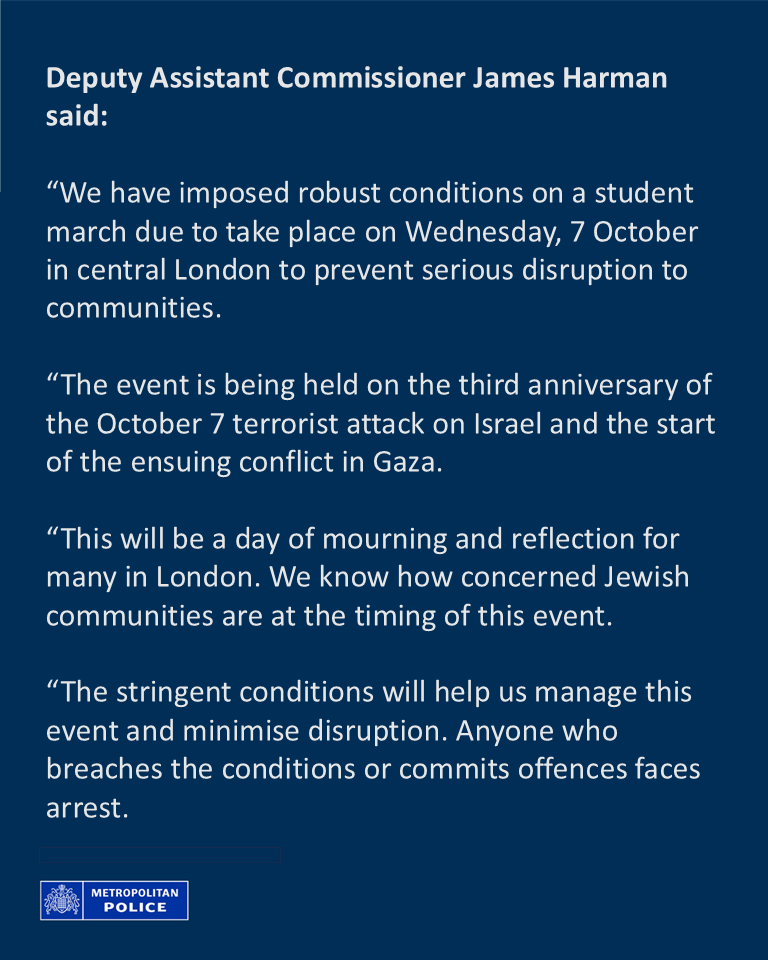
This post is yet another sorry excuse for inaction.
Organising a march without providing your name and address to police is a criminal offence. Will the police do anything? It seems not. Yet another law that might as well not exist.
They don't like to ban marches but to move them, they say, like they did to multiple UKIP marches in Tower Hamlets and other areas. This situation is the same, they say, but actually this march is happening in prime central London and hasn’t been materially moved.
Basically the extent of police action on this has been to ask the organisers (whomever they may be, because the police don’t seem to know) to reconsider marching on 7th October. And if they won't reconsider (they won’t), the police ask that they might march a slightly shortened route.
It’s pathetic and an insult to Londoners’ intelligence.



Miriam Shalom retweeted

We'll look back on the Jews' response to October 7, and we'll be awestruck by how restrained they were. We'll marvel at this country that waged war more humanely than any power has ever waged war, and we'll be horrified by the jackals and nihilists and the swarms of cowards and TikTokkers who insisted the world do something about the "genocide" that never was.

Miriam Shalom retweeted
Worse than Hamas propaganda. I have now seen the documentary NAZA in its entirety, and it is worse than I imagined. Over three years, I’ve tried not to be surprised by ignorance, disinformation, and distortions relating to war, but this is at the top for many reasons.
I will write a detailed analysis soon, but one of the worst, a massive claim displayed in the middle of the film, in bright yellow against a black screen: “Israel has killed more than 73,000 Palestinians in Gaza.”
Not even Hamas says this. Meaning not even Hamas claims Israel has killed every Palestinian that has died in Gaza since October 7th. Hamas has publicly killed Palestinians to maintain power in the Gaza. There have been battles between Hamas and anti-Hamas clans. Up to 20% of the 12,000 Hamas and Palestinian Islamic Jihad rockets fired at Israel fell inside Gaza. Recent Hamas reporting shows natural deaths on their list. To say every person that died in Gaza was killed by Israel is a vulgar lie.
There are a lot of other lies, lies by omission, and lies of ignorance in NAZA, but this claim is unique and follows the lies, damned lies, and statistics for accusations that go against the actual number put out by Hamas or reality.
More to follow on Naza.

Miriam Shalom retweeted

Jewish Greens leaving the party *now*, like they waited for the third verse of the Horst-Wessel-Lied before they decided Pogrom Night at the bierkeller had finally gone too far.

Miriam Shalom retweeted

I hate to break it to you — but all things considered — Israel's response to October 7 was insanely measured and restrained.
Miriam Shalom retweeted
One year on from the Manchester synagogue attack, we need to wake up.
Antisemitism does not begin with a terrorist killing British Jews at a synagogue. It is fuelled by many evil forces, including the relentless demonisation of the world’s only Jewish state.
The Government must never enable it.


