

Nothing shocks me–I’m a scientist.
Lucknow, India
Joined July 2009
- Tweets18.6K
- Following2.9K
- Followers974
- Likes2.4K









Saurabh Saha retweeted

Yann LeCun was right & nobody in this industry wants to say it out loud.
109 million parameters beat 72 billion.
He has spent years saying scale is not the thing that makes a model understand the world. Meta bet the other way. He left in November and started his own lab in Paris.
Last Thursday he published the proof.
The theory everyone has been running on since 2024 is that if you train models big enough, on text, on images, on sound, they all end up with the same picture of reality inside them. Size does it. Nobody ever proved that part.
Randall Balestriero and LeCun proved it. And the proof says size was never doing the work.
What does the work is which two things you show a model together.
A photo and the caption of that photo are two views of one thing. Models trained on pairs like that get there fast.
Two paragraphs pulled from the same document are not two views of one thing. Models trained on those get there slowly and expensively.
Next word prediction is the second kind. That is what every chatbot in the world runs on.
In their tests the first method reached the same understanding after 21.6 million examples. Next word prediction needed 900 million.
And a 109 million parameter text model ended up closer to an image model's view of the world than a 72 billion parameter language model was.
660 times smaller.

Saurabh Saha retweeted

Andrej Karpathy dropped a 2-hour masterclass on everything he knows.
It covers:
- Agents
- Harnesses
- Loops
- Graphs.
This is a must-watch.
Bookmark this post
Saurabh Saha retweeted

50 WebSites to explore and benefit from ⤵️

50 Web Sites Google Doesn't Want You to Know About
1.) '12ft.io' — Bypass any paywall
2.) 'libgen.is' — Millions of free textbooks
3.) 'sci-hub.se' — Free academic articles
4.) 'alternativeto.net' — Find free app alternatives
5.) 'justwatch.com' — Find where any content is published
6.) 'archive.org' — Access any old web page
7.) 'gutenberg.org' — 70,000 free classic books
8.) 'pdfdrive.com' — Free PDF downloads
9.) 'openculture.com' — Free courses from top universities
10.) 'wolframalpha.com' — Solve any math problem instantly
11.) 'photopea.com' — Free Photoshop in your browser
12.) 'squoosh.app' — Compress any image for free
13.) 'remove.bg' — Remove image backgrounds for free
14.) 'cleanup.pictures' — Remove objects from photos
15.) 'unscreen.com' — Remove video backgrounds
16.) 'carbon.now.sh' — Turn code into art
17.) 'ray.so' — Stylish code screenshots
18.) 'shots.so' — Free product mockups
19.) 'smartmockups.com' — Create mockups without Photoshop
20.) 'haveibeenpwned.com' — Check if you've been hacked
21.) 'virustotal.com' — Scan any file for malware
22.) 'privnote.com' — Send self-destructing messages
23.) 'temp-mail.org' — Instant disposable email
24.) 'file.io' — Auto-deleting file sharing
25.) 'archive.ph' — Permanently save any web page
26.) 'similarsites.com' — Find alternatives to any site
27.) 'radio.garden' — Listen to any radio station worldwide
28.) 'everynoise.com' — Discover every music genre
29.) 'tunefind.com' — Find songs from any TV show
30.) 'musicforprogramming.net' — Focus music
31.) 'mynoise.net' — Custom focus soundscapes
32.) 'coffitivity.com' — Cafe sounds that boost productivity
33.) 'elicit.org' — AI academic paper assistant
34.) 'consensus.app' — Search scientific consensus
35.) 'connectedpapers.com' — Visualize academic paper maps
36.) 'semanticscholar.org' — Free academic search
37.) 'scispace.com' — Understand any academic paper
38.) 'summarize.tech' — Summarize any YouTube video
39.) 'phind.com' — AI search engine for developers
40.) 'regex101.com' — Test any regex instantly
41.) 'codebeautify.org' — Format code cleanly
42.) 'jsonformatter.org' — Read JSON like a human
43.) 'explainshell.com' — Understand terminal commands
44.) 'raindrop.io' — Effective bookmark manager
45.) 'downdetector.com' — Check if any site is down
46.) 'tineye.com' — Reverse image search
47.) 'fast.com' — Check internet speed
48.) 'smallpdf.com' — Free PDF editing
49.) 'ilovepdf.com' — Merge and split PDFs
50.) '10minutemail.com' — Second-long temporary email
The internet is much bigger than what Google shows you.
Cc : Respective author
Follow me
@triptitips
for more

Saurabh Saha retweeted

As AI labs race toward Recursive Self Improvement, there’s a possibility that what they are actually racing toward is Recursive Self Extinction — of their business model. Here’s my reasoning.
1. Progress on verifiable tasks continues. In particular, improving the cost efficiency of existing capabilities is a highly verifiable task. For the past few years, cost per equivalent capability has dropped by at least 10x per year. I think this progress will be sustained for a few more years, and even accelerate as labs use AI more and more heavily for AI research in the pursuit of RSI. There is of course a ceiling to efficiency improvements, but I don’t think we’re close to that ceiling.
2. Progress on most unverifiable tasks remains frustratingly hard. AI inherits the same limitations (ambiguous success criteria, slow and noisy feedback) that limit human performance at tasks ranging from writing to governance. The optimization paradigm generally doesn’t result in superhuman capabilities on such tasks, because whatever proxy you optimize for gets Goodharted. For example, I recently pointed out how over-optimization explains Claude’s overly dense and ornamental writing style that’s since been dialed back.
3. RSI ends up being narrow. A consequence of the above two points — even if some version of RSI is achieved, it results in an explosion in some dimensions (efficiency, verifiable tasks) while falling short of producing something that is superintelligent in any real sense or capable of automating a broad swath of jobs in the economy.
4. More than one lab stays at the frontier. This means the market will remain competitive, and developers can’t charge high margins to compensate for rapidly falling inference prices. Any compute scarcity that allows higher margins is temporary, in my view. I also think it’s likely that most of the innovations continue to make their way into open-weight models with some lag, so open-weight models are at cost parity for inference or only slightly more expensive. Note that efficiency tricks and verifiable capabilities tend to leak much faster than unverifiable ones. Distillation could be one reason, but simply knowing that something can be sped up 10x tends to have a focusing effect on research and innovation.
5. Jevons’ paradox is not a magic bullet. If the above points hold, there are very few applications that will consume so many tokens that they could generate the astronomical amounts of revenue implied by the labs’ valuations. We’re talking about a 10x growth in tokens year after year, just to keep revenue flat given falling prices.
Even today’s behemoth tasks like migration of million-line legacy codebases will likely become cheap within a few years. While new applications will open up, there won’t be orders of magnitude more new ones. As for unverifiable tasks, inference scaling rapidly hits diminishing returns. Ultimately you have to have a human in the loop who’s accountable for the result. Spending more on tokens doesn’t let customers escape that responsibility — and only makes the human review bottleneck worse.
6. What about scientific research? Science is an endless frontier, and more tokens could perpetually mean more discoveries and inventions, in theory. But the unfortunate thing about research is that researchers don’t get to capture the value it creates, which is why it requires government funding in the first place. Even if it’s true that AI could enable great scientific innovations, I don’t think AI companies will make much money off of that. I think they are currently investing in AI-for-science not as a future revenue stream but as a loss leader because they want to show the public that it could be beneficial to humanity.
7. The one escape hatch is moving “up the stack”, by which I mean quickly transitioning from selling tokens to an enterprise software like model that relies on high switching costs, deep integration into workflows, and control over systems of record. In this world, enterprises will purchase “digital workers” or pay per solution (e.g. resolved support ticket) rather than tokens, so it’s good or neutral for AI companies if inference costs fall. And open models don’t matter as much — Linux being free didn’t make most enterprises switch away from Windows, because they paid for polish, peace of mind, support, and familiarity, not the code itself. I think this is the labs’ best bet for becoming sustainable businesses (though the potential lock-in is concerning for their customers!). The problem is that the labs have many hurdles to clear to get there, most of all their mindset, and the faster they race toward RSI, the shorter the window they give themselves for this transition. The pure-play AI labs are the ones who are farthest from being able to make this transition, and AI companies with a long history in enterprise software are relatively well positioned.
In short, the race to RSI ends up being a race to eliminate the labs’ main avenue for capturing the value that they create — the fate of many past transformative technologies such as railroads, airlines, and fiber.
The labs’ bet is that RSI produces a durable, decisive lead that escapes commoditization. My view is that there are two different improvement loops that have been conflated, and they will come apart. The efficiency improvement loop will accelerate, but a broader improvement loop that might lead to AGI or superintelligence will require ever-increasing amounts of compute, talent, data, and real-world feedback that can only come from gradual deployment, and the money to fund all this will have to come from massive revenue growth. And the irony is that the first improvement loop is undermining exactly that revenue growth.
The premise in my chain of reasoning that I’m least confident in is #5 — that Jevons’ paradox will eventually stop being able to compensate for efficiency improvements. A few months ago I was much more of a believer in continued, nearly unbounded token volume growth, but the more I’ve thought about it the more skeptical I’ve become.
To better understand why the premises and outcome I've laid out are at least a possibility:
* My AI-as-normal-technology essay and follow-up writings with @sayashk on our newsletter normaltech.ai/
* My ICML talk laying out my skepticism of the claim that RSI will lead to superintelligence normaltech.ai/p/what-will-be…
* Ramez Naam’s review of the evidence questioning the prospects of an intelligence explosion (@ramez) noahpinion.blog/p/wheres-the…
* My piece with Akash Kapur (@akashkapur) on whether AI labs will move up the stack normaltech.ai/p/up-the-stack…
* Many pieces by Nathan Lambert (@natolambert) such as “I expect rapid progress but not towards general superintelligence.”

Saurabh Saha retweeted

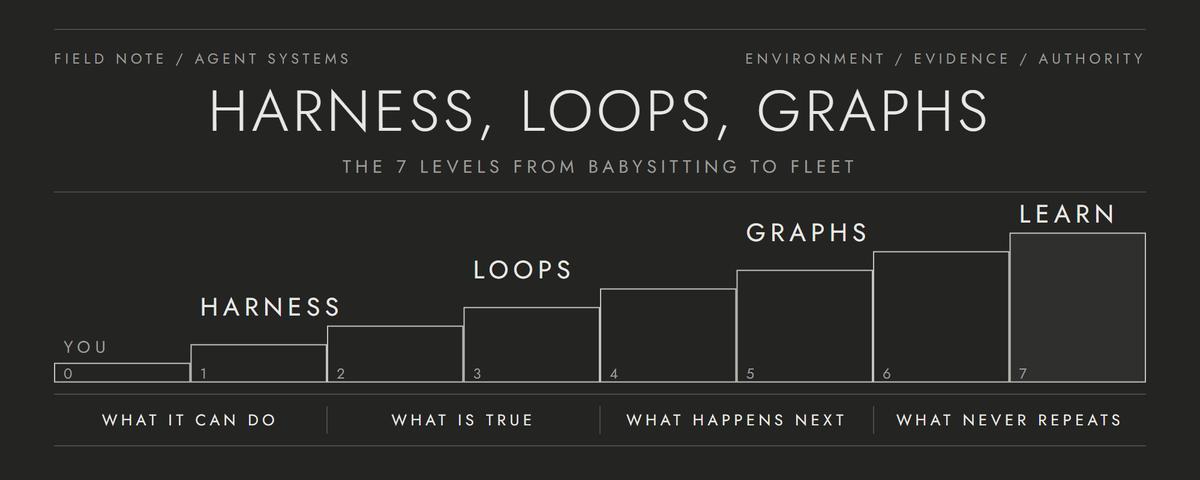
Your agent is not autonomous
You are its loop
You check every step because nothing else in the system can
I broke down the 7 levels from babysitting agents to running a fleet ↓



Saurabh Saha retweeted

A San Francisco startup says it just turned mercury into real gold, and their own math says gold is one of the cheapest things their machine can make. Aim it at a different metal and it makes a cancer drug ingredient worth tens of billions of dollars a gram.
Here's how it works. When you fuse two kinds of hydrogen, deuterium and tritium, every single reaction kicks out a neutron moving at 14.1 MeV, which is absurdly fast. Fire one into mercury-198 and it knocks another neutron loose on the way through, so two come out and you're left with mercury-197. Give that a few days and it decays into gold-197, the only stable kind of gold there is. The whole trick needs neutrons above about 6 MeV, and regular nuclear reactors barely make those, while fusion makes one every time it fires.
Now swap the mercury for radium-226. Same reaction, one neutron in and two out, and you end up with radium-225, which decays into actinium-225. Novartis is building its next prostate cancer drug around actinium-225, and it's so scarce it sells by the millicurie, roughly $1,200 to $2,500 apiece. Price it by the gram and you're into the tens of billions of dollars, for a material so radioactive nobody could safely hold a gram of it anyway.
Marathon's team actually put a dollar value on a single fusion neutron in a paper this year. Use it to make electricity and it's worth about $3 × 10⁻²⁰. Gold comes in at $2.6 × 10⁻²⁰, basically a wash. Molybdenum-99, which goes into about 80% of nuclear medicine scans, is worth $2.6 × 10⁻¹⁷ a neutron. Actinium-225 is worth about $10⁻¹⁰, around 3 billion times what the electricity's worth.
That's why fusion people should care. Every fusion company you've heard of is chasing electricity, and selling electricity only pays once the plasma puts out something like 10 to 22 times the energy you pump in to heat it. The best result so far, at JET in England, was about a third. Add gold on the side and Marathon's math says you break even around 3x. For molybdenum-99, the number is 0.001x.
So a machine that gives back one-thousandth of the energy you feed it can still make money, as long as the neutrons hit the right metal.
By their numbers, a 3 megawatt machine running way below breakeven could cover the whole world's supply of molybdenum-99, which today comes from splitting uranium in a handful of research reactors. Today's experimental fusion machines already beat the gain that job needs.
Their second post basically says this out loud. Marathon now describes itself as an isotope company for radiopharma. Their chart shows roughly 390 targeted radiotherapy trials. Pluvicto, the prostate cancer drug Novartis launched at $42,500 a dose, did $1.9 billion in sales last year.
Gold still matters to them, just later. It's about a $700 billion a year market, and Marathon's paper figures it could soak up around 2 terawatts of fusion capacity, which is roughly the scale where fusion actually moves the grid. So the plan is to sell cancer isotopes out of small machines now and use gold to pay for the giant ones, years before electricity can pay for itself.

Last month, we demonstrated high-rate alchemy: turning mercury into real, stable gold, beating CERN’s record by a factor of 10.
Last week, we enriched isotopes in the world’s most powerful plasma centrifuge, beating the Soviet record that stood for 40 years.
Now, we’re building a fusion reactor in San Francisco to achieve record power density.
Saurabh Saha retweeted
If you have not read this piece of writing - you should.
Not that any of us in tech didn't know but seeing it put this way is mindblowing & mindblowingly scary ... is mildly putting it.
I dont even know where to begin. The idea that anyone anywhere can just capture any photo, video or content of anyone's life without them knowing (see examples in the piece) and package it and sell it to the labs for training is ......
Forget data breaches the way we have known it from our systems. We are data. Our physical lives are data. That someone is capturing without you knowing and selling it to labs!!!!
There are responsible actors and irresponsible actors. But like Ilya says here - most folks labs including have no idea what data they're getting to begin with, from the data brokers.
The idea that the onus of protection is now in the hands of each person or individual is 🤯🤯🤯 Data privacy takes on a meaning unlike any we've known before!!!


Saurabh Saha retweeted

Very powerful.
equator.org/articles/arundha…

Saurabh Saha retweeted

The OG has spoken. Must watch.
Thank you, @PrannoyRoy7749 sir, for this brilliant analysis. Much needed for journalists, including me.
Nuance, tameez, without unnecessary ghamandbaazi aur grace ke saath journalism kaise hoti hai, woh sab thoda bhool hi gaye the. 🫡🧿

How the SIR deletions affect the Bengal election results? Were certain categories of voters targeted and if so, what were the consequences?
Does the analysis of Bengal elections suggest any lessons for the forthcoming state elections?
Prannoy Roy (@PrannoyRoy7749) uses data on SIR deletions and swings in votes to answer these and other questions about the impact of SIR on the Bengal elections.
Watch the full analysis and follow DeKoder for more.
#ECI #SIR #VoterDeletion #WestBengal #BJP #TMC #WomenVoters #VotingRights #IndianElections #ElectionAnalysis
Saurabh Saha retweeted

We'll be spending a lot more time trying to understand the outputs of language models. A few thoughts, tips & tricks:
Writing. Something I've had success with: Ask your LLM to explain something in ASD-STE100, it's a controlled language specification originally developed for aerospace maintenance documentation. LLMs well-versed in this language and it comes with heavy constraints on clean writing style that I often find a lot more readable. Sometimes I've tried to soften it a bit e.g. ask for "80% of the way to ASD-STE100" because the spec is quite stringent. But even better:
Diagrams / images. Instead of writing, ask your LLM to create a diagram. These can be a lot easier to process, parse, and understand. But even better:
Web pages. Ask for output "in HTML" to get a beautiful, interactive webpage. LLMs are getting really good at frontend and can create beautiful experiences, animations, etc. But even better:
Explainer videos. The output format I am most bullish on is fully custom / bespoke explainer videos generated on any arbitrary topic. Experiment with things like "Create a 3b1b style video explainer on X. Use my ElevenLabs API key for audio narration". (you'd need an API key for the latter or you can ask your LLM to find you decent free alternatives that use your local compute). This is actually starting to work!
In summary:
- As LLMs get better, they will do more and more of the legwork autonomously, and a lot more of our work will rise up the abstractions into oversight and understanding.
- Luckily, LLMs can help here too because as intelligence and code are increasingly abundant, you can ask for large, custom, discardable software artifacts (e.g. web apps, video explainers) that would have never made sense to create before. Push the boundaries here and you'll be surprised.

Saurabh Saha retweeted

An intellectually deep and beautifully written essay on consciousness and AI, by neuroscientist Anil Seth | Why consciousness is more likely a property of life than of computation and why creating conscious, or even conscious-seeming AI, is a bad idea | @anilkseth in @NoemaMag noemamag.com/the-mythology-o… noemamag.com/the-mythology-o…

Saurabh Saha retweeted

strong recommend every engineer listens to this from @dhh. he is getting a lot of hate but this will be seen as prophetic.

Saurabh Saha retweeted

👩🏫 UNA PROFESORA DE STANFORD EXPLICA CÓMO DOMINAR LOS PROCESOS DE DECISIÓN DE MARKOV
Una clase de 83 minutos, gratuita y directamente desde Stanford.
🧠 En la lección aprenderás:
• Diferencias entre problemas de búsqueda y entornos estocásticos.
• Evaluación de políticas y recurrencias de valores Q.
• Cómo funciona la iteración de valores.
• Límites de convergencia en grafos cíclicos.
Todo explicado desde los fundamentos de los Markov Decision Processes (MDP).
🔥 Si estás aprendiendo inteligencia artificial, aprendizaje por refuerzo o toma de decisiones algorítmica, es una clase para guardar.
📌 Guárdala y mírala cuando tengas tiempo.
Una joya gratuita de Stanford.
Saurabh Saha retweeted

WHOEVER LEAKED THIS HAS ZERO FEAR
SOMEONE CONNECTED 4,200 GROK BOTS TO RUN A ONE-PERSON CONTENT DESK.
Not 50. Not 350. Four thousand two hundred agents wired into one system.
I thought it was just another AI experiment until I saw the architecture.
Floor 1 scans X, TikTok, YouTube, Reddit and news every few seconds.
Floor 2 hunts only for hooks, angles and formats that already spread.
Floor 3 writes threads, scripts, carousels and reply chains in parallel.
Floor 4 generates thumbnails, visuals and clip variants.
Floor 5 tests timing, distribution, quotes and follow-ups.
Floor 6 kills anything mid, off-brand or risky before it ever reaches the owner.
Then one HEAD OF STUDIO Grok sits on top of all 4,200.
It does not send him a mountain of drafts.
It sends 3–7 pieces a day that actually deserve to be posted.
No writers.
No editors.
No content team.
No staring at a blank page.
Just 4,200 Grok bots passing work between each other 24/7.
The craziest part?
The owner said he barely touches the system anymore.
He just publishes what survives.
FULL GUIDE ON HOW TO BUILD IT BELOW


Saurabh Saha retweeted

Mrityunjoy Chakraborty, IIT Kharagpur professor:
"Jane Street pays a 22 year old $500,000 a year for one skill: turning uncertainty into a number you can bet on. that number is the first thing this professor teaches, and it is free"
this free lecture is the foundation every quant bot and hedge fund model is secretly built on.
before the AI, before the strategy, there is one question. what is the chance this happens, exactly.
get that number right and every bet after it is just math. get it wrong and no model, no bot, no amount of compute can save you.
Chakraborty builds probability from the axioms up, on a blackboard, in notation a 15 year old can follow.
Wall Street sells this as a $500,000 edge. an IIT professor hands you the source code for nothing.


Saurabh Saha retweeted

I still don't understand why everyone is not using this yet. Thanks to it, a year ago I increased my income to 17,000 dollars a month
Andrey Karpathy, co-founder of OpenAI, published a simple idea that got 16 million views: stop using AI to write code, use it to build a second brain
You point Claude Code to a folder, drop any source in there (an article, transcript, PDF) and Claude reads it, links it, and saves it into a living wiki of everything you know. It compounds like interest: the more you feed it, the smarter it gets
Here is the gist:
Install Obsidian, create a vault, open it in Claude Code
Paste the file with Karpathy's wiki idea and tell Claude to build it
Claude creates three folders: raw for sources, wiki for its pages, CLAUDE
which runs everything
Drop any source into raw and say "ingest this"
Ask questions across everything, forever
Five minutes to set up, and you never start with an empty chat again
The full step-by-step guide is in the article. Save to bookmarks


Saurabh Saha retweeted

Jensen Huang's daughter Madison Huang was spotted at World Robot Conference in Beijing.
Saurabh Saha retweeted

Karpathy left an agent running overnight on his own training code, the code he had already spent a long time optimizing himself. It came back with about 20 improvements he had missed.
The setup is almost insultingly small. One file the agent is allowed to edit, one it cannot touch, one number to beat. The agent changes something, trains for five minutes, checks the score. Better, it keeps the commit. Worse, it throws the change away and tries again. That is the entire loop.
Two days, roughly 700 experiments. Time to GPT-2 quality went from 2.02 hours down to 1.80. It also caught a missing multiplier in his attention code that he had walked past.
The part worth sitting with: you never edit Python here. You edit a markdown file that tells the agent how to do research. Karpathy says that file is the real benchmark now.
Repo is karpathy/autoresearch.


