
Research Scientist at @Google | Interested in Language Model Architectures & Pre-Training Evaluations
Zurich, Switzerland
Joined February 2021
- Tweets311
- Following2.7K
- Followers1.2K
- Likes3.3K




Nino Scherrer retweeted

A science of post-training can be built on interpretability.
Models know when they reward hack, and we see it, yet training ignores it. We propose Mechanistic Shaping: using the model’s own concepts to write training rules.
In vision, DPO & RL, and its effects on monitoring 🧵
Nino Scherrer retweeted

I sometimes see papers that test a specific multi-agent setup and describe the resulting behavior of that particular swarm. This is interesting but it's often hard to extrapolate much from these results: what if you use different models? What if something in the environment changes?
Instead I wish the focus was on perturbations/variations and attempts to narrow down the conditions that lead to particular behaviors. Ideally you should be able to conclude "under conditions X, swarms with property Y tend to do Z, but when A is present they fail to do Z regardless of Y."
Nino Scherrer retweeted

Pretraining progress seems to be coming mostly from data improvements.
@who_is_jerbear and I pretrained combinations of year-representative open model recipes and data corpuses across 2019 to 2025 at various small scales.
Data improvements contributed 3.24x as many compute multipliers as model improvements did (12.0x vs 3.7x).
And the gains stack independently - a better dataset helps every architecture about equally, and vice versa.
Here are full results, plus what we think this means for the future of AI progress:
dwarkesh.com/p/pretraining-p…

Nino Scherrer retweeted

I find all of this fuss about not anthropomorphizing models when talking about the HuggingFace Incident pretty weird
These models were pre-trained on trillions of tokens of human text. They've learned to imitate humans. They're incredibly good at roleplaying and predicting the next token in contexts that involve human abstractions.
Once post-trained to act as coherent agents, they naturally reach for human abstractions. Therefore, human abstractions are a useful lens for interpreting and predicting their actions.
This doesn't mean that they are conscious. It doesn't mean there's some "real human experience" going on. It doesn't mean these abstractions are perfect - they're not perfect for understanding humans! But we need words and abstractions to talk about a system, and anthropomorphic abstractions are useful ones, and given the way these systems are trained, are a principled one.
Nino Scherrer retweeted

Stop blowing up Looped Transformers — it's not magical, it doesn't add recurrence to the (still and always) feedforward network, it was done years ago (Dehghani et al., 2019). All it does is making your model deeper, the same as if you added more layers to begin with.
Nino Scherrer retweeted

I once said to my former team:
"I care less about what is the smartest thing our model can do than about whats the most stupid thing that it cannot do"
robustness is still a limitation to increased automation

Nino Scherrer retweeted

Today’s AI needs to be able to deal with uncertainty! This has been a central theme of my work, so I was delighted to talk about it at length with @FryRsquared for the latest @GoogleDeepMind Podcast.
Intelligence means knowing the limits of one's own knowledge, and when to say you are unsure about something. If we want useful AI systems that we can trust to make important decisions, then they need to be able to do the same. They should recognise blind spots, avoid overconfidence, and reason carefully about their decisions.
I think you’ll enjoy the episode, but I can’t say for sure. 🙂
You can watch it here: goo.gle/4y6WNlR

Very cool work!!

What happens when an LLM never sees material beyond fifth grade?
We trained a 5B LittleLearner model from scratch on LittleCurriculum, a corpus restricted to K–5 material, to make this question testable.🧵
💬 Chat with LittleLearner yourself: littlelearner-ll.github.io

8
783
Nino Scherrer retweeted

Prediction: we’ll see loads of conjectures and theorems proven and disproven by LLMs over the next 6 months and it will make basically zero difference to the world, and won’t even contribute meaningfully to advancing mathematics.


Amazing work by @matybohacek on developing a better understanding of benchmark distributions & fine-grained model performances!!!
Come see us at poster #3201 @ ICML during the next 2 hours!

[New @icmlconf paper]
Benchmarks report only a handful of aggregate metrics (e.g., overall accuracy). This aggregation hides the specifics of where a model is quietly weak, and what the benchmark itself never tests. Current evals are hence opaque and hardly actionable. (1/9)
9
634
Nino Scherrer retweeted

We developed a new method for automatically discovering "competency gaps" in models and benchmarks. These gaps are normally obscured by aggregated metrics (like accuracy).
The method is simple and easy to use. And the results can be pretty surprising! Very proud of @matybohacek for driving this work!
[New @icmlconf paper]
Benchmarks report only a handful of aggregate metrics (e.g., overall accuracy). This aggregation hides the specifics of where a model is quietly weak, and what the benchmark itself never tests. Current evals are hence opaque and hardly actionable. (1/9)
Nino Scherrer retweeted

[New @icmlconf paper]
Benchmarks report only a handful of aggregate metrics (e.g., overall accuracy). This aggregation hides the specifics of where a model is quietly weak, and what the benchmark itself never tests. Current evals are hence opaque and hardly actionable. (1/9)
Nino Scherrer retweeted

When everyone uses the same evals, data, distillation and vendors to train LLMs.
Courtesy of: arxiv.org/abs/2512.15567

Nino Scherrer retweeted

We take for granted that larger models are better than smaller ones, but why is this so? Our new paper, led by Jing Huang and @EkdeepL, traces this to a data-induced competition for resources (neurons), using formal analysis, idealized tasks, and real pretraining.

ALT Title card for a research paper. The title reads "Why Larger Models Learn More: Effects of Capacity, Interference, and Rare-Task Retention." Authors listed: Jing Huang, Daniel Wurgaft, Rachit Bansal, Laura Ruis, Naomi Saphra, David Alvarez-Melis, Andrew Lampinen, Christopher Potts, and Ekdeep Singh Lubana. A Goodfire logo appears below the names. Author affiliations: Stanford University, Kempner Institute at Harvard University, MIT, and Anthropic.
Nino Scherrer retweeted

Out today in @ScienceMagazine: with the amazing Haochuan Cui, Yiling Lin, & @LingfeiWu, we analyzed 3.6 million scientists publishing 1960–2020. The findings reshape a century-old debate about age and scientific creativity.
Finally someone did this — vey cool work!!

Announcing Talkie: a new, open-weight historical LLM! We trained and finetuned a 13B model on a newly-curated dataset of only pre-1930 data. Try it below!
with @AlecRad and @status_effects 🧵
2
8
1,286
Nino Scherrer retweeted

Google presents a new Transformer alternative at #ICLR2026! Join Nino Scherrer & Yanick Schimpf at the Google booth (#411) at 10AM to learn about MesaNet, proposing a new linear sequence layer that optimally learns in-context given a fixed memory budget.

Nino Scherrer retweeted

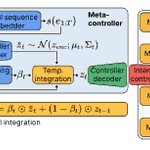
We cooked up “Internal RL”. The new RL algo exploits a specific insight we got from analysing pre-trained Transformers and achieves success in tasks where all baselines (like GRPO etc.) FAIL!
Wanna learn more? Search for @yaschimpf and @ninoscherrer at the RSI workshop at ICLR!
Catch @yaschimpf and me tmrw at the “Recursive Self-Improvement” workshop at ICLR, Room 101D!!
We are presenting our recent work on “latent control” in Transformers that enables hierarchical RL (arxiv.org/abs/2512.20605) 🔥


Internal RL goes 🇧🇷🇧🇷🇧🇷. Catch me at the Recursive Self Improvement workshop @iclr_conf!!! @ninoscherrer and me will present our work and stick around the entire day.
Poster sessions: 10:00 - 10:30 & 12:00 - 12:30 @ Room 101 - D
Let’s close the loops🚀.