






As someone who does not have to imagine being a student graduating from UMD last week with a degree in aerospace engineering (I am one), I would appreciate it if fox news did not presume to know how we feel

Gaines: You can even make this up. Instead of honoring entrepreneurs or veterans or innovators, they picked Kermit the Frog…
3
202
I've been working on a fun project recently

ALT Kicad screenshot of board with text "danger: lethal voltage" and high voltage symbol
2
2
91

I think I've got a way to modulate (D)BPSK at the clk_hstx frequency with a configurable divider to set datarate and it uses 0 CPU cycles (only DMA and PIO). I preordered some pico 2s so I'll test it out when they come in.


1
12
452
I saw an article about using an FPGA as a strain gauge by looking at the frequency of a ring oscillator and I wanted to try it. Half an hour later, I had this graph. The two spikes are the times I was pressing on the FPGA, with maybe 3 lbs of force. FPGA is an Artix 7.

ALT DMM with a graph of frequency over time showing two spikes
I found out about here: voltagedivide.com/2024/03/18…
Original article: hackaday.com/2015/09/27/myst…
19
1,226

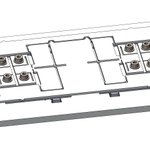
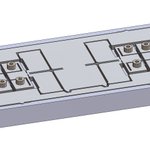
After seeing the video on MEMS IMUs from @BreakingTaps I wanted to make a similar model that's actually functional. Starting with the Z accel, a few changes make it suitable for laser cut aluminum, which is both denser and has more predictable properties compared to printed parts

1
3
626
Sims show a deformation of 95um at 10m/s2, so sensing will be tricky. I'm thinking interferometry might work, but only because I've done that before based on @BenKrasnow's video on self mixing laser interferometers.

1
5
301


I'm back to work on the Pico SDR, and I think I found a way to make RX doable. The AT86RF215 uses a DDR LVDS bus that runs at 64 MHz/128 Mb/s, and the Pico can't synchronize with an external clock (unless it's used as the main clock, which could work but not with my current PCB).

1
5

I built a SDR using a RPi Pico and a AT86RF215 transceiver! It's capable of transmitting and receiving simultaneously in either the 440 MHz, 900 MHz, or 2.4 GHz ISM bands. The xcvr communicates over LVDS, so there's a driver and receiver to convert to single ended 3V3.

ALT 2 PCBs stacked with a connector, one with SMA ports and a transceiver and the other with a raspberry pi pico and a LVDS driver and receiver

ALT Screenshot of a spectrum showing repeating transmissions from the SDR

ALT Picture of an oscilloscope screen showing the clock and data signals containing the IQ samples being transmitted
The capabilities of the RP2040 are truly insane. I'm working on a project that would usually require an FPGA or microprocessor, and yet this simple $1 chip looks like it might be able to pull it off. It may even be the first of it's kind to run from just a basic microcontroller.
2
14


Ok that is a really good deal, just the chips cost more than that and aren't even in stock on DigiKey (but please don't buy a bunch of boards and @joebarnard them)


Tuesday's #CyberWeek2021 deal is a doozie - we're giving 50% (yes, half off) of ANY Arty board featuring @XilinxInc tech. We call it "The Arty of the Deal".
fal.cn/3kf0W

3

I wrote up a blog post back in May about this, but never had the chance to finish it until now (getting the LaTeX working was tricky). So here it is: nathankerns.me/projects/2020…

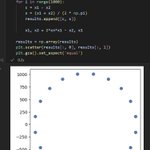
Here's something I've been working on for the past day or so: simulating a phased array with Python. I couldn't find any simple methods of analyzing them, so I figured I'd just start from the beginning. It creates a wave on a 2D surface, with the appropriate position and phase.


1

