







To extrapolate from pacing the frontier to a slowdown in infra spending is somewhat inaccurate as the leading labs are effectively caught in a prisoner dilemma. Most training will still continue, but restricted RL or 3rd par eval will most likely be involved in the development process going fwd.
That being said, I agree with the prevailing pessimism since model capabilities are directly associated with ARR accel. More importantly, the difference between capex and cumulative ARR remains the key justification for infrastructure buildout, ROI concerns, and capex sustainability.
I’m personally looking for more opportunities to be involved in $BUG and other cyber-tangent names. There are not a lot of certainties in the market, but model improvements will be inevitable and safety concerns will incentivize more spending on security.

We Must Pace the Frontier: I’ve written a new essay on why the AI industry should slow down, with a three-part plan for doing so.
Anthropic is unilaterally committing to the first of these steps. We’ll provide third-party evaluators with permanent, employee-level access to our systems, so that they can verify adherence to our safety measures, report on incidents, and assess models’ alignment during training.
You can read the full post here: darioamodei.com/post/we-must…

1
2,426
GPT-6 may be the first model where persistence itself becomes a meaningful new inference workload and therefore a new memory demand vector.
The model records no step-forward improvement in coding capabilities, yet saturates ARC-AGI-3, a benchmark built around agents entering unfamiliar interactive environments with no instructions or stated objective, then exploring, inferring the underlying rules, identifying the goal, and executing a multi-step plan. I think the model is specifically optimized for persistent agentic workload.
For the last several years, we have largely framed AI memory demand as a function of more prompts × more tokens per prompt, but persistent agents change the unit of consumption from token throughput per query to stateful compute per objective
active goals × agent-hours/goal × inference intensity × persistent state/agent × tool interactions.

It's called "persistent/long horizon agent memory"
SanDisk didn't even include it in their TAM estimates
IMO, this will be the largest driver of NAND demand
Probably around 500-600EB by 2030

2
6
2,592
I find it puzzling how little work has been done around the rate of EPS accretion as $SNDK commit to deploy billions of FCF into share repurchases over the next 3 years. At its core, investors should interpret memory P/Es as the company's payback period (i.e., the number of years required to earn back its entire market cap)
With NBMs, SanDisk is positioned to generate approximately $168B in cumulative FCF through FY31 against $254B market cap as of Friday’s close (8/14). Deploying 100% of FCF at current valuation retires nearly 66% of its outstanding shares, driving explosive per-share accretion as the share denominator contracts far faster than top-line fundamentals can mean-revert. In this report, we want to provide a quantitative framework modeling the EPS accretion through FY30 under 6 different buyback scenarios.
Please Don’t Bid Memory Up deepdivex.substack.com/p/san…

Ran the numbers on what a 100% FCF payout through FY30 means for $SNDK outer-year EPS across 6 execution scenarios. Will publish on Substack soon, but sharing some work here:
1. Taking the low end of the revenue guide and assuming a flat 16% growth FY28–30, base case revenue runs ~$57B / $66B / $76B in FY28/29/30 against Street consensus declining at ~$59B / $49B / $35B (+20% / −17% / −29%). Delta is −3% / +35% / +117%, or +$56B cumulative (+39%).
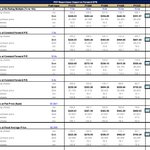
2. With zero buybacks, EPS under the guided framework is still $244 / $279 / $319 (+50% / +126% vs. Street in FY29/30). But we model six potential buyback execution pathways and lay them out in Image 1.
3. The longer the stock stays flat or trades at a depressed multiple, the more FCF returns maximize EPS accretion power.
4. Across 20 years pre-WDC, SanDisk traded at 10–13x two-year-forward EPS at sustained earnings peaks, such as Peak III (2010–11, smartphone) at 10.3x and Peak IV (2013–14, SSD and enterprise) at 13.4x. Per friday's close it trades at ~5–6x.


$SNDK Investor Day Takeaways
1. NBM structurally resets the earnings floor with 1/2 of FY27 bits and 2⁄3 of FY28 are under 4+ year agreements, with ~$94B TCV and ~80% GM even at floor pricing. SNDK structurally raised through-cycle margins and reduced earnings volatility versus prior memory cycles.
2. Data center/inference is replacing consumer as the marginal NAND demand driver, while BiCS productivity supports mid/high-teens bit growth without commensurate wafer additions. Persistent KV cache / eSSD are the core demand legs; HBF is unmodeled upside rather than required for the base case.
3. Management guides to ~50% FCF margins and 100% excess cash returns, while current Street estimates barely reflect the resulting share shrink. On a framework-consistent 7x repurchase-price path, FY28/29/30 EPS reaches roughly $285 / $363 / $464, versus current Street around $259 / $186 / $141 roughly +10% / +95% / +230% upside. CY30 reaches ~$533 at 7x and approaches ~$600 if average repurchases occur around ~$2,000/share.
4. Valuation: SNDK has historically traded around 7–10x forward earnings. Using the midpoint 9x × CY27 EPS of $250 = $2,250 Dec-27 PT.


It's really amazing to see how much image generation tools improved these days. I asked GPT to generate a snapshot of my NAND article and this is the output
$SNDK analyst day tomorrow
Per JPM: " Lots of folks yesterday were asking for a preview of expectations for SNDK’s Investor Day tomorrow at 9am.
We don’t have anything formal, but from conversations it sounds like folks want to hear a few things. Above all, we hope for even more disclosure around NBMs (long term agreements), which should support an updated financial outlook (last one was Feb 2025) that – in Harlan’s view – will show topline growth of 20%+ p.a., with flattish GMs and opex leverage driving high 20s-to-30%+ EPS growth, with low cyclicality.
This is a high bar where there remains much disbelief, but it’s something that SNDK CEO Dave Goeckeler successfully pulled off at WDC, so he has some credibility.
Folks also expect an updated capital allocation framework, seemingly with very material buybacks (perhaps annual buybacks in the neighborhood of 10%, based on my chats), and of course hope for more color around HBF and other new AI opportunities. Overall there is hope this can serve as a catalyst to help jump-start shares that have languishes."
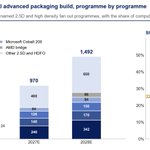
$INTC is uniquely positioned across the most relevant bottlenecks (CPU + Memory + Advanced Packaging) while the U.S. government is on the cap table.
Lip bought 12m shares today following the CapEx raise, as management spent the last year repeatedly telling investors it wouldn’t deploy meaningful 14A capacity ahead of customer commitments.
All developments point to a lot of optionality across:
18A / Memory: AMD FPGA + HBM base-die, with the latter potentially representing a ~$4–5B annual opportunity, alongside TPU-related advanced packaging optionality.
14A / Foundry: Apple iPhone, Tesla Physical AI Chip, Broadcom Switch and NVIDIA Gaming GPU, with later-stage Trainium variants adding another potential foundry / packaging revenue stream from 2027 into 2028.
A lot of ways to win if even a portion of the pipeline converts.

Intel's Lip-Bu Tan on memory:
"CPU and memory, there's a lot of ways we can do stacking together and also try to find some new architecture for memory. I think in some way, in memory, a lot of innovation are not there. I used to not invest in memory because it's kind of commodity business, but now it's become different, there's a lot of new technology coming out. One of my pet project is looking at some of the memory new architecture, and I think you just saw the news that I hired my good friend Seok-Hee Lee. He used to run SK Hynix, so you kind of know something that i'm thinking about we're not ready to unfold it."
$INTC $DRAM $MU $EWY $SKHY
Imagine yourself as a pod analyst with weeks to maximum 6 months for a position to yield alpha: in order to deal with memory underperformance, either you rotate into sectors with better narrative / catalyst support, or you hold like a LO investor and get fired.
L/S analysts can be bullish for the medium and long term but still be selling because of duration..
Therefore, a lot of outsized fluctuations are better explained by positioning these days, and the rotation has already begun early August when @SemiAnalysis_ posted the Rubin HBM note.
Would expect players like $SMTC $TSEM to outperform in this environment as performance loss are compensated with higher NPO content.

I think the market ultimately has no choice but to go sell memory, long optical in the "short term." Actually, some hedge funds already seem to have this position on.
There are three main reasons.
1. With Korean leveraged ETFs effectively dead, LPs are in a redemption rush, which could bring out additional sell on flow.
2. Nvidia is nerfing Rubin Ultra's HBM and responding with optics, tying multiple racks together, so that even if Rubin Ultra's per rack performance is not superior to Rubin, at the cluster level optics let the Rubin Ultra cluster hold an edge over the Rubin cluster. This holds even if Rubin Ultra's HBM nerf is a supply problem rather than a demand problem.
3. Consensus is forming that memory prices will peak within the next two quarters.
Medium to long term I am still a memory bull, but short term I am somewhat bearish on memory. I currently have no memory position.
At the core of the recent pullback in AI infra and semis resembles what the software sector faced earlier this year. It's essentially a debate surrounding terminal value and whether growth can be sustained over time and whether longer-dated earnings still carry sufficient visibility.
Over the past three weeks, several debates have converged and weighed on risk appetite. These include 1) progress in China’s semiconductor equipment localization and DUV capabilities, 2) the potential supply impact of CXMT’s capacity expansion on the global DRAM market, 3) the implications of open-weight models such as Kimi K3 for the competitive position of frontier labs and the intensity of infrastructure buildout, as well as 4) concerns around the sustainability of hyperscaler capex, financing capacity, and payback periods. Together, these issues have reduced earnings visibility for the semiconductor sector across 27'–30' and made it more difficult for investors to value long-term growth under the previous framework.
We therefore need to separate two questions: 1) whether earnings expectations have actually been cut materially, and 2) what multiple the market is willing to pay for the same earnings. Even if earnings expectations remain unchanged, a decline in confidence around the AI capex cycle can still compress the earnings multiple rapidly and drive the share price lower. The sharp momentum reversal across semiconductors has therefore reflected, to a meaningful extent, a repricing of valuation and narrative rather than a simultaneous deterioration in fundamentals.
Returning to the value of infrastructure, the most important driver is the non-linear rate of improvement in AI capabilities. Frontier models can already match or exceed human performance across a broad range of tasks. What are the economic implications when model capability doubles from today’s best level, or moves closer to AGI? Improvements in model capability may be gradual, but their economic value often has a clear threshold effect.
On the surface, achieving a 2x increase in model capability may require 10x the training compute, which appears to imply rising marginal costs. But this ignores the rapid improvement in the underlying infrastructure itself. GPU and TPU performance per chip continues to increase, while networking, optical interconnects, and software optimization are reducing cluster communication bottlenecks and raising end-to-end token throughput. 10x the compute therefore does not necessarily translate into 10x the cost. As infrastructure efficiency continues to improve, AI infrastructure will increasingly become an “intelligence superhighway” connecting compute production with economic applications.
This is why I still believe investors should remain structurally bullish on AI infrastructure. Hyperscalers are effectively caught in a prisoner’s dilemma: no cloud provider can easily be the first to cut CAPEX, because doing so risks permanently losing ground in next-generation model capabilities, cloud share, and enterprise AI distribution. Microsoft’s relatively cautious infrastructure expansion in 2024 contributed to capacity constraints for Azure in 2025, underscoring that future cloud growth will increasingly depend on compute availability and frontier-model competitiveness. From this perspective, capex is a strategic cost required to preserve future platform relevance. Concerns around financing pressure and CDS spreads are worth monitoring, but for hyperscalers with strong balance sheets and substantial cash flow, those risks may already be overstated.
More fundamentally, investing in technology is investing in innovation, and the pace of innovation is precisely what makes the AI era so compelling. Frontier labs have already begun exploring more advanced forms of recursive self-improvement, or RSI, in which AI participates in code generation, architecture optimization, and experimental iteration. This is a term investors are likely to hear much more frequently. If these capabilities continue to develop, model improvement could shift from “human engineering speed” to “machine speed,” allowing leading labs to build more durable capability and cost advantages. RSI is not a necessary condition for the AI infrastructure thesis to work, but it is a highly consequential upside option with a deeply uncertain timeline.
Ultimately, the key metric for enterprise AI adoption is not simply token price, but the cost per unit of intelligence. In high-value use cases such as cybersecurity, software development, biological research, and scientific computing, enterprises should not focus on which model offers the lowest price per million tokens. The more important question is which system can complete more valuable tasks at lower cost and with greater reliability. As intelligence becomes both cheaper and more dependable, growth in new applications, task complexity, and usage frequency may continue to exceed the compute savings created by model efficiency, supporting a longer-duration expansion cycle across compute, storage, networking, and power infrastructure.
As several of these risks begin to resolve over the next two weeks, I hope the market can return to a more rational assessment of fundamentals and long-term returns. We still need to monitor changes in narrative closely, but the more important variable remains the pace of technological innovation itself.

Market is overreacting to hyperscale credit spreads widening from my perspective. TL;DR Spot pricing for renting GPU compute materially above contracted rates implies hyperscalers are underearning while operating cash flow acceleration is an underestimated source of funds for AI capex.
The fact that spot prices for GPU rentals are at least 2x higher than contracted rates is the missing piece from the discussion about hyperscaler credit, which is the only fundamental factor behind this selloff. Multiple private companies are planning on spending at least 2x more per GPU for compute as contracts roll-off and some have spoken about this publicly.
As contracts roll-off, hyperscale growth rates are going to continue to accelerate as their installed bases of compute reprice higher. Hyperscale operating cash flow growth using a mix of estimates and actuals is modeled to accelerate from 31% in the first quarter of 2026 to 50% in the second quarter. This acceleration should continue for the rest of the year and this is not in estimates which incorrectly model a deceleration in the third quarter from my perspective.
Some math. Consensus estimates are probably for 25-35 gigawatts added by hyperscale and neoclouds in CY28 (using a range as standing up datacenters is hard and a lot of the neos plus labs are still private). At 60b per gigawatt, that is 1.5 to 2.2 trillion in capex. Consensus estimates for hyperscale/neo operating cash flow is 1.3 to 1.4 trillion. I think this gets revised up materially as contracts reprice and growth accelerates so the 100b to 700b that would hypothetically need to be plugged by debt goes away. And their credit profiles materially improve. Not to mention the said 100b to 700b would be less than 1 turn of incremental leverage on consensus EBITDA estimates. And obviously the Nvidia and Broadcom “credit wrappers” help improve creditworthiness as well given their FCF profiles.
OpenAI, Cursor/Grok and the various Open Source inference clouds have accelerated materially over the last two months per public data and Anthropic continues to grow insanely fast while likely generating FCF. This - along with the fact that spot prices for GPU rentals are so far ahead of contract - are the missing pieces from the BofA chart on hyperscale FCF vs. semiconductor FCF.
Hyperscalers are underearning and anyone who signed a contract for GPU compute in 2024 and 2025 is overearning. Operating cash flow will be enough to fund capex but as contracts reprice and cloud growth continues to accelerate then spreads likely come in as well.
Would also note that CDS markets are easy to manipulate - was a huge feature of the GFC - short the stock and then buy the CDS. So I would not put attach much signal to CDS.
Net, net I’m not that concerned about the widening spreads in hyperscale credit. The real risk is that bringing power online and energizing all these GPUs is really hard but we are getting better at this every day.


Investors seemed to be a lot more anchored on S&D FUD given the magnitude of the drawdown we've seen in TMT momo names. +ve news get sold and negative views get embraced and exaggerated to explain PA.
I think it's pivotal to remain convicted to EPS and fundamentals, but it's also increasingly important be be mindful of the prevailing narrative, key debates, and fund flows.
$SNDK $SKHY


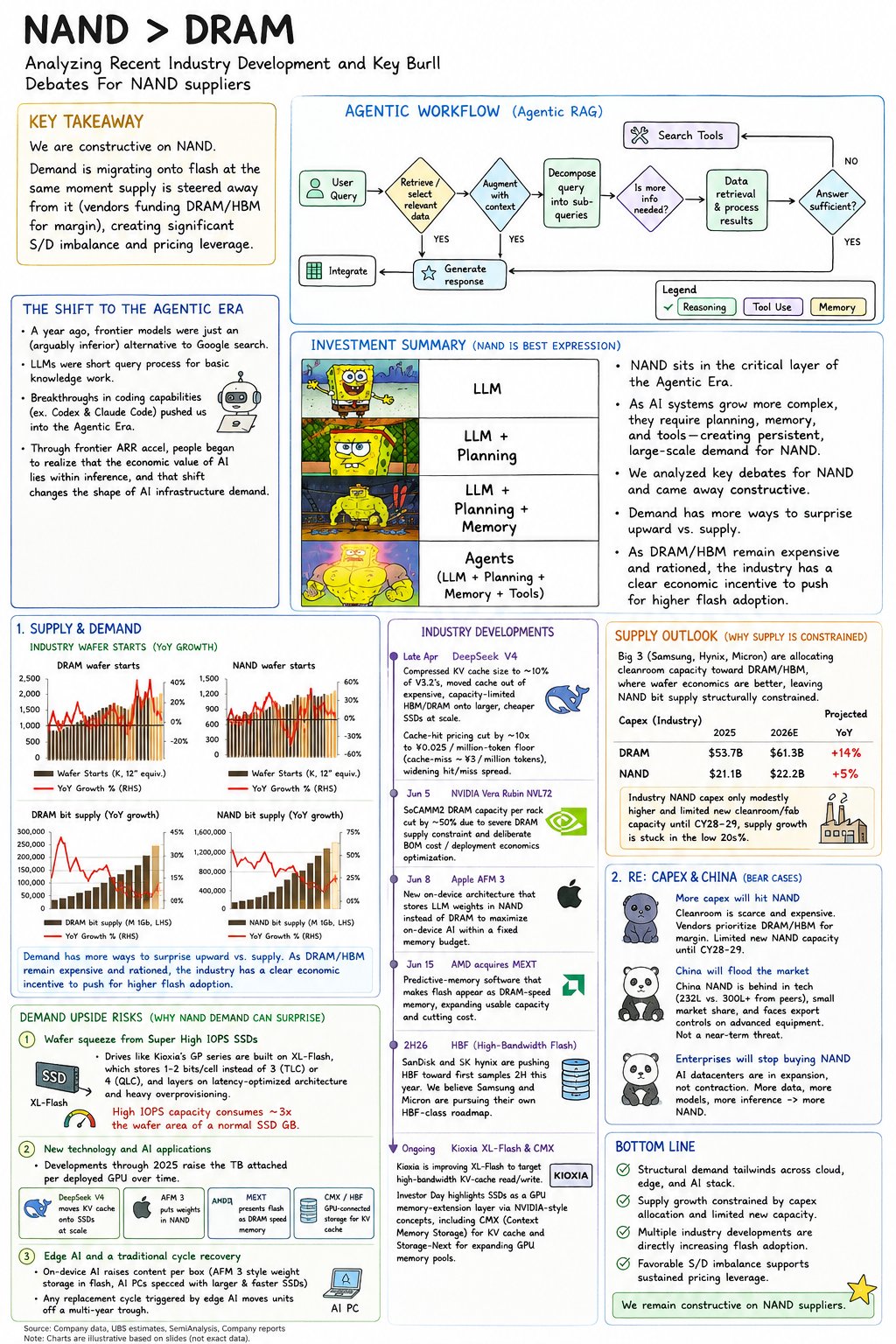
I acknowledged China supply as the No. 1 bear case in my NAND > DRAM article. However, I believe the market is pulling forward (and overstating) a risk that is more likely to become material over the medium term.
YMTC remains primarily exposed to consumer and client NAND, with a commercial footprint concentrated in China. Although it already offers enterprise SSDs—including the PE310 launched in 2022 and the PE501 enterprise QLC SSD—we have seen no public evidence of meaningful qualification or deployment at major Western hyperscalers. YMTC can pressure pricing in consumer and client NAND today, but a credible challenge to the higher-value enterprise SSD profit pool is more likely a 2027–28 risk than an immediate supply shock.
More importantly, rising domestic AI demand should absorb part of China’s incremental NAND output. Chinese model developers are increasingly using storage to relieve pressure on scarce and expensive HBM and DRAM. DeepSeek V4 reportedly compressed its KV cache footprint to roughly 10% of V3.2’s, enabling more state to be offloaded onto cheaper host memory and SSDs. Moonshot has pursued a similar architecture, aggressively moving KV cache into host memory and storage to support longer context windows and higher concurrency, with reported throughput improvements of 59% to 525% while remaining within service-level constraints.
Consequently, while YMTC adds incremental NAND capacity, China’s own AI ecosystem is also becoming more storage-intensive. I believe domestic demand absorption and limited hyperscaler qualification should contain the impact on the global enterprise SSD market.
$SNDK $KXIAY

Apparently, some idiots have suddenly started dumping memory stocks because of this post I made…
Yes, I posted it to warn people not to underestimate YMTC. But that doesn’t mean I was telling anyone to panic-sell.
NAND is still in short supply, and that shortage will persist.
NVIDIA’s CMX racks are currently so constrained by NAND shortages that they cannot even be shipped fully populated. Customers looking to purchase CMX racks are reportedly being asked to source some of the NAND themselves to fill the racks.
I’m not a NAND bear—let me be absolutely clear about that. YMTC is still heavily exposed to the consumer market, and it should not be underestimated. But that does not mean YMTC is going to push the NAND market into oversupply.


Anthropic first unveiled Mythos-level capability as "Claude Mythos Preview" on April 7, 2026, with Fable 5 reaching GA on June 9.
K3 is a genuinely strong model with similar capabilities to Fable on coding/agentic benchmarks. But that timeline means frontier labs are still at least 3 months ahead given the release cadence.
So China OSS catching up concern is overstated imo.
491
HDD: ms + tmtb pounding the table
1. HDD pricing checks continue to strengthen. Industry contacts are pointing to CY27 nearline HDD pricing reaching ~$25–30/TB, with incremental demand being sold at 25%+ premiums to contracted pricing. Non-hyperscaler customers are already paying $30+/TB in the spot market.
2. The key driver is that hyperscalers still have no economically viable alternative to HDDs for cold storage, while the TCO advantage of HDD vs. NAND is widening. As a result, the market could see 30%+ YoY HDD price increases in 2027.
3. Checks suggest Seagate is not aggressively locking customers into LTAs because management believes supply-demand dynamics give them pricing power. That is incrementally positive for future earnings leverage.
4. If HDD pricing reaches ~$30/TB by CY28 (vs. Street assumptions still below $20/TB), earnings power could be materially higher:
$WDC: potential for $70+ EPS
$STX: potential for ~$100 EPS
5.Structural thesis remains intact: unlike compute, storage demand compounds over time because every AI-generated token/output must be stored. Even if AI compute spending eventually moderates, storage spending can continue growing independently. The report views HDDs and NAND as two of the most attractive AI infrastructure segments today, with HDD stocks potentially having more near-term upside as investors adjust to improving pricing data points.

A lot of noise re: NVDA/Rubin SOCAMM content cut from the @SemiAnalysis_ article.
The actual article was saying that Nvidia is reducing Rubin NVL72 SOCAMM DRAM capacity per rack by roughly 50% b/c of severe DRAM supply constraint. It's also a deliberate effort to optimize Rubin’s memory configuration around BOM cost and deployment economics.

3
378