
UC Berkeley
Joined December 2010
- Tweets160
- Following340
- Followers863
- Likes464


🚨 Job Alert! 🚨 Join the UC Berkeley Physics Department! We’re hiring an Assistant Professor in soft condensed matter (broadly defined). Both experimentalists and theorists are encouraged to apply!
aprecruit.berkeley.edu/JPF05…
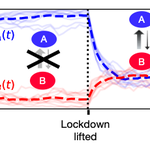
After a long and winding odyssey, excited to finally drop anchor in open-access waters. This preprint shows how neutral allele frequency time series can illuminate disease transmission rates between communities— key for epidemic fore- & backcasting. medrxiv.org/content/10.1101/… 🧵

With NIH (esp. NIAID) funding under threat, this work underscores the importance of genomic epidemiology for global health. Supporting such analyses is vital—any suggestions on alternative funding sources?
This work owes its existence to the incredible Takashi Okada, with support from @QinQinYu, @giulioisacchini, and invaluable input from friends and experts. Read more: medrxiv.org/content/10.1101/…

Oskar Hallatschek retweeted

We usually think of genetic drift as the stochastic force in evolving populations. But working with model microbial populations, we found a distinct source of stochasticity that scales (and behaves) differently than drift
Learn more in our new paper 👉 rdcu.be/d07Np
🚨 Job Alert! 🚨 Join the UC Berkeley Physics Department! We’re hiring an Assistant Professor in soft condensed matter (broadly defined). Both experimentalists and theorists are encouraged to apply!
aprecruit.berkeley.edu/JPF04…
Oskar Hallatschek retweeted

Excited to share that our work on inferring genetic drift in SARS-CoV-2 transmission using lineage frequency time series is now published in PLoS Pathogens! journals.plos.org/plospathog…
w/@ohallats, @jaascensao, Takashi Okada, @erikmvolz, and Olivia Boyd

Why do SARS-CoV-2 lineage frequency time series fluctuate so much, even when the population size (# positive individuals) is large? In our new preprint, we find high levels of stochasticity in transmission dynamics of SARS-CoV-2 in England. biorxiv.org/content/10.1101/… 🧵1/

Oskar Hallatschek retweeted
Do you enjoy mysterious population stochasticity, chaotic dynamics, and/or popgen? Then this preprint might be for you!
Super excited to share a project that has been an exciting journey, and a fun blend of theory and experiment! @ohallats
biorxiv.org/content/10.1101/…
Oskar Hallatschek retweeted
Happy to say that our work on how microbial communities rediversify after a perturbation is now published!
authors.elsevier.com/c/1iYm6…
🧵from the preprint👇

New preprint on @biorxivpreprint! We investigated the potential for microbial communities to regenerate ecological diversity following species removal, and we found a couple surprises! 🧵👇
biorxiv.org/content/10.1101/…

Oskar Hallatschek retweeted

Very excited our recent work with Daniel Fisher and @BhayaDevaki on long-term coevolution of natural cyanobacteria is up on bioRxiv. Instead of diverging into specialist strains, we find different species slowly merge on timescales of 100k years. (1/n) doi.org/10.1101/2023.06.06.5…
Oskar Hallatschek retweeted

Perspective: Proliferating active matter
By @ohallats, Sujit S. Datta @TheSquishyLab, @knutdrescher, Jörn Dunkel, Jens Elgeti, Bartek Waclaw & Ned S. Wingreen
rdcu.be/ddqwS


Oskar Hallatschek retweeted
Wastewater holds great promise as an emerging public health tool, but ~20% of households in the US are not connected to public sewers. Who is not connected to sewers, and what does this mean for equity?
medrxiv.org/content/10.1101/…
🧵👇
The evolution of minimalistic communities keeps surprising us. Thanks to @jaascensao's eagle eyes for spotting rediversification events.
New preprint on @biorxivpreprint! We investigated the potential for microbial communities to regenerate ecological diversity following species removal, and we found a couple surprises! 🧵👇
biorxiv.org/content/10.1101/…
In the very best sense of the phrase, this was a fishing expedition, producing a rich catch of fascinating hypotheses. Congrats @jaascensao
How do fitness landscapes shift upon ecological diversification? And do they depend on the presence of other ecotypes?
Excited that our paper is finally out! Huge thanks to the reviewers who really helped us clarify and improve the paper!
@ohallats @benjaminhgood @AdamArkinLab