





ALT The Orion spacecraft captured this image on Dec. 5, 2022, during the 20th day of the Artemis I mission. The Orion spacecraft is partially visible on the left side of the image. The gray, cratered surface of the Moon is partially in shadow near the bottom of the image. The Earth, which appears as a crescent moon, can be glimpsed in the distance on the right side of the image. Glare is reflecting off the Orion spacecraft. Credit: NASA


ALT The solar eclipse as seen from the surface of the Moon in Mare Crisium by the Blue Ghost Mission 1 lander. The Sun's corona shines as a bright circle around the dark disc of the Earth. A "diamond ring" flare glows at the five o'clock position against the darkness of space. Credit: Firefly Aerospace


ALT DakotaCon12
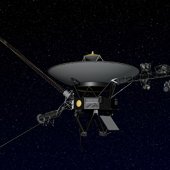

ALT A historic image showing Earth and the Moon together for the first time, captured by NASA's Voyager 1 spacecraft in 1977. The bottom of the image features Earth, partially illuminated, with its blue oceans and white clouds visible against the blackness of space. Above and to the left, the Moon appears as a smaller, dimmer crescent, emphasizing the vast distance between the two celestial bodies. This photograph, taken just 13 days after Voyager 1’s launch, offers a profound perspective of our planet and its natural satellite, floating together in the cosmic void.


ALT This mid-infrared image from NASA’s James Webb Space Telescope, glows throughout these two galaxies, IC 2163 and NGC 2207. Some of the pink dots may be extremely distant active supermassive black holes known as quasars. Image credit: NASA, ESA, CSA, STScI

ALT A view of New York City, and surrounding areas, as seen from space. Near the tip of Manhattan, at the center of the photo, a plume of smoke can be seen, extending into the sky and across the bay. Credit: NASA/Frank Culbertson


ALT Circular metallic instrument of concentric circles on aluminum foil, the TAGSAM head from the OSIRIS-REx spacecraft. The outer ring contains many small circles containing small particles of black dust. The inner circle contains small rocks.


