

PhD student @Oxford and very slow ultrarunner :)
Oxford/Malta
Joined April 2023
- Tweets57
- Following90
- Followers168
- Likes87





Jason Rader retweeted

Looking forward to presenting this work at #NeurIPS2024 !
Come find us on Thursday from 11-2 @ West Ballroom A-D #6907

Want to know why Mamba beats other state-space models—and where it falls short?
Then check out our #NeurIPS 2024 paper: "Theoretical Foundations of Deep Selective State-Space Models."
🔗 Read the paper: arxiv.org/abs/2402.19047 💻 Access the code: github.com/Benjamin-Walker/s…
🧵1/6

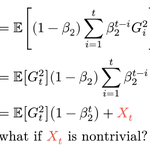
Adam depends on the gradient distribution during training, which, as far as I know, we don't understand well?
Here, adapted from the Adam paper, v_t is the var estimate, G_t is the gradient r.v. and X_t is an error r.v. for distribution shift.

Should we be trying to detect distribution shift and correct it (eg. by taking more samples at the same set of parameters)? Does this matter in some models and not others?
Jason Rader retweeted

My first PhD paper!🎉We learn *diffusion* models for code generation that learn to directly *edit* syntax trees of programs. The result is a system that can incrementally write code, see the execution output, and debug it. 🧵1/n
Screw it, here's a new JAX implementation in Optimsitix:
github.com/packquickly/sched…

Schedule-Free paper is up!
arxiv.org/abs/2405.15682
Joint work with collaborators @alicey_ang @HarshMeh1a @konstmish @akhaledv2 @AshokCutkosky
We have some strong small-scale experiments on Transformers, comparing to chinchilla-style cosine 10x reduction schedules.

Jason Rader retweeted

Jasmin Paris @JasminKParis finished loop five of the #BM100 in 59:58:21.
⭐ Lineax is now on arXiv! ⭐
If you’re doing linear solves or linear least-squares in JAX, give it a shot today!
Lineax
is fast ⚡️,
has new solvers (eg. QR, tridiagonal),
supports general linear Operators.
github: github.com/google/lineax
arXiv: arxiv.org/abs/2311.17283
1/n

The paper describes out how we achieved many of these things (such as differentiation through all our solvers,) and outlines some of the design choices we made when creating Lineax.
arxiv.org/abs/2311.17283
Finally, a million thanks to @PatrickKidger, who supervised this whole project.
If you’re following me, chances are good you already follow him. If not, go give him a follow! (right after installing Lineax of course 😉)
4/4
Tikhnov regularised trust-region methods (*cough* Levenberg-Marquardt) oddly use two different approximations to the objective function at each step.
One regularised, one not.
What if we just regularised both?
1/

This example was taken from an offhand comment in "Training Deep and Recurrent Networks with Hessian-Free Optimisation" by Martens and Sutskever.