

Here to help provide clarity on the transition to vehicle electrification. Looking at charging, batteries, costs, safety, and research.
Joined January 2025
- Tweets645
- Following192
- Followers38
- Likes4.6K





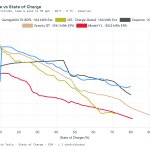

I've been working to develop and populate my new EV comparison site for true nerds:
evbench.pluginpath.com
It's still a rough work in progress as I feel out what questions it needs to answer, but I would love feedback on any and all aspects!

136
It would be better if they specifically marked these regions to be filled in with something indicating low/no confidence.
6

What's worse is the opposite.
teapawt.net/SamuelD2022/status/212…


They desperately need to feed the visualization regions that are obscured and can't be trusted.
Ideally, they'd also "paint" things that the driving model is using for decision making, but that's probably extremely hard, bordering on impossible with the construction of the model.
8
Decades of inertia using supplier provided control modules that were never developed with concepts of anything besides "running" or "off"
2
The visualization makes shit up though. Because it's generative AI.
And it doesn't show what the driving model is making decisions based on.
I don't understand the utility beyond parking selection.
IMO the old wireframe and 3D models were more useful from a perspective of understanding/trust, as they showed *objects* and their classification.
1
12
Clearly the driving model understands that it doesn't have clear sight, else it would have pulled out.
Let me see that.
4
Clearly the driving portion of the model understands that it doesn't have clear sight. Else it would have pulled out.
Let me see that.
It's probably making decisions along the lines of:
"I can see only 100ft of road.
I cannot accelerate quickly enough to reliably avoid collision if a vehicle is traveling in the occluded region.
Creep forward until I can see 200ft of road.
Then go if clear."
1
1
22
Regardless, it was rendering a clear road while there was a vehicle on it. The car didn't appear from nowhere, like the visualization shows. It appeared from a region of no information (as far as the car is concerned).
The driving model apparently understands this (hence the hesitation and creeping) - it would be far more interesting if the visualization showed *how* it knew if it had adequate vision to proceed.
I'm hoping they update this to include that type of information. Right now it's a bit of an AI slop hallucinated version of the world.
7
It seems like the UVE needs to provide the visualization layer a "unknown" or "low confidence" region where vision can't see. This would look somewhat like LIDAR shadows when re-visualized by the visualization layer.
At the end of the day, this is a visualization that is supposed to show the users what the system understands about the world. What it shows is that, like every AI model, it is "forced" to predict things that have no statistical power. Whether or not this feeds into the actual decision making of the driving portion of the model, or is just an artifact of the diffusion layer on top, I have no idea.
1
1
69
100%
It seems like the UVE needs to provide the visualization layer a "unknown" or "low confidence" region where vision can't see. This would look somewhat like LIDAR shadows when re-visualized by the visualization layer.
At the end of the day, this is a visualization that is supposed to show the users what the system understands about the world. What it shows is that, like every AI model, it is "forced" to predict things that have no statistical power. Whether or not this feeds into the actual decision making of the driving portion of the model, or is just an artifact of the diffusion layer on top, I have no idea.
1
1
18
I've said it elsewhere:
It's a really cool tech demo, and it's pretty impressive that they have the image generation running at this speed on this hardware.
I think they got this "cheaply" because someone pointed out they could slim down their training pipeline. It won because eye candy before they decided *why* it is useful or "better"
If we consider Nvdia DLSS... real-time image diffusion/frame generation is not new, and this looks terrible in comparison to what runs in real time on a GPU.
BUT, this is (supposedly) coming from the tokenization layer of the vision model, so there's a lot more going on than repainting an image with some motion vectors.
I want them to demonstrate the real utility of it beyond picking a parking spot.
Also: it's funny to see how it clearly doesn't know/care about text. Always gibberish unless it is car-sized.
5
Did you navigate to the charger (triggering preconditioning)? If the battery is hot (>115F) when you arrive, this is about what I'd expect.
Otherwise, probably a charger issue, though the truck would normally tell you.
It would be nice if the message explaining the reason for charging speeds being limited was *always* up
"Charging limited by charger"
"Charging limited due to charging equipment variability"
"Charging limited by high/low battery temperature"
"Charging limited by high SoC"
"Charging optimal"
7
Likely because this sytem doesn't use any 3D engine at all? Or if so, it's an extremely lightweight one that just renders the arrows over the top.
4
I'm guessing its different in CA.
In the Midwest, Teslas aren't ubiquitous/cost effective enough to regularly be the worst driven cars.
Worst to least worst:
Altima -> Prius -> Model Y -> Forester
1
13
Its *guessing* at the state using context.
Which is a prediction. Which can be useful.
I don't know if these hallucinations are in the UVE (world interpretation) or image generation / diffusion layers.
1
1
25
They need the range because they need to be able to handle extreme hot and cold temperatures, and 10 years of battery degradation, and still be able to complete their route without a detour to charge.
So that average 400kWh battery might only be 340kWh in 10 years and on a frigid winter day, they might average 0.5mi/kWh - 170mi of range.
Over an 8hr shift that's ~22mph.
16