

Psychedelics X Placebo research | Clinical Data science | ML | Psychiatric research bias | Meta-analysis | RWE @UCSF @TrPR_program @Imperial_PRG
San Francisco
Joined September 2021
- Tweets2.2K
- Following690
- Followers3.6K
- Likes5.8K




Pinned Tweet
🚨MAJOR NEW PAPER 🚨 just out in @JAMAPsych : Psychedelic Therapy vs Antidepressants for the Treatment of Depression Under Equal Unblinding Conditions (tinyurl.com/yu2rbtaf).
I am very proud of this one, was a lot of work for me - both co-first and last author! Eternal gratitude to co-first @QuantPsychiatry and twitterless Hannah Barnett!
The premise is that it is biased to compare open-label trials (=where patients know what treatment they are getting) to blind trials (=where patients do NOT know what they are getting). Open-label trials would gain an unfair advantage by higher placebo response. Even formally blinded psychedelic trials are practically open-label as its obvious to distinguish placebo from 25mg of #psilocybin. In contrast, traditional antidepressants (SSRIs/SNRIs) trials are are close to be truly blind (Lin 2022). Given the bias of open-label vs. blinded comparison, we compared the efficacy of psychedelic-therapy (which is practically always open-label) vs. open-label antidepressants for the treatment of major depression.
We tested 3 prior hypothesis:
- There will be a significant difference between psychedelic-therapy vs. open-label antidepressants, favoring psychedelic-therapy.
- There will be a significant difference between blinded and open-label antidepressants trials, favoring open-label.
- There will NOT be a significant difference between blinded and open-label psychedelic-therapy, as practically they are always open-label.
In contrast with our prior hypothesis, we did not find psychedelic-therapy to be more effective than open-label antidepressants (H1). Not only was the difference not clinically meaningful, but practically there was no difference at all. This finding means that antidepressants administered knowingly to patients, which is the case in real-life medical practice, is as effective as psychedelic-therapy. This result was robust across variations in study selection, including when we removed psychedelic-therapy trials on treatment-resistant depression.
We also assessed the impact of blinding in both psychedelic-therapy and antidepressants trials. We found that for antidepressants (H2), but not for psychedelic-therapy (H3), open label is associated with better outcomes than blinded treatment. However, even in the case of antidepressants, the difference was practically small (~1.3 HAMD units).
How come hypothesis 1 failed, i.e. that psychedelic-therapy is no ore effective than open-label antidepressants, given that antidepressants trials are famous for small drug-placebo difference (~2.4 HAMD units), while psychedelic-therapy trials reported large effects (~7.3)? The key factor is that in psychedelic trials the placebo response is about 50% relative to antidepressants, ~ 4 vs 8 HAMD units (Hsu 2024, Hieronymus 2025). This suppressed placebo response leads to an inflated between-arm difference, as the treatment arm is measured against a lower floor.
The suppressed placebo response in psychedelic-therapy trials is likely attributable to the ‘know-cebo’ effect, i.e. the disappointment when patients realize they are in the control group. In psychedelic-therapy trials, this placebo suppression accounts for 4.0 / 7.3 ~ 55% of the specific treatment effect. In other words, ~55% of psychedelic-therapy’s effect is not explained by patient improvement after the treatment, but rather by the lack of improvement in the placebo group.
In summary, we found that for the treatment of depression, psychedelic-therapy is no more effective than open-label SSRIs/SNRIs. Our results for psychedelics are twofold: psychedelic-therapy demonstrated a robust and large therapeutic effects (~12 HAMD units), which justifies optimism. On the other hand, psychedelic-therapy’s lack of superiority compared to open-label SSRIs/SNRIs highlights the influence of blinding integrity and argues against overly optimistic narrative's about psychedelic-therapy's potential.

New paper from our @TrPR_Program at @UCSF_BCHSI
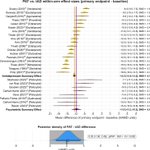
We compared the effects of psilocin vs. psilocybin. People often don't know, but psilocybin is actually not what makes you trip, it is psilocin, psilocybin's metabolite! Here we found that ... well, they are pretty much the same as one would expect :)
Great breakdown below by co-author👇

“A randomized crossover trial comparing the acute physiological and psychological effects of botanical formulations of oral psilocybin, oral psilocin, and sublingual psilocin“ is now published in Journal of Psychopharmacology.
journals.sagepub.com/doi/ful…

Balázs Szigeti retweeted

Coauthored with Marlene L. Tai, @psybalazs, Amanda E. Downey, Lisa Fredenburg, Kimberly Sakai, Cesar Molina, Gisele Fernandes-Osterhold, Ellen R. Bradley, Maddie Pantoni, Ryan Moss, Benjamin Lightburn, Franziska Plessow, Aoife O’Donovan, & Josh D. Woolley

What I found fascinating is that the Compass trials' lackluster patient improvement was explained by most due to lacking therapy, having only 'psychological support'. But Definium has no proper psychotherapy either!
So therapy vs. no/minimal therapy does not explain the small patient improvement in the phase 3 #psilocybin trials... maybe #LSD is just a better medicine?

The new @definiumtx LSD trial (tinyurl.com/4rym2x8m) is both the same old story and something new at the same time:
- In classic AD trials the placebo response on average is ~11 MADRS units, while here it is 5.2 at the week 6 primary endpoint. So again, the placebo response is cut in half, leading to an inflated between-arms effect.
- However, here the mean patient improvement (i.e. the within-arm effect of the treatment arm) is 13.3 MADRS units, which is not unheard of, but certainly the upper end of the distribution.
Other phase 3 psychedelic trials had both diminished placebo response AND marginal patient improvement. Here the placebo response is again marginal, but the patient improvement is really good for a phase 3 trial. The specific treatment effect (aka the between-arms difference) is still likely to be overestimated due to the diminished placebo response, but IMO that is less important than the actual patient improvement - medicine should be about helping patients!
Maybe #psychedelic therapy will deliver after all? :)

They defined remission as ≤12 MADRS, while the majority of the literature uses ≤10. This makes comparisons difficult. The 24% is OK, but unexciting in particular given this permissive definition.
I have noticed that in psychedelic studies remission rates are relatively low for what are the average improvements. Low remission rates and high averages imply that maybe in psychedelic therapy the response is more 'all or nothing' (i.e. patients who improve get much-much better, but some don't improve at all) than with traditional ADs where the distribution of improvement is more flat (i.e. everyone improves more or less the same).
I am not claiming this with certainty, but its a hunch I have. More on this later ... if I can find the time to look into it properly. If anyone interested collaborating on this, please DM me :)

The new @definiumtx LSD trial (tinyurl.com/4rym2x8m) is both the same old story and something new at the same time:
- In classic AD trials the placebo response on average is ~11 MADRS units, while here it is 5.2 at the week 6 primary endpoint. So again, the placebo response is cut in half, leading to an inflated between-arms effect.
- However, here the mean patient improvement (i.e. the within-arm effect of the treatment arm) is 13.3 MADRS units, which is not unheard of, but certainly the upper end of the distribution.
Other phase 3 psychedelic trials had both diminished placebo response AND marginal patient improvement. Here the placebo response is again marginal, but the patient improvement is really good for a phase 3 trial. The specific treatment effect (aka the between-arms difference) is still likely to be overestimated due to the diminished placebo response, but IMO that is less important than the actual patient improvement - medicine should be about helping patients!
Maybe #psychedelic therapy will deliver after all? :)
Found this beer in an SF supermarket, will try tonight. Will make sure i am in a good space in case it hits different than expected 🙃

I know its repetitive and boring, but one more time to drive home the point: another #psilocybin trial on major #depression, another missing #placebo response.
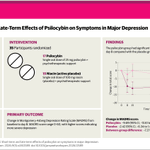
This time the placebo response is merely ~2.4 points, which is less than ~1/3 of antidepressant trials. This lack of a placebo response drives the large between-arm effect (~7.3), while the patient improvement after psilocybin is a respectable, but not great, ~10 MADRS units - its about ~12 after antidepressants.
If you are in San Francisco for the @APA conference, come and see my talk this topic on Sunday from 15:45 in room 206!

Link to papers:
- RCT: jamanetwork.com/journals/jam…
- AD effects: bmj.com/content/378/bmj-2021… (note the numbers are on HAMD, used this paper to convert to MADRS: pubmed.ncbi.nlm.nih.gov/2903…)
Sorry, wrong link to paper, use this: jamanetwork.com/journals/jam…

Balázs Szigeti retweeted

New preprint on BP effects of psilocybin, drawing from 536 high-dose sessions across 14 studies from @JHPsychedelics
BP changes generally modest, transient, and self-limiting, similar in magnitude to moderate exercise or sex.
We argue for allowing up to 160/100 baseline BP

Balázs Szigeti retweeted

Headed to @APApsychiatric? Come check out our @TheLancet Psychiatry symposium showcasing our recent Collection, "Reconceptualizing Placebo and Nocebo Effects" ft. @psybalazs @marta_pecina & Joe Taylor
Hope to have a lively debate on how to best navigate this controversial topic!

Balázs Szigeti retweeted

Happy to share our (@sdpnayak @rick_strassman & Cliff Quals) new publication titled "5-HT1A receptor blockade potentiates the subjective effects of DMT" which is a bayesian analysis of previously collected data by @rick_strassman journals.sagepub.com/doi/10.…

Balázs Szigeti retweeted

New furthure episode for those clinical trial nerds out there with @psybalazs
open.spotify.com/episode/5b7…
Plus, the placebo effect is legitimately cool and everyone should pay more attention to it 🙃


Balázs Szigeti retweeted

Imagine being in a magic mushroom study, and you get the placebo. Womp womp. This leads to what researchers are now calling the "knowcebo" effect. This wipes out the impact of placebo controls in these studies. @psybalazs : podcasts.apple.com/us/podcas…
Balázs Szigeti retweeted
The second article of this Lancet Psychiatry Collection offers new strategies for navigating the contentious terrain of placebo effects in clinical trials (blinding, expectancy, stats etc).
Special thanks to co-first authors Joe Taylor and @psybalazs
thelancet.com/journals/lanps…

Our mega-review of #placebo effects is out now in @TheLancet Psychiatry: tinyurl.com/mwuwvnxn. Everything you wanted to ask about placebo effects, but were afraid to ask😉
Gratitude to @MattBurkeMD @JD_Rosenblat and all other co-authors🫂❤️
Balázs Szigeti retweeted

“#Psychedelics may still be a valuable treatment option,” said Balázs Szigeti, PhD, a clinical data scientist at UCSF’s Translational Psychedelic Research Program and the co-first author of a new paper which found that drugs like #LSD and #psilocybin are no better than antidepressants when it comes to treating major #depression. “But if we want to understand their true benefits, we have to compare them fairly — and when we do that, the advantage over standard antidepressants is much smaller than many people, including myself, expected.”
Szigeti's study focuses on a long-standing challenge in psychedelic research: blinding. In standard drug trials, the study is blinded, meaning neither patients nor researchers know who receives the active treatment and who gets a placebo. Psychedelic studies are hard to blind because the drugs cause strong effects.
In psychedelic studies, placebo groups often improve less, partly because participants may realize they did not receive the drug. In antidepressant trials, placebo groups tend to improve more, possibly because more placebo recipients believe they received the active therapy. This difference can make psychedelics appear more effective.
psychiatry.ucsf.edu/news/are…

ALT Man wearing a white textured cardigan and light green shirt standing in a modern office with glass walls and city views.
Balázs Szigeti retweeted

I was interviewed about a study of GH001, vaporized 5-MeO-DMT, for treatment-resistant depression. I commented that, while promising and encouraging, the thing that popped out to me was the almost complete lack of placebo response in the placebo group. Even smaller than for other psychedelic trials. Even smaller than the Raison et al. trial I was a part of, which showed a trivial placebo response in the control group. This might be approvable eventually but trials should start start assess the integrity of the blind. Here, they touted the large effect size in the discussion, compared to other antidepressants, but we need to recognize that these large effects for depression in psychedelic trials are partially driven by very small placebo response in control conditions due to functional unblinding. I mentioned to the reporter that was in line with recent finding from @psybalazs