Faculty Lead, Syracuse University London | DPhil, Quantum Foundations (Oxon) | Rhodes Scholar | All opinions my own

Oxford and Lahore
Joined January 2016
My DPhil thesis is finally available online and can be accessed here: ora.ox.ac.uk/objects/uuid:00… If any of the key phrases -- string diagrams, process philosophy, quantum foundations, quantum computing, constructor theory, spin-wave computing, wave-based computation, quantum natural language processing -- excite you, there may be something for you in the thesis.
4
2
21
1,283
“The ultimate hidden truth of the world is that it is something we make, and could just as easily make differently” — David Graeber (1961-2020) Link: tinyurl.com/y9a24tv9
22
53
18
316
59,464
One of the silver linings of the AI-in-mathematics buzz is the earnest debate on questions like what mathematics is, what/whom it is for, why we do it, etc. These are extremely important questions for education, culture and life. The AI onslaught in mathematics this year has made these questions more urgent than ever. I am curating a list of my favourite pieces of writing here: hamzanama.github.io/AImath/ I will update it regularly. Happy to receive recommendations for the list. @3blue1brown @StefanoGogioso @littmath @mathyawp @emilyriehl @davidbessis
2
20
1
59
3,785
added to the list (hamzanama.github.io/AImath/): writings: @zetalyrae, @wtgowers in conversation with @rowlsmanthorpe @AGamburd18746, @Timeroot, Kevin Buzzard, @zetalyrae, Tristan Buckmaster, @mathandcobb, @Frances01896069 some tweets and some multimedia featuring @3blue1brown, @VillaniCedric, Terence Tao, Hugo Duminil-Copin, @stevenstrogatz, Tristan Buckmaster
3
81
I do not quote `Science is the man'* by Saeed Ajmal in jest. I mean it earnestly. In 2022, during a public talk on Karl Popper and the methodology of science at The Black Hole in Islamabad, I almost played that video to summarise my perspective (theblackhole.pk/event/karl-p…). Now, in 2026, developments in AI models are sending shockwaves through mathematics, science, and academia, accompanied by absurd, false, and, above all, dangerous claims like `mathematics is solved; we don't need mathematicians anymore'. Because of this, I think these kinds of discussions are more important than ever. We the practitioners of science need to rise to the occasion. Apart from all the possibilities of what could go wrong (and there is a lot that could), there is also a once-in-a-generation opportunity to make science, to borrow Ajmal's word, more `man' than it has ever been before. There is a lot to be done, and the situation is delicate. All hands on deck, please! *Science is for everyone. I quote Ajmal as is, but I am sure he meant `human' rather than `man'. @REALsaeedajmal
1
1
2
232
Hamza Waseem retweeted
I am a member of the Norwegian Nobel Committee. There are five of us. Five people, appointed by a parliament most of the planet could not find on a map, who decide, once a year, which human being the world has agreed to call good. I know. I know. I think about it on the tram. We meet in a building on Henrik Ibsens gate, a street named after a man who wrote almost exclusively about people discovering they are frauds, which nobody on the committee finds funny except me. There is a room with a long table and the portraits of the dead laureates looking down, Mandela, the Dalai Lama, a great many earnest men in spectacles, and one portrait we do not discuss, which is Kissinger, 1973, awarded while the bombs were still falling, after which two of our predecessors resigned and the satirist Tom Lehrer said political satire was now obsolete. We keep him on the wall. A reminder. Every family has the uncle. It is October in Oslo, which means the sun gives up around four in the afternoon like a civil servant, and it rains the particular Norwegian rain that isn’t quite falling, just hanging there, judging you. I arrive with wet shoes. I always arrive with wet shoes. There is coffee, because this is Norway and there is always coffee, we drink more of it per person than almost anyone alive, and someone’s wife has sent kanelboller, the cinnamon buns, and we sit, five Norwegians, damp, caffeinated, sugared, and we decide the moral standing of the entire species. Let me tell you how it actually works, because the world imagines a cathedral and it is, I promise you, a book club with a mandate. 287 nominations this year. 208 people, 79 organizations. Anyone can nominate, that’s the secret nobody understands: a professor, a parliamentarian, a former laureate, so the “nominee” list is meaningless, it’s a suggestion box, and every autumn some congressman nominates his own golden retriever and the press writes “SHORTLISTED.” Nobody is shortlisted. There is no short list the public ever sees. There is us, and the coffee, and the rain, and the portraits, and a Norwegian stubbornness that is older than the prize itself. We read reports. The institute’s advisers write them, thick dull documents, and we argue. Our chairman told the BBC once that in the final meeting “there is a high temperature.” High temperature, for a Norwegian, means someone slightly raised an eyebrow and then apologized for it. We don’t do high temperature. We do a long silence, and then Kristin says “well,” and everyone knows exactly what “well” meant, and it’s settled. That’s our shouting. “Well.” You’d have to be raised here to hear the violence in it. Now. This year. I will not say the name, because we never say the name, but you know the name. A certain head of state wanted this prize the way a child wants a thing in a shop window, which is to say loudly, and in public, and with the full belief that wanting it was itself the argument. He said he deserved it. He said he’d ended eight wars, a number that grew most times he said it, like a fish. He had other heads of state phone us. Israel’s prime minister posted it on the internet, “Give him the Nobel.” The leaders of Cambodia and Pakistan announced they’d nominated him, as though announcing it were part of it, as though we tally mentions. A man flew around the globe collecting endorsements for a Norwegian committee the way you’d collect signatures for a petition to the council about a noisy dog. And here, uff da, is the detail I treasure, the one that makes me smile into my coffee. The nomination deadline is the 31st of January. He took office on the 20th. So for all the phone calls, all the posts, all the gilded lobbying, the only nominations that could possibly count for this year’s prize were filed in the first eleven days of his term, before he had, by his own arithmetic, ended a single one of the eight wars. He campaigned all year for a prize whose window had shut while he was still hanging up his coat. We didn’t have to reject him. The calendar did. We just watched. Norwegians are very good at watching. We have long winters. People think we sit there weighing his deeds. We don’t. That’s the thing I can’t make the world understand. We’re not grading his homework. We don’t owe anyone the prize for a ceasefire, however real, however loud the announcement. “He made peace” is not a sentence that ends in a medal, the way he believes it does, the way he believes every good thing ends in his name on it. The will of a dead Swede says the prize goes to whoever did the most for fraternity between nations. A dead Swede, I should add, who made his entire fortune inventing dynamite and selling arms, and spent his last years horrified at his own obituary, which called him a merchant of death, and so bought his way to immortality as a man of peace. The whole prize is one guilty arms dealer’s attempt to launder his name. We are, all of us, administering a dead man’s public relations. I find this clarifying. It keeps me humble. It should keep everyone humble, and it keeps, by my count, no one humble at all. So who did we give it to? An eighty-five-year-old woman. A judge. Born in Durban, under apartheid, granddaughter of a Tamil man who came to South Africa as indentured labor, a bus driver’s daughter from the poor Indian quarter, who became the first non-white woman to run a law practice in her province, who defended Mandela’s people when defending them was dangerous, who sat on the Rwanda tribunal and the court at the Hague, and who, at eighty-five, is right now a judge weighing whether a genocide is a genocide. When we told the world, our chairman said the rule of law “underpins the system we have set up to ensure peace,” and that “peace requires justice.” She wasn’t even in Oslo. She was in Nuremberg. In courtroom 600. The actual room where they tried the Nazis. You cannot stage that. God staged that, and God, it turns out, is a better satirist than any of us. She did not phone us. She did not post. No prime minister demanded it for her on the internet. She had, as far as our deliberations are concerned, the one qualification the loud man could never manufacture, which is that she wanted the work and not the medal. The medal finds those people. It flees the ones who chase it. This is not a rule we wrote. It’s just the only pattern the hundred-odd years of our mistakes has ever shown. The reaction from across the ocean was immediate. His spokesman posted that we “place politics over peace.” Ja. Perhaps. We’re five damp pensioners in a rainy city; of course it’s political, it was always political, it was political when we gave it to a sitting American president nine months into his first term for the promise of things he had not yet done, and we have been quietly embarrassed about that one for fifteen years, so believe me, we had a particular reason this year to prefer a woman with fifty years of verdicts behind her over a man with eight wars in front of him and a deadline already behind him. Here is what he will never understand, the thing I’d tell him on the tram if he ever took one. We are the one prize he cannot buy, cannot post his way to, cannot have a friendly dictator phone in for him. Not because we’re incorruptible, nei, we’re as vain and wrong and human as the portraits on our wall. But because the entire point of the thing, the only power a small cold country’s book club has ever held, is that it goes to the person not performing the wanting. The moment you demand it, you’ve proven you don’t understand what it’s for, and proving that is itself the disqualification. He ran the most expensive campaign in the history of the prize and the campaign was the reason. He was never losing to Navi Pillay. He was losing to the concept. It’s dark now. Four o’clock dark. The buns are gone. Kristin said “well” an hour ago and we all went home. I’m on the tram with my wet shoes, and somewhere across the water a very powerful man is explaining to a camera that the prize is rigged, that we’re corrupt, that he’ll win it next year, and he genuinely might, we’re only five idiots and we’ve been wrong before, Kissinger is still on the wall. But not this year. This year an old woman in Nuremberg, in the room where the law once stared down the exact kind of man who thinks wanting a thing loudly enough should make it his, got a phone call she didn’t ask for. That’s the job. We don’t reward the man who ends the war and announces it. We reward the woman who spent fifty years deciding what a war was. He’ll never see the difference. That’s rather the whole point of him. Takk for i dag. I have to change trams.
2,192
10,583
2,216
44,773
5,216,047
Congratulations to @AnwarSabieh on being elected a Fellow of the American Physical Society (APS): "for creating an enduring, annual science festival in Pakistan that brings the delight of physics to a vast number of people and encourages many young students into careers in science, and for developing laboratory courses, software, and equipment for teaching physics with minimal resources." aps.org/funding-recognition/… As an undergraduate student in Lahore, my greatest privilege was working with Sabieh on developing the Lahore Science Mela (ksslsm.org/) and the single-photon quantum physics lab (physlab.org/qmlab/). I was lucky enough to join the Mela when it was just an idea in 2016, and it remains a science festival like no other. And his physics teaching labs, created with minimal resources, surpass many I have seen since, on so many levels. Photo: Sabieh, on a break during the shoot of the Lahore Science Mela anthem video, circa late 2016 or early 2017.
4
28
1,002
They have withdrawn 3 connected papers “solving” a case of the Hodge conjecture. One of them had a sign error that invalidated the argument, and with it the other two. The subscription models can easily find that error. So they rushed to put out a partial result on a Millennium problem without even checking it twice. That’s the level of care, the seriousness, with which mathematics was approached here. LLMs are an amazing tool for doing math. But using them like this is just irresponsible. Also, they have already benchmarked these models on proving big theorems. I’d love to hear what investors think about all of this.
107
337
81
2,485
205,138
Hamza Waseem retweeted
Criticism of OpenAI's Big Bag of Slop released two days ago goes beyond the presentational problems I pointed out yesterday (🔽). Some colleagues have started looking into various proofs, and there are… issues. 🧵⤵️ •1/11
As expected, people are completely missing the point of my criticism of OpenAI's extremely sloppy presentation. Does it matter mathematically? No, of course not. But does it reveal something about the limitations of using AI for certain tasks? I certainly think it does. ⤵️
10
43
6
214
25,141
Hamza Waseem retweeted
The vibe on here re: AIxMath is kind of apocalyptic, and what’s true is that highly capable AI models have significant impacts on (non-mathematical!) questions around hiring, journals, etc. But if you just log off in fact the day to day of doing math research is really not so different, except that you can talk to your computer about it and sometimes it’s helpful. What does this help look like? In practice high quality math research has never looked like “run a for loop through open conjectures and try to resolve them all,” and it still doesn’t. Most interesting work does not have the form of a problem set, but is rather an open-ended exploration of some phenomenon. There are lots of ways talking to one’s computer can help with this, but I don’t feel particularly worried that it will be automated. After all, it’s a process that is only done when I say it is! Anyway, it’s a great time to be a congenitally calm mathematician.
27
37
3
549
26,764
Hamza Waseem retweeted
Very nice piece written by my colleague Matilde Marcolli, arguing why the current panic in the math community is unwarranted. To appear in Newsletter of the London Mathematical Society.
17
46
5
227
29,418
Mathematical rigour is now free. Unburdened by formalisation, a new generation of mathematicians will be able to explore a vastly larger universe of models, focusing on understanding, inferring and communicating, as opposed to merely proving.
2
3
15
1,033
Hamza Waseem retweeted
Posting this again in light of today's "proof-bomb." its.caltech.edu/~matilde/AIm…
1
3
1
29
9,505
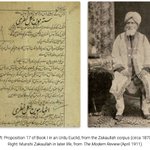
Euclid in Urdu In the nineteenth century, Euclid's Elements was translated into Urdu and taught in North Indian colleges, largely through the work of Munshi Zakaullah of Delhi. A good number of his books survive. They have been almost entirely ignored by historians of mathematics. I have been meaning to work on this for five years. So here goes nothing: a project to study the books and answer some questions. What happened to the Elements when it crossed into Urdu? Which English editions did Zakaullah work from? How did he render proof and diagram? What did he keep from the Arabic and Persian Euclids? And what did the whole undertaking mean for a reform movement that put Western mathematics at the centre of Indian and Muslim education? I am looking for collaborators: mathematicians, historians, translators, linguists, mathematics teachers and popularisers. If any of that is you, or you know who it is, I would like to hear from you. My email is [email protected]. More details here: hamzanama.github.io/euclid-i…
2
156
Hamza Waseem retweeted
[1/2] I have capacity to support up to two applicants for the 𝗖𝗼𝗺𝗺𝗼𝗻𝘄𝗲𝗮𝗹𝘁𝗵 𝗣𝗵𝗗 𝗦𝗰𝗵𝗼𝗹𝗮𝗿𝘀𝗵𝗶𝗽 who are interested in pursuing a DPhil in Materials Science at Oxford, starting in October 2027, in research areas aligned with my group.
2
23
113
7,981
Terry Tao on trying to solve the Riemann Hypothesis (2015)
43
82
13
1,369
108,645
Another "coincidence", like the one that happened to Tristan Buckmaster with the solution of the Navier-Stokes problem? Except now it's in biology: Did Anthropic’s A.I. Really Make a Scientific Discovery on Its Own? nytimes.com/2026/09/27/scien… via @NYTimes
12
57
3
279
36,962
Hamza Waseem retweeted
A few days ago I walked by a classroom in which the lecturer (not in math) was reading from clearly AI-generated slides. If I was a student I think I would find this pretty demoralizing.
38
39
10
1,070
73,847
Buckmaster not mincing words...
7
16
181
20,418
Hamza Waseem retweeted
Replying to @littmath @zetalyrae
Still crazy to me that this was 1994, had basically no effect on the community. Now that an external force is pushing the conversation, will it?
1
5
101