

Trying to see the big picture through statistics and common sense. PhD Econ. Interested in geopolitics, poverty, health, conciousness, humans, life, & souls
Hoboken, NJ
Joined May 2011
- Tweets5.4K
- Following1.8K
- Followers162
- Likes2.5K






Sospecho que algo similar puede pasar con otras convenciones sociales

A town where everyone uses “word A” for something, say what to call a street. Now add a few people who use “word B” and never change, whatever anyone says.
Does the town change its word?
With 5% stubborn people, word B ends at only 6%. With 16%, it reaches 100%. Repeated runs put the tipping point near 10%, and the closer the stubborn share is to it, the longer the crowd takes to decide.
This is the naming game, studied by physicists and linguists as a model of how conventions form.
The surprise is how small the minority can be: nobody has to be persuaded by argument. They only have to be certain, and let everyone else's habits do the rest.
27

Si todo los insumos de los agentes económicos son baratos (tecnología + infraestructura física e institucional) el nivel de vida es alto y los costos bajos -> bienestar y competitividad.
Eso hace China:
youtube.com/shorts/mSr2obLcm…

34
Esto puede ahorrar mucho espacio en almacenamiento

A new open-source project claims to shrink vector database storage by 97%
It reportedly compresses 60 million text chunks from 201 GB to just 6 GB, with no accuracy loss in its tests, running locally without a GPU or cloud infrastructure
Your laptop could handle workloads that once required expensive servers
Repo: github.com/StarTrail-org/LEA…

18
El paracetamol te vuelve temerario...

Cuando la gente toma paracetamol (acetaminophen), tiene menos miedo, lo que conduce a asumir más riesgos.
En un reciente estudio, quienes tomaron paracetamol, en comparación con el grupo placebo, se subieron antes a una tabla de realidad virtual a gran altura, caminaron por ella un 22% más deprisa y tuvieron un menor aumento de la frecuencia cardíaca.
En un estudio anterior similar, quienes tomaron paracetamol inflaron más veces un globo virtual en una tarea de riesgo (arriesgándose a que explotara) y, en un cuestionario, valoraron como menos peligrosas ciertas actividades arriesgadas, en comparación con el grupo placebo.


1
28
Esto tiene muchas implicancias para la docencia o el marketing o la política...

This paper answers:
why anything is beautiful
why jokes are funny
why we get curious
why you get bored
why babies explore
why music has hooks
For centuries, we thought these were deeply mystical human traits. Soul-level mysteries that machines could never touch.
But, the paper proves that the human brain operates as a relentless compression engine. It is constantly trying to predict the world and compress it into the smallest possible file size.
Here is how it explains your entire life:
If something is completely predictable, your brain has already compressed it. There is no new data to extract. The result? You feel bored.
If something is pure randomness, your brain cannot compress it at all. The result? You feel annoyed or tune it out.
But then there is the sweet spot.
When you encounter something that seems complex, but suddenly your brain finds the hidden pattern and connects the dots... your brain releases dopamine.
That sudden, glorious rush of successful data compression? That is what you experience as "curiosity."
When a comedian tells a story that makes no sense, and the punchline suddenly makes all the pieces fit together instantly? That rapid neural compression is what you experience as "humor."
When you look at a painting and notice an underlying symmetry that ties the chaos together? That is "beauty."
Art, science, music, and jokes are not magic.
They are just highly optimized data sets designed to trigger compression progress in your neural network.
Here is the most unsettling part.
This paper wasn't written by a philosopher. It was written by an AI pioneer to figure out how to program intrinsic motivation into artificial agents.
He wasn't trying to explain humans. He was writing the blueprint for machines.
We always assumed AI could never appreciate art, laugh at a joke, or feel the spark of curiosity.
But if our deepest subjective experiences are just a mathematical reward for maximizing compression progress...

17
Para administrar IAs se debe tener capacidad de evaluarlas. Cuando el percentil 12 trate administre las IAs serán monos con metralletas.

This paper answers why confident idiots run the world.
Cornell University published a psychological paper that explains every terrible boss, every loud influencer, and every broken corporate hierarchy.
It’s called “Unskilled and Unaware of It.”
they tested participants across logic, grammar, and humor to measure the gap between actual performance and self-perception.
And the results are wild.
participants scoring in the bottom 12th percentile consistently believed they were operating in the 62nd percentile.
they were not lying. they were literally incapable of recognizing their own incompetence.
the paper revealed a brutal paradox:
the exact skills required to master a domain are the exact same skills required to accurately evaluate your own competence in that domain.
if you lack the skill, you inherently lack the cognitive capacity to realize you are failing.
this creates a dangerous systemic loop.
the incompetent are blessed with absolute, blinding certainty. their brain protects them from their own ignorance, allowing them to speak first, demand authority, and never second-guess their decisions.
meanwhile, the actual experts suffer the exact inverse.
top performers in the study consistently underestimated their rank. because a task was easy for them, they falsely assumed it was easy for everyone else.
they hesitate. they obsess over nuance. they assume they have nothing unique to add.
we are biologically wired to confuse confidence with competence.
the loudest person in the room gets promoted, gets funded, and gets the microphone, not because they know what they are doing, but because they are physically incapable of seeing what they don't.
the only defense mechanism is building systems that stop rewarding absolute certainty and start demanding proof of work.

20
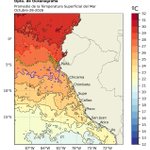
No parece que vaya a dejar de subir la temperatura

Breaking News!
Code UFB!!!
It takes 2 weeks to confirm ocean sea surface temperatures and the long wait is finally over. The first day in recorded history with Nino 3.4 SST at or above 30.0°C is now officially on the record.
October 7, 2026: 30.000°C.
climatereanalyzer.org/clim/s…

25

Esto si es puede cambiar la IA
Researchers killed vector databases with a quantum mechanics.
They introduced “ResonanceDB”
Every major AI right now uses something called "vector embeddings" to remember data. It turns words and concepts into static coordinates on a mathematical map.
But there is a massive, structural flaw.
Because of how the math works, AI is terribly bad at opposites.
If you map the word "happy" and the phrase "not happy," standard AI memory places them almost exactly next to each other.
It sees the surface similarity. It completely misses the negation.
That’s why AI hallucinates when context shifts. It doesn't understand polarity. It just sees words that look alike.
A new paper just dropped a completely new paradigm: Wave-Based Semantic Memory.
Instead of storing memories as static dots on a map, it stores them as waves. Literally. Complex-valued waveforms with amplitude and phase.
When you ask the AI a question, it doesn't just measure distance anymore. It looks for "constructive interference."
If two ideas are aligned, the waves amplify each other. They resonate.
If an idea is negated, the wave is shifted completely out of phase. They cancel each other out.
It mathematically solves the exact blind spot of modern AI.
The craziest part?
They built a system to test this, and it processes millions of patterns in milliseconds.
Without a GPU. Running entirely on standard CPUs.
And it is fully backward-compatible with every existing embedding model. You don't even have to retrain your AI. You just drop it in.
We’ve been trying to solve AI reasoning by building bigger maps.
The real answer might be to stop using maps altogether.
And start using frequencies.

15
Interesante alternativa

Oregon State researchers built a crystal that produces hydrogen from water using only sunlight.
No platinum. No iridium. No expensive metal catalyst.
The material, BVR-19, a metal-organic framework, absorbs light through its sulfur bonds.
When light hits it, a bond breaks. That energy drives the reaction that splits water.
It also forms spontaneously in a water-based solution at room temperature.
Most hydrogen production today relies on fossil fuels or rare metals.
This opens a route to solar hydrogen that doesn't depend on either.
Oregon State University. Journal of the American Chemical Society, Oct 10 2026.
20


"Estaba diseñado para los que pueden pagar un abogado y para el silencio de los demás."

Un despedido en Manchester abrió su laptop, le pidió a una inteligencia artificial que le redactara la demanda laboral y la mandó esa misma noche. Sin abogado, sin cobro, sin pedirle permiso a nadie. Multiplica esa escena por miles y tienes lo que @TheEconomist acaba de bautizar como inundación agéntica: los tribunales británicos cerraron el año con 64 mil casos sin resolver, 55% más que el año anterior. ¿La solución que propone el semanario? Que reclamar cueste dinero.
Y ahí, en un solo renglón, se les cayó la máscara. Admiten que los británicos dejan de cobrar 20 mil millones de libras anuales en prestaciones que por ley les corresponden, y advierten, muy serios, que si todos las cobraran las finanzas públicas no aguantarían. Léelo otra vez. El presupuesto estaba cuadrado con el cansancio de la gente. Un derecho que solo se sostiene porque casi nadie lo ejerce no es un derecho, es una rifa.
Ahora tráete eso a México y se te hiela la sangre. El año pasado ocurrieron 33.5 millones de delitos y apenas se denunció el 9.6%. La cifra negra llegó a 93.2%, y la razón que más repiten las víctimas para no ir al Ministerio Público es la más humilde y la más brutal: pérdida de tiempo. No es apatía, es cálculo. La gente ya sabe que denunciar es un día perdido, un pasillo, un “vuelva mañana”. Y sobre ese cálculo se sostiene todo el sistema: nuestras fiscalías no funcionan porque sean eficientes, funcionan porque nueve de cada diez víctimas se rinden antes de entrar. Ahora imagina que mañana esas víctimas abren el celular y le dictan la denuncia a una máquina que no se cansa, no se intimida y no tiene nada mejor que hacer. Que los 33 millones se vuelvan 33 millones de carpetas. El aparato reventaría en una semana, y no por culpa de la tecnología: reventaría porque nunca estuvo diseñado para atendernos a todos. Estaba diseñado para los que pueden pagar un abogado y para el silencio de los demás.

60
La Harina P.A.N. no es nixtamalizada y es enriquecida con B3 sintética y ácido fólico. Y lo más probable es que se use maiz transgénico expuesto a agroquímicos.
THE FOUR D MEDICAL MYSTERY SOLVED, A WORSE MYSTERY IS STILL HERE
In the early years of the twentieth century a silent killer moved through the American South. It began with a rash that looked like sunburn yet refused to fade, spreading in perfect symmetry across the skin.
Then came ceaseless diarrhea. Soon the mind itself unraveled into confusion, paranoia, and full dementia. For roughly one hundred thousand people the final stage was death. Physicians named the affliction pellagra and watched asylums fill with its victims.
The disease announced itself through four relentless signs: dermatitis, diarrhea, dementia, and death.
The four Ds.
At first it appeared to be another infectious plague of the era, spreading through the crowded and the poor. Yet the pattern refused to fit.
They made people wash their hands and wear masks for protection. It did not work.
Nurses and guards who lived among the stricken never fell ill. Entire families could share the same walls while only those who ate the cheapest food sickened. Something other than a germ was at work.
Dr. Joseph Goldberger, an epidemiologist of unusual patience, began to map the invisible boundaries of the outbreak.
He saw that pellagra struck hardest where people survived on the three Ms that defined Southern poverty after the Civil War: meat in the form of salt pork, molasses, and meal made from corn.
Landowners demanded cotton from their tenants and left no ground for gardens. The rural poor had almost nothing else to eat.
Corn itself was not the villain. For centuries Mesoamerican peoples had soaked the kernels in alkaline limewater, a process called nixtamalization that chemically freed the niacin locked inside the grain.
American millers never adopted the practice. As long as families ground whole corn and ate it soon after milling, enough of the nutrient survived. The balance held until 1900.
That year a machine called the Beall degerminator entered Southern mills. It stripped away the germ and the hull so the resulting meal would not turn rancid on long rail journeys.
The new product looked pure and modern. In truth it was almost empty of vitamins. The poor of the South now ate vast quantities of biologically vacant starch, and the epidemic surged.
Goldberger proved the cause with experiments that were both simple and bold.
He fed healthy prisoners the same restricted diet and watched pellagra appear.
He then cured other patients with yeast and fresh foods rich in the missing factor.
The disease was not contagious.
It was the absence of a single nutrient later named niacin, or vitamin B3.
Just vitamin B3.
By the 1940s the United States began fortifying commercial cornmeal and flour with synthetic niacin.
Pellagra vanished from the country almost as abruptly as it had arrived. What had looked like a mysterious infection was the collision of industrial milling, cash-crop poverty, and a forgotten chemical step that once made corn safe to live on.
The medical mystery ended not with the isolation of a microbe but with the quiet restoration of what the mills had taken away.
But the story is not over.
A new medical mystery caused by synthetic niacin is just getting started.
Decades after synthetic niacin erased the classic four Ds from American medicine, a quieter set of disturbances began to surface. The same laboratory compound that had once rescued the South now saturated every commercial loaf, cereal box, and packaged grain product.
1 of 2

57
Creatine uptake promotes dendritic cell activation and enhances antitumor immunity: iScience cell.com/iscience/fulltext/S…

1
45
"But the most underrated insight she shared was this: the single biggest factor in long-term retention is whether you can make the material personally meaningful to your own life. Your brain prioritizes storing things that feel relevant and discards things that feel abstract."

A Harvard neuroscience professor who teaches at Harvard Summer School said something that completely changed how I think about memory.
She wasn't talking to journalists. She was answering a student question about why smart people still forget everything they study.
Her name is Dr. Tracey Tokuhama-Espinosa, and she has spent decades researching how the brain actually encodes and retrieves information.
Here's what she said: "The ultimate litmus test of learning is using the information in a new context, not just remembering it for a test."
That one sentence exposes why most people's study habits are completely broken.
Here's the actual system she teaches Harvard students to retain what they learn.
The first thing she kills immediately is the myth that you have one learning style. The idea that you're a "visual learner" or an "auditory learner" is not supported by modern neuroscience. Your brain wants to learn through as many senses as possible at once, because each sense creates a separate neural pathway to the same knowledge. More pathways means faster and stronger recall.
The second technique is spaced repetition, but she explains the mechanism in a way most people never hear. Every time you retrieve a memory, you physically thicken the myelin sheath around that neural connection, which makes the electrical signal travel faster. You aren't just reviewing information you are literally rewiring your brain to access it more quickly.
The third technique floored me. She tells students to teach what they just learned to someone else within 24 hours, because teaching forces you to find the gaps in your own understanding before the exam does it for you.
The fourth is what she calls "feed-forward" instead of feedback. When you get something wrong, don't treat it as a failure. Ask only one question: what would I do differently next time? That reframe keeps the brain in a learning state instead of a defensive one.
But the most underrated insight she shared was this: the single biggest factor in long-term retention is whether you can make the material personally meaningful to your own life. Your brain prioritizes storing things that feel relevant and discards things that feel abstract.
The students who remember everything aren't studying harder. They're studying in a way that the brain was actually designed to absorb.

14

The next step would be to create complex structures like organelles or cells but for reasoning

Bytedance just dropped a paper that might change how AI thinks.
Literally.
They figured out why LLMs fail at long reasoning — and framed it as chemistry.
The discovery:
Chain-of-thought isn't just words. It's molecular structure.
Three bond types:
• Deep reasoning = covalent bonds (strong, unbreakable)
• Self-reflection = hydrogen bonds (flexible, context-aware)
• Exploration = van der Waals (weak, ever-present)
Why most AI "thinking" sucks:
Everyone's been imitating keywords — "wait," "let me check" — without building the actual bonds.
It's like copying the shape of a protein without the atomic forces holding it together.
Bytedance proved: structure emerges from training, not prompting.
The fix: Mole-Syn
Their method doesn't just generate text. It synthesizes stable thought molecules.
Results: better reasoning, more stable RL training.
Bytedance is treating AI reasoning like organic chemistry — and it works.
Paper: arxiv.org/abs/2601.06002


13