











ALT a Waptia swims by an underwater ROV, small particulates suspended in the water column are illuminated by the light Waptia is an extinct crustacean-like arthropod who's fossils are found in the Middle Cambrian aged Burgess Shale of British Columbia, Canada. It looked similar to tadpole shrimp with a bivalved carapace, however, it had a whale-like tail flaps most likely used for swimming in an up and down motion

ALT a mother Megapterygius swims with her calf by the surface of the water, the sunny water is filled with plankton looking for a feed Megapterygius is a mosasaur from the Late Cretaceous Toyajo Formation of Wakayama, Japan. it's most well known for supposedly having evidence for a dorsal fin, though, as there are no consistent osteological correlates for dorsal fins, many have questioned this interpretation, this doesnt negate the possibility of a dorsal fin however. it was a pelagically adapted animal with relatively long flippers compared to other mosasaurs, used for stabilisation while swimming. like other mosasaurs it had a long torso and is typically reconstructed with an incorrectly deep chest.

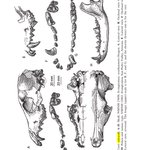
ALT an Eomola is kicked around by the waves at the surface of the water Eomola is a relative of molas and sits just outside of the family Molidae. it's known from jaw fossils from the Middle Eocene age Kuma Formation in Krasnodar Krai, Russia. we know nothing about how it looked properly, but its unfused premaxillae suggest it had a very different diet to its extant relatives. here i have obscured the posterior portion of its body in the waves and reconstructed the anterior portion of the body similar to the genus Ranzania, known to most as slender molas.

ALT at night in a dense forest, a Kauaʻi mole duck pokes through the underbrush searching for food with its great sense of smell and using its sensitive bill and whiskers to feel around. the sudden flash of light stuns it however the Kauaʻi mole duck (Talpanas lippa) is an extinct duck which was likely blind and flightless. its remains were found in Makauwahi Cave, Kauaʻi, Hawaiʻi and were dated to around 4050 BCE. it wouldve looked like a short and fat duck with small legs and small eyes, there is evidence for a broad beak, however it was potentially not as long as people usually reconstruct it with. i have given it speculative sensory whiskers similar to a kiwi's.


