

SJP at the Rhode Island School of Design. Stand with us in solidarity with the Palestinian struggle for liberation and freedom. #FreePalestine
Providence, RI
Joined August 2020
- Tweets326
- Following143
- Followers330
- Likes359




Pinned Tweet
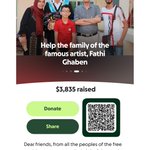
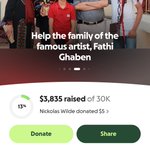
Since the most recent “ceasefire” donations to Palestinian families in Gaza have slowed, if not stopped entirely. But the Zionist entity has not lifted its siege, and the genocide continues. Please join us in supporting these families by d•nating generously and shar¡ng widely 🙏

RISD Students for Justice in Palestine retweeted

FATHI GHABEN AND IDENTITY
The Painting They Tried to Silence
There are paintings that record history.
And then there are paintings that seem to sense history approaching.
Fathi Ghaben’s Identity — الهوية (Al-Hawiyya) belongs to the latter.
Painted in 1980, years before the First Intifada, it compresses the Palestinian experience into a single extraordinary canvas: Jerusalem, mourning, traditional dress, a funeral procession, a raised fist, and above them all a horse whose body breaks into the colours of Palestine.
The Palestinian catalogue record identifies it as Hawiyya (Identity), oil on canvas, 100 × 70 cm, 1980.
But the story of Identity begins long before Ghaben touched this canvas.
It begins with a child who lost his home.
- THE BOY FROM HIRBIYA
Fathi Ghaben was born in 1947 in Hirbiya, a Palestinian village near al-Majdal.
He was an infant when the Nakba transformed the geography of his life. His family was displaced in 1948 and eventually settled in Jabalia refugee camp in Gaza.
Palestine, therefore, was never an abstract political subject for Ghaben.
Displacement formed part of his earliest existence.
He grew up poor, left formal education young and worked to help his family, including selling newspapers. Yet he continued to draw.
Largely self-taught, he eventually became one of Gaza's most distinctive painters and an influential teacher to younger Palestinian artists.
His people became his subjects: farmers, refugees, workers, women in traditional dress, demonstrations, weddings, Jerusalem, village life and the land.
And nowhere is the relationship between art, memory and resistance clearer than in Identity.
الهوية — IDENTITY
At the centre of the painting stands an enormous Palestinian man.
His proportions are deliberately distorted. His body rises monumentally through the composition, his face solemn beneath his white headdress.
Beside him is a Palestinian woman.
Together they carry a shrouded body.
Behind them stretches a procession of people.
And behind those people:
Jerusalem.
The Palestinian Art Court–Al Hoash archive, which preserves a postcard reproduction of the work, describes the scene as a funeral procession before Jerusalem's walls, led by a traditionally dressed Palestinian man and woman carrying the body of a martyr.
Suddenly the title becomes clear.
Identity.
Ghaben constructs Palestinian identity not from documents or borders imposed upon a people, but from accumulated memory:
the land, Jerusalem, traditional dress, community, loss — and the living carrying their dead forward.
The dead are present.
But they do not dominate the painting.
The living do.
Behind them comes the community.
Grief has become collective memory.
- JERUSALEM
Across the horizon stand Jerusalem's ancient walls, with the golden dome glowing beneath the extraordinary animal occupying the sky.
Ghaben doesn't paint the city with photographic precision.
He paints what it means.
For a refugee artist living in Gaza, Jerusalem becomes geography and memory simultaneously: a real place transformed into a symbol of belonging.
The people may have been displaced.
But the city remains.
- THE HORSE
And then Ghaben does something magnificent.
Above the entire scene rises a horse.
Its head is thrown backwards, its mouth open in an enormous neigh. Al Hoash's archival description specifically notes the horse whose cry seems to rise into the sky.
But look at its body.
It dissolves into bands of:
black.
white.
green.
red.
Palestine.
The flag has become a living creature.
That mattered enormously when Ghaben painted it. Palestinian artists worked in an environment where national symbols, including the Palestinian flag and its colours, could attract censorship, confiscation and punishment.
Ghaben found another way to paint Palestine.
The flag no longer needed a flagpole.
He gave it a body.
He gave it a voice.
And he sent it charging into the sky.
Below it rises the clenched fist of the Palestinian figure.
Follow the diagonal of that arm and it leads directly towards the horse.
Ghaben has constructed a political sentence without writing a word.
- WHEN A PAINTING BECAME POLITICAL EVIDENCE
Four years later, Identity acquired another life.
In 1984, Ibn Rushd Publications in Jerusalem reproduced the painting as a postcard, and thousands of copies circulated throughout Gaza, the West Bank and farther abroad.
This probably explains why Identity is sometimes incorrectly dated 1984.
The strongest Palestinian catalogue record gives:
Hawiyya — Oil on canvas — 100 × 70 cm — 1980.
1984 was the year the image was reproduced and widely circulated.
And that circulation had consequences.
Ghaben was arrested, fined and imprisoned for six months. Seven of his paintings were reportedly confiscated. Accounts surrounding his prosecution describe Israeli authorities treating his imagery and its reproduction as political incitement.
Think about what that means.
A self-taught refugee artist from Jabalia had created an image considered dangerous enough for paintings and reproductions to become evidence against him.
There was no written manifesto on Identity.
Just a Palestinian man.
A Palestinian woman.
A funeral.
Jerusalem.
A fist.
A horse.
And four colours.
- BEFORE THE INTIFADA
There is another reason Identity acquired such power.
Ghaben painted it seven years before the First Intifada erupted in December 1987.
Yet so much of the visual language later associated with the uprising already appears within it: crowds, mourning, raised arms, national colours and an overwhelming sense of accumulated resistance.
Some later Palestinian writing consequently described the painting almost as a premonition of the Intifada.
But perhaps there is an even simpler explanation.
Ghaben lived in Jabalia.
He knew the refugee camps, their poverty and their anger. He understood occupation not from newspapers or television but from everyday life.
He wasn't predicting history from outside it.
He was painting from inside the conditions that would eventually produce it.
- THE FIRST IDENTITY DISAPPEARS
Then comes one of the strangest chapters in the painting's history.
According to Ghaben's family, the original Identity disappeared around the period of his imprisonment.
His son Khaled later explained that Ghaben had entrusted the canvas to someone for safekeeping. After leaving prison, he tried to retrieve it but was unable to do so.
Its ultimate fate remains uncertain.
So Ghaben did something painfully appropriate for an artist whose own life had begun with dispossession.
He painted Identity again.
A second canvas.
A reconstruction of something lost.
- AND THEN CAME GAZA
Nearly forty years later, history reached the painting again.
During Israel's war on Gaza beginning in October 2023, Ghaben and his family were displaced from Jabalia.
His home was destroyed.
Inside it had been the accumulated labour of a lifetime — paintings, memories and an artistic archive that could never simply be replaced.
Among the works stored there were two paintings particularly important to his family:
The Battle of Ain Jalut.
And the second Identity.
According to Ghaben's son Khaled, when family members later searched the ruins, they discovered the frames.
The canvases were gone.
The family believed the paintings had been removed.
The first Identity had disappeared decades earlier.
Ghaben had recreated it.
Now the second had disappeared too.
Yet by then the image itself had escaped the fate of the physical canvas.
Thousands of reproductions had already travelled through Palestinian homes and beyond Palestine.
The painting had become part of an archive no single bomb, prison or confiscation could contain.
- “I WANT TO BREATHE”
The final chapter of Fathi Ghaben's life is considerably harder to read.
By early 2024, the 77-year-old artist was gravely ill with severe chest and lung problems.
Gaza's healthcare system had been devastated by the war. Hospitals were overwhelmed and medical supplies desperately scarce. Ghaben required treatment that could not adequately be provided to him inside Gaza.
His family sought permission for him to leave for treatment in Egypt.
The paperwork was completed.
He waited.
According to PEN America's Artists at Risk Connection, Ghaben waited approximately two weeks without receiving permission from Israeli authorities to leave Gaza for medical treatment.
Meanwhile his condition deteriorated.
This was happening within a much wider medical catastrophe. Gaza's patients were increasingly trapped between a collapsing healthcare system and severe restrictions on medical evacuation. Essential medicines and equipment were in desperately short supply due to the Israeli blockade.
For Ghaben, the shortage was brutally immediate.
Medicine and oxygen were scarce.
Six days before he died, his daughter Rubou' recorded an appeal asking for help to save her father.
During it, Ghaben interrupted.
He reduced everything — the politics, the crossings, the paperwork, the siege, the destroyed hospitals and the unanswered request for evacuation — to four words:
“I want to breathe.”
Permission to leave never came.
Fathi Ghaben died in Gaza on 25 February 2024, aged 77. R.I.P🕯️
The child driven from Hirbiya during the Nakba had lived almost his entire life as a refugee.
He died displaced once again.
- BUT IDENTITY REMAINS
Perhaps this is where Ghaben's painting becomes greater than the canvas on which it was painted.
What is the original Identity now?
The missing 100 × 70 centimetre canvas painted in 1980?
The second version?
One of the postcards that travelled across Palestine?
Or the image itself?
There is a bitter lesson in its history.
A physical artwork is vulnerable.
A painting can be confiscated.
A canvas can disappear.
A home and studio can be destroyed.
But once an image enters the collective memory of a people, destroying the object does not necessarily destroy the art.
Look again at Ghaben's painting.
The people carry their dead.
Jerusalem stands behind them.
A fist rises.
And above everything is that impossible horse, its body becoming the colours Ghaben was not supposed to paint:
black, white, green and red.
Its mouth remains open to the sky.
More than forty years after Fathi Ghaben painted Identity, after imprisonment, confiscation, displacement, disappearance and destruction, perhaps its greatest achievement is simply this:
we are still looking at it.
The original could disappear.
The second could disappear.
The artist himself could die.
But by then it was too late.
The painting had become memory.
And memory is considerably harder to confiscate.
— Zara Zhar


RISD Students for Justice in Palestine retweeted

This is Sliman Mansour’s most famous work, and I decided to share it in a separate post.
It is called Jamal al-Mahamel (جمل المحامل), meaning “Camel of Hardship.”
Mansour first painted it in 1973, then created two other versions in 1975 and 2005.
Our Palestinian people today are not only displaced, carrying their cities and villages on their backs. They are also carrying the rubble of their homes, beneath which the bodies of their loved ones remain trapped. They carry their uprooted trees, their burned tents, their destroyed homes, and the remains of refugee camps.


RISD Students for Justice in Palestine retweeted

Today's #LL4GazaHighlight thread - 08/21 🔦
🚨🚨🚨 Currently 262 (-2) appeals without support for over 2 months.
Please share widely, check the links in the replies 👇 (which will be added throughout the day), visit lifeline4gaza.com & support regularly ✨🫒

RISD Students for Justice in Palestine retweeted

🚨🚨We are screaming at the top of our lungs. We are sounding the alarm. We need to get back to work🚨🚨 chuffed.org/pay/campaign/019…
Just yesterday, three young men were killed in a fight over drinking water. People are so deprived of the most basic necessity of life, that they are now dying trying to access it.
The situation in Gaza is desperate, and it is quickly deteriorating.
People need water. They need food. They need the basic essentials required to stay alive. And The Sameer Project needs to be able to respond.
But we do not have consistent funding to operate at the capacity Gaza demands. And yet people are waiting, they need our assistance.
We need monthly donors.
Consistency allows us to plan. Gaza needs stability. And in a place where almost everything has been made uncertain, your monthly donation allows us to show up not just today, but tomorrow.
Please sign up to become a monthly donor today: $5, $10, $25, $50, $100 - whatever you can commit to consistently. And then send this to everyone you know. Ask your friends. Ask your family. Ask your coworkers. Ask your community to sign up with you.
We are sounding the alarm because this is critical now. Monthly giving means daily survival. Help us get back to work.
Scan and become a monthly donor to our Food and Water Campaign.
Other ways to donate include:
paypal.me/mahertali (Paypal option, please make sure to add a message saying "WATER")
account.venmo.com/u/Maher-Al… (Venmo option, please make sure to add a message saying "WATER")

RISD Students for Justice in Palestine retweeted
The Art of Defiance: Mohammed Al Rakoui (محمد الركوعي)
Ashkelon Prison Series No 16
Born in 1950 in Gaza, Palestinian artist and revolutionary Mohammed Al Rakoui is one of the most powerful voices to emerge from the dungeons of Zionist prisons. A member of the PFLP, he was arrested in 1975 and sentenced to multiple life sentences for resisting the occupation. He spent years in the notorious Askalan (Ashkelon) prison.
In the darkness of Zionist cells, where art was banned and creativity punished, Al Rakoui created powerful drawings and paintings that exposed the brutality of the occupation. Materials were smuggled in at great risk by fellow prisoners and visitors — tiny pieces of paper, pencils, and colors hidden in food or clothing. The finished works were smuggled out the same way, often folded into tiny pieces and passed through families or released prisoners, becoming testimonies of resilience that reached the outside world.
When caught, the occupiers responded with savage cruelty: solitary confinement, brutal beatings, and destruction of his work. Yet Al Rakoui refused to be silenced. His prison art stands as a damning indictment of the Zionist regime — a system so terrified of Palestinian creativity and memory that it tortures artists for daring to draw their own humanity.
From behind bars, Al Rakoui turned suffering into beauty and resistance. His work continues to remind the world: no prison can kill the Palestinian spirit.


Mohammed Al Rakoui Artworks (1984) 2/3/4
Over The Next Few Days, To Commemorate Palestinian Prison Day - 17th April, I'll Be Releasing Artwork From 'The Askalan Prison Series'
Mohammed Al Rakoui from Gaza, fedayeen, for the Popular Front for the Liberation of Palestine (PFLP), which had been established in 1967.
Rakoui was thrown in jail at the notorious Askalan prison in 1975. While inside, this self-taught artists made work by any means necessary.
Despite restrictions on art materials or it being forbidden to create anything about Palestine, he managed to have art materials smuggled in, leading to punishment when caught.
After creating work in secret, with any material he could use, he smuggled out his art. This followed the ongoing tradition of famous and beloved Palestinian poets who smuggled their written pieces out of jail – such as Mahmoud Darwish, Tawfiq Zayyad, and Samih Al Qasim.
The bright colors in his work contrasts the dull and limited colors inside the prison, and act as not only a contrast but an act of defiance to keep his imagination alive.

RISD Students for Justice in Palestine retweeted

First new workshop in a minute. Very proud to be hosting this very timely one on "terr*rist* designations, counterinsurgency, and the path of resistance with @alahrarprisoner - 8.22 7pm EST, donations to @EleElnaElak workshops4gaza.com/calendar/…

RISD Students for Justice in Palestine retweeted

Hind Rajab’s last words, particularly these, always make me tear up. I find them - and the fate that befell her and tens of thousands of Gazan children - extremely difficult to think about. But we must. Keep their memories alive always. Never stop making noise for Palestine.

RISD Students for Justice in Palestine retweeted

I applied to Anhalt University, was recently invited to an interview, and I’m incredibly grateful to say that I received an unconditional offer to study Biomedical Engineering in Germany. 🇵🇸🇩🇪
Now the goal is simple: get out of Gaza and reach whichever safe academic path becomes possible first.
If you can help me make that journey possible, please donate here:
chuffed.org/project/odaysedu…
Every contribution brings me one step closer. 🤍

RISD Students for Justice in Palestine retweeted
Will you help us reach 80%? 🥹
Repost this.
Donate if you can.
And if you can’t, just leave a ❤️ so more people see it.
Who’s with us? 🇵🇸🇫🇷

RISD Students for Justice in Palestine retweeted
🚨🚨🚨 MUTUAL AID GROUPS IN GAZA ARE SOUNDING THE ALARMS 🚨🚨🚨
Please help urgently: chuffed.org/project/help-us-…
Not only are mutual aid groups forced to provide less aid due to lack of funds but also international organizations with millions in funding have significantly decreased aid for Palestinians in Gaza. This is disastrous and is going to lead to further deaths and severe cases of malnourishment.
500,000 daily meals to Gazans were stopped and 256 areas stopped getting water. All this happened over the last few weeks, and no substitutes have been provided. Palestinians in Gaza are left struggling for survival.
The Sameer Project had to reduce food production by 50% and will stop doing some medical days. If donations don’t pick up, we will also have to reduce our water distributions, which we really don’t want to stop during the hot summer!
Help us provide life-saving sustenance by donating to the Food & Water Campaign now: chuffed.org/project/help-us-…
Other ways to donate include:
paypal.me/mahertali (Paypal option, please make sure to add a message saying "Food")
account.venmo.com/u/Maher-Al… (Venmo option, please make sure to add a message saying "Food")


RISD Students for Justice in Palestine retweeted

The Art Institute of Chicago has censured a faculty member for making an assignment that has “anything with Palestine in it,” in this case just quite literally the existence of a Palestinian.
US higher education is actively policing Palestinian existence as ‘antisemitism.’

RISD Students for Justice in Palestine retweeted

Sama is the daughter of my friend. Her family is trying desperately to secure her release from Israeli kidnappers.

RISD Students for Justice in Palestine retweeted

These beautiful faces, these beautiful hands are doing unpleasant work on a daily basis to keep Palestinians in Gaza safe from bacteria and disease. Please donate to support them.

Every day Palestinians in Gaza think about where to get food from, where to find water - but few think about the men who wake up every day to clean the streets, remove garbage, and prevent disease from spreading in a place where the occupation has systematically destroyed sanitation infrastructure and waste management systems. Donate now: chuffed.org/project/help-us-…
Their work is exhausting. The piles of waste grow larger, resources are scarce, and the conditions become more dangerous by the day. Yet they continue because they believe that cleanliness is part of faith, part of dignity, and part of caring for their community.
These sanitation workers are often unseen and rarely thanked. But Gaza would not function without them.
As part of our Eid meat distribution in Gaza City, Translating Falasteen x The Sameer Project made sure to visit and honor the sanitation crews who continue serving their people under impossible circumstances. Alongside the distribution of 200 kilograms of meat, we wanted to recognize the dedication, sacrifice, and humanity of those who work tirelessly to keep their neighborhoods clean and livable.
The full 200 kilograms of meat distributed cost $3,257 after fees and commissions. These workers preserve dignity, protecting public health, and continuing to serve our people despite all obstacles.
Give them a thanks in the comments and continent to donate to our Food and Water Campaign: chuffed.org/project/help-us-…
Other ways to donate include:
paypal.me/mahertali (Paypal option, please make sure to add a message saying "Food")
account.venmo.com/u/Maher-Al… (Venmo option, please make sure to add a message saying "Food")
RISD Students for Justice in Palestine retweeted
Plz donate to Shadia!

🚨 Urgent 🚨
I am currently in the hospital and need surgery as soon as possible. The cost of the operation is $600, and I am unable to afford it. My health is at risk, and I urgently need your support.
chuffed.org/project/157051-u…
@ireallyhateyou
@deedeehimawari
@AbubakerAbedW
RISD Students for Justice in Palestine retweeted

Dad made a children’s chair for his grandson (my nephew) using simple materials we had available here in Gaza.
Necessity is the mother of invention. 👍


RISD Students for Justice in Palestine retweeted
Also check out resolutebayan on IG 🔥


