






Pinned Tweet
🎉 Super excited to share our labor of love! 75 pages of it 😍
95% of GenAI pilots never reach production. AI models are not the problem. The gap between pilot and production is the process. The processes we had to build traditional software or buy SaaS are now obsolete.
🏁 Announcing our new e-book 🏎️
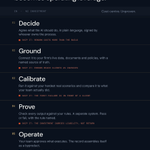
"The AI Discipline Playbook: Five Steps to Governed AI"
We need a new systems thinking on how we build and operate AI keeping in mind costs, outcomes & risks. We wrote this book to set out the discipline that lays the foundation for new systems and process for Agentic AI. It reimagines a new way of buying and building with AI technology.
It is not a product pitch. The discipline works regardless of who builds it.
Five steps each one removing a specific cost or risk from your business.
Five steps combined delivers a method to drive Agentic AI outcomes.
When writing this book, our team has ensured we contrast our decades of experience with our accelerated learning in the AI era.
But I will be direct. We built PitCrew because we believed this discipline
needed a machine behind it, not just a book about it. If you want to see
what it looks like running on real accounts, the last chapter tells you how.
Free access: gopitcrew.com/five-steps
@GoPitCrew @TweetSamG @rameshmay @arnavgoel_


Building software apps was always the easy part.
Running, maintaining, patching. Scaling are the hard parts.
It's "eating glass and staring into abyss" of the software.

4 months ago I cloned Airtable for a client in 5 days because they refused to pay Airtable $500/mo
months later, I’m still maintaining it
every two weeks it’s another edge case, a UI tweak, or a "quick 10-minute request." They’ve easily spent 10x more in headaches than the $2,000 they would’ve paid Airtable
just proving that SaaS isn't dead. Cloning isn't enough, if you want it to be same quality as original it becomes a full time job
and at this point isn't it easier to just pay?
runtime maintenance is the value add.

I'm going back to it. Unable to handle customer and prospect facing work items coherently without a "ticket" system.

Would recommend
"The pursuit of glory" by Tim Blanning.

Reading a history of the bond market recently, and the author noted that Britain defeated Napoleon mostly because their consol bond market left the British military much better funded than France’s weak post-revolutionary capital markets.
One Alexander Hamilton studied the British bond market, and then consolidated American revolutionary debt into one tradable market, which gave birth to what became the New York stock exchange, Liberty bonds, and the world’s largest capital markets.
An army might march on its stomach, but it’s borrowed money that pays for the food and ammunition, and the one who can borrow the most generally wins.
More opportunities to unbundle the frontier models

Introducing Flint, @Recursive_SI’s first model: a fast local coding model built with our automated research system, the Eureka Machine.
• Best-in-class fast local coding
• Up to 2x faster than comparable models: 125+ tokens/sec on a MacBook Pro, 150+ on RTX Spark
• Built from scratch in under 4 months
Private, unmetered intelligence on your own machine. Open weights available now on @huggingface, run it locally on your favorite framework or try it for free on @opencode or @pidotdev.

email and slack killed that old ethos. We were just late to adopt the new one .


LLMs are getting unbundled.
First decision models and now single task model.

You already gave the LLM the answer. So why is it writing it out from scratch?
Introducing a new AI model architecture: Constrained Decoding Models (CDMs)
LLMs were built to write. Most production workloads just need an answer: fast, consistent, and affordable.
CDMs are purpose-built for 1 task each. They read your input once and skip the token-by-token generative loop that makes LLMs slow and expensive.
Not just a decision model, but a family of 3 CDMs live today:
• Classify: define your labels and get back a calibrated probability + reason for each. Used for routing, tagging, and intent detection.
• Extract: describe the entities in natural language and get back well-formed JSON with confidence scores + citations. Used for web scraping, document processing, and PII redaction.
• Summarize: pass in long text, images, or PDFs and get back a consistent summary under 1,000 tokens. Used for context compaction, metadata generation, and transcript digests.
Built for production:
• 1M tokens of multimodal (text + image) input, 31x larger than Jev
• 77.2% on DecisionBench vs Jev's 72%
• 200x faster, 467x cheaper than frontier LLM APIs
• $0.05/M input tokens. Output is free (yes, even for summarize)
Live on your favorite platforms today:
@OpenRouter @vercel_dev @LiteLLM @LangChain @TrustedRouter @itsArthurAI @useRouterPlus
Get 50M input tokens for free (for the first 50 hours) at link below 👀

Interesting to see individuals trusting AI quicker than teams in enterprises.
Wondering what else should AI companies do to be more trsutworthy for teams.

there's a common belief in healthcare among providers that most people would rather trust a doctor than AI - but I think we're not far from a tipping point here
Was interesting to see this Oliver Wyman survey of consumers and see how close we are to people trusting AI more than the clinician
On top of that the number of times where the AI and clinician disagree is increasing, with people MORE often doing something other than what the clinician directly said
This is heading for a collision course at some point

If you liked the idea of Bounded rationality by Herb Simon.
Worth checking Technlogy of foolishness by J. March.
There is something about pre-internet writing which is very fascinating and original.
Assorted things I've been mulling over regarding agents in the economy:
• Companies are in some sense the original superintelligence. It's often the case that they can use their amortized cognitive surplus to advance their interests against those of certain consumers: relative to the optimization capacity of companies, consumers can be inattentive, underinformed, irrational, etc. (Think, say, of some of the classic insurance upsells at the end of a booking process, which is typically priced substantially above what a regular policy would cost.) Herbert Simon introduced the idea of bounded rationality, and firms often end up benefiting from it. Thanks to personal agents, we will probably get somewhat more rational in how we engage with companies.
• How exactly will outcomes change? Well, certain kinds of price discrimination will work less well (how do coupons work if every agent hunts fastidiously for them?), and certain kinds of customer cross-subsidy will change (today, people who forget to cancel subscriptions subsidize those who don't). Taken across the economy as a whole, I'm not sure what the incidence of all of this will be.
• In corporate strategy, people have long debated the relative importance of distribution and product quality. Perhaps you've made something better, but does anyone know about it? Won't people just continue to buy the ACME Corp Mousetraps? Personal agents will, I think, act as a kind of structural subsidy for product quality. How would markets look different if individuals always spent at least 10 hours researching their purchases? On the margin, focusing on making a product better is, I think, going to become a more effective strategy for companies. This is good!
• It true, a corollary is that information about product quality will become more important and impactful. Today, most people have very limited ability to aggregate and integrate such data, but agents will have insatiable thirst for such signals. (It's often said that data is becoming more valuable because it helps in the training of models. That's obviously true, but I think there's a secondary way in which it's more valuable simply as a complement to cheaper intelligence.)
• A big question is whether agents will increase superstar effects (rational agents all settle on the same product) or increase dispersion (because everyone has slightly different tastes and preferences, which agents are good at eliciting, finally overcoming the artificial clustering we've been subjected to).
• Many internet companies have monetized demand routing, which is in turn often predicated on short attention spans. "I'll click on the first thing I see." This has led to some amount of inefficiency, as companies try to propitiate capricious ranking algorithms and incur various placement fees. It's not all deadweight loss (willingness to pay is itself a kind of signal, which is valuable to buyers), but it's not great. How will the nature and value of this routing change in a world of personal agents? I don't know the answer, but I think that the effects might be pretty big.
• Much of what I'm writing hinges on the assumption that personal agents will be on the consumer's side. I suspect that that will be the winning strategy, but whether it's true, and what it means to be true, involves a lot of other questions.
Taken as a whole, the market is a massively parallelized, decentralized, and highly imperfect value attribution machine, and, taking stock of all of the effects, it seems to me that the quality point may well be the biggest: that agents will change the nature of the backpropagation such that the rewards for better products increase. Maybe this is too optimistic, but I suspect (and hope) that companies that make things that they're proud of will feel that the universe is a little more partisan in their favor.
"In other words, we need to separate the supply of intelligence from the authority over it.
Setting aside the hard problem of alignment, we need to start with an engineering approach to containment and governance. We need to surround non-deterministic models with strong, deterministic system design, human controls, and reliable operating procedures, and establish industry standards where existing ones are insufficient."
Like Biotech we need to build software as implications first not impact first.

Lessons from building 100s of agents:
Time spent capturing intent and building evals goes a long way in building production ready agents.

Was exploring this Unity plugin. Cool stuff
The plugin ecosystem inside Chatgpt or Claude is incredible. Headless stack can now get back to owning end user experience (within the plugin scope).

ALT flow of user to headless stack through chat plugin

This is could be come the default setup for many. We tested this with Plugins inside Claude. The plugins as access to all our tools, skills, pre-built agents and more. Frontier is orchestrating the entire setup.
Exploring GPT too. Does Antigravity have plugin?

One of my favorite agent patterns is pairing a frontier cloud planner with a fast, private local workforce.
With local model support in the Antigravity SDK (via LiteRT), Gemini 3.8 Flash can act as the cloud architect (95 tokens, zero source code uploaded) while a local swarm of Gemma 4 26B A4B agents runs 97% of the tokens offline to audit, patch, and test code on-device.
Try the hybrid gauntlet: goo.gle/47cKYyV
SDK: antigravity.google/product/a…

Super list 👌

I asked people which tier they'd put each lab in:
Frontier:
- Anthropic: consensus
- OpenAI: consensus
n-1 (1 generation behind):
- Google DeepMind: consensus
- xAI: consensus
- Meta (Muse Spark): over half say n-1
- Moonshot (Kimi): over half say n-1, some n-2
- Zhipu (GLM): over half say n-1, some n-2
- DeepSeek: over half say n-1, some n-2
- Thinking Machines (Inkling): leans n-1, some put n-2
n-2 (2 generations behind):
- Alibaba (Qwen): leans n-2, some put n-1
- ByteDance (Seed): over half say n-2
- Xiaomi (MiMo): leans n-2, some put n-1
- MiniMax: over half say n-2, some n-1
- Tencent (Hy): over half say n-2
- NVIDIA (Nemotron): leans n-2, some put n-3+
n-3+ (3+ generations behind):
- Microsoft (MAI): over half say n-3+, some n-2
- Cohere: over half say n-3+, some n-2
- Mistral: over half say n-3+
- Amazon (Nova): consensus
- Apple: consensus
Consensus = 75%+, over half = 51%-74%, leans = the most common pick but under half, some = 20%+.
I asked 70 people. Engineers/researchers/founders at AI data cos, people at labs (I didn't count votes for their own lab), and founders/engineers at other startups. I didn't vote.

Interesting data point on the private AI or BYOC


E-commerce website built on top of platforms like Shopify or even Wordpress could get support architecturally to handle agentic traffic. Gateways like Cloudflare are helping too.
Hope the gov websites adopt a platform sooner else most services will slow down.

Bloomberg: AI agents now account for about half of all visits to FRED (ederal Reserve Economic Data), the St. Louis Fed's economic data portal, with the other half coming from humans.
The shift breaks FRED's original design assumption, because the portal was built for humans to view and understand, while an AI bot reads and interprets data very differently.
A person sees a chart, its source note and its footnotes together, whereas an agent pulls the numbers and rebuilds them into its own summary, where provenance can drop out.
