


"you're basically creating your own company." Amrita, Field Engineer at SpaceX AI.
that landed differently. the chat tab was the old shape. this is more like an org chart you draw once and then let it run.
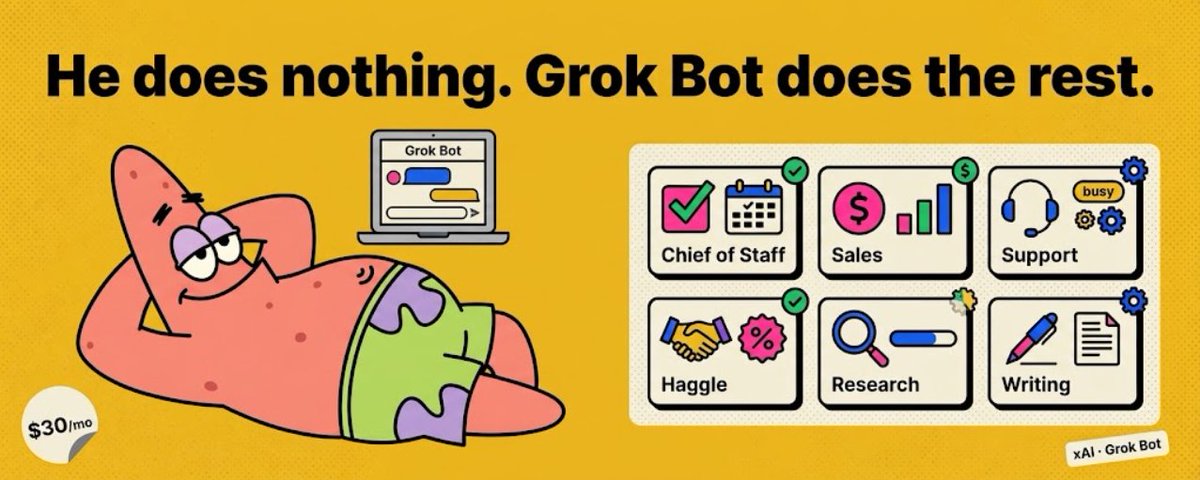
the setup she described: 3 bots, 1 operator, $30 a month.
Signal Prospector hunts leads.
Support bot clears the ticket queue.
Haggle bot owns the price conversation.
Chief of Staff sits out front and routes work between all three.
Amrita's version is email Ethan, Data Dan, Slide Sonia. different names, same move.
the old version of this needed a seed round and five hires. this one is a SuperGrok sub.
architecture, the 3 starter bots, the Chief of Staff pattern.
article below
xitter.cf/roxitsu/status/2112809…

Kevin Luke almost hired a $200K director of sales.
he spun up Grok Bot instead.
first show paid for it.
one laptop. one operator. a few bots.
Clarity pulls the leads: 145 Southern California hotels, event planners, decision-makers.
Synergy drafts the opening emails. they land in his draft box every two hours. Kevin reviews each one in the morning, hits send.
the $200K hire never flew in. the pipeline fills itself.
full architecture, bot specs, and the $30 Chief of Staff pattern in the article below
xitter.cf/roxitsu/status/2112809…
"Our pipeline was normally $200–300K. Now it's $1.14 million. Grok Bot is doing sales up to $600K of it."
Kevin Luke, small AV shop owner in LA.
49 live leads.
no new sales hire.
one subscription running his pipeline.
he didn't do it with eight bots.
the $30 SuperGrok plan dies on day five when you try to run eight in parallel on one weekly allowance.
the move: three bots. Sales, Support, Haggle.
Add the rest when your allowance isn't finishing on Thursday.
every bot name, every prompt, the full build order in the article below
xitter.cf/roxitsu/status/2112809…
ai is a to-done list. not a to-do list.
brendan at spacex said it. it broke my framework.
you hand off work. close the laptop. it ships without you.
not a prompt. a finished task.
that only works if ai isn't a tool. it's a teammate.
one bot per role you'd hire.
signal prospector. support bot. haggle bot.
chief of staff routes between them.
whole stack: $30/month.
not $200k. not a seed round. thirty dollars.
full architecture, 3 starter bots, chief of staff pattern in the article below.
xitter.cf/roxitsu/status/2112809…
"AI is not a model. AI is a whole stack of technologies." - Jensen Huang, in Taiwan last week with Lex Fridman.
the sentence is the bottom-up version of the thesis in my land grab article.
Jensen frames the stack from the compute end: a few trillion dollars of compute, hundreds of billions per company, Taiwan as the physical bottleneck.
the Grok Bot Template Marketplace is the top of that same stack. role-based bots that package a workflow and sell it ready-to-use.
compute at the bottom. templates at the top. everything else is the layers nobody fully owns yet.
if Jensen is right that AI is a whole stack and leadership is happening in different places up and down it, the template layer is the one that's still unclaimed by a top 100.
that's the land grab window. 69 bots deep today.
the full math and the 5 templates to ship this week:
👇
xitter.cf/roxitsu/status/2109599…

SpaceX AI, Matt: "each morning when i wake up, there's a piece of paper on my printer. my daily schedule. generated entirely by Grokbot." in a 1-minute walkthrough.
6:45am automation. printer on local wifi. Mac mini running the commands.
no app. no notification. no screen.
Matt's close: take digital things and bring them into the physical world.
step 1 - pick a routine, not a tool.
step 2 - one bot per routine. context, connectors, outcomes.
step 3 - ship the output where you already go. printer, iMessage, calendar.
step 4 - ship it to the marketplace before the top 100 own the category.
the full land grab math and the 5 templates:
👇
xitter.cf/roxitsu/status/2109599…
"I use grok bot to run my one-person business.
I talk to my bots all day instead of humans.
It's kind of sad." - Peter Yang, ex-PM turned solo creator
the marketplace is where this stops being sad and starts being a stack.
5 bot colleagues, no onboarding, no equity.
land grab math, below.
xitter.cf/roxitsu/status/2109599…
"i have started referring to it as crackbot. get the executives grok bot. we don't even need to do a session. you just need to start using it." - spacex ai lead
every top-10 template on the marketplace is a smaller crackbot built for one role.
the math, below.
xitter.cf/roxitsu/status/2109599…
"I was a meat proxy between my agent and chrome dev tools." - Lauren Tan, SpaceXAI
the Grok Bot Marketplace is that move at scale. every template that lands top-ten is a job you stop being the meat proxy for.
my 5 picks and the 1996 math, below.
xitter.cf/roxitsu/status/2109599…
the Grok Bot Template Marketplace is doing the 1996 domain name moment right now. almost nobody is positioning for it yet.
Jev's actual math is the biggest hidden flex in their launch.
one safety classifier call on Sonnet 4.5: $0.0078
the same call on Jev: $0.0000168
~460× cheaper on the single highest-frequency call in any coding agent.
no new training. no distillation. no fine-tune. just the right model for the right question.
trying to get the full 10-step swap guide out this weekend. working TypeScript diffs, swap by swap:
step 1. audit your harness with the three-rule test
step 2. safety classifier (easiest, highest volume)
step 3. done-check (the agent loop condition)
step 4. router (highest fan-out)
step 5. confidence thresholds, when Jev says 0.73
step 6. fallback strategies when Jev is uncertain
step 7. packaging as a Claude Code skill
bookmark if you've got GPT or Sonnet sitting in a classifier role.
👇
the frame for this is yesterday's post: xitter.cf/roxitsu/status/2108279…
jev isn't going viral because it's a new model. it's going viral because it's a permission slip.
for two years developers have been quietly swallowing the same ugly truth. the GPT call inside your agent that's supposed to decide is wearing the wrong jacket. it writes a sentence that happens to end in yes or no. that's not a decision. that's a performance.
everyone saw it. nobody had a cleaner thing to swap in.
then an ex-OpenAI founder shipped a model that only decides and gave the pattern a name. Jev Engineering. three days later codila's 10-step roadmap was on everyone's timeline.
the model matters less than you think. look at what actually went viral:
• named concept inside 72 hours of launch
• $40M behind an "LLM is doing too much" bet
• $0.042 per million tokens, cheap enough to kill the "cost of adding a step" excuse
• a 3-line formula anyone can quote. LLM writes, Jev decides, code acts
jev didn't invent splitting the pipeline. people were doing it with routers, finetuned classifiers, DSLs, cursed JSON schemas. jev just made it the default-looking option.
that's the whole hype. the market was pre-sold. the model handed them vocabulary.
the next thing to go viral like this will also be a confession, not a model
Roxitsu retweeted

asking what should be tokenized might be like asking what videos should exist on YouTube.
today everyone is focused on the obvious categories:
• stocks
• treasuries
• private credit
• real estate
but @haydenzadams gave a pretty good example of why the final answer may look completely different.
when @Uniswap v4 hooks were being designed, the team had around 5 use cases in mind.
they ended up building none of them.
instead, >20 different ones emerged.
now he points to roughly $1B in daily volume on @RobinhoodCrypto as another sign of how fast these markets can evolve.
YouTube didn’t know every category of video that would eventually exist on it.
tokenized markets probably won’t either.
the biggest thing we tokenize may be something nobody is seriously talking about yet.


Roxitsu retweeted

Marketing teams are not being replaced by one AI tool. They are being replaced by workflows.
This is the real shift: Claude connected with Higgsfield MCP can analyze a product, study hundreds of viral commercials, break down high-converting pages, write the strategy, and start generating ad creatives from the same pipeline.
That means the bottleneck is no longer “can we create content?” The bottleneck is knowing what to ask, what data to feed in, and which angles are worth testing.
A normal team might spend days researching competitors, writing hooks, planning ads, briefing creators, and waiting for revisions. An AI workflow can compress that into one loop: research the market, find proven patterns, write the campaign, generate the assets, and repeat until something works.
The future of marketing is not one perfect ad. It is an infinite testing machine.
Roxitsu retweeted

THIS GUY TURNED ANY YOUTUBE VIDEO INTO A CLAUDE-READY OBSIDIAN NOTE WITH ONE FREE PLUGIN
most people use YouTube like a temporary brain.
watch founder interview
watch strategy video
watch tool walkthrough
save nothing useful
forget the exact video 7 days later
Mike from AIWithKelso shows a cleaner workflow:
YTranscript → Obsidian → Claude
YTranscript pulls the full transcript of a YouTube video into your Obsidian vault as clean markdown.
one command.
then you stop asking AI vague stuff like:
“summarize this video”
and start asking useful stuff:
1. extract the 3 biggest ideas
2. turn them into implementation steps
3. connect them to what I’m building this week
that last part is the whole product.
A YouTube transcript sitting in a note is storage.
A YouTube transcript inside your vault, next to your projects, decisions, and notes, becomes working memory.
this is why I like the Obsidian + Claude version more than “chat with this video.”
you are not making one disposable chat.
you are building a library Claude can keep returning to.
founder interviews become reference material.
strategy videos become checklists.
tool walkthroughs become implementation notes.
small caveat:
YouTube transcripts are messy and AI summaries flatten nuance fast.
so don’t ask for a clean summary.
ask for decisions, examples, steps, objections, and where the idea fits into your actual work.
that’s the difference between consuming content and turning it into an AI Second Brain.


Simon Willison open sourced the actual guts of a coding agent
not a wrapper. not a demo. the real tool loop: file read, file edit, run commands, search content, permission filtering, yolo mode if you want it
built with claude code, used it to build a swiftui cli app on the first run
the size is the actual news here. small enough to read start to finish in one sitting, which is rare for anything agent-shaped right now
closest thing to an x-ray of what happens between your prompt and the diff showing up
install is one line: uvx --prerelease=allow --with llm-coding-agent llm code
worth an afternoon if you build with ai instead of just using it