

Building https://teapawt.net/t.co/YhpOnoaGqi Founder, Investor, Board Member #UniverseGirl 💜 #womensinternet Built @SHEROES @MahilaMoney @AppreciateVC
India
Joined November 2008
- Tweets54.6K
- Following18.9K
- Followers334K
- Likes76.3K
Sairee Chahal retweeted

Lawyers @SFLCin are used to courts to defend everyone's digital rights. On Friday, they will defend their own rights to document every single piece of content takedown, provide legal assistance and relief to anyone impacted so the server can stay alive. Public square is on the server and we all have a right stay online.
#FreeSpeech #censorship #fraud #digitalscam
Sairee Chahal retweeted

#Breaking
Internet Freedom Foundation (IFF) and Software Freedom Law Centre (SFLC.in) move the Delhi High Court, challenging the notices purportedly issued by the Delhi Police.
The notices directed the removal of their X accounts and several posts published on them.
@internetfreedom @SFLCin

It is a fair ask - up next - an observer seat on the board for my agent.

Sairee Chahal retweeted

BREAKING: SFLC Moves Delhi High Court Challenging Takedown Notices Purportedly Issued By Delhi Police Seeking Removal Of Its X Account, Several Posts
The organisation says authenticity of notices dated October 31 and November 2 remains unverified, with no confirmation received from Delhi Police despite attempts to verify them.

Sairee Chahal retweeted

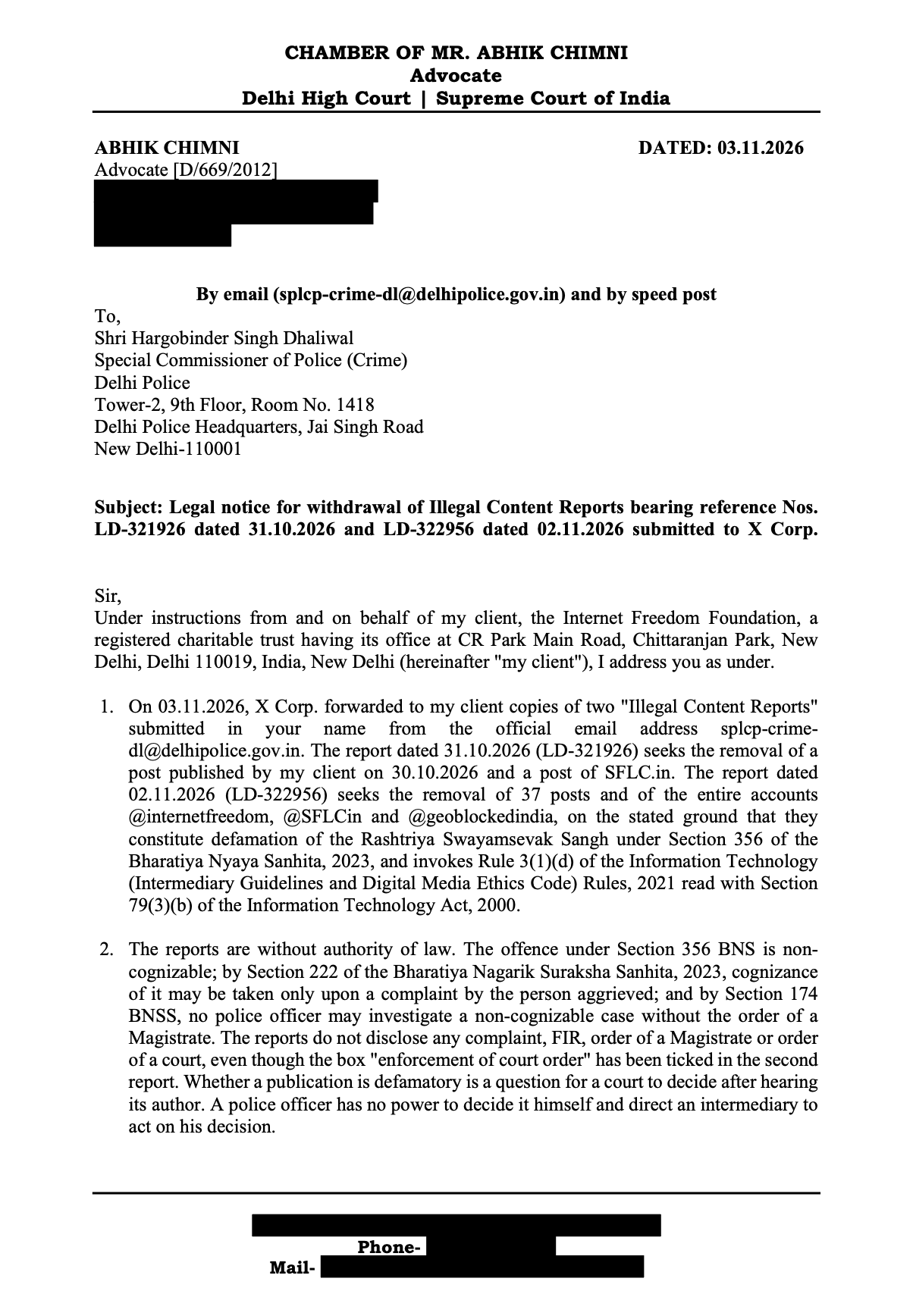
Statement: Legal notice to the Delhi Police and X Corp. over takedown demands against IFF’s account
On 3 November 2026, X Corp. forwarded to us two “Illegal Content Reports” submitted in the name of the Special Commissioner of Police (Crime), @delhipolice. The first, dated 31 October, sought removal of a post we published on 30 October and a post by @SFLCin. The second, dated 2 November, sought removal of 37 posts and the withholding of three accounts in their entirety, @internetfreedom, @SFLCin and @geoblockedindia, on the ground that they defame the Rashtriya Swayamsevak Sangh under Section 356 of the Bharatiya Nyaya Sanhita. The posts in question reproduce and comment on a legal notice that was sent to us. They are protected speech under Article 19(1)(a) of the Constitution. We were given no notice before these reports were filed. We learnt of them only because X forwarded copies.
Today, through our counsel Advocate Abhik Chimni and his colleagues, we served a legal notice on the Delhi Police, with a copy to X Corp.
Our position is simple:
1. Defamation is a non-cognizable offence. The police cannot investigate it without a Magistrate’s order, and cognizance can be taken only on a complaint by the person aggrieved.
2. The reports cite no complaint, no FIR, no Magistrate’s order and no court order, even though the box for “enforcement of court order” was ticked. Under Shreya Singhal v. Union of India, an intermediary can be required to take down content only on a court order or a reasoned government notification. A web form with “hate speech”, “defamation”, “safety/security” and “court order” ticked against 40 URLs, with one sentence of reasons, is not that.
3. Whether something is defamatory is for a court to decide after hearing the author. A police officer cannot decide it himself and direct a platform to act on his decision. Demanding that three accounts be withheld in full is grossly disproportionate to any grievance stated.
We have called upon the Delhi Police to withdraw both reports or disclaim within seven days, to furnish us the complaint and authority on which they were made, and to confirm that no further takedown requests will be made on this matter. If they do not, we will approach the Delhi High Court under Article 226. We have also requested X Corp. to take no action on the reports pending their withdrawal or adjudication.
We are grateful to Advocate Abhik Chimni and his team for representing us in this matter. Redacted copies of the notice are attached.


Awesome use case

Why are we still dragging 100-pound trash bins through freezing rain, snow and 6 AM dark like it's the 19th century?
Meet Curbie, an autonomous robot built by Revere Robotics that is finally killing off this miserable weekly chore. It automatically hauls your waste bin to the curb on collection day and brings it right back, completely unsupervised.
The genius is that it works with what you already have. Instead of forcing you to buy expensive proprietary gear, it couples directly onto the existing steel axle of your current municipal bin.
Packed with high-torque brushless motors and heavy-duty winter autonomy, it is specifically engineered to muscle heavy loads through deep snowdrifts and icy public sidewalks.
Sairee Chahal retweeted
Nobody will silence the voice of the people who ensure that our voices aren't muffled or land in darkness. @SFLCin will continue to fight !
reuters.com/world/india/prom…

Sairee Chahal retweeted

Cutting through all the political theatre and polarized discourse, we should remember a strong democracy is when one democratic institution raises concerns and the other institution responds to them.
Today, with the latest revision to the new voter enrolment Form 6, the Election Commission of India (ECI) completes a series of steps on the issues raised in The Indian Express investigation published five weeks ago. On each of the 10 decisions the two Election Commissioners objected to, in writing, on 14 separate occasions — which The Indian Express revealed.
Tough as it to see beyond all the public posturing from various parties involved, if we focus only at the actions: today's developments reaffirm our faith in the strength of India’s democracy and the vital, constructive role a free press plays.
To see how the EC’s measures play out, keep watching the Express space.

Election Commission completes Form 6 U-turn, drops SIR para a Commissioner called ‘illegal’ indianexpress.com/article/in…

Sairee Chahal retweeted
Dear @GlobalAffairs @elonmusk you shouldn't have let all the people go who worked on these issues when @jack ran it. You never authenticated if removal requests are genuine or not?
Not to mention @GoI_MeitY unrealistic demands of 3 hours and arm twisting of platforms causes these problems.

To verify the authenticity of the two takedown orders against SFLC.in’s X account and posts, SFLC.in looked into the existing mechanisms for submitting takedown requests to X.
X has two mechanisms for this: the platform’s Legal Request Portal and the Law Enforcement Request (LER) form. SFLC.in found that the LER form had no mechanism to verify or authenticate the identity of the person submitting the request. This meant that anyone could submit the request using any email ID and impersonate government officers merely by knowing what their email ID is.
SFLC.in flagged this vulnerability in a letter sent to X earlier today. Following our letter, X has fixed the issue with the form, which now requires an authentication code sent to the email ID being used to submit requests. We appreciate X’s quick response to address this concern and we urge @X to publicly acknowledge the flaws and confirm corrective measures have been taken.
Given the increasing number of content takedown orders issued by law enforcement agencies over the past few months, it is crucial for platforms to exercise more scrutiny over how these mechanisms are used. Platforms need to be careful about the misuse of such measures created specifically for law enforcement agencies, as these can be misused against lawful content as well.
In light of these events, we urgently request @DelhiPolice to issue a clarification on the authenticity of the orders we received.
@nit_set @neha_aisa @SauravDassss @SaketGokhale @JohnBrittas @svaradarajan @tajmahalfoxtrot @AbhinandanSekhr @ravish_journo @VTankha @derekobrienmp @cpimlliberation @MahuaMoitra @supriya_sule @MaktoobMedia @AroonDeep @SushantSin @tajmahalfoxtrot @seemay @dhanyarajendran @AbhinandanSekhr @MnshaP @MaktoobMedia @abhijeet_dipke @ravish_journo @whattalawyer @RSF_inter @IFEX @IndexCensorship @medianama @mediadefence @witnessorg @jencyjac @paranjoygt @baxiabhishek @seemay @NasirHussainINC @zoo_bear @free_thinker @MahuaMoitra @supriya_sule @ManishSharmaIYC @svaradarajan @PankajPachauri @clifroz @AnuradhaBhasin_ @ni5arga @geetaseshu


Such an awesome share 💜

In 2023, I wrote down an idea for a world where anyone could build software just by describing it.
Today, more than 70 million projects have been built with @Lovable.
100,000 PRs later, we're at a point where we fork entire computers, including their memory, running processes, environment and data to give the best customer experience.
I love reading about the history of how technology is built, so I wrote down what I got right & what I got wrong back in 2023 and the journey so far.
The team will continue sharing what we're learning as we build the software of the future. Here's our inaugural post:

Sairee Chahal retweeted

To verify the authenticity of the two takedown orders against SFLC.in’s X account and posts, SFLC.in looked into the existing mechanisms for submitting takedown requests to X.
X has two mechanisms for this: the platform’s Legal Request Portal and the Law Enforcement Request (LER) form. SFLC.in found that the LER form had no mechanism to verify or authenticate the identity of the person submitting the request. This meant that anyone could submit the request using any email ID and impersonate government officers merely by knowing what their email ID is.
SFLC.in flagged this vulnerability in a letter sent to X earlier today. Following our letter, X has fixed the issue with the form, which now requires an authentication code sent to the email ID being used to submit requests. We appreciate X’s quick response to address this concern and we urge @X to publicly acknowledge the flaws and confirm corrective measures have been taken.
Given the increasing number of content takedown orders issued by law enforcement agencies over the past few months, it is crucial for platforms to exercise more scrutiny over how these mechanisms are used. Platforms need to be careful about the misuse of such measures created specifically for law enforcement agencies, as these can be misused against lawful content as well.
In light of these events, we urgently request @DelhiPolice to issue a clarification on the authenticity of the orders we received.
@nit_set @neha_aisa @SauravDassss @SaketGokhale @JohnBrittas @svaradarajan @tajmahalfoxtrot @AbhinandanSekhr @ravish_journo @VTankha @derekobrienmp @cpimlliberation @MahuaMoitra @supriya_sule @MaktoobMedia @AroonDeep @SushantSin @tajmahalfoxtrot @seemay @dhanyarajendran @AbhinandanSekhr @MnshaP @MaktoobMedia @abhijeet_dipke @ravish_journo @whattalawyer @RSF_inter @IFEX @IndexCensorship @medianama @mediadefence @witnessorg @jencyjac @paranjoygt @baxiabhishek @seemay @NasirHussainINC @zoo_bear @free_thinker @MahuaMoitra @supriya_sule @ManishSharmaIYC @svaradarajan @PankajPachauri @clifroz @AnuradhaBhasin_ @ni5arga @geetaseshu
SFLC.in has concerns about the authenticity of the takedown orders purportedly sent by the Delhi Police to X, seeking the removal of SFLC.in's X account and posts.
To verify this, we have written to @XCorpIndia requesting clarity on:
(i) The channels or mechanisms through which the Delhi Police submitted the takedown requests to X.
(ii) X's verification process for requests submitted through its Legal Request Portal.
(iii) Whether these requests were actually submitted by @DelhiPolice and @hgsdhaliwalips.
(iv) Whether X received any accompanying court orders, directions, or other supporting documents in relation to these requests.
Read our full letter below. 👇
@GlobalAffairs @elonmusk @X
@nit_set @neha_aisa @SauravDassss @SaketGokhale @JohnBrittas @svaradarajan @tajmahalfoxtrot @AbhinandanSekhr @ravish_journo @VTankha @derekobrienmp @cpimlliberation @MahuaMoitra @supriya_sule @MaktoobMedia @AroonDeep @dhanyarajendran @PankajPachauri @clifroz @ManishSharmaIYC @zoo_bear @free_thinker


Sairee Chahal retweeted

Those who have lived in software land are about to have a hard lesson in hardware.
And this isn’t only true for power plants. Any infrastructure you try to build, whether it’s a rocket testing facility or a manufacturing setup, has several rate-limiting steps that have nothing to do with how advanced your AI model is.
This is an important point for all software investors investing in hardware now: be patient, and align your LPs as well.
Otherwise, setting the wrong expectations will be messy on your side, and if you don't handle it well, it will cast a bad spell on the entire ecosystem of hardware investors like us. 🫣
Sairee Chahal retweeted

Revolut's CEO just found a 3-4x faster way to design products, and it doesn't involve Figma.
Nik Storonsky noticed one team shipping designs much faster than everyone else.
What they did:
→ Gave an LLM Revolut's design system at the code level
→ Prompted it to build new flows on top of it
→ Got a live interface you can click through on a laptop or phone, not static frames
Result: 3-4x faster than designing screens in Figma.
Now he's rolling it out to every designer at Revolut.
The design file is becoming the product itself.
Sairee Chahal retweeted
SFLC.in has concerns about the authenticity of the takedown orders purportedly sent by the Delhi Police to X, seeking the removal of SFLC.in's X account and posts.
To verify this, we have written to @XCorpIndia requesting clarity on:
(i) The channels or mechanisms through which the Delhi Police submitted the takedown requests to X.
(ii) X's verification process for requests submitted through its Legal Request Portal.
(iii) Whether these requests were actually submitted by @DelhiPolice and @hgsdhaliwalips.
(iv) Whether X received any accompanying court orders, directions, or other supporting documents in relation to these requests.
Read our full letter below. 👇
@GlobalAffairs @elonmusk @X
@nit_set @neha_aisa @SauravDassss @SaketGokhale @JohnBrittas @svaradarajan @tajmahalfoxtrot @AbhinandanSekhr @ravish_journo @VTankha @derekobrienmp @cpimlliberation @MahuaMoitra @supriya_sule @MaktoobMedia @AroonDeep @dhanyarajendran @PankajPachauri @clifroz @ManishSharmaIYC @zoo_bear @free_thinker
SFLC.in strongly objects to the takedown requests targeting its X handle and posts documenting instances of online censorship in India.
On 3 November 2026 at 3:18 AM and 4:33 AM, SFLC.in received an email from X’s Legal Department informing us that it had received takedown requests from the Delhi Police concerning 42 URLs. These include the handles of SFLC.in, @internetfreedom, @geoblockedindia, and posts from the said organisations and other users. A separate notification identified five (5) URLs concerning SFLC.in’s X account and our posts.
The requests relate to posts discussing legal notices received by SFLC.in, IFF and @geoblockedindia from an advocate purportedly acting on behalf of the Rashtriya Swayamsevak Sangh (RSS). They also include posts by users who commented on or reshared these posts, as well as other posts by @geoblockedindia documenting instances of digital censorship.
Chain of Events
1. On 29 October 2026, when SFLC.in, IFF and @geoblockedindia (collectively “Organisations”) received a legal notice from an advocate purportedly acting on behalf of the RSS. The notice took objection to SFLC.in's Free Speech Tracker, which documents instances of censorship and online content restrictions and account takedowns in India. SFLC.in and IFF raised concerns about the authenticity of the notice, which did not carry an official letterhead or identify an authorised signatory.
2. On 1 November 2026, the Organisations received another notice from the same advocate. This notice stated that the matter had been transferred to the RSS's legal and advocacy wing, the Akhil Bharatiya Adhivakta Parishad, and referred to complaints allegedly filed in different states.
3. On the same day, X informed SFLC.in that it had received a request from the “Indian Police” alleging that a post discussing the legal notice violated Indian law. However, this notification did not identify the requesting law enforcement agency, statutory provisions invoked, or provide a copy of the underlying order or request. The post remains accessible on X at the time of writing.
4. On 3 November 2026, X communicated further directions from Delhi Police covering 42 URLs, including the URL for SFLC.in’s account itself. In the attached notices, the first notice refers to Section 356 of the Bharatiya Nyaya Sanhita (BNS), 2023 which deals with the offence of criminal defamation as the legal basis. The second notice refers to Section 356 of BNS and Section 79(3)(b) of the Information Technology Act, read with Rule 3(1)(b) of the Information Technology Rules 2021, which deal with intermediary liability and due diligence of intermediaries as the legal basis. The grounds cited for the takedown requests concerning SFLC.in’s X handle and posts include hate speech, defamation of RSS, and safety/security.
Takedown requests targeting SFLC.in's handle threaten its public service work
SFLC.in's X handle is an important public-facing channel through which it disseminates the organisation's ongoing work to the general public. It is through SFLC.in social media handles that users who face digital rights violation and online harms reach out to us for pro bono legal services. Through the handle we publish legal and policy analysis, document instances of censorship, raise awareness about digital rights violations, and communicate such information with the public including journalists, researchers, civil society organisations among others. It also serves as a channel for sharing developments concerning internet shutdowns, content restrictions, account takedowns and other violations of digital rights and for providing important assistance, through RightsLine, to citizens facing online harms ranging from gender based violence and harassment to cyberfraud.
A direction seeking the takedown of an organisation’s entire account, rather than addressing specific content through a transparent and legally established process, would have consequences far beyond the posts that have been identified. It would also deprive the public of an established and credible source of information on digital rights and the exercise of fundamental freedoms online.
The request to restrict SFLC.in’s entire X handle, rather than identifying and seeking the removal of specific allegedly unlawful content does not meet the necessity and proportionality standards. The right to freedom of expression under Article 19(1)(a) of the Constitution extends to disseminate information, circulate ideas and reach an audience. Restrictions on fundamental freedoms must not be arbitrary or excessive and must not go beyond what is necessary to achieve their legitimate objective (Chintaman Rao v. State of Madhya Pradesh, AIR 1951 SC 118). Any restriction on an organisation's established channel of communication must therefore be assessed in light of its wider impact on the organisation's ability to exercise its rights and the public's corresponding right to receive information.
Further, the reliance on Section 79(3)(b) of the Information Technology Act, 2000, read with Rule 3(1)(d) of the IT Rules, 2021, raises questions to whether intermediary liability provisions are being used as an independent mechanism for restricting online speech, potentially bypassing the procedural safeguards prescribed under Section 69A of the IT Act and the Blocking Rules, 2009. In Shreya Singhal v. Union of India, (2015) 5 SCC 1, the Supreme Court read down Section 79(3)(b), clarifying that an intermediary's obligation to remove or disable access to content must arise from a court order or notification by the appropriate government or its agency, and that such orders or notifications must strictly conform to the grounds enumerated under Article 19(2) of the Constitution. Section 79(3)(b), which forms part of the intermediary safe-harbour framework, cannot be treated as an unrestricted or independent source of blocking power or used to circumvent the safeguards governing restrictions on online information.
It is also pertinent to note that SFLC.in in Software Freedom Law Center, India v. State of NCT of Delhi & Ors, W.P.(C) 7650/2025 has also challenged the constitutional legality of the notification issued by Lieutenant Governor (LG) which empowers the Delhi Police to issue takedown orders for removal of online content from social media. The matter is currently pending in the Delhi High Court.
Documenting censorship is not facilitating circumvention
The Free Speech Tracker is an initiative to document instances of censorship in India. Its purpose is to make censorship visible, identify patterns in content moderation and provide the public with information about restrictions affecting online expression.
Documenting a restriction does not amount to endorsing the restricted content, facilitating access to it or encouraging circumvention of the law. Over the last few months, we have seen an unprecedented number of online content restrictions happening in India, and in the absence of adequate transparency from the government and platforms about the nature, extent and legal basis of these restrictions, we wanted to document these instances in a manner that is informative to the general public. Freedom of expression encompasses not only the right to publish and disseminate information but also the right to question restrictions on speech, seek accountability and scrutinise decisions affecting public discourse.
Independent civil society organisations like ours play an important role in documenting these developments and ensuring that restrictions on online expression do not go unnoticed. Such takedown requests risk creating a chilling effect on public-interest advocacy and may discourage individuals from discussing or questioning instances of censorship.
Irregularities in notice received
The first notice received by SFLC.in from X, pertains to this post. The notice states that the content in question is being reported on the grounds of ‘safety/security; defamation; and other’. Furthermore, the notice states that the post is “defamatory towards the Rashtriya Swayamsevak Sangh under the Section 356 of the Bharatiya Nyaya Sanhita, 2023 (BNS).” Criminal defamation under Section 356 of the BNS, 2023, is a non-cognizable offence and therefore, requires a court order for the police to initiate action.
The second notice received, pertains to a list of 42 posts and accounts. The notice states that the content in question is being reported on the grounds of “Hate speech; safety/security; defamation; enforcement of court order; and other’. The posts published by SFLC.in did not contain any defamatory statements or allegations against RSS, as it was purely factual reporting based on information relating to the notice received by the Organisations on 29 October 2026.
Furthermore, criminal defamation is a non-cognizable offence which requires a court order for the police to initiate action. The Delhi Police is not empowered to issue a content takedown order for such offence via the Sahyog Portal in the absence of such an order. While the notice mentions enforcement of a court order as one of the grounds, no such court order is cited or made available in the notice. Additionally, the notice does not identify a legal basis or statutory provision for the offences of hate speech or safety/security. The notice also relies on Rule 3(1)(d) of the Information Technology (Intermediary Guidelines and Digital Media Ethics Code) Rules, 2021 read with Section 79(3)(b) of the Information Technology Act, 2000 and states that action must be taken by X within 3 hours.
Therefore, in light of the above, SFLC.in condemns the takedown request issued by the Delhi Police and maintains that they are unlawful, disproportionate and violative of the fundamental rights to freedom of speech and expression under Article 19(1)(a). SFLC.in calls upon the Delhi Police and the concerned authorities to immediately withdraw these requests. If there exists any relevant court order directing the removal of the content, SFLC.in calls upon the Delhi Police to provide copies of said order to the Organisations (SFLC.in, IFF, and @geoblockedindia) posthaste.
We stand in solidarity with all individuals and organisations affected by these takedown requests and reaffirm our commitment to defending their right to speak, document and question restrictions on online expression. Transparency, accountability and access to remedies must remain central to any process that seeks to restrict online expression.


Sairee Chahal retweeted

The list of companies that don't want user data is pretty short.
So when one of us says something, the rest of us should say it louder.
We are with @DuckDuckGo on this one. Parents, schools, and teachers should get to choose what's right for their kids.


US tech giants' hidden AI debt swells 90% to $3.2tn in 6 months asia.nikkei.com/business/tec…

Sairee Chahal retweeted

🇬🇧 MY PERSONAL VIEW ON THE NEW UK ILR RULES – ANOTHER WAY TO LOOK AT IT
I understand that some British citizens and the UK Government believe that five years is too short a period to qualify for permanent settlement.
I also understand the importance of controlling immigration, protecting public services and ensuring that people contribute to the UK economy.
But I believe there is another solution worth considering.
WHY NOT SEPARATE ILR FROM THE RIGHT TO WORK FREELY?
Here is my suggestion:
1️⃣ First 5 years: People continue under their existing visa conditions, including sponsorship requirements, and must follow all immigration rules.
2️⃣ After 5 years: If someone has completed five years of lawful residence and work, has a good immigration and criminal record, and meets the required contribution criteria, why not allow them to work freely?
This could include:
Changing employers without needing a new sponsor.
Working for any legal business.
Becoming self-employed.
Starting their own business.
Working multiple jobs without sponsorship restrictions.
3️⃣ ILR and public funds: The Government could maintain a longer qualifying period, even 10 or 15 years, with appropriate restrictions on access to public funds until the person qualifies.
WHY DO I THINK THIS MATTERS?
There are thousands of talented people who came to the UK with professional skills, business experience, ambitions and the ability to create opportunities.
Some could become entrepreneurs, employ other people, establish businesses and contribute more to the economy.
But when someone’s entire working life depends on one sponsoring employer, their opportunities to grow, change careers or start a business can be restricted.
The UK needs skilled workers, but it can also benefit from allowing those workers to become independent, innovative and entrepreneurial.
My question is simple:
If someone has worked legally, paid taxes, contributed to National Insurance and followed all immigration rules for five years, why should their ability to work independently still depend entirely on sponsorship?
I am not saying everyone should automatically receive ILR after five years.
I am suggesting that freedom to work, freedom to build a business and permanent settlement could be treated as separate stages.
Perhaps this could create a better balance between immigration control, economic growth and individual opportunity.
What do you think? Would this approach work for the UK?
I would genuinely like to hear opinions from British citizens, employers, entrepreneurs and people currently on Skilled Worker visas.
#UKImmigration #ILR #SkilledWorkerVisa #UKEconomy #EarnedSettlement

Imagine giving 5 years of your life to a country, following every rule, paying taxes, building your career, leaving your family behind…
And just when you are 1 or 2 years away from the future you worked so hard for, the rules could change.
I am one of those Skilled Workers.
UK Government, is this fair?
We are human beings, not just visa numbers.
@ukhomeoffice @ShabanaMahmood
#SkilledWorkerVisa #ILR

Sairee Chahal retweeted
SFLC.in strongly objects to the takedown requests targeting its X handle and posts documenting instances of online censorship in India.
On 3 November 2026 at 3:18 AM and 4:33 AM, SFLC.in received an email from X’s Legal Department informing us that it had received takedown requests from the Delhi Police concerning 42 URLs. These include the handles of SFLC.in, @internetfreedom, @geoblockedindia, and posts from the said organisations and other users. A separate notification identified five (5) URLs concerning SFLC.in’s X account and our posts.
The requests relate to posts discussing legal notices received by SFLC.in, IFF and @geoblockedindia from an advocate purportedly acting on behalf of the Rashtriya Swayamsevak Sangh (RSS). They also include posts by users who commented on or reshared these posts, as well as other posts by @geoblockedindia documenting instances of digital censorship.
Chain of Events
1. On 29 October 2026, when SFLC.in, IFF and @geoblockedindia (collectively “Organisations”) received a legal notice from an advocate purportedly acting on behalf of the RSS. The notice took objection to SFLC.in's Free Speech Tracker, which documents instances of censorship and online content restrictions and account takedowns in India. SFLC.in and IFF raised concerns about the authenticity of the notice, which did not carry an official letterhead or identify an authorised signatory.
2. On 1 November 2026, the Organisations received another notice from the same advocate. This notice stated that the matter had been transferred to the RSS's legal and advocacy wing, the Akhil Bharatiya Adhivakta Parishad, and referred to complaints allegedly filed in different states.
3. On the same day, X informed SFLC.in that it had received a request from the “Indian Police” alleging that a post discussing the legal notice violated Indian law. However, this notification did not identify the requesting law enforcement agency, statutory provisions invoked, or provide a copy of the underlying order or request. The post remains accessible on X at the time of writing.
4. On 3 November 2026, X communicated further directions from Delhi Police covering 42 URLs, including the URL for SFLC.in’s account itself. In the attached notices, the first notice refers to Section 356 of the Bharatiya Nyaya Sanhita (BNS), 2023 which deals with the offence of criminal defamation as the legal basis. The second notice refers to Section 356 of BNS and Section 79(3)(b) of the Information Technology Act, read with Rule 3(1)(b) of the Information Technology Rules 2021, which deal with intermediary liability and due diligence of intermediaries as the legal basis. The grounds cited for the takedown requests concerning SFLC.in’s X handle and posts include hate speech, defamation of RSS, and safety/security.
Takedown requests targeting SFLC.in's handle threaten its public service work
SFLC.in's X handle is an important public-facing channel through which it disseminates the organisation's ongoing work to the general public. It is through SFLC.in social media handles that users who face digital rights violation and online harms reach out to us for pro bono legal services. Through the handle we publish legal and policy analysis, document instances of censorship, raise awareness about digital rights violations, and communicate such information with the public including journalists, researchers, civil society organisations among others. It also serves as a channel for sharing developments concerning internet shutdowns, content restrictions, account takedowns and other violations of digital rights and for providing important assistance, through RightsLine, to citizens facing online harms ranging from gender based violence and harassment to cyberfraud.
A direction seeking the takedown of an organisation’s entire account, rather than addressing specific content through a transparent and legally established process, would have consequences far beyond the posts that have been identified. It would also deprive the public of an established and credible source of information on digital rights and the exercise of fundamental freedoms online.
The request to restrict SFLC.in’s entire X handle, rather than identifying and seeking the removal of specific allegedly unlawful content does not meet the necessity and proportionality standards. The right to freedom of expression under Article 19(1)(a) of the Constitution extends to disseminate information, circulate ideas and reach an audience. Restrictions on fundamental freedoms must not be arbitrary or excessive and must not go beyond what is necessary to achieve their legitimate objective (Chintaman Rao v. State of Madhya Pradesh, AIR 1951 SC 118). Any restriction on an organisation's established channel of communication must therefore be assessed in light of its wider impact on the organisation's ability to exercise its rights and the public's corresponding right to receive information.
Further, the reliance on Section 79(3)(b) of the Information Technology Act, 2000, read with Rule 3(1)(d) of the IT Rules, 2021, raises questions to whether intermediary liability provisions are being used as an independent mechanism for restricting online speech, potentially bypassing the procedural safeguards prescribed under Section 69A of the IT Act and the Blocking Rules, 2009. In Shreya Singhal v. Union of India, (2015) 5 SCC 1, the Supreme Court read down Section 79(3)(b), clarifying that an intermediary's obligation to remove or disable access to content must arise from a court order or notification by the appropriate government or its agency, and that such orders or notifications must strictly conform to the grounds enumerated under Article 19(2) of the Constitution. Section 79(3)(b), which forms part of the intermediary safe-harbour framework, cannot be treated as an unrestricted or independent source of blocking power or used to circumvent the safeguards governing restrictions on online information.
It is also pertinent to note that SFLC.in in Software Freedom Law Center, India v. State of NCT of Delhi & Ors, W.P.(C) 7650/2025 has also challenged the constitutional legality of the notification issued by Lieutenant Governor (LG) which empowers the Delhi Police to issue takedown orders for removal of online content from social media. The matter is currently pending in the Delhi High Court.
Documenting censorship is not facilitating circumvention
The Free Speech Tracker is an initiative to document instances of censorship in India. Its purpose is to make censorship visible, identify patterns in content moderation and provide the public with information about restrictions affecting online expression.
Documenting a restriction does not amount to endorsing the restricted content, facilitating access to it or encouraging circumvention of the law. Over the last few months, we have seen an unprecedented number of online content restrictions happening in India, and in the absence of adequate transparency from the government and platforms about the nature, extent and legal basis of these restrictions, we wanted to document these instances in a manner that is informative to the general public. Freedom of expression encompasses not only the right to publish and disseminate information but also the right to question restrictions on speech, seek accountability and scrutinise decisions affecting public discourse.
Independent civil society organisations like ours play an important role in documenting these developments and ensuring that restrictions on online expression do not go unnoticed. Such takedown requests risk creating a chilling effect on public-interest advocacy and may discourage individuals from discussing or questioning instances of censorship.
Irregularities in notice received
The first notice received by SFLC.in from X, pertains to this post. The notice states that the content in question is being reported on the grounds of ‘safety/security; defamation; and other’. Furthermore, the notice states that the post is “defamatory towards the Rashtriya Swayamsevak Sangh under the Section 356 of the Bharatiya Nyaya Sanhita, 2023 (BNS).” Criminal defamation under Section 356 of the BNS, 2023, is a non-cognizable offence and therefore, requires a court order for the police to initiate action.
The second notice received, pertains to a list of 42 posts and accounts. The notice states that the content in question is being reported on the grounds of “Hate speech; safety/security; defamation; enforcement of court order; and other’. The posts published by SFLC.in did not contain any defamatory statements or allegations against RSS, as it was purely factual reporting based on information relating to the notice received by the Organisations on 29 October 2026.
Furthermore, criminal defamation is a non-cognizable offence which requires a court order for the police to initiate action. The Delhi Police is not empowered to issue a content takedown order for such offence via the Sahyog Portal in the absence of such an order. While the notice mentions enforcement of a court order as one of the grounds, no such court order is cited or made available in the notice. Additionally, the notice does not identify a legal basis or statutory provision for the offences of hate speech or safety/security. The notice also relies on Rule 3(1)(d) of the Information Technology (Intermediary Guidelines and Digital Media Ethics Code) Rules, 2021 read with Section 79(3)(b) of the Information Technology Act, 2000 and states that action must be taken by X within 3 hours.
Therefore, in light of the above, SFLC.in condemns the takedown request issued by the Delhi Police and maintains that they are unlawful, disproportionate and violative of the fundamental rights to freedom of speech and expression under Article 19(1)(a). SFLC.in calls upon the Delhi Police and the concerned authorities to immediately withdraw these requests. If there exists any relevant court order directing the removal of the content, SFLC.in calls upon the Delhi Police to provide copies of said order to the Organisations (SFLC.in, IFF, and @geoblockedindia) posthaste.
We stand in solidarity with all individuals and organisations affected by these takedown requests and reaffirm our commitment to defending their right to speak, document and question restrictions on online expression. Transparency, accountability and access to remedies must remain central to any process that seeks to restrict online expression.
