
skilled at googling things
Joined April 2018
- Tweets5.9K
- Following157
- Followers148
- Likes845




scaredycat retweeted

The market is crashing because they can no longer deny that current LLMs past a certain point will be good enough in most legal purposes, and open weight models could potentially surpass frontier models because of the unrestricted freedom. Stopping Jenson won't stop what's inevitable, they only stopped a Mag7 company from endorsing the truth. LLMs are commodities and will be swapped out to serve the purposes needed for cheapest cost. Frontier models have no moat.
The thing about building God, is its only profitable if they can control the gates of Heaven. If it's not profitable, there is no investment thesis that makes sense for the current datacenter buildout, and this runs down the line to every bottleneck compute company. This is a total selloff, despite these companies making record profits now, because the cut off will eventually be swifter than the growth they enjoyed.
Fact is: Without AI the past three years, the market would have stagnated or become bearish. They were hoping it would save the West, to buy us enough time to bring back manufacturing and production that is desperately needed for a healthy, competitive society. The wars, the tarrifs. These were last ditch efforts to regain control. These didn't work either.
scaredycat retweeted

No one serious doubts that there is sectarian, hateful rhetoric - but a lot of violence can be also viewed through lens of economic collapse; in rural areas, land ownership drives a lot of violence (people will kill, kidnap, intimidate others to scare off legal disputes)

scaredycat retweeted

Donald Iwuchukwu has stolen millions of dollars from the elderly. If the authorities do not act, he is going to get away with it. My hope is that publicity will lead to the arrest of him and his co-conspirators. Link below, and please RT:

scaredycat retweeted

Tried to cut down part of an interview I did a while ago about the Mecca Pact, and if it'll actually gonna do anything.
youtu.be/OckN9fy2JXI

scaredycat retweeted

🗣️The “why does Jensen’s Mandarin suck?” conversation is a useful chance to explain how Taiwanese history shaped language differently than Chinese history, especially for Gen X and older diaspora families.
🤷🏻♀️Chinese people surprised by Jensen Huang’s Mandarin often only know Taiwan’s story through a PRC Chinese lens. Jensen was born in Taiwan in 1963, during the authoritarian KMT period. His family spoke Taiwanese (Hokkien/Taigi) at home, not Mandarin. His grandparents, like many of that generation, grew up under Japanese rule (1895–1945) and spoke Japanese in public and Taiwanese at home.
👋🏼 After the KMT lost the Chinese Civil War and retreated to Taiwan in 1949, it imposed martial law (which is the academic way of saying it ruled through political repression, imprisonment, and execution of Taiwanese people for four decades) and made Mandarin the only official language.
🚫 Local languages were restricted in schools and public life. My mom and dad said they were punished for speaking Taiwanese at school. My grandparents conditioned them to avoid getting into trouble. A lot of people they knew were killed or jailed when they were younger.
🇺🇸 It’s actually the reason why my mom and dad immigrated to the U.S. in the 70s. They didn’t want me growing up under authoritarian KMT Taiwan.
✈️ So for families who left Taiwan as children in the 1960s–80s, this forced Mandarin learning never fully took hold. We continued speaking Taiwanese freely at home and in diaspora communities (places like Monterey Park, CA, in the ’70s and ’80s where I grew up), without the same pressure to switch to Mandarin. We grew up in America speaking Taiwanese at home and English everywhere else.
✏️ Sure, some of us were sent to “Chinese school” on Saturdays in the ’80s to learn bopomofo and traditional Chinese reading and writing, but I rebelled hard against that. By the time I got to college in the ’90s and took an interest in learning more about China, it was like starting from scratch. They teach simplified Chinese and pinyin instead of bopomofo.
🥲My crappy Mandarin was a source of insecurity, but it didn’t stop me from moving to China in the ’90s to see what it was about firsthand. My tones and accent were so Americanized that I got tired of explaining to taxi drivers that I was born in Taiwan and grew up in America, because it would always trigger a dumb conversation about why China was going to invade Taiwan soon.
🧋It used to be a source of insecurity, but I’m too old now to care about what people think based on their limited understanding of Taiwan and our history. I tell my son all the time to never be ashamed of where you come from and how our family arrived where we are today.

Makes sense. He’s was born in Tainan and grew up speaking Taiwanese Taigi (Hokkien) at home. Mandarin wasn’t his first language.
I’m also Gen X and grew up speaking Taiwanese at home while growing up in the US and it was also the only way I could communicate with my grandparents because they grew up under Japanese colonization until their 20s and never became fluent in Mandarin.
Here’s a clip where he acknowledges his Mandarin sucks but switches to Taiwanese and it’s fluent.
scaredycat retweeted

This is absolutely brilliant, by legendary Australian investor John Hempton, who explains the core financial paradox at the heart of the AI story (and which also, to some extent, may explain the Jensen Huang story).
The numbers say that about $7 trillion in AI compute is set to be built by 2030. For the industry to earn that back, given those chips have a roughly 5-year lifespan and cost a lot to run, they need to generate about $2 trillion of AI revenue a year.
Hempton says the only way you can get to these sorts of numbers is by selling AI as a productivity tool to businesses, meaning replacing workers.
And since, for reasons he explains in the video, no company fires people to save just 10% in costs, the savings have to be about double what businesses pay for the AI: roughly $4 trillion in savings on wages a year.
What does firing $4 trillion worth of workers mean concretely? Hempton calculated this equates to roughly 10% of the OECD’s total wage bill of about $40 trillion: one in every ten dollars paid to workers across the OECD’s 38 member countries.
Which, naturally, when you suddenly take that much income out of people’s pockets, would trigger a massive global recession.
And here's the paradox: in a massive global recession, there's no way businesses will pay $2 trillion a year for AI, so the return disappears anyway.
In other words, AI's only possible path to success given the numbers requires destroying the very economy that is supposed to pay for it.
HOWEVER - and here's where the Nvidia/Jensen Huang story might come into play (and, to be clear, this is now me speaking and not Hempton given this interview is prior to the whole Nvidia saga) - this all rests on a core assumption: that compute stays super expensive. Which in practice means Nvidia keeping its pricing power, with a 75% gross margin on its chips.
Break Nvidia's pricing power, and the $7 trillion bill, the $2 trillion in revenue and the 10% of jobs all shrink with it.
This would also put the whole China story in a different light. Maybe it's not so much a "we don't want the Chinese to be competitive with similar chips to us" story as it is a "we don't want Chinese demand to drive up chip prices" one. Or probably both.
And, as such, you could actually think about the US export controls not as a national security measure but as a good old subsidy for US AI players (together with a handicap for their Chinese competitors), a way to limit the price of chips.
This holds even with China itself blocking Nvidia imports, since Chinese firms simply rent the chips abroad instead, in places like Southeast Asia, which is precisely what this whole Alice Huang/Megaspeed story is about.
The main obstacle for all this was, of course... Jensen. Obviously, the guy wanted the exact opposite: as many buyers as possible, Chinese players included, to keep chip prices and Nvidia’s margins sky-high. He was also the one man with the clout to make that happen.
All hard to prove, of course, but I can imagine that quite a few corks popped this week in Anthropic's offices: nothing like the news that the man keeping your biggest cost sky-high is out when you're a week away from a $1.2 trillion IPO.
scaredycat retweeted

OCHA thanks the United States 🇺🇸 for its generous contribution of $107 million to the #SyriaHumanitarianFund.
With this vital support, we can continue delivering life-saving assistance and empowering vulnerable communities across #Syria when they need it the most.

scaredycat retweeted

The narrative around Liwa al-Baqir pushed by some government figures and outsiders was exaggerated from day one in a very transparent attempt to prevent post-war violence between parts of the Aleppo Sunni community.
Ask any opposition fighter from Aleppo city and they will tell you what happened. Some Liwa al-Baqr fighters stayed home during the battle while others continued to fight for the regime. But going home was the extent of their 'support' - they were not some secret fifth column that participated in the liberation of Aleppo.
The Liwa al-Baqir story is no different than the tens of thousands of Sunni and Alawi soldiers who deserted during the final offensive, yet these men are not lauded by government leaders. The Sunni base easily sees through this political rhetoric and has not forgiven Liwa al-Baqir for their crimes during the revolution, nor any of the other Sunni militias and shabiha who fought for the regime.

#Syria after Raqqa Governor Abdulrahman Salame praised the role of former IRGC-affiliated Khaled al-Mer'i and his al-Baqer militia for flipping against Assad in Aleppo battle in 2024. Locals figures of Anadan, where both Al-Mer'i and Salame come from, declared their disavowal of them.
Another example of the government's indifference to transitional justice and its obsession with whitewashing Assad-era criminals from tribal backgrounds is making local communities more angry and disappointed even after June protests
scaredycat retweeted
There are many challenges about Israel and Palestine that are complicated and fraught and difficult but surely we can all agree that repairing torn tents and helping people to dry out after flooding is a basic human obligation. Let’s help these people, because they are people.

scaredycat retweeted

I’m suing you guys for terminating my channel for no reason. I have been in contact with my legal team.
You said I violated the spam policy but I very clearly did not. You then offered no explanation as to how or why I did this

@TeamYouTube I know your spam policy. I literally laid it out for you and how the prongs work and how I didn’t violate anything
1) ENGAGEMENT MANIPULATION
This is when you get viewbots, offer rewards for subs, or do a sub-for-sub scheme. I have never engaged in this
2) FAKE ENGAGEMENT
This is when you post high volumes of low effort, repetitive polls. I have never engaged in this. I use the community tab to ask my audience who wins each game, and to let them know my streaming schedule
3) COMMENT SPAM
This is when you make comments on other videos that are identical and low effort. I make *maybe* one comment a week on other channels pertaining to their actual video. It’s not this
4) OFF-PLATFORM DIVERSION
Content created to drive users to external sites. I have never done this. All my stuff is on YouTube. The irony is so many other channels illegally show games and get you to click a link to watch the full game on their site
5) DETECTION EVASION
Intentionally trying to bypass abuse detection by mirroring something. Again, I have never done this. 100% of my streams are me commentating the game like a radio broadcast with my face in the forefront at all times
6) AUTOMATED OR SYNTHETIC MASS PRODUCTION
Using AI tools to put out a ton of content with minimal changes. Mass producing videos. I don’t do this. I don’t use AI. I stream one game at a time, and everything is done by me
7) SCRAPED CONTENT
Reposting material from other sites. I’ve never done this. My streams are my face and are live
8) SCAMS
Trying to steal private data, among other things. Again, I’ve never done this. I literally just commentate sporting events
9) MALICIOUS CLICKBAIT
Using misleading titles and thumbnails to trick users into clicking on a video that doesn’t deliver what it was promised. The thumbnail of my videos says “live play by play and reaction.” The titles say the same thing. I have never, not once, shown a game on stream, because I am not allowed to because I know copyright law, and have never advertised that I can do that. I am doing what the entire sports commentary community does, including people that you gave plaques to and verified
So, if it’s not one of those 9 things, and if you’ve never told me specifically what I did wrong or how I violated it, then how is my channel now gone?
scaredycat retweeted
Rural western Homs was torn apart by sectarian violence during Syria's revolution. In Talkalakh, thousands of Sunni residents were displaced, detained, or killed by regime militias. Yet after liberation, this area has seen a gradual return of peace and security.
My first for @SyriaDirect looks at how residents, civil society, and local officials have come together to rebuild inter-faith relations in this town. Talkalakh is another example of how powerful local initiatives can be, but also how fragile civil peace remains in post-Assad Syria.
syriadirect.org/in-syrias-di…

scaredycat retweeted

A thread with some disjointed thoughts on this week's evacuation from Oleshky, as the ceasefire that allowed the humanitarian operation is set to expire tonight:


scaredycat retweeted

my genuine "AI bubble" bear case is that it's all B2B VC funded AI startups selling tools to each other and booking that as ARR, like an ARR Ouroboros.
here's the problem:
Company A sells sales agents. Frontier Lab B sells tokens. Company C sells RL Envs. All are funded by VC and booking huge ARR growth.
C uses A's sales agents to do B2B sales to labs, spending 7 figs, which makes A spend 6 figs from B. Suddenly, C stops using A bc they're happy working with B. A now uses fewer tokens from B. B now has less revenue and has a smaller budget for RL envs.
the whole uptrend is levered all the way up and down. this is because genuine heavy AI usage is concentrated in early adopters w money ... which are all other AI startups spending VC money. if enough parts of the ecosystem cut spend, it could cause a death spiral.

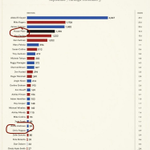
This chart shows the key risk to the AI trade, and it's missing from the latest revenue announcements.
The AI boom is fundamentally driven by a top 1% of companies that drive 80% of spend. Within that top 1%, 80% are venture-backed.
That's all fine if the AI trade works out, and if, as some prominent investors say, everyone wins.
But if it doesn't work out, then we have a cascading effect of large customers simultaneously pulling back their AI spend.

scaredycat retweeted
6) This is one of the more frustrating fields in Syria today. For the past year I have been volunteering time with some local CSOs working on civil peace in rural Syria.
These organizations often receive no, or at best minimal, outside support, despite being rooted in their communities for more than a decade. Instead, INGOs with international connections & funding either ignore these areas, or come and displace/co-opt the local work…
scaredycat retweeted

4. There, you'll see the spirit—restaurants, sweet shops, and groceries reopening on the ground floor of destroyed houses. Some repair their flats -three shops selling building materials are seen in the background. There is some power but on the roofs you see water tanks and solar.


scaredycat retweeted

New paper: how did al-Sharaa Syria build a national army out of dozens of rebel factions without a power-sharing deal? Short answer: by opposing political negotiations and make it something administrative. papers.ssrn.com/sol3/papers.… (thread) (1)
scaredycat retweeted

I am disappointed that almost a month since President Trump ended Syria’s designation as a state sponsor of terrorism, @BISGov still has not removed export controls on Syria. Syria continues to be placed in country list E, the only country in this group that is not a state sponsor of terrorism, hurting American companies and jobs which want to invest in Syria.
Hopeful that updated guidance can come out of @BISGov soon implementing Pres Trump’s vision to give Syria a chance!
scaredycat retweeted

👇🏼

Check out my new article for CTC Sentinel: "Managing the Muhajirin: The Future of Syria’s Foreign Fighters" ctc.westpoint.edu/managing-t…
