

High Energy Physics 5 Optical Fiber Patents | Dark Matter and Dark Energy |•| Astrophysics
USA
Joined November 2011
- Tweets64K
- Following74
- Followers1.6K
- Likes23K
NASA Reveals New Details About Dark Matter’s Influence on Universe
Scientists using data from NASA’s James Webb Space Telescope have made one of the most detailed, high-resolution maps of dark matter ever produced.
nature.com/articles/s41550-0…

Caustic crossings in giant arcs with extended dark matter objects
Caustic-crossing stars observed in giant arcs behind galaxy clusters provide a powerful probe of dark matter substructure.
arxiv.org/abs/2511.20952

3
50
Dark Matter Detector Releases Best-Yet Result
From one mile underground in a disused South Dakota gold mine, the LUX-ZEPLIN (LZ) experiment has been hunting for dark matter since 2021. Physicists expect that some of the signals emanating from its liquid-xenon-filled chamber come from weakly interacting massive particles (WIMPs), a leading dark matter candidate.
physics.aps.org/articles/v18…

1
81
Improved Treatment of Bosonic Dark Matter Dynamics in Neutron Stars: Consequences and Constraints
It is conceivable that a bosonic dark matter (DM) with non-gravitational interactions with SM particles will be accumulated at the center of a neutron star (NS) and can lead to black hole formation.
arxiv.org/abs/2408.16091

Total Solar Eclipse White Light Images as a Benchmark for PFSS Coronal Magnetic Field Models: An In-Depth Analysis over a Solar Cycle
Potential Field Source Surface (PFSS) models are widely used to simulate coronal magnetic fields. PFSS models use the observed photospheric magnetic field as the inner boundary condition and assume a perfectly radial field beyond a ``Source Surface"
arxiv.org/abs/2408.16149

1
46
High-redshift, small-scale tests of ultralight axion dark matter using Hubble and Webb galaxy UV luminosities
We calculate the abundance of UV-bright galaxies in the presence of ultralight axion (ULA) dark matter (DM), finding that axions suppress their formation with a non-trivial dependence on redshift and luminosity.
arxiv.org/abs/2404.11071

2
55
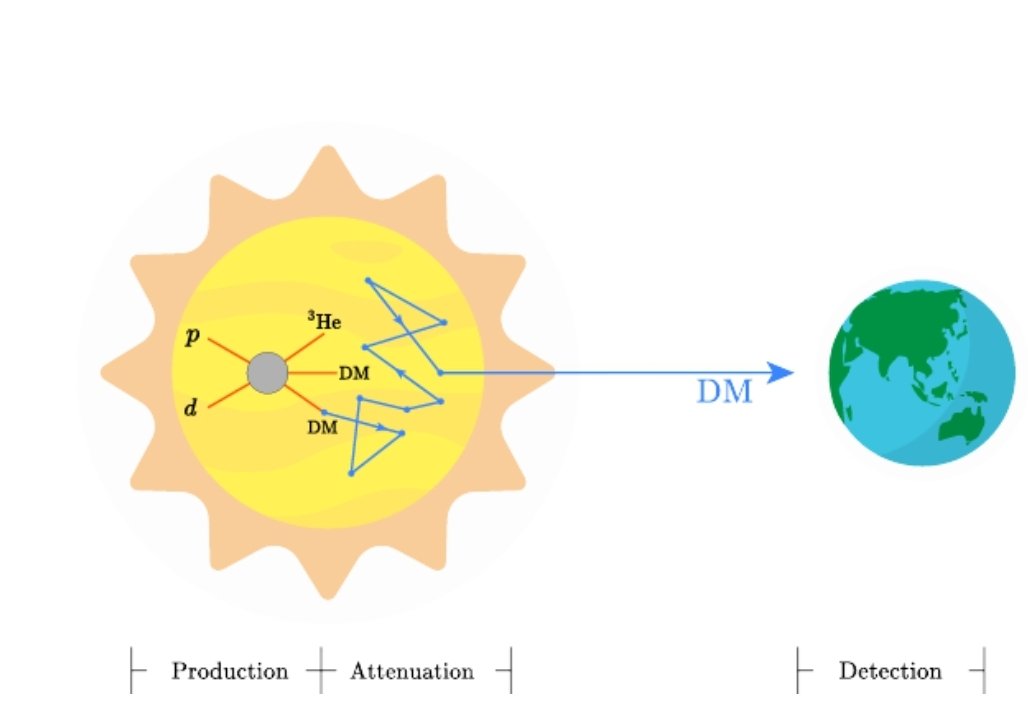
Nuclear Production and Analytic Attenuation of Energetic MeV Solar Dark Matter
We propose a solar production mechanism of MeV dark matter to overcome the energy threshold in direct detection experiments. In particular, the proton and deuteron fussion to 3He of the pp chain that produces energetic neutrino and gamma photon with 5.5MeV of energy release can also produce a pair of dark matter particles.
arxiv.org/abs/2408.12448
1
52
Asymmetric self-interacting dark matter with a canonical seesaw modell
We study the possibility of generating dark matter (DM) and baryon asymmetry of the Universe (BAU) simultaneously in an asymmetric DM framework, which also alleviates the small-scale structure issues of cold DM.
arxiv.org/abs/2404.14912

33
Dark Matter Line Searches with the Cherenkov Telescope Array
Monochromatic gamma-ray signals constitute a potential smoking gun signature for annihilating or decaying dark matter particles that could relatively easily be distinguished from astrophysical or instrumental backgrounds.
We find that current limits and detection prospects for dark matter masses above 300 GeV will be significantly improved, by up to an order of magnitude in the multi-TeV range.
arxiv.org/abs/2403.04857

1
26
Dark Photon Dark Matter and Low-Frequency Gravitational Wave Detection with Gaia-like Astrometry
Astrometric surveys offer us a method to search for elusive cosmic signatures, such as ultralight dark photon dark matter and gravitational waves, by observing the deflection to the apparent positions of the stars.
arxiv.org/abs/2407.16488

1
38
An indirect search for dark matter with a combined analysis of dwarf spheroidal galaxies from VERITAS
(VERITAS collaboration)
Understanding the nature and identity of dark matter is a key goal in the physics community. In the case that TeV-scale dark matter particles decay or annihilate into standard model particles, very-high-energy (VHE) gamma rays (greater than 100 GeV) will be present in the final state.
The study addresses a broad dark matter particle mass range, extending from 200 GeV to 30 PeV. In the absence of a detection, we set the upper limits on the dark matter velocity-weighted annihilation cross section.
"The photon spectrum from dark matter annihilation depends on the annihilation channel of the dark matter pair into Standard Model particles."
arxiv.org/abs/2407.16518

22