

Group leader @SingMolSci @UNSWRNA. Interested in quantitative regulation of gene expression in single cells. Views my own.
Sydney, New South Wales
Joined June 2018
- Tweets313
- Following286
- Followers744
- Likes727




Pinned Tweet
What happens when you suddenly remove half of an essential enzyme from cells? 🤔
We watched in real-time as cells deploy multiple backup strategies to buffer against changes in RNA Pol II abundance.
Our lab's new preprint 👇
bit.ly/4pyPgax
This fun project was driven by the talented and rigorous Alex Gillis @acftbl, in wonderful collaboration with @ana_tufegdzic lab!
Also take a look at complementary work by
@SvejstrupLab:
sciencedirect.com/science/ar…
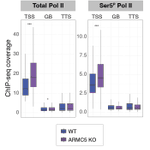
When both ARMC5 and INTS8 are depleted, excess Pol II is released into genes but often fails to transcribe the full transcription unit, resulting in major gene expression changes...lots more results and discussion in the paper, of course!

This finding pushed us to try to understand what stops Pol II from entering the elongation phase and actually making more RNA. We found that ARMC5 and Integrator phosphatase play complementary roles in this process.

ARMC5 also regulates homeostatic Pol II levels - seemingly responsible for around half the cell’s Pol II turnover. But the extra Pol II that accumulates in cells upon ARMC5 loss doesn’t lead to more Pol II in gene bodies: it is mostly in the free pool or in the proximal promoter.

However, using live-cell imaging and cellular fractionation, we found that this excess Pol II mostly accumulates off-chromatin.

It has long been known that Pol II is degraded when transcription is inhibited - either with small molecules or if specific cofactors are depleted. We now know the ubiquitin ligase responsible is CUL3-ARMC5. When we remove ARMC5, Pol II is no longer lost upon inhibition.

Building on our previous work on RNA concentration homeostasis doi.org/10.1016/j.cels.2022.…, we were interested in how global levels of Pol II are controlled. We teamed up with Ana's lab who delve deep into mechanisms of ubiquitin-mediated regulation of the transcription cycle.
📢 New paper from the lab!
In a fantastic new collaboration with @ana_tufegdzic lab, we characterise a major Pol II homeostasis pathway in human cells. Congratulations Roberta @caciopporobi, Alex @acftbl, Ivan @IvanShlamovitz, and Andrew.
cell.com/molecular-cell/full…

Was a pleasure working with @ana_tufegdzic on this!

The first paper from our lab is online! A wonderful collaboration with @scottbscience lab. We discover that Pol II is extensively regulated by Ubiquitin at the beginning of the transcription cycle! 🧵
cell.com/molecular-cell/full…
Scott Berry retweeted

Global transcription regulation revealed from dynamical correlations in time-resolved single-cell RNA sequencing @CellSystemsCP
@DVolteras
@VShahrezaei
doi.org/10.1016/j.cels.2024.…

My group is looking for new PhD students! Australian and International applicants welcome.
findaphd.com/phds/project/re…

Scott Berry retweeted

Genome-wide quantification of RNA flow across subcellular compartments reveals determinants of the mammalian transcript life cycle
authors.elsevier.com/c/1jMoV…
Published @MolecularCell
Big thanks to
fellow co-first authors @BrendanSmalec Albert Xu
@stephenfloor
mentor @fiddle
+team!

Scott Berry retweeted

We were selected for the cover! our papers under the spotlight in the current issue of @MolecularCell. Congratulations to Govind Menon for his beautiful design 😍☺️


Scott Berry retweeted

Cofactors are a crucial part of the gene activation process. Yet, we still don't have a comprehensive understanding of how and why they are used by different genes. Proud to present our attempt to address this key question, now published
nature.com/articles/s41588-0…

Scott Berry retweeted

1/2 The @nswdpi pilot project to fast-track an mRNA vaccine for border disease virus (BDV) has been successfully manufactured for the first time in NSW by the @UNSWRNA.

Scott Berry retweeted

We at the @UNSWRNA team are very proud of this that @dpinsw led! First batch of an animal mRNA vaccine that was made here in Australia by us in March in collaboration with @Tibabiotech who developed this vaccine. #mRNA

1/2 The @nswdpi pilot project to fast-track an mRNA vaccine for border disease virus (BDV) has been successfully manufactured for the first time in NSW by the @UNSWRNA.
Scott Berry retweeted

Australian PhD candidates & Early Career Scientists, don’t miss this opportunity to participate in a dedicated 2 day program in the lead up to Biomolecular Horizons 2024. Connect with colleagues from across the globe! Visit bmh2024.com Applications close 29 Feb 2024
