

Research Economist at @BanqueDeFrance | PhD @TCDEconomics @IMTCD | Previously @EconomicsUCD @Centralbank_IE @ECB
Paris
Joined September 2019
- Tweets840
- Following1.1K
- Followers758
- Likes15K





Pinned Tweet
What an incredible journey the PhD has been! Yesterday I graduated from @TCDDublin and I'm officially Dr. Arrigoni! 🎓☘️
And as this chapter ends, a new one is about to begin. I’m thrilled to share that in September I will be joining the @BanqueDeFrance as a Research Economist!

Simone Arrigoni 🇪🇺🇺🇦 retweeted

This is not just idiotic. It shows a complete lack of imagination regarding the ways humans can bring value to each others.
In that sense, it is profoundly misanthropic. I do not see how so many people can end up making these prophecies unless they evolve in echo chambers.
Ideological or religious movements that pretend to redefine mankind do not need to have a good grasp of humanity to be dangerous. They just need to have power.

Anthropic Researcher Tao Lin: Pretty much all humans on earth will become permanently unemployable because of AI
"It's very likely that pretty much all humans on earth will become permanently unemployable"
"And will need to strictly rely on government welfare to sustain themselves"
"Human employment will go away."
Simone Arrigoni 🇪🇺🇺🇦 retweeted

I am sharing a new paper today with Dario Caldara: “Can Peer Review Survive AI-Generated Text?”
sas.upenn.edu/~jesusfv/Peer_…
Dario and I, as editors, are increasingly getting papers submitted to our journals that are 99 percent AI-generated. Even worse, we are also receiving many AI-generated referee reports, both as editors and, more frustratingly, as authors.
And we cannot emphasize this enough: the real problem is not that the papers and reports were AI-generated; it is that no one had done the thinking behind them, and you can so easily tell. The papers were eminently forgettable, and the referee reports were disappointingly uninsightful. We have seen too many reports of the form: “The paper is well-written and addresses an important problem. However, the authors should consider additional baselines.”
This deluge of AI-generated text puts peer review in jeopardy: journals will be flooded with low-quality submissions, economists will decline requests to referee papers or routinely use AI to referee them, and which papers get published will become less and less linked to their quality.
We do not want to defend the status quo entirely. Peer review is slow, many reports are poor, and editors (including us!) make bad calls all the time. Still, well-executed peer review remains the best system we have for assessing each other’s work and advancing the profession. AI could improve peer review if used deliberately for that purpose, for instance, to check proofs and code. That is not what we are seeing.
The difficulty is that readers, including editors and referees, cannot see how AI was used. As a result, in practice, the burden of verification shifts from the author to the reader.
Since we reject this shift, Dario and I did what economists always do when something bothers us: we wrote a paper.
So, what do we do in it? First, we check whether AI detectors such as Pangram get this right: is a referee report flagged as AI-generated indeed AI-generated? Or is Pangram just flagging proofreading and editing? No. We run an experiment with 25 referee reports from the pre-AI era. Proofreading and editing do not trigger AI-generated flags. Only when we ask the LLMs to substantially rewrite the referee report or to generate a new report do we get the AI-generated flags. Pretty compelling evidence, if I may say so.
Second, we build a theoretical model to explore who should bear the burden of verification: the author or the reader? (Yours truly always enjoyed the courses on the rules of evidence in law school; yes, as Billy Wilder would say, nobody is perfect.)
The answer is that it is much more efficient for the author to do it, because the author can verify at a much lower cost and only needs to do it once (rather than each reader repeatedly). Before AI, the authors more or less had to verify the results, even if only because they had to type them in. This was not perfect (and all papers ever published in economics probably have at least one mistake). But the problem is that, with AI, the author does not even need to read the text. Or can just skim it. Writing is thinking, and without writing there is usually not much thinking.
So, a paper flagged as AI-generated is prima facie evidence that the author has not verified it. Should this lead to an automatic rejection? No. But there should be a zero-tolerance policy for serious mistakes. The first serious mistake we find in the paper, and it is out! In comparison, for a non-flagged paper, a serious mistake is something that the editor might determine it can be fixed in a revision.
We are stricter with referee reports. There is absolutely no point in the referee generating a report using an LLM. As an editor, I can do that directly and save myself the trouble of asking you for it. Now, of course, you can use the LLM to help you with the report (if the journal allows it! Many journals do not allow you to upload the paper to an LLM, and you need to follow the rules). For example, you can use the LLM to search for existing results in the literature.
But peer review is not about finding one sentence that is not entirely precise or a slightly sloppy mathematical proof. Referees are asked: “Is this idea important despite its flaws?” And, relatedly: “Is the paper a good fit for the journal in terms of quality and focus?” That judgment is the task for which you are selected as a subject expert.
We also propose that journals require that, before a paper is submitted, the author submit it to an LLM using an approved prompt and include the LLM report and a discussion of what was and was not fixed. That way, the referee would not need to check (or at least not check so carefully) every technical detail, and they could focus on the big picture: Is this a good paper? Is this a good fit for this journal? What is fundamental for this paper to become publishable at this journal?
Anyway. The paper has many other arguments, and we try to be nuanced. So, before ferociously typing the first complaint that crosses your mind, would you consider reading it? Chances are that we have already discussed your objection. We have been thinking about this for a long time.
But by all means, leave good comments!

Simone Arrigoni 🇪🇺🇺🇦 retweeted
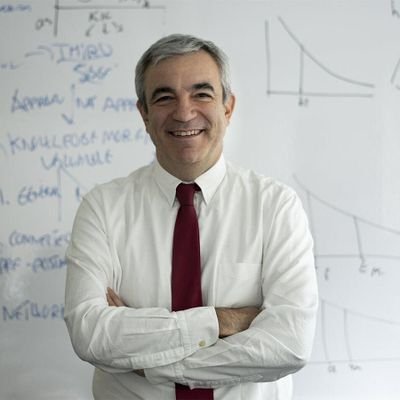
An announcement: Under the leadership of Mario Draghi and @patrickc we have set up the Rhine Group: policymakers, economists, entrepreneurs and business people pushing European reforms and the Draghi agenda.
rhinegroup.eu/

Simone Arrigoni 🇪🇺🇺🇦 retweeted

This week we published an article critically assessing the work of @DAcemogluMIT. In response, the Nobel prize-winning economist has robustly defended his research and core ideas. Read his letter in full: economist.com/letters/2026/0…

Simone Arrigoni 🇪🇺🇺🇦 retweeted

Rest assured Daron…
… you know you achieved legendary status when you are the target of absurd weirdly motivated hit pieces 🎯
To the Economist you have seen better days and I hope you will soon again… you can do better!
Would be great to actually show interest snd write a piece on some topic and show different perspectives and go deep. But since when do you write a collage of random critiques on one person? I’m sure many good journalists and economist at the Economist found this piece terrible.

For some time Daron Acemoglu has been the colossus of economics. Give an economist a few drinks, however, and some of them will venture their true opinions about this giant economist.com/finance-and-ec…



Simone Arrigoni 🇪🇺🇺🇦 retweeted

Madame Celeste Amarilla,
Vous êtes une femme méprisable et indigne de sa fonction.
Vous ne représentez pas le Paraguay, ce pays qui a transpiré la passion et l’honneur tout au long de la compétition. Par votre inconscience et votre racisme décomplexé, le monde entier a déjà oublié le parcours et l’effort historique que vos joueurs ont réalisés durant cette coupe du monde pour laisser place à une dame incompétente donnant la pire image possible de son pays.
Je ne laisserai jamais aux gens comme elle, la liberté de laisser propager leur haine et leur racisme à travers le monde.

Check out our column 😊👇
Thanks @voxeu for the opportunity!

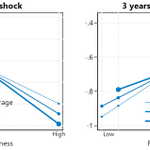
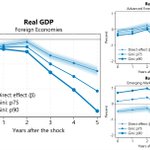
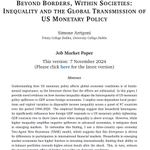
Beyond borders, within societies: Inequality and the global transmission of US monetary policy
Simone Arrigoni @simone_arrigoni @banquedefrance, Massimo Ferrari Minesso @ecb
ow.ly/GEq950Z32H0

3
108
Simone Arrigoni 🇪🇺🇺🇦 retweeted

Chris Sims’ contribution to economics
@Francesco_Bia @JHUArtsSciences, @marcodelnegro @NewYorkFed, @gprimice @NUEconomics, Frank Schorfheide @penneconomics
ow.ly/xlnj50YzzhJ

Simone Arrigoni 🇪🇺🇺🇦 retweeted

Stablecoins are macro-relevant and reshape the international monetary system.
Our new ECB Working Paper with Massimo Ferrari shows how USD stablecoins create global linkages --changing U.S. monetary policy effectiveness and exposure to foreign shocks.
=> tinyurl.com/dzva5pxd
Simone Arrigoni 🇪🇺🇺🇦 retweeted

Our PhD programme is now taken applications for its Sept 2026 intake!
🚨 The deadline for funding consideration is 15th January 2026 🚨
Past students have found their first appointment in institutions like @PSEinfo, @ESRIDublin, @centralbank_ie and many more!

Simone Arrigoni 🇪🇺🇺🇦 retweeted
Let me explain why I believe modern economics is such a powerful tool for understanding the world. I’ll do this by discussing a great paper by Simone Cerreia-Vioglio, @UncertainLars, Fabio Maccheroni, and Massimo Marinacci, “Making Decisions Under Model Misspecification,” published in the Review of Economic Studies a few months ago.
Imagine I want to drive from UC San Diego to UCLA, but I’ve never driven that route before. I need to build a “model of the world” to guide me, which we usually call a map. Maps are simplified representations of reality. They can’t include every detail if they’re to be useful. Borges, in his short story On Exactitude in Science, makes this point beautifully. (In practice, I don’t draw the map myself—I use an app—but someone still had to make it.)
Because maps simplify, I can’t fully rely on them. Maybe last night’s storm knocked down a tree and closed a street, or there’s construction and the ramp off the highway in LA is shut down.
This uncertainty matters. Suppose I’m driving to UCLA for an important talk at 11 a.m. If the ramp is closed, I might need 15 extra minutes. When should I set my alarm to arrive on time, while still getting enough sleep to give a good talk?
The problem is that I can’t assign precise probabilities to all these contingencies. How likely is the fallen tree? Or new roadwork? Even the best traffic apps can’t capture every disruption, and some might happen after I’ve already left.
In economic terms, my “model of the world” (the map) is misspecified—and no matter how hard I try, I can’t fully fix that.
But sitting down and crying about misspecification doesn’t answer my basic question: when do I set the alarm? Too early, and I’m exhausted. Too late, and I’m late.
Simone and his co-authors offer a way to think about this. They start from the idea that we often hold several structured models of an economic phenomenon, grounded in theory. For example, a central bank might use a standard New Keynesian model and a search-and-matching model of money.
Yet, aware that each model is misspecified by design, the bank adds a protective belt of unstructured models—statistical constructs that help it gauge the consequences of misspecification.
The beauty of the paper is that it provides an axiomatic foundation for this protective belt (and even generalizes it to include a Bayesian approach). It shows that if a decision-maker’s preferences meet certain conditions —reflecting both rational and behavioral features— then those preferences can be represented by an augmented utility function that formally accounts for misspecification.
Crucially, we don’t assume that augmented utility function; we derive it. We start with general, plausible properties of preferences and prove that they imply such a representation.
That’s real progress. Instead of writing endless critiques of expected utility or rational expectations (as many have done for decades, with little to show), we now have a formal way to reason about misspecification—precise definitions, clear boundaries of validity, and awareness of what we still don’t know.
Take, for instance, a brilliant Penn graduate student on the market, Alfonso Maselli
economics.sas.upenn.edu/peop…
His job-market paper pushes this frontier further. He studies cases where a decision-maker not only faces model misspecification but is also unsure which model best fits the data and can’t assign probabilities to them—what we call model ambiguity. In my example, the central bank is unsure whether the New Keynesian or the search-and-matching model fits better, and it worries that both might be incorrect.
If you read Simone et al. or Alfonso’s paper, you’ll see how misguided—and, frankly, cartoonish—many of the recent criticisms of economics on X have been.
First: the idea that economists don’t understand math or have “physics envy.” The math in these papers is subtle and advanced—utterly different from what physicists do (neither better nor worse, just distinct). An engineer transitioning into economics would find these tools unfamiliar.
Second: claims of ideological bias are unfounded. I have no idea about the political views of the authors, and I’d be surprised if anyone could infer them from the analysis—beyond vague guesses about typical academics.
Third: This has almost nothing to do with what one learns as an undergraduate, or even in first-year graduate school. If your knowledge of economics stops at an intro textbook, it’s best not to pontificate on the field’s frontiers.
Fourth: Is this science? Debating that word’s boundaries is pointless; every definition of “science” breaks down somewhere.
The Germans solved this long ago with the idea of Wissenschaft—the systematic pursuit of knowledge, whether of nature, society, or the humanities. By that measure, modern mainstream economics is clearly a Wissenschaft: a disciplined, cumulative, and highly useful effort to understand how the world works. Simone and his co-authors have demonstrated that beyond any reasonable doubt.

Simone Arrigoni 🇪🇺🇺🇦 retweeted
✍️New Research ✍️
Congratulations to @abenetrix and @DavideRomelli on the publication of their paper in Open Economies Review (@SpringerNature) 🧐
Read the paper: tinyurl.com/5bumn883
@imtcd @TRiSSTCD @TrinityResearch


📢 New paper published in Open Economies Review!
(with @abenetrix @calder_tara @DavideRomelli)
👉 Check it out: doi.org/10.1007/s11079-025-0…
A short summary thread 👇🧵
1/5
📥 As an illustration of its potential, we use the augmented dataset to examine how education relates to portfolio returns and risk, between and within countries.
4/5
1
37
Simone Arrigoni 🇪🇺🇺🇦 retweeted

📣 We are excited to share the program for the IM-TCD virtual seminar series 2025-26!
Would you like to join? Sign up here 👇:
forms.office.com/e/hYhCPCZ2L…
We are now on BlueSky — follow us: @imtcd.bsky.social
@tcdeconomics, #EconTwitter, #MacroSeminar

Simone Arrigoni 🇪🇺🇺🇦 retweeted

It's that time of the year ☘️
Our new Call for Speakers is out! 🚨
If you are a young researcher in Economics and Social Sciences and you would like to present your work to other young researchers based in Ireland, please fill out the form here below! 👇
docs.google.com/forms/d/e/1F…
