

CFA. Ex-sell side analyst. Fundam. research focus. Do more of what is working, less of what isn’t. See what others don’t. https://teapawt.net/t.co/0WS5pK8d60
Omnipresent
Joined May 2009
- Tweets12.3K
- Following1.3K
- Followers12.8K
- Likes10.2K


Pinned Tweet
Why the QQQ's are Under Pressure: The AI Trade Is at an Inflection Point
The fear in this market is palpable.
The shift from free-cash-flow positive to negative, combined with the accumulation of massive amounts of debt among some of the largest weights in the indices, is concerning. Add geopolitics, U.S. political dysfunction (I can say that because I’m Canadian), and the growing anxiety surrounding the existential implications of AI: job displacement, IT security, lack of defensible moats, existential threat fears and the potential disruption of entire business models.
It is also becoming increasingly clear that we have moved past the euphoria phase of this cycle and into the air pocket between the massive infrastructure buildout and the realization of actual returns on investment. Corporate America is still figuring out how to deploy this technology in practical, measurable ways—with identifiable use cases and quantifiable economic paybacks.
Meanwhile, the rate of growth is slowing as a growing number of bottlenecks constrain the pace of expansion. Rising interest rates, combined with the sheer volume of capital that still needs to be raised, have pushed the financing bottleneck to the forefront of the market narrative.
This has become a "scare-you-out-or-wear-you-out market."
Underneath the headline indices, much of the market outside technology is already in a bear market, with energy, financials and healthcare among the notable exceptions.
The underlying fundamentals supporting the AI/SI trade have not necessarily deteriorated. But the market is increasingly looking through the circular financing arrangements, guarantees and investment mark-ups that have helped support spending—and, in some cases, create the appearance of stronger earnings than the underlying economics justify.
On the surface, multiples appear to be contracting. Yet across much of the semiconductor universe, valuations remain well above historical norms. The market's reaction to otherwise strong earnings tells you almost everything you need to know: the market is saying "no mas" to further multiple expansion in hyper-scalers and AI hardware.
The AI/SI investment cycle is shifting, and the incremental investment dollar will shift with it.
The AI/SI investment cycle is shifting, and the incremental investment dollar will shift with it.
What we are witnessing is a wholesale reset of valuations and expectations. That reset is arguably necessary to clear the runway for a new phase of growth—one in which returns are increasingly justified by real earnings and free cash flow rather than investment momentum and future promises.
We already know where the money is going... click the link in the bio if you would like to hear my full thoughts about where the real money in AI/SI will be made in this next phase of the cycle.

All of the major cloud-hyperscalers (CSPs) are accelerating revenues YoY with GCP revs up triple digits yet the ai infrastructure stocks are getting wrecked because the hyperscalers didn’t raise capex for Q4.
All of these companies have said they’re still compute constrained and therefore capex spending will increase significantly in 2027… but the market doesn’t seem to care.
Elon said that demand is so strong he wants to bring on 10GW of capacity in 2027 which might cost $400B+ but he said it’s justified because the payback is ~12 months… but the market doesn’t seem to care.
Anthropic is coming public at $1.5 trillion
OpenAI probably comes public at $1.5 trillion.
Cognition is raising money at $80 billion.
Dozens of other ai labs are raising VC money at $10-50B valuations with the overwhelming majority of that fresh cash going into compute… but the market doesn’t seem to care.
GPU rental rates are hitting new highs every single week… but the market doesn’t seem to care.
These are very strange times because it appears that ai demand / adoption is still accelerating which means compute demand keeps growing which means the spending needs to continue but the market is clearly not buying it.
Most of the ai infrastructure stocks continue to report great numbers… many of them saying 2027 growth and margins will be even better than 2026 growth and margins (ie $BE and $CLS) but the stocks still can’t catch a sustainable rally.
I’ve lost track of how many ai infrastructure companies are growing revs and eps by 50-100% this year and guiding to 50-100% growth next year yet they’re all trading with PEG ratios below 0.5x, some under 0.2x
Wake me up when the market starts to make sense. Thanks.
$MRVL $141.70 COMPELLLING: MOST DISCLOCATED VALUATION IN THE SEMI/AI INFRASTRUCTURE FUD FLUSH
Pro-forma $LITE run-rate EV/S:
9.7x vs $AVGO 11.8x & $NVDA 11.7x
→ ~18% discount
Next-qtr guide:
8.2x vs 10.1x & 10.4x
→ ~20% discount
Pro-forma EV/EBITDA (incl. $1B synergies):
21.2x vs AVGO 27x & NVDA 22x
→ 24% & 3.5% discounts
Through this entire AI cycle the market has paid $MRVL a premium multiple for its higher growth, despite being a fraction of the size of these elephants.
Post-deal still only ~12% of $AVGO and ~4% of $NVDA.
I WOULD POSIT THAT THIS DISCOUNT RETURNS TO A PREMIUM ONCE THE DUST SETTLES ON BOTH THE ACQUISITION AND THE AI BUILD-OUT FUD.
... link in bio for more top picks, macro thoughts, and ongoing $MRVL dialogue....

This is actually crazy.
Not long ago, $MRVL signed a deal valuing $LITE at $115 billion, about $1,132 per share.
Today, Lumentum’s ENTIRE market cap is $48 billion. Marvell’s is $122 billion. The two companies COMBINED now cost $170 billion, less than Marvell alone was worth earlier this year.
Same deal, same sold-out optics business, Marvell even reaffirmed its quarter in the deal press release. The all-stock structure just dragged both down through the worst semiconductor week in years.
The market cut the price of the same merger by more than half in five days. Nothing about the business changed, only the fear did.

$AXTI $55. Ludicrous, '27E P/E is 20.8X, with earnings growth the PEG is a mere 0.17X. Revenue growth, margin expansion, backlog explosion, further efficiency gains, multiples of demand vs. supply. All customers on allocation. No pressure to sign LTA's given pricing power... the set up here is one of the best on board.
... time to head back under your bridge, troll.

$LQDA $39+ in AH. See link in bio to get my latest thoughts on where we go from here on this name as well the best opportunities I currently see in this market. A lot of content (hundreds of hours of work) soon be be dropped... @StoryTrading

Another outstanding call from one of FinTwit’s sharpest fundamental analysts, @smantel! 👏
He reiterated his $LQDA thesis around $27 today, and the stock traded right into his target range.
Get access to his research and trade ideas inside StoryTrading with code GODFATHER for 25% off recurring!👇
linktr.ee/TheGodFatherKnows
Thanks bud, much appreciated. $LQDA fair value still much higher. Mr. Market will be surprised & $UTHR pissed by how much “off label” PH-ILD they continue to get. This patent ruling changes little for the relatively small community of specialist dr’s who rely on the vastly superior inhalation of Yutrepia.

Great call! Takes guts to hold ,but @smantel always on fire with his research.
Was waiting on some kind of judgement but conviction is key! NIce one Story Team
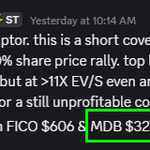
... and $MDB hits $370.43 this morning...
... another big payday for our community...
... click the link in the bio if you are interested in getting ahead of the curve...
@StoryTrading


$MDB $336.60
... anyone who listened to the investor day today knows that there will be a deluge of analyst upgrades coming tomorrow...
... the same lemmings that sold this down 20% yesterday will be chasing it back higher in the coming days.
... at the end of the day what matters most are the numbers they put up...
... as a reminder, this is what happened the last time they reported numbers:
... thanks Chirantan Desai for the🎁.
Click the link in my bio if you'd like to leave the land of the lemmings...
@StoryTrading

TheGodFatherKnows retweeted

The implications of this are massive. Running a small business used to require multiple people across accounting, marketing, sales, customer service and operations.
Now imagine one entrepreneur + one AI agent plugged directly into the tools that run the business. That’s where Muse is heading.
AI isn’t just making people more productive. It’s giving individuals leverage that previously required an entire team.
Well done to the @Muse team. 👏 $META

$MDB $336.60
... anyone who listened to the investor day today knows that there will be a deluge of analyst upgrades coming tomorrow...
... the same lemmings that sold this down 20% yesterday will be chasing it back higher in the coming days.
... at the end of the day what matters most are the numbers they put up...
... as a reminder, this is what happened the last time they reported numbers:
... thanks Chirantan Desai for the🎁.
Click the link in my bio if you'd like to leave the land of the lemmings...
@StoryTrading

I am not convinced this sudden departures of MongoDB's $MDB CEO is a red flag.
If you look through his LinkedIn profile, he is a career professional and his last job before MongoDB was at CloudFlare $NET where he only lasted for a little over a year.
There were other companies (Symantec, Pivotal) where he only lasted for a year or two.
An opportunity to have a larger impact at $META was probably hard to pass up for a career CEO.

TheGodFatherKnows retweeted
Here’s the 4-Pillar Card we sent to the StoryTrading community yesterday on $RSKD. Understanding the story behind the trade is what we do best at StoryTrading.

TheGodFatherKnows retweeted

Think the $rskd setup is compelling.
Companies outsource their ecomm fraud risk to them. They guarantee a transaction approval rate and fraud friction rate better than companies can achieve themselves. They are the leader in the space, winning 75% of RFPs, and have built a platform around this offering.
The bottleneck that modulated growth had been companies keeping their fraud management in house. As agentic ai has changed the ecomm risk profile and transaction identity verification is becoming more critical, their extensive fraud and identity data set makes their capabilities even more important. This showed up in q2 growth acceleration - more new logos, more upsell among existing logos.
The stock hadn’t worked for a long time- more bc of illiquidity in the face of legacy shareholder sales, despite large share repurchases. This was a Covid-era busted ipo with pre-ipo shareholders that needed to get out. The spike in volume since q2 eps is addressing this- I think we are close to finished with legacy stock supply.
EV/fcf (excludes big net cash balance) is 14x stale 27 estimates. Consensus has rev growing only 11% in 27. This should move materially higher.
I think 20x higher 27 fcf + 200mm current net cash is justifiable, if not still cheap. Thats $18.50/sh.
So the thematic, fundamentals, technicals, and valuation line up here, imho.
TheGodFatherKnows retweeted

$FRO $DHT $INSW $LPG $BWET (Bloomberg) -- The soaring cost of moving oil around the world is making some long-distance crude trades uneconomical, threatening to disrupt flows at a time when fuel markets have never been tighter.
The jump is being driven by a shortage of available supertankers. In some parts of the world, there are barely any of the ships — each the length of three football fields — left for hire. The squeeze is making faraway barrels less attractive and encouraging refiners to snap up supplies closer to home if they can find them.
Moving a cargo from Houston to Asia now adds about $26 a barrel — $52 million a cargo — to the cost of supplying the world’s largest crude-importing region. That’s equal to roughly a quarter of the price of West Texas Intermediate futures. Before the war, shipping typically accounted for only a tiny fraction of the cost.
The rally is minting fortunes for the small group of shipowners that dominate the tanker market — several industry executives and brokers said the surge would previously have been unimaginable. The value of the world’s largest oil tanker equities soared to a record of almost $70 billion this week.
But for oil traders, the risk is that shipping becoming prohibitively expensive. They’re concerned that the higher costs make it unprofitable for some refiners to turn crude into fuels, deterring them from buying cargoes that have to sail over long distances, even when demand to make diesel and gasoline is strong.
On the industry’s main benchmark route, very large crude carriers hauling 2 million barrels of crude from the Persian Gulf to China are earning upward of $1.2 million a day. Similar pressures are now spreading across the freight market globally.
“It has never been this expensive to move oil around,” Saad Rahim, chief economist at trading giant Trafigura Group, said at the Bloomberg Commodity Investor Forum on Thursday. With freight becoming a larger portion of the value of the cargo, “it becomes a much bigger issue now when you start to think of that in terms of logistics.”
Some long-haul routes that became crucial after wars disrupted energy flows are now looking unattractive as a result of the surge.
Ship-tracking data from Vortexa show US-Asia flows have fallen in recent weeks, as freight costs roughly tripled. A Japanese refiner recently bought a cargo of Alaskan crude — a grade not typically well-suited for the country’s processors — because of the relatively short sailing distance, people familiar with the matter said.
In contrast, the clamor for nearby barrels shows up in Europe’s crude prices.
While Brent futures topped out close to $110 a barrel this week, the European Dated Brent physical crude price climbed above $131 as buyers hunted short-haul cargoes. The region’s processors are also scrambling to replace barrels from the Middle East after Saudi Arabia gave no cargoes to European buyers under their term contracts for next month.
Further afield, sales of Angolan oil, which usually sails thousands of miles to buyers in China, are sluggish.
“Current freight levels can become self-limiting over time — they eventually close arbitrage routes and reduce demand for the most expensive long-haul barrels,” said Sumit Ritolia, senior manager of modeling at analytics firm Kpler.
Photographer: Mark Felix/Bloomberg
A crude oil tanker at the Enterprise Marine Terminal in Freeport, Texas.
Shipbrokers with years of experience said they’ve never seen supertanker availability so tight, while multiple industry executives said they’ve never known a market like it. Many said there are few, if any, of the vessels available for hire in certain locations, depending on the timeframe in which they are required.
That’s rippling down to smaller ships.
Asian refiners are turning to 700,000-barrel Aframax tankers for some purchases from the US, rather than the supertankers typically used for those journeys. Shipments loading from ports in the Atlantic, including Brazil, are being booked on two 1 million-barrel Suezmax vessels rather one supertanker with twice that capacity, traders and shipbrokers said.
It’s dragged earnings for smaller vessels higher too. Earnings for Suezmaxes are on average north of $300,000 a day, rates typically associated with sailing in and out of war zones.
The biggest drivers of the surge are twofold: the knock-on effects of the US-Iran conflict, and a huge wager by a South Korean tycoon that was already sending shipping rates higher before the war began.
Vessels shuttling barrels through the Strait of Hormuz are sucking up more ships for longer as they switch cargoes near Oman. Other tankers are sailing thousands of miles around Africa to pick up cargoes in the Mediterranean, while until now, Asian buyers swapped lost Middle Eastern barrels for longer-haul supplies from the Americas. Those factors all help stretch out the tanker fleet and boost rates.
The key for oil traders is how long elevated freight rates can be sustained. Diesel futures in Europe are near $200 a barrel, a sign the region’s processors still need to get their hands on every cargo they can.
“Freight has never taken a big part of the delivered cost of oil, but it’s now playing a much bigger role in oil markets,” said Xavier Tang, senior market analyst at analytics firm Vortexa. “This is having a knock-on effect on end buyers.”


$FRO $INSW $LPG $BWET RED SEA & STRAIT OF HORMUZ: IMPACT ON GLOBAL TANKER DAY RATES
The simultaneous disruption of both the Strait of Hormuz (Iranian-controlled) and the Red Sea/Bab el-Mandeb (Houthi-controlled) has created an unprecedented dual-chokepoint crisis, eliminating the two primary energy export arteries from the Middle East and driving crude tanker spot rates to historic highs. As of this morning, the situation has intensified further: Saudi Arabia's East-West pipeline — the last meaningful bypass route for Hormuz — was shut on September 11 following drone attacks launched from Iraq, while Houthi forces are reportedly advancing on Mokha near the Bab el-Mandeb Strait.
GEOPOLITICAL BACKDROP
Strait of Hormuz: Daily transits plunged 97% in August 2026, with a network of stealthy crude tankers managing to restore flows to only roughly half prewar levels via shuttle runs to ports outside the chokepoint by end of August. Iran and Oman have reportedly reached an agreement in principle on a proposed shipping lane through the strait, with a joint statement in final drafting — but Iran is seeking transit fees, which European nations reportedly now accept as inevitable.
Red Sea / Bab el-Mandeb: Houthis have enforced a blockade, turning back vessels bound for Saudi ports. Nippon Yusen has stated its earnings outlook assumes Cape of Good Hope rerouting continues throughout FY2026 (ending March 2027).
Saudi East-West Pipeline: Shut as of September 11, eliminating the primary overland bypass that allowed Saudi crude to reach the Red Sea without transiting Hormuz.
IEA Assessment: A recovery in Middle East oil flows is now expected to stretch into 2027, with global oil demand cut to 102.4 mb/d in 2026 (down 2.5 mb/d from prior forecast).
CRUDE TANKER DAY RATES
The Hormuz disruption obstructed approximately 20–25% of global seaborne crude oil trade in H1 2026, causing historical highs in crude tanker earnings across all vessel classes.
VLCC spot rates on the TD3C benchmark route (Middle East Gulf to China) reached $218,154/day on February 27, 2026, then surged above $423,000/day in early March as the Hormuz closure took hold, before reaching a new high of $579,443/day as of September 11 — coinciding with the Saudi pipeline attack.
Commercial shipping traffic through the Strait of Hormuz decreased by over 85% at peak disruption.
The displacement effect from VLCCs concentrating on long-haul routes to Asia has indirectly tightened the Suezmax and Aframax markets, lifting demand and freight rates for smaller tanker classes.
Time-charter rates in H1 2026 increased 74% year-over-year for Aframax crude tankers, significantly above the ~10–20% YoY growth that had been forecast.
PRODUCT TANKERS (MR, LR1, LR2)
The product tanker market has been supported by refinery dislocations caused by the Hormuz disruption, with LR2 vessels switching into dirty trades (crude carrying), tightening clean tanker supply.
MR tanker time-charter rates increased 38% YoY in H1 2026, well above prior forecasts.
Handy chemical tanker TC rates rose 32% YoY in H1 2026.
Security risks around Hormuz and Red Sea avoidance have lengthened shipping routes and tightened vessel availability, pushing freight rates higher across clean tanker segments.
Escalating hostilities caused shipping costs for refined products to increase by nearly 20% to East Asia and 40% to East Africa within a short window, with several tanker owners pausing new vessel offers due to regional uncertainty.
Hull and machinery insurance for ships transiting the Strait of Hormuz increased from 0.125% to 0.2% of ship value.
It is worth noting that prior to the Hormuz escalation, the product tanker market faced structural headwinds: supply growth was projected to outpace demand by 630 basis points in 2026, and MR tanker rates from the Middle Eastern Gulf to Singapore had already declined 48% on average in 2025. The geopolitical shock has overridden these fundamentals, at least in the near term.
LNG CARRIERS
Approximately 20% of global LNG supply originates from Qatar and the UAE, relying on unobstructed passage through the Strait of Hormuz. Any restriction or halt in tanker traffic could force major LNG buyers such as China to rely on the spot market.
The LNG carrier market in 2026 remains mixed — carriers are under pressure from a period of vessel oversupply, but the Hormuz disruption has added significant volatility, impacting LNG and LPG flows from Qatar and the wider Gulf.
The LNG carrier market was expected to see a 19% structural surge in tonne-miles in 2026 driven by new supply coming online, but the Hormuz closure has disrupted the realization of that demand.
Disruptions through Hormuz — through which 20% of global LNG trade passes — could cause supply chain disruptions similar in magnitude to the Red Sea situation in December 2023.
REROUTING: TONNE-MILE IMPACT
The Cape of Good Hope detour adds 15–20 days per voyage versus Suez Canal routing. Hormuz transit was down 97% in August 2026, while Suez Canal crossings were up 37% in August as rerouted flows bypass Hormuz via Red Sea alternatives. Rerouting from the Red Sea/Suez crisis has increased voyage distances by 30–50% overall. These longer voyages absorb vessel capacity, structurally tightening supply across all tanker classes.
The tanker freight market is expected to remain firm through the remainder of 2026, supported by ongoing geopolitical disruptions and structural shifts in global oil trade flows that have significantly increased tonne-mile demand.
FORWARD RATE OUTLOOK
Bull case (escalation): Oil tanker spot rates are projected to surge approximately 37% to $300,000/day by October if Hormuz tensions escalate, driven by a prolonged recovery and a shift to long-haul Cape of Good Hope routes.
Base case (slow normalization): VLCC spot rates are expected to end 2026 in the $90,000–$110,000/day range, supported by a significant backlog of vessels awaiting Hormuz passage and a global effort to rebuild depleted energy inventories.
Reopening scenario: A full Hormuz reopening with fast production recovery could trigger a race to book shipping capacity, driving a sharp increase in Gulf shipping rates as the market shifts from "low volume + high rates" to "high volume + high rates."
Bear case (2027 normalization): If shipping activity normalizes, tanker rates could decline approximately 30% from current levels.
Important caveat: A complete and sustained Hormuz closure would likely be net-negative for tanker rates, as the volume loss would not be offset by longer-distance routes — with VLCCs being the most impacted segment.
The key variable for the remainder of 2026 is whether the Iran-Oman Hormuz deal is finalized and what transit fee regime emerges. The Saudi East-West pipeline attack this morning eliminates the primary bypass option and raises the stakes materially for any near-term resolution.


$META $664.60
This is a very noisy market... X is a very noisy platform...
If you feel like you might be missing out on some lucid thoughts, I'd encourage you to follow the link in my bio.
We offer a real community dedicated to cutting through the noise and generating real Alpha.💵 @StoryTrading

Ogruz is spot on imho.
Frontier model companies have both alignment and ROI issues.
The safer bet if you want exposure to AI is through the likes of $META which is the cheapest of the names mentioned.
Selective AI picks and shovels can still work but at current prices given the near-term hurdles in the market weighing on sentiment (read: multiples) I'm willing to wager that even your favorite name in that group will present you with better entries over the next 4-6 weeks.

If you think Dario has called for slower AI development purely for altruistic reasons, you are pretty naive.
His company is going public, but he is between a rock and a hard place.
Being public means you can’t recklessly raise money to buy compute without your shares getting crushed by the market.
Same applies to $SPCX and OpenAI probably thinks they can benefit from lower spending to polish their balance sheet ahead of the IPO.
Meanwhile other labs at the frontier like Google, Microsoft and Meta don’t care because they already have strong cash flows and deep pockets.
Only way to slow down without losing market share is calling for industry wide slow down, otherwise competitors with deep pockets will take you on.
I don’t think he is short-sighted enough to call for acceleration last year and change his mind this year. After all, looks like nothing has changed in AI’s trajectory since the last year.

... I couldn't agree more. Compare below forward P/E multiples of < 20X for these vs. crazy valuations for the Frontier model cos with seemingly little pricing power and it becomes clear that IPO buyers will once again become exit liquidity.

CAPITAL DRIES UP + SUSPICIOUS IPO TIMING
If outside capital becomes less willing to finance repeated frontier-training runs, the advantage increasingly shifts toward incumbent technology companies with enormous existing cash flows.
Frontier AI may require tens of billions of dollars of recurring investment with no certainty that each new generation produces durable pricing power. $GOOGL, $META, $AMZN and $MSFT can absorb that spending because AI does not need to stand alone economically. AI can strengthen search, advertising, cloud, commerce, productivity software and existing customer relationships.
Standalone frontier labs have a much harder problem. Eventually the model business itself has to generate enough economic value to justify the enormous capital being invested into it. If private investors become less willing to continuously finance the next training run, frontier development increasingly becomes a balance-sheet game rather than a startup game.
This also makes the timing of frontier-lab IPOs potentially suspicious.
If these companies go public while training costs are exploding, future capital requirements remain unknowable and normalized margins are still impossible to estimate, investors should ask why they are being offered the equity now.
One possibility is simply that these companies need more capital, employee liquidity and acquisition currency. But the more bearish interpretation is that existing private investors recognize how expensive the frontier race could become and want access to the much larger pool of public-market capital before private financing becomes less willing to fund it.
In that scenario, the IPO is not necessarily the point at which the economics have matured. It could be the point at which the financing model needs to change.
That distinction matters enormously.
The ideal IPO would occur after a frontier lab demonstrates that training intensity is stabilizing, inference economics are attractive, customers are sticky, pricing power exists and recurring cash generation can fund a meaningful portion of future R&D.
A much more concerning IPO would occur while the company still needs repeated massive injections of outside capital merely to maintain its technological position.
Public shareholders could effectively become the next funding source for an indefinite frontier arms race.
The key question when a frontier lab IPOs therefore should not be:
“How fast is revenue growing?”
It should be:
“Why are the existing owners choosing this moment to sell equity to the public, and can this business eventually fund the frontier from its own cash flow?”
If the answer to the second question is unclear, the IPO should be viewed partly as a financing event rather than evidence that the underlying business model has matured.
The broader thesis is that if frontier AI remains extraordinarily capital intensive, economic power gradually shifts toward companies capable of funding the race internally.
That favors the incumbent hyperscalers and makes standalone frontier labs structurally more dependent on capital markets.
Ironically, the biggest risk to standalone labs may not be that they lose the technological race.
It may be that the cost of continuously staying in the race eventually exceeds what outside investors are willing to finance.
$META $614.47 The deeper I look into Meta’s consumer AI agent launch, the more compelling the thesis gets.
Meta has been a stealth AI leader for years monetizing algorithms behind the scenes by optimizing ad targeting, content ranking, and user engagement.
Given their massive installed base, reliable utility and user trust could set new speed records for scaled consumer engagement.
The key question now: Will this translate into a major sentiment catalyst and ultimate multiple expansion?
$META is back on my primary watchlist for the first time in years. 👀
$META $615
The market has been deeply skeptical of Meta's ability to deliver a successful Personal AI product, especially against the ROI hurdles and high bar that come with the $150B in annual run-rate capex. But I don't think today's initial 1% "pop then fade" reaction to Muse reflects this product's long term return potential. It opens up a cross sell commerce TAM at a scale few, if any, competitors can match.
Could this be the start of an inflection move that finally sees the stock sustainably push above its 200-day moving average?
At 18x forward earnings, sentiment looks like a more forceful headwind than fundamentals right now.
The accelerating cadence of new product launches lately might be enough to finally flip that sentiment and set up another push toward $700.
At this juncture, I'd take a simple break of its $660 resistance level.

$META $615
The market has been deeply skeptical of Meta's ability to deliver a successful Personal AI product, especially against the ROI hurdles and high bar that come with the $150B in annual run-rate capex. But I don't think today's initial 1% "pop then fade" reaction to Muse reflects this product's long term return potential. It opens up a cross sell commerce TAM at a scale few, if any, competitors can match.
Could this be the start of an inflection move that finally sees the stock sustainably push above its 200-day moving average?
At 18x forward earnings, sentiment looks like a more forceful headwind than fundamentals right now.
The accelerating cadence of new product launches lately might be enough to finally flip that sentiment and set up another push toward $700.
At this juncture, I'd take a simple break of its $660 resistance level.

So if $META's Muse was a stand-alone company, what is Muse.AI worth? What would be its market cap knowing it has a partner that could market the product to 3.6 Billion users? AND it has ~$150 Billion worth of its own data centers...
Is it worth $200 Billion? $500 Billion? $1 Trillion?
Whatever the number, in my opinion, it's not included in $META's market cap!

$LULU ugly. …and set to get worse

lulu...case study in fixed cost deleverage
>SSS% down 10% (NA SSS% down 12%)
>SG&A as % of sales: 400 bps in the wrong direction (41.7% up from 37.7%)
>EBIT margins incl. 560 bp benefit from tariff refunds; excluding that, margins compressed 750 bps (!!) from 20.7% to 13.2%
>3Q guide may imply even worse/be even ooglier (I'm not involved or current here --> "too hard" pile)
FY guide is the op deleverage in quoted tweet: revs down 5-7%, EPS down 30%.

$LULU $100.53
Welcome to your new ceiling at $100.
Fundamentally, the numbers go lower before they go higher as it increasingly looks like the business needs to "shrink to grow." That's the right move for the new CEO in my view, even though she's historically been a growth specialist, not a turnaround one.
Lower numbers plus a multiple under pressure from souring sentiment which could suffer further as the market runs out of patience with how long this fix will take point to a path of least resistance that's still lower, even after the quarterly release plunge.
Low-to-mid $9-handles look inevitable from here. Possibly lower depending on how big the "kitchen sink" is...
For my more in-depth thoughts see the link in my bio. Would love to have you onboard.
$MRNA $144
… if only someone had predicted this before it happened….
See link in bio for 50% off more predictions
$MRNA $147.20
Now that analysts have completed their target price upgrades—likely preserving syndicate positioning for upcoming underwriting mandates—an equity or equity-linked capital raise appears imminent.
While a straight equity offering would realistically require pricing in the $80–$120 range (~$100 midpoint), a convertible debt offering paired with a capped call overlay represents the far more prudent execution. This structure enables management to capture a higher effective strike, minimize immediate equity dilution, and monetize elevated implied volatility.
Given the aggressive capital expenditure required to fund the clinical pipeline and commercial scaling, relying solely on the remaining COVID windfall balance sheet runway is sub-optimal.
Opportunistically executing an equity-linked deal at these levels is the prudent capital allocation move—so much so that failing to evaluate it raises valid fiduciary questions for the board in my humble opinion.
Your move Bancel. The clock is ticking.⏲️⏳
Meanwhile daily volumes show the fast fading money flow...
19-Aug 199.25M
20-Aug 99.5M
21-Aug 87.3M
24-Aug 31.7M
25-Aug 49.2M
26-Aug 22M
$NVDA's results supporting the AI trade will only serve to expedite this back to pre-announcement mid single digits M's.
Volume precedes price.
$MRNA $147.20
Now that analysts have completed their target price upgrades—likely preserving syndicate positioning for upcoming underwriting mandates—an equity or equity-linked capital raise appears imminent.
While a straight equity offering would realistically require pricing in the $80–$120 range (~$100 midpoint), a convertible debt offering paired with a capped call overlay represents the far more prudent execution. This structure enables management to capture a higher effective strike, minimize immediate equity dilution, and monetize elevated implied volatility.
Given the aggressive capital expenditure required to fund the clinical pipeline and commercial scaling, relying solely on the remaining COVID windfall balance sheet runway is sub-optimal.
Opportunistically executing an equity-linked deal at these levels is the prudent capital allocation move—so much so that failing to evaluate it raises valid fiduciary questions for the board in my humble opinion.
Your move Bancel. The clock is ticking.⏲️⏳
Meanwhile daily volumes show the fast fading money flow...
19-Aug 199.25M
20-Aug 99.5M
21-Aug 87.3M
24-Aug 31.7M
25-Aug 49.2M
26-Aug 22M
$NVDA's results supporting the AI trade will only serve to expedite this back to pre-announcement mid single digits M's.
Volume precedes price.