

USAF Retired Pilot. Current Airline Pilot. 35 years flying experience...B747, B737, C-17, T-43, E-4B...I quit counting at 15,000 hours.
Joined April 2022
- Tweets7.8K
- Following779
- Followers806
- Likes2.3K


Pinned Tweet
The only time in my career that static discharge traveled from the tanker to my aircraft. It was in the clouds near a line of thunderstorms. I had no idea the boom operator had someone video it until a couple years later. One of my more memorable flights.
youtu.be/KVzpV3V_V3U?si=iB4x…

3
44
4,468
Now that the CVR/FDR is recovered we can hopefully get some clarity.
Things we really don't know yet:
1. Did they actually see the storm cell, did they fly into the storm cell, or were they just above it.
2. How bad were the turbulence and altitude deviations.
3. How long were they getting icing and did they see evidence of significant ice.
4. What were the internal cockpit communications and what will those communications expose.
5. How effective was CRM used
6. Did they get a stick shaker/stall warning or did the plane stall without warning. I'm thinking if it stalled without stick Shaker, then ice is a certainty.
7. How large were the control inputs and when did the structural damage occur.
Feel free to comment with any unknowns you are hoping to see from the black box data.

The “Black Box” aka Cockpit Voice Recorder (CVR) and the Flight Data Recorder (FDR) have been recovered by the NTSB after a Learjet 60 crashed in Palm Beach County over a week ago.


Readers added context they thought people might want to know
Only the cockpit voice recorder (CVR) has been recovered by the NTSB from the Learjet 60 crash. No flight data recorder (FDR) recovery is reported, consistent with regulatory requirements for this aircraft.
x.com/NTSB_Newsroom/…
en.wikipedia.org/wiki/2026_Palm…
wflx.com/2026/11/09/nts…
tracethefailure.com/articles/palm-…
3
6
242
I've coined a new phrase for all the new aviation analyst on X. "Aviation X-perts". It actually works for any subject matter where people on X become self proclaimed experts.

20yo Learjet co-pilot dove 35k feet into a Florida neighborhood. 9 people dead.
Will investigators research the role of her “girlboss” attitude in the crash?
3
7
856

Can someone explain how a person with absolutely no knowledge of a subject convince themselves that they are qualified to offer analysis to the world?
unavailable
1
1
83
I've said for years, checked bags should be free, carry-on should be charged. Imagine how fast boarding would go if we charged for each carry on.
If it doesn't fit in your pocket, you get charged. TSA security lines would dwindle to nothing.
You're welcome, I just solved everyone's hatred of airports and flying.

waiting to board my @SouthwestAir flight rn, and they gate agent is BEGGING people to check their bags (for free, of course, cuz fuck the people who already paid $50 to do so).
"Please guys, I only have 45 checked bags and we have 120 passengers, your bags aren't going to fit on this plane."
WELL THEN WHY DO YOU INCENTIVIZE CARRYING ON AND PUNISH CHECKING BAGS.
airlines are so fucking retarded for this, and @SouthwestAir used to be the exception. no more ¯\_(ツ)_/¯
i am throwing away all my liquid toiletries and carrying my suitcase on on my return trip out of pure spite.
Just a reality check here. In the past 3 decades I have flown with many female pilots. None were influencers.
And thqere are also many male pilot influencers I've seen on YouTube.
Also, posting videos about your career in aviation isn't dangerous until you do it in a way that interferes with your duties.

Women become pilots so they can post themselves in the cute uniform, video themselves “studying” (coloring their ‘notes’ with highlighters), get attention/validation and followers, post Get Ready With Mes, LARP intellectual with “As a pilot” content, have Daddy Daughter Dates, and prove They’re Not Just Freeking Pretty Girls And Are Smart And Cool Too But Also Don’t Forget They’re Pretty btw.
None of them are actually interested in operating the plane, it’s just an avenue for them to social media celebrityhood, which is their version of Making It Out The Hood
I don't generally like the influencer career population. And its easy to pile hate onto influencers. But it's also unfair to label them all as equals. Some are ridiculous, some aren't. I don't know this one specifically, but I didn't see anything in this clip that would concern me.
Her cockpit video was no different than when pilots let children come into the cockpit and get photos.
In reality, it's probably more of a distraction letting the children get photos than what this girl did.
35
CitizenSmith retweeted

This is a developing story: European airlines are currently being inundated w/ bomb threats, which are all almost certainly fake, but they have to take seriously.
It’s becoming a major problem.


CitizenSmith retweeted

Membership has its privileges.
Walked into one of my favorite restaurants tonight to have a bone-in pork chop. I asked if we could watch Airwolf, they knocked out a sports channel for me. 🙌🥳
ALL HAIL AIRWOLF!


This is a full uncut version of the Lear 60 incident. Skip to the 19:40 min mark after the incident. The post incident audio is most sobering for myself as a pilot. I've been on frequency for incidents and it is a quick snap into reality.
Also, this controllers handling of this situation is impressive. You'll notice they swapped controllers fairly quickly for obvious reasons.
youtu.be/Ph9sczldTMw?is=5Xzr…
1
1
113
Generally there are two possibilities when aircraft deviate for weather.
First ATC gives broad warnings of areas of storms around your route. Then you as the pilot will analyze (you probably already knew it was there and have a plan) and request deviations. Once you have been cleared to deviate, ATC leaves it up to the pilot to deviate as needed. This is what happened in this scenario. They were ultimately given clearance to deviate left and right and asked by ATC to report when they were direct to Freeport. I would expect them to report "direct to freeport" when they believed they were done deviating. Which they eventually did report "we are turning direct to Freeport".
Does ATC have a responsibility to inform you if you are headed into something after they clear you to deviate? I'm not sure, but they already warned you, so that may meet their requirement. They are also super busy during times when dozens of planes are deviating, and probably aren't capable of watching every aircrafts specific detailed deviation plan perfectly.
OR
Another common occurrence, especiallyin Florida: ATC warns you of storms and assigns you specific routing around them. This has been the most common method in my experiences in Florida. But this is not what happened in this incident. Ultimately they asked to deviate, and we're given clearance to deviated left and right. And they did deviate for nearly 20 minutes prior to the crash.
So, I suspect, they never saw the final thunderstorm cell on the radar because they did actually report "we are turning direct to freeport" which would indicate that they believed no further deviations were necessary. Unfortunately they were wrong and that turn to freeport took them directly into that last storm cell. They were almost home free.

NEW ATC AUDIO: Controllers Warned Learjet 60 Pilots
About the Weather Before the
Crash
Newly highlighted ATC audio adds another important
piece to the investigation into the
deadly Learjet 60 crash over South Florida.
Air traffic controllers communicated weather-related
information to the pilots before theaircraft encountered trouble. What did the controllers say? What did the pilots report?
And how does this audio fit into the final minutes of the flight?
On November 1, 2026, a Learjet 60 crashed near
Greenacres, Florida, killing all nine people aboard. The aircraft reportedly encountered severe weather before entering a rapid descent.
For those wondering how they could miss that last storm cell, I offer the radar operation as a possibility.
This old style radar has a manual tilting beam. More modern radars are automatically set. What this means?
A radar display is presented on a 2 dimension display. Storms are 3 dimensional in the real world. So the radar will give you a slice of radar returns picked up within the narrow beam width and display it in 2 dimensions. The horizontal returns are picked up by the antenna rotation, at any given manual tilt setting. Typically 6 to 8 degree beam width depending on the antenna size.
So to build a 3 dimensional mental picture you have to adjust the beam up and down often. This is how you find the storm tops. Typically you point the beam down to find strong returns, when you do that you can also get clutter returns from the ground. Then you raise the beam up until you see the ground returns disappear to give a less cluttered depiction. Then you keep raising it until you see the returns disappear. You can then look at the tilt and do some quick head math to calculate the storm tops in relation to the aircraft altitude using a simple math technique called the "60 to 1 rule".
So what could happen, when I am threading through a line of storms, I work the beam up and down, fine tuning the picture, to find the tops and a clear path through the storm. So at any given point, I may have the beam high, low, or somewhere in between. Different pilots like it set Different ways so often I might take control and analyze using my preference, then the other pilot might change it while they back me up with their own analysis.
So what could happen: If the tilt is set too high, you might not see the storm cells, set too low and it might be hidden in ground clutter.
Another phenomenon that happens is more applicable to storms that would be below the aircraft altitude. So you would have the beam slightly pointed down to "paint" the lower storm cell. In this scenario, as you get closer to the storm, you have to keep pointing the beam down further. Simple geometry causes this. If you don't point the beam down as you get closer, it disappears from the display because the beam is above the storm cell.
Another phenomenon is that this radar probably has a range of 320 nautical miles or so, and in all honesty, its almost useless beyond 240 nm. So you are limited by seeing only the returns within its range. You can't see the entire storm front. So in some large storm systems, you can get yourself into a "sucker hole" and the deeper you get into the storm system, the more of it becomes visible and can turn a great 1st plan into a less desirable modified alternative plan. So you have to be careful.
At the airlines we all carry IPADs with internet connectivity so we can see ground based doppler radar and it gives you a slightly delayed but full picture of the entire storm system.
Here is an AI generated transcript for reference.
12:21 EST (prior frequency)
Crew: N722BD requesting direct Freeport.
Controller: That was unreadable.
Crew: 722BD requesting direct Freeport.
Controller: N722BD cleared direct Freeport.
Crew: Cleared direct Freeport, thanks, 2BD.
Controller: N2BD, the turn to Freeport looks pretty nasty. There is a moderate to extreme precipitation 11 o’clock and 25 miles, 100 miles in diameter.
Crew: Roger, we’ll look at it, 2BD.
Crew: Center, 722BD, we’re just going to do FIMED and then Freeport.
Controller: N722BD, roger.
Controller: N722BD, descend and maintain flight level three five zero.
Crew: Three five zero, 2BD.
~12:36 EST
Crew: 2BD I need to deviate.
Controller: N722BD, deviations left or right of course are approved, Freeport when able.
Crew: Freeport when able, going left, 2BD.
Controller: N2BD, Miami Center on 125.07, 25.07.
Crew: 25.07, 2BD.
Miami Center ~12:47 EST
Crew: Miami, 722BD, 350 turning direct Freeport. We have light clear ice that is manageable and moderate turbulence.
Crew: 722BD, 350, moderate turbulence, plus or minus... okay, now 700 feet, 600 feet...
Controller: November [inaudible] roger. Say outside air temperature?
Crew: -47°C. We’re managing the ice, but it is moderate turbulence. We’re direct Freeport.
Controller: Okay, N722BD, roger, let me know if you need anything else, I’m just working you into my airspace right now.
Crew: Thank you. If you have any better ride, let us know. 2BD.
Controller: N2BD, the ride should improve in my airspace. You’re kind of far outside of it right now, you can expect a better ride ahead.
Crew: Roger, 2BD. Now we’re picking up precipitation. We need to climb 370 if able. 2BD.
Controller: N722BD, roger. Climb and maintain flight level 370, no further right than your present heading for traffic.
Crew: Climb 370. 2BD.
Crew: 722BD, we’re descending 8,000. Mayday, mayday. We’re descending 10,000 feet per minute.
1
1
82
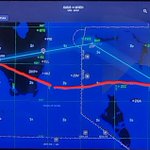
Looking at the storm system, there were at least a couple safe options through the storm system. I drew a couple paths here that look safe to me. But that turn into that last little cell was the issue.

I wrote this a few years back and it seems applicable to the current events.
I don't think people understand the hiring and training process for commercial airline pilots. Let me give some background information.
1. To start in flying, there is no qualification process. You pay money, and you get flight instruction. You build ratings and hours for years in small aircraft. You get periodically evaluated and must meet standards to pass.
2. When you have enough hours and the qualifying ratings, you apply at a small airline. The application process is nothing more than submitting your hours, ratings, and personal qualifications. There is no real way to determine that you are better qualified than other applicants unless you have a history of failures on your past evaluations. Which if you do, you probably won't get an interview. When you interview, no one flies with you to determine your skills. It's just like any job interview with a focus on aviation and personal qualifications.
4. After hired, you start training where you learn company procedures and learn your aircraft specifics. You spend weeks learning your aircraft with numerous simulators and periodic evaluations. You must meet standards to continue. After simulator training is complete, you fly an Initial Operations Evaluation (IOE) with a very experienced evaluator pilot. You fly maybe 7-10 days and are evaluated the entire time. Once again, you must meet standards. After completing IOE, you become a qualified airline pilot. Once you are qualified, you get annual simulator evaluations where, again, you must meet standards.
3. Once you have been flying at a small airline for at least a couple more years, you then apply at a major airline. The application, interview, and training process is the same.
Currently, our pilot labor force is getting less experienced. Why? Because we just had a major pilot shortage. In the past, to get hired at a Major Airline, you perhaps needed 5000-8000 flight hours. Currently, it's much lower. Even less than 2000 hours in some cases.
Many people have brought significant attention to the fact that First Officer Nathalia Gadelha Filgueiras made her radio call describing moderate turbulence and then claims the aircraft altitude deviations were 600 feet. This brings up an interesting revelation to me. When in severe turbulence (even significant moderate) you can hear the pilots voice being affected by the turbulence. Its like you can hear the abrupt changes in the pilots voice as they are bounced around. So I listened carefully many times to see if I can hear it. I can't. It's certainly not definitive evidence that they weren't in severe turbulence, but it is one more piece of evidence.
It may turn out that the altitude deviations that she was calling out were actually the climb and descent rates of the verticle velocity indicator (VVI). Which wouldn't be nearly as extreme as 600 foot actual altitude changes.
I really hope the FDR/CVR was installed and survives.
123
For everyone who keeps blaming the Lear 60 because its the formula 1 of aircraft. Here is the OG of icing accidents.
youtu.be/iCnZII6KTyc?is=F98r…
1
1
143