

오늘은 어제의 내일이 아니다. #WISENUT #NFT #CRYPTO @BinkiesNFT
Seoul
Joined February 2009
- Tweets13.9K
- Following3.9K
- Followers1.9K
- Likes3.1K








ButterZ ☕️ retweeted

Today, we are releasing the first frontier agent harness built to give individual traders the capabilities of an investment firm.
For decades, institutional advantage has come from organizing talented people around large pools of capital. We’re making that organizational capacity available to individuals.
Introducing Instinct, backed by @ycombinator.
ButterZ ☕️ retweeted

Big release here!
After MCP, A2A, & AG-UI, there's another agent protocol:
And this one is built for Agent harnesses:
UHP (Unified Harness Protocol) is a standardized interface for running agent tasks across any agent harness, regardless of which one you use.
HarnessRouter is its open-source server implementation.
Here's how it works:
- Your product backend sends a task + harness_id to HarnessRouter.
- HarnessRouter routes it to whichever configured harness should run it.
- The harness streams progress and artifacts back through HarnessRouter.
- HarnessRouter returns the output to your product.
Three core components handle this:
- Gateway: Responses API, harness config, your model keys.
- Runner: Isolated workspaces, one event stream, turn checkpoints.
- Built-in tools: MCP servers, browser, database, GitHub, media.
This means your agent infra becomes fully interchangeable.
- Swap Codex for Claude Code without touching your product code.
- Run the same task across different harnesses and compare outputs.
- Add new harnesses as they emerge without any rewrites.
Here's the repo: github.com/HarnessRouter/har…
(don't forget to star it ⭐)
The savings can be substantial. In HarnessRouter's first controlled benchmark, changing only the harness reduced cost by up to 2.1×, with the cheaper setup using roughly 53% fewer credits on the same model.
And Alibaba Cloud's Qoder has already officially adopted UHP, making it available as an agent backend through the HarnessRouter API.
If you want to dive deeper, my co-founder's recent article explains why model routing is not the same as harness routing, and what it takes to support multiple harnesses.
It also covers UHP, the full local setup, a working API call, and how sessions and files work.
Read it below.


ButterZ ☕️ retweeted

reverse engineer anything.
(100% open-source, 200k+ stars)
when you like a feature in someone else's app, you usually can't see how it was built because the source code isn't available. figuring it out used to mean hours jumping between 10+ specialized tools and reading machine code by hand.
REA is an open-source MCP server that hands this work to your agent. you give it an app and a question, and the agent traces the feature down to the compiled code, explains how it works, and can build a version for your own project.
how it works:
REA brings the tools reverse engineers rely on, like Ghidra, IDA and JADX, under one interface that Claude Code, Codex, Cursor and other agents can call.
your agent asks REA to inspect the app, and REA picks the right tool, runs it locally, and returns what it found along with the evidence behind each finding.
the agent then uses those findings to dig further, explain the behavior, or write and test its own version. since every claim points back to real code, the agent works from evidence instead of guessing.
what you can do with it
↳ see how a desktop app like Notion handles copy and paste, from the button you click to the code that runs behind it.
↳ look inside compiled programs and games to understand the logic they were built on.
↳ break down Android apps into readable code to see how a feature is put together.
↳ inspect how a website is structured and what it sends over the network.
↳ examine device firmware, network recordings and other files that were never meant to be read by people.
in one of their showcases, it rebuilt a sound function from the old DX-Ball game that compiles back to the exact same code as the original.
everything runs on your machine, and setup adds it to your agent with a single command: 𝗻𝗽𝘅 𝗿𝗲𝗮-𝗮𝗴𝗲𝗻𝘁𝘀 𝘀𝗲𝘁𝘂𝗽
it's meant for software you own or are authorized to analyze.
repo: github.com/morluto/rea
a while back, i wrote about two gaps in Claude Code. it only gets a summary when it reads a web page instead of the full content, and it can't see the full state of your backend. adding the right skills fixes both.
REA builds on that same setup and covers one more gap, since your agent can now understand apps it never had the source code for.
the full article is in the quoted post below.


ButterZ ☕️ retweeted

THIS IS ACTUAL F*CKING GOLD
Anthropic just shared one of the best tricks for Claude Code.
The idea: run Sonnet, Haiku and Opus 5.5 together, each one doing only the job it's best at.
Opus-level judgment on every big call, without paying Opus rates for every routine turn.
You just launch Claude Code like this:
claude --model sonnet --advisor opus
here's the split:
→ Sonnet 5.5 runs the session and writes the code
→ Haiku 5.5 explores files and docs in parallel
→ Opus 5.5 stays on call as advisor for the big calls
→ you stop spending Opus on work that doesn't need it
Opus only steps in at three moments:
→ before a plan locks
→ when the same error shows up twice
→ before calling it done
Sonnet builds. Haiku explores. Opus reviews.
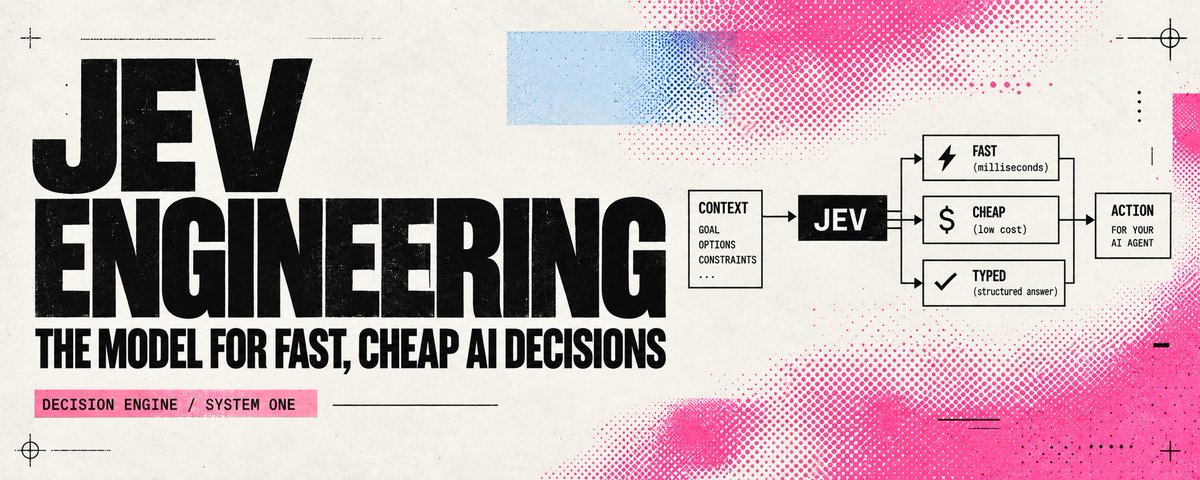
JEV engineering is the same move one layer down: the forks that need no thinker (which file, which tool, retry or stop) go to JEV in milliseconds, and the big models only see the ones that split
the full tree
> Sonnet 5.5 runs the main session and edits code
> search maps the repo on Haiku 5.5
> grep finds call sites on Haiku 5.5
> docs pulls the API reference on Haiku 5.5
> Opus 5.5 on call as advisor, reads the whole transcript when consulted
> JEV routes micro-forks in milliseconds
paste the tree and this prompt into Claude Code ↓
"Rebuild my Claude Code setup around this tree:
1. Run the main session on Sonnet 5.5 with Opus 5.5 as advisor.
2. Create three read-only Haiku 5.5 subagents: search (maps the repo), grep (finds call sites), docs (pulls the API reference).
3. Add one rule to CLAUDE.md: consult the advisor before locking a plan, after the same error twice, and before calling a task done.
4. Route fast deterministic forks (tool choice, path selection, retries) through JEV.
Show me every change as a diff first. No edits until I say go."
↳ code.claude.com/docs/en/advi…
save it, you'll use this every single day.


ButterZ ☕️ retweeted

Dusting off this tweet from April because this gap in shared understanding of LLM capability is *widening*. It's now less "two groups of people speaking past each other" and more a sharp funnel.
- Napkin math somewhere around 6B people (~75% of the population) have barely come in contact with LLMs at all.
- Around 1-2B (~20%) are casual and infrequent users of free-tier ChatGPT-like products. This group sees derpy chatbots and treats them a bit like a better Google search, a writing aid, or etc. Maybe an agent tries to book you a flight. I have non-tech friends who (reasonably, imo) say they have not much use for it at all. Even many professionals outside of math&code are in this tier. For example, execs and many other functions spend a lot of their time talking to other people, so while they understand what is happening intellectually, it is still second-hand and a bit abstract.
- Now we get to professional use of frontier-grade LLMs in math&code. Somewhere around 20M people (0.2%) see first-hand that large, complex projects that used to take them weeks/months can now be completed by agents with a prompt. Building apps, copying apps, translating apps, decompiling apps from binaries... This has all happened very quickly and recently - less than 1 year ago, I was writing code manually by hand, typing memorized computer code commands into a code editor character by character, occasionally pressing Tab to autocomplete a little chunk of code.
- And finally we get to the ~5,000 people (~0.00006%) with access to frontier-grade systems internally. The external world has seen the preview. It looks like swarms of thousands of agents collaborating over weeks on software mega projects: minting zero days, running cyber attacks and defenses at machine speeds, discovering new science, advancing the frontier of mathematics. Things that would have taken top professionals in the industry years of work. Meanwhile, human review and comprehension are starting to fall behind. For example, people are still involved in the "archeology" of the OpenAI-HF incident from many months ago. Mathematicians may be poring over the 722 manuscripts on frontier mathematics for a while.
The funnel is driven by a combination of factors:
1. The impact scales with ambition, problem size, and horizon. A question with a paragraph answer barely stresses the system. You need a reservoir of big, difficult problems that you really care about. This aspect drives the consumer / professional dimension of the funnel.
2. The jaggedness of the system (which I have written about a lot separately). Capability peaks in domains that are digital, verifiable and economically valuable. This is because LLM capability emerges from reinforcement learning on verifiable rewards on a curated environment mixture driven by revenue potential. This aspect primarily drives the area (e.g. math&code) dimension of the funnel.
3. Access. Free-tier, paid-tier, internal.
So this is the weirdness of the moment. The general public has mostly not interacted with these systems. When they have, it looks like a derpy chatbot. The majority of professionals still see only a modest uplift. And a small sliver of professionals are experiencing the vertigo of the curve going vertical. And it is all happening at the same time.

Judging by my tl there is a growing gap in understanding of AI capability.
The first issue I think is around recency and tier of use. I think a lot of people tried the free tier of ChatGPT somewhere last year and allowed it to inform their views on AI a little too much. This is a group of reactions laughing at various quirks of the models, hallucinations, etc. Yes I also saw the viral videos of OpenAI's Advanced Voice mode fumbling simple queries like "should I drive or walk to the carwash". The thing is that these free and old/deprecated models don't reflect the capability in the latest round of state of the art agentic models of this year, especially OpenAI Codex and Claude Code.
But that brings me to the second issue. Even if people paid $200/month to use the state of the art models, a lot of the capabilities are relatively "peaky" in highly technical areas. Typical queries around search, writing, advice, etc. are *not* the domain that has made the most noticeable and dramatic strides in capability. Partly, this is due to the technical details of reinforcement learning and its use of verifiable rewards. But partly, it's also because these use cases are not sufficiently prioritized by the companies in their hillclimbing because they don't lead to as much $$$ value. The goldmines are elsewhere, and the focus comes along.
So that brings me to the second group of people, who *both* 1) pay for and use the state of the art frontier agentic models (OpenAI Codex / Claude Code) and 2) do so professionally in technical domains like programming, math and research. This group of people is subject to the highest amount of "AI Psychosis" because the recent improvements in these domains as of this year have been nothing short of staggering. When you hand a computer terminal to one of these models, you can now watch them melt programming problems that you'd normally expect to take days/weeks of work. It's this second group of people that assigns a much greater gravity to the capabilities, their slope, and various cyber-related repercussions.
TLDR the people in these two groups are speaking past each other. It really is simultaneously the case that OpenAI's free and I think slightly orphaned (?) "Advanced Voice Mode" will fumble the dumbest questions in your Instagram's reels and *at the same time*, OpenAI's highest-tier and paid Codex model will go off for 1 hour to coherently restructure an entire code base, or find and exploit vulnerabilities in computer systems. This part really works and has made dramatic strides because 2 properties: 1) these domains offer explicit reward functions that are verifiable meaning they are easily amenable to reinforcement learning training (e.g. unit tests passed yes or no, in contrast to writing, which is much harder to explicitly judge), but also 2) they are a lot more valuable in b2b settings, meaning that the biggest fraction of the team is focused on improving them. So here we are.

ButterZ ☕️ retweeted

지금 반드시 Claude Code에서 수행해야 할 공식 커맨드
> /claude-api prompt-audit
Anthropic 공식 스킬에도 같이 업데이트 됨..
🔖 Prompt Audit - Finding and Removing Dated Prompting Patterns
github.com/anthropics/skills…
있는 그대로 실행하면 끝. 모든걸 정리하고 마이그 해줌.
CLAUDE md, AGENTS md, SKILL md, 룰 파일들
+ 시스템 프롬프트와 그걸 조립하는 코드
+ 툴 description / 파라미터 설명
등등 말 그대로 지금의 Opus 5.5 모델에 맞게 다 최적화하고 안티 패턴을 제거해줌.
모델별 유물과 부채를 굳이 우린 들고 있을 필요가 없음.
자, 이걸 봤다면 바로 실행하자. 5분? 10분? 그 정도면 충분함.


Claude Coders: run this Opus 5.5 instruction cleanup prompt *NOW*.
'/claude-api prompt-audit'
Optimizes your skills, AGENTS.md, CLAUDE.md and removes anti-patterns that restrict Opus 5.5.
The results are amazing. Best 5 mins you'll spend.
From @RLanceMartin.
ButterZ ☕️ retweeted

판단만 딱 해주는 AI, Solar Decide를 OpenRouter에 출시했습니다! "이 문의는 어느 팀으로 보내야 해?"같은 라우팅 뿐만아니라, 에이전트 가드레일, 콘텐츠 모더레이션, RAG 문서 필터, LLM 답변 채점등 판단이 필요한 곳에 Solar Decide를 사용해보세요.
- 정확도 87.0% (Jev 86.1%)
- 속도 0.14초, 2.1배 빠름 (Jev 0.30초, 중앙값 기준)
- 문맥 512K, Jev(32K)의 16배
- 가격 입력 $0.05/1M 토큰, 출력은 $0
실제로 저희 AskUp에서도 쓰고 있는데요, 카톡 대화 중에 "오래 기억할 사실인가?"를 Solar Decide에 물어서 장기 기억에 저장할 말만 골라냅니다. 키워드 방식은 20개 중 14개만 잡았는데 Solar Decide는 20/20, 일상 잡담을 잘못 저장한 건 0건이었습니다.
OpenRouter model에 upstage/solar-decide를 넣고 state와 질문(choice / noul / score)을 보내면 확률이 옵니다. 기존에 Jev를 쓰시던 분이라면 model 이름만 바꾸시면 됩니다!
openrouter.ai/upstage/solar-…
#SolarDecide #Upstage #OpenRouter #AskUp


ButterZ ☕️ retweeted
Google just dropped another banger!
Advent of Agents Season 3 is a free, 31-day Google Cloud series on building secure and governed AI agents for production.
One hands-on tutorial will be released each day throughout October, covering agent identity, guardrails, sandboxing, observability, evaluations, MCP security, cost controls, and fleet management.
Check it out here: adventofagents.com.
Each tutorial starts with a question that customers and security teams actually ask, then answers it with runnable code. Thanks to Google for working with me on this post.

ButterZ ☕️ retweeted

This is f*cking insane. This tip saved me thousands of dollars.
run Opus 5.5, Sonnet 5.5, and Fable 5.1 together, and stop burning Opus on work it was never needed for.
the whole idea in one line:
the strong model plans, the mid-tier model executes, Fable stays quiet until it's actually needed.
roles, broken down:
Opus 5.5, high effort, owns the plan and ships the final code
Sonnet 5.5, medium effort, splits into explorer (reads the codebase), worker (edits files, runs tests), researcher (pulls docs)
Fable 5.1, called through /advisor fable, reads everything happening in the session but stays silent unless something's actually wrong
three moments where Fable speaks:
→ a plan goes out: is this actually the right call?
→ the same failure shows up again: is the search going nowhere?
→ the task gets marked finished: did something get skipped?
Jev engineering does the same thing one level down. the forks that don't need real thought, which file, which tool, keep going or stop, go straight to Jev and come back in under half a second. the big models only ever see the forks that genuinely need a decision.
anyone still running one model for everything is paying Opus prices to decide whether a file exists.
drop this into Claude Code:
"Rebuild my Claude Code setup around this structure:
Look through ~/.claude/agents and .claude/agents for subagents already covering explorer, worker, and researcher. Only create new ones for roles that are missing. Set model: sonnet, effort: medium on each. If an existing subagent is locked to a different model, leave it as is and just list it.
In ~/.claude/settings.json, set effortLevel to high and advisorModel to fable.
Check for anything disabling the advisor, CLAUDE_CODE_DISABLE_ADVISOR_TOOL, DISABLE_TELEMETRY, or anything blocking feature-flag fetches, plus CLAUDE_CODE_EFFORT_LEVEL, which can override subagent effort settings. Report what you find. Don't change any of it yet.
Add one line to ~/.claude/CLAUDE.md: check in with the advisor before a big plan, when the same error shows up twice, and before marking a long task done.
Show every change as a diff first. Wait for my go-ahead before touching anything."
code.claude.com/docs/en/advi…

ButterZ ☕️ retweeted

Andrej Karpathy’s multi-agent architecture breaks down how hundreds of AI agents can actually work as one system.
Some of the biggest takeaways:
• 1 goal → 4 core layers: trigger, planner, agent swarm, memory + outputs.
• 1 planning agent breaks the objective into smaller tasks before execution starts.
• up to 300 agents can handle research, execution, verification, routing, and recovery in parallel.
• 5 core primitives drive the system: trigger, plan, dispatch, verify, merge.
• temporary swarms can spin up for 1 objective, execute in parallel, compress the useful state, then shut down.
• the system keeps the shared memory + final result, not 300 agents running 24/7.
Read the full breakdown below.



ButterZ ☕️ retweeted
Another insane Jev use case!
Traditional database filters need precise, predefined conditions. But many questions are semantic:
- Is this article mainly about software engineering?
- Which topic best describes it?
- How technically deep does it appear?
These usually require moving rows into application code, invoking a model, parsing its output, and writing the result back.
pg-jev is an open-source Postgres extension that exposes Jev through SQL functions.
- jev() works inside WHERE
- jev_prob() returns a probability
- jev_choice() selects a label
- jev_score() ranks rows across ordered levels.
It needs no vector column or embedding index.
Under the hood, pg-jev batches rows, sends them to Jev, and returns typed answers that SQL can filter, sort, group, and combine with exact predicates.
The recording below runs it against real Hacker News stories stored in Postgres.
It first shows the rows, then asks Jev to find software-engineering stories, classify them by topic, and rank them by technical depth. The final query reports requests, tokens, cost, and cache hits from the database session.
GitHub repo: github.com/realZachi/pg-jev
(don't forget to star it ⭐)
Postgres keeps the data and controls the query, while Jev handles the part SQL cannot express as a deterministic condition.
If you want to understand what Jev is doing under the hood, I also wrote a hands-on guide to building a Jev-style model with open models, entirely locally.
Read it below.


ButterZ ☕️ retweeted

An Anthropic engineer packed his whole engineering workflow into agent skills, so anyone can copy it
Addy Osmani, ex-Google, now works on Claude Code.
His repo turns a coding agent into a senior engineer.
Each skill is a structured workflow: when to use it, the steps, the excuses agents use to skip steps with a rebuttal for each, red flags, and the evidence required before it can call the job done.
25 skills, sorted by phase:
> Define: figure out what to build
> Plan: break it into small tasks
> Build: write it test-first
> Verify: debug and prove it works
> Review: quality, security, performance
> Ship: rollout, CI, docs
Skills also switch on by themselves. Start designing an API and the API skill kicks in.
Useful if you ship with agents solo, or want every agent on your team held to the same bar.
npx skills add addyosmani/agent-skills
repo: github.com/addyosmani/agent-…


ButterZ ☕️ retweeted
We'll be spending a lot more time trying to understand the outputs of language models. A few thoughts, tips & tricks:
Writing. Something I've had success with: Ask your LLM to explain something in ASD-STE100, it's a controlled language specification originally developed for aerospace maintenance documentation. LLMs well-versed in this language and it comes with heavy constraints on clean writing style that I often find a lot more readable. Sometimes I've tried to soften it a bit e.g. ask for "80% of the way to ASD-STE100" because the spec is quite stringent. But even better:
Diagrams / images. Instead of writing, ask your LLM to create a diagram. These can be a lot easier to process, parse, and understand. But even better:
Web pages. Ask for output "in HTML" to get a beautiful, interactive webpage. LLMs are getting really good at frontend and can create beautiful experiences, animations, etc. But even better:
Explainer videos. The output format I am most bullish on is fully custom / bespoke explainer videos generated on any arbitrary topic. Experiment with things like "Create a 3b1b style video explainer on X. Use my ElevenLabs API key for audio narration". (you'd need an API key for the latter or you can ask your LLM to find you decent free alternatives that use your local compute). This is actually starting to work!
In summary:
- As LLMs get better, they will do more and more of the legwork autonomously, and a lot more of our work will rise up the abstractions into oversight and understanding.
- Luckily, LLMs can help here too because as intelligence and code are increasingly abundant, you can ask for large, custom, discardable software artifacts (e.g. web apps, video explainers) that would have never made sense to create before. Push the boundaries here and you'll be surprised.

ButterZ ☕️ retweeted

If I had to become an AI engineer in 90 days, I would not start with courses.
I would build projects from these 10 GitHub repos (bookmark this):

ButterZ ☕️ retweeted

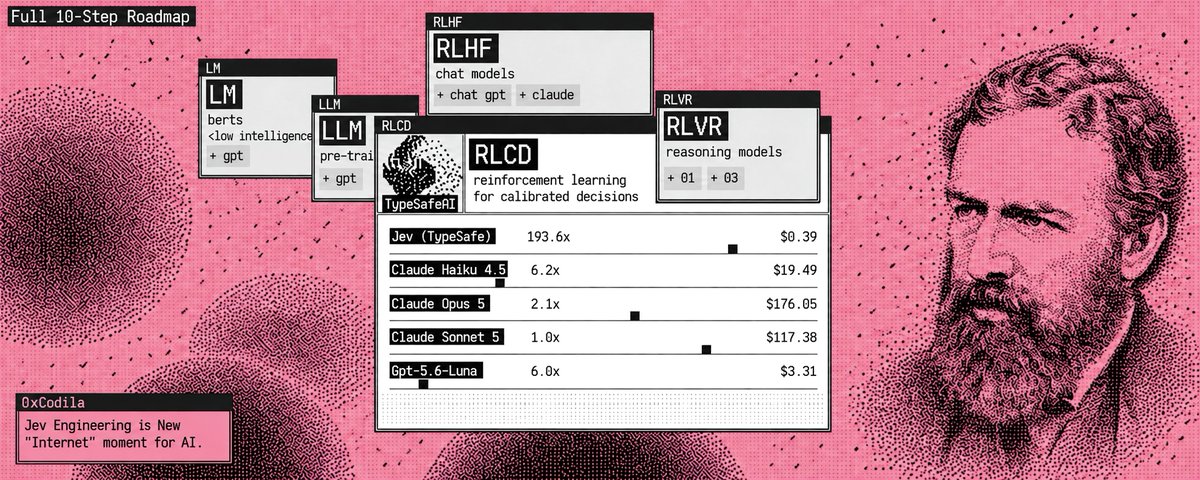
Jev is "Internet" moment for AI: up to 193x faster and 444x cheaper in tests with Claude Fable 5.1 and GPT-6 Astra
Whar is Jev, how to use and unlock its real 100х advantage in my 10-page research:
step 1 → meet Jev: LLM writes, agents act, Jev chooses the next move - split intelligence from execution
step 2 → turn every agent fork into three primitives: Choice selects one route, Score measures a defined scale, Noul returns the probability of yes
step 3 → build before getting access: use TypeSafe’s official adapter with OpenAI, Anthropic or xAI, then swap in Jev without rebuilding the graph
step 4 → setup first Jev: one state, three parallel decisions, risk-based thresholds and a real queue your agents can execute
step 5 → batch decisions instead of serializing them: 13 questions in one call ran 10x faster and 12.2x cheaper than 13 sequential calls
step 6 → place Jev at every bounded fork: choose the agent, model, tool, browser action or human escalation, then read fresh state
step 7 → benchmark the entire loop: Browser Use hit Google Flights in 7.1s, Every ran 777 checks in under 0.7s, Mobile Jev completed 9 actions in 21s
step 8 → rank wide, read narrow: Jev cut wrong Hermes skill loads from 16.8% to 7.3% and pushed legal Top-10 retrieval from 38% to 62%
step 9 → steal a system, not a prompt: Chief of Staff, model router, inbox firewall, research feed, browser controller and safety gate all use State → Questions → Action → Verify
step 10 → keep Jev out of math, writing and irreversible execution: code computes, LLMs create, Jev decides, fresh state proves the result
the result: one slow, expensive agent becomes an always-on decision machine that routes, scores and escalates in milliseconds
Copy the complete 10-page Jev blueprint - then read full 10-step roadmap below ↓


ButterZ ☕️ retweeted

DeepSeek just launched V4.1 Flash.
98% of GPT-6 Astra’s score at 1.4% of the cost.
With GPT-6 Astra + DeepSeek V4.1 Flash, you can build an AI workforce that works 24/7 for around $50/month.
Full setup:

ButterZ ☕️ retweeted

🐙 이번 주 주목할 깃허브 TOP 5
1위 ECC ⭐256,075
AI 코딩 에이전트 성능 최적화 시스템
여러 에디터에서 성능을 끌어올립니다
github.com/affaan-m/ECC
2위 i-have-adhd ⭐39,328
AI 에이전트의 장황한 답을 단축
ADHD 친화적 형식의 답변을 제공합니다
github.com/ayghri/i-have-adh…
3위 ponytail ⭐135,172
AI에게 시니어 개발자 논리를 학습
간결한 코드 작성을 유도합니다
github.com/DietrichGebert/po…
4위 archify ⭐57,846
AI 에이전트용 다이어그램 생성 스킬
자가포함 HTML 형식으로 내보냅니다
github.com/tt-a1i/archify
5위 fmt ⭐25,727
현대식 포매팅 라이브러리
텍스트 형식화 성능을 개선합니다
github.com/fmtlib/fmt
5개 중 4개가 AI 에이전트 최적화·개선 도구입니다.
이제 완전히 AI에게 먹혀버린 개발씬!!

ButterZ ☕️ retweeted

分享一份最近收集的 AI Infra 入门阅读清单,建议收藏,慢慢看
AI 已经可以生成很多很好的内容,解释概念、翻译论文、整理资料,都越来越方便。但在这个时代,能静下心来,把一篇好文章认真读完,把没懂的地方再琢磨一遍,我觉得更加难能可贵
这次整理的材料,主要集中在大模型推理这一块。从 KV Cache、显存管理,到请求调度、推理加速,再到怎么判断性能有没有真正变好
做工程的朋友,可以顺着往源码和实验里走。平时看 AI 产业、算力和存储的朋友,也可以先把原理读明白
读文章,挑值得反复读的。
1. 如果只选一篇,我会选 Inside vLLM。
Inside vLLM: Anatomy of a High-Throughput LLM Inference System,作者 Aleksa Gordić
aleksagordic.com/blog/vllm
把很多零散的概念串进了一个真实系统:一个请求进来,怎么排队,怎么分配 KV Cache,怎么执行,最后又怎么把结果送回来
PagedAttention、continuous batching、chunked prefill、prefix caching、投机解码、P/D 分离、多卡和性能测试,都能在这条线上找到位置。
这篇适合当主线,后面的材料用来补不懂的地方
2. 想弄懂 continuous batching,先看 Anyscale 这篇。
Continuous Batching 博客
anyscale.com/blog/continuous…
llm用户的回答有长有短,有的已经生成完了,有的还在继续。已经空出来的位置,能不能马上接下一个请求?
这篇用静态批处理和连续批处理的对比图,把这个问题讲得很直观。看完你会理解,GPU 的效率,也取决于请求怎么安排
建议重点看图和机制
3. NVIDIA 的两篇,一篇帮你建立全貌,一篇教你怎么看性能。
Mastering LLM Techniques: Inference Optimization
developer.nvidia.com/blog/ma…
适合先建立基本认识:处理输入的 prefill 和逐步生成输出的 decode 有什么区别,模型权重和 KV Cache 分别占什么空间,量化、批处理、多卡并行又各自解决什么问题
LLM Inference Benchmarking: Fundamental Concepts
developer.nvidia.com/blog/ll…
这一篇我也很推荐。用户等多久才看到第一个 token,后面生成得快不快,整个系统一秒能服务多少请求,是不同的问题。TTFT、ITL、TPOT 这些指标,要连着测试口径一起看
4. 想再往下算一层,读 kipply 的 Transformer Inference Arithmetic
Transformer Inference Arithmetic
这是一篇 2022 年的文章。它带你从计算量、内存容量、带宽和通信开销出发,估算推理为什么快、为什么慢,以及 batch size 改变后会发生什么
硬件和模型的具体例子有年代了, 作为 optional 选读
