




Hey @hulu , your moronic interface makes it impossible to watch the last minute or so of an episode on Apple TV. You do that "jump to the next episode" thing without any way for users to say "No".
Some shows go right up to the end. The Good Place is one. Rick & Morty another.
1
23
You used to be able to swipe up to get out of the skip timer, but now that shows More To Watch and the timer keeps going.
I don't want to watch something else. I'd simply like to finish watching the thing I'm already watching.
@Hulu fix this. You've made some shows unwatchable.
1
6

Stephen Rider retweeted

A lot of people have real trouble thinking about the aggregate behavior of groups. They can only think about individuals.
So they think about Elon Musk as an individual. Maybe they think that he must be retarded, because they need that for emotional reasons. Or maybe they think he is a talented rocket designer.
But even if they realize he understands rockets, they can only think about him as an individual doing tasks. Not about his impact on what the whole company does.
If Elon Musk is just a talented rocket designer, then he can spend all day, every day, improving rocket designs.
But he is just one of 7000 engineers. So even if did a perfect job, he would only improve progress by about .014%
So, when a midwit looks at SpaceX, he sees 7000 engineers, and says to himself "Elon Musk cannot possibly be designing the whole damn rocket himself. These people are giving him too much credit."
This would be absolutely true if Musk were just a some random SpaceX engineer. But he isn't. He's the absolute dictator of the whole damn company.
He decides, with absolute and unquestionable authority, which behaviors are punished and which are rewarded.
Why is this important?
When I worked at Boeing, on various classified projects, I naively came in with the assumption that I was a software engineer, employed to design and build functional software as quickly and cheaply as possible.
Because of this, I focused on functionality and efficiency, for example suggesting changes that would obviate the need for entire projects and software components.
And I very rapidly became persona non grata.
At first, this caused me to adopt an air of aggrieved innocence. I was just trying to do my job well, and I was being punished for it.
Then I gradually came to realize that I hadn't properly understood what my job was, or what the actual mission of Boeing Defense, Space, and Security was.
Boeing DSS was not an aerospace company. Boeing DSS was a fraud company.
Its goal was twofold. First, to maximize transfer of public tax dollars to stockholder pockets. Second, to maintain the appearance of being an aerospace company, to prevent the fraud from being exposed.
Which meant that my real job was twofold. First, to generate billable hours. Second, to look busy.
This is why Space Launch System sucks. Why it is always late when it doesn't fail outright. Why it is at 300% of its target budget. Why it leaves American astronauts stranded and needing a lift from SpaceX.
That's because, for Boeing, building rockets is a side quest. Something they have to do to look busy. Yes, a rocket does occasionally fly, but that's just happening so programs don't get shut down.
For Boeing, coming in early and under budget would actually be failure. The system is functioning exactly as designed.
The cost, not the rocket, is the goal.
Musk and SpaceX don't work like that.
Unlike Boeing executives, Musk is not a useless grifter asshole. He is an entirely different kind of asshole... a rocket obsessed sperg.
So, at SpaceX, engineers do not get rewarded for generating billable hours. They get rewarded for making rockets fly. And for all the subtasks of this, like figuring out how to make rockets lighter, figuring out how to make engines reignite better, figuring out how to make rocket exhaust not destroy launch pads, etc.
And this attracts engineers who care about rockets. You've seen them on broadcasts, crying on open microphones because they dedicated their lives to something and it just flew.
As a rocket engineer, who designs rockets, Musk is probably replaceable. As a rocket company engineer, who designs rocket companies, he is not.
For over 50 years, the US space industry stagnated precisely for the lack of a Musk-like figure, who could not only create an effective aerospace company, but who could thereby demonstrate what an effective aerospace company looks like.
Which makes it much more difficult for fraudsters to get away with fraud.
I'm envious. I wish I could have worked for an aerospace company instead of a fraud company.
But what's more important is that some of us now no longer have to play "who gets the most cheese?".
They get to play "What can we build today?".

Let’s take this gentleman’s argument at face value that anyone can throw money at rockets and get something like Starship, Falcon or Dragon.
Perhaps he can explain to everyone how SpaceX is able to catch giant starships from orbit with chopsticks and deliver 85% of all Earth payload to orbit with Falcon, while Blue Origin, which started before SpaceX and was funded by the immensely wealthy Jeff Bezos, is not yet able to launch reliably?
Also, why is it that Boeing and Lockheed received several times what SpaceX did from the government for development of their rockets and spacecraft, but the Boeing capsule is still not operational and ULA delivers less than 5% of SpaceX payload to orbit?
I am genuinely curious about these questions.
Stephen Rider retweeted

Every grade school, middle school, high school, and every university, and I should add every person under the age of 40 years old. Should watch this over and over again until they finally understand what that section of America is doing to destroy the United States. Wake up America.
Stephen Rider retweeted

I found this waaaaaay to interesting and entertaining. And who doesn't love a surprise ending? 🤣🤣🤣


This is going to keep happening until the big companies finally register that AI can't outright replace all your engineers.
The tool makes things easier, but can't actually do the job.


10
Stephen Rider retweeted
After some recent trends, I finally decide to read the Harry Potter books.
And I came away with something I didn't expect.
I came away with an understanding of what makes a generationally beloved classic.
It isn't authorial skill. Rowling is certainly talented, but, at least at the time, she was also relatively unpolished, and the series has plenty of rough patches. Uneven pacing, awkward plots, exposition dumps, two-dimensional secondary characters. I could write quite a few lines about what might be fixed. And I probably will at some point.
But none of that matters.
Because a generationally beloved classic is almost never the best book of a generation. A generationally beloved classic is the book that most perfectly captures what that generation yearns for.
Hogwart's School of Wizardry did that for millennials, just as the quest to destroy the One Ring did so for the boomers.
Boomers grew up hearing tales of recent history, and the heroism of previous generations, who got us through the great depression, and the great war. Their father, or grandfathers, or both, were heroes. But they were left growing up in the 1950s, a near-ideal time of growth, happiness, and prosperity.
Near-ideal isn't ideal. Humans need goals. The boomers were left with no great struggles to fight, no great tasks to do, nothing that could make them feel like they measured up.
So they invented something. A new struggle. A moral struggle. They decided that, because the great depression, and the great war, had happened when the institutions of Western Civilization existed, therefore those institutions were responsible. That those institutions needed to be torn down, gutted, and rebuilt in the new Boomer Morality.
This was their great quest, what allowed them to imagine themselves heroes. As an added bonus, it allowed them to imagine that the men who fought WW2 were not. They were, after all, adherents of the old creed.
When the hippies took to the streets, chanting "fascist scum, your time has come", they meant the very same people who had fought the Nazis.
Lord of the Rings dovetailed perfectly into this narrative. Its central struggle, its great quest, is not a martial struggle or a political struggle, but a moral struggle... the quest not to seize an object of power, but to destroy one.
Frodo was not some great warrior, or wise wizard. He was an innnocent, whose virtue was moral worth. The young, unaccomplished, and very small man had to resist the temptations of power, and to destroy it, because it was wicked.
Is it any wonder that the boomers decided to tear down and hollow out the institutions of society, rather than inherit and incrementally improve them?
Even to this day, any younger person who seeks power, wanting to improve the world, is subjected to any number of brain-dead aphorisms about Boromir and the Ring.
Never mind that Tolkien never intended any of this. Never mind that the Ring wasn't a symbol of anything. It was a ring. It was evil not because it represented power... it was simply evil because it was made by evil for evil purposes, and possessed a malign will of its own.
LOTR, the way the boomers read it, fit perfectly into their worldview, and they imagine themselves perpetual revolutionaries, always fighting the evils of power, even now when they are 70 years old and own everything.
Which brings us to millennials. They grew up in the world that the gutting of Western institutions left us. They went to government schools run by characters straight out of a Franz Kafka novel, sent there by parents who inexplicably hated them from the time they were old enough to talk.
When they yearned, they didn't yearn for a great moral struggle, or to tear anything down, or to be revolutionaries.
They yearned for a society that cared about them, for parents who loved them, for a civilization that saw them as the future, and invested in them accordingly.
They wanted to go to Hogwart's. They wanted get a letter by owl, telling them that the reason they didn't quite fit wasn't because they were inadequate, but because they were special.
They wanted to be the special ones, the chosen ones, the boys and girls who lived. And that last sentence may sound a bit conceited... until you realized that when they wanted to be special, they wanted to be special in precisely the way that Harry Potter was special, the way that every child in a healthy family is naturally special... not because he is talented or great, but because his mother loved him.
This is what saved Harry Potter in the inciting incident of his young life. This is what millennials wanted for themselves. Not to be astronauts and war heroes and rock stars, but to fit into a place like Hogwarts. To be mentored by wise and caring elders like Dumbledore. To be part of a community. To have mothers who loved them.
To write a story like this isn't necessarily to understand a generation, because it never seems to happen except by accident.
It is, rather, to help a generation understand itself.
That's why fan fiction, with visions like this picture, matters. Not because it has so large a footprint as to change the world, perhaps, but because it represents the spirit of an age.
It tells us what people want. And if we look carefully, it tells us why.


Stephen Rider retweeted

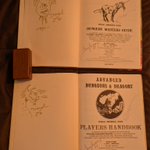
Castles and Crusades Battle Report -
Hold on to your butts, this is a doozy.
Players get sent to kill/or capture BBEG.
BBEG is holed up in evil temple committing sacrifices to try to release the champion of an evil diety into the world.
Player's lay siege and defeat his forces. He makes a run and they chase him down and capture BBEG alive.
Game over. Happy ending. Right??
Naw.....
Players want to go back and clear temple. Find treasure.
The find Sacrificial Altar.
Players say "townsfolk were probably going to execute him anyway. Why not save them the trouble?"
So they actually do it. Runes in the chamber start lighting up. One of the Players says, "hey, I've got a special ability to read runes! Watch me!"
So he reads them off as they light up.
Ceremony accelerates. Execution takes place. All runes are read in proper order.
Culmination - soul is sucked out of sacrifice victim and imbued into the Death Knight Champion of evil diety.
Death Knight emerges, and ignores Players. Immediately leaves to go do the bidding of his foul master.
Players -
"What just happened..."
"I dunno"
"Should we tell the townsfolk?"
"No......"
"We don't even know what happened for sure. It might have been nothing. We don't want to worry them. Don't say anything."
And I'm sitting behind the screen like -
"WHAT. THE. FUCK.
ARE. YOU. KIDDING???"
Stephen Rider retweeted

TL;DR warning. One of the most fascinating things about the past ten years has been watching different people who weren't part of Sad Puppies speak authoritatively on Sad Puppies.
I have my own thoughts, of course.
Understand that everything I am about to say, I say as a guy with several authorial accolades under his belt, including the DragonCon Dragon for Best SF novel in 2019, and three readers' choice awards from Analog magazine in 2010, 2012, and 2014. I was also the rare triple-nominee for Hugo, Nebula, and Campbell awards in 2012.
So . . . did Sad Puppies fail?
For my part I wanted the Hugos to have broad cultural relevance within literary SF again. Versus continuing their long slide into activism-induced irrelevance. In this regard Sad Puppies 3 failed spectacularly. The net dividend of 2015 was the power brokers of Worldcon declaring, "We're gonna Feminist and Queer the Hugos even HARDER!" and that's precisely how it went.
The Hugos are now ignored by the great majority of spec fic and fantasy readers because they know beyond a shadow of a doubt the award has been made into an explicitly political activist totem.
As of 2026 only a fraction of spec fic and fantasy readers even know who the Hugo winners are year to year, and most who remember the Hugos think of the Hugos as they think of almost all entertainment awards: that legacy thing we used to care about but we've stopped caring about because people on stages giving each other trophies doesn't matter to the consumer like it did a few decades ago.
It was already becoming true by 2010. Much moreso, now. Grammys, Emmys, Oscars, yadda. Just don't have the cultural heft of the 1970s-1990s. And the same for both the Hugo and Nebula. Which are not signposts of quality (on a book cover) like they once were. In fact, for many readers they are a, "Stay away, this is a Modern Audience (said in Drinker voice) book!"
And that's precisely what I wanted reversed. Because I remember when the words HUGO WINNER and NEBULA WINNER on a dust jacket actually described what was between the covers. Like with Ender's Game and Speaker for the Dead.
But the opposite occurred. Because the Nielsen-Haydens and George R. R. Martin and many other people with media reach and influence decreed that no dirty normal Hugo voters would have a say in their sainted backroom politicized log-rolling process. The Hugos would be perma-Woke.
And so they are. And that's a damned shame, because most readers don't give the Hugos any regard anymore—as they don't give most lit awards any regard.
And if you doubt it ask yourself if Ann Leckie is bigger than Heinlein? Who has been dead for decades. But he outsells Leckie 20 to 1 on Grandpa Bob's slow days.
They hate Heinlein for that. They want him dustbinned.
They tried their best to make Leckie into a thing. Heaped every award possible on her between 2014 and 2016. And all that resulted were massive stacks of deluxe boxed merchandise at B&N locations. With the words HAS WON EVERY SCIENCE FICTION AWARD KNOWN TO MAN plastered across the slipcases and the special selection signage. But the merchandise didn't move.
I repeat: the merchandise didn't move.
They tried the same thing from '16-'18 with Nora Jemisin, and it was a similar result: triple-Hugo Best Novels that sat on shelves. And kept sitting.
Neither Leckie nor Jemisin are bigger than Heinlein. Both remain midlist activist authors who could not be catapulted over the cultural relevance wall by any means, because that's not how a literary work (nor author) achieves long-standing relevance in both geek culture and the wider English-speaking culture as a whole.
You know who does have relevance?
J.K. Rowling. Or Orson Scott Card. Or any dozen other caps-n Names nobody needs to spotlight trophies about. Because their books gained and kept vast audiences all on their own power. Much like Heinlein's.
The dog of culture cannot be wagged.
You can take over institutions believing you will take over culture, but it doesn't really work like that. The Soviet system dominated the Eastern Bloc for most of a century. It literally owned every institution. But all it did was teach generations of Iron Curtain dwellers to subsist on black humor about how their supposed Socialist paradise was in fact a corrupt hell of bureaucrats, toadies, secret police, and fear.
I believe we're entering something like that, where American pop culture is concerned. The Woke own the big gaming companies, along with gaming media. But who's buying and playing the games?
Similarly, the Woke own the big movie studios and all of the media media, but ticket sales have cratered on huge blockbuster projects over and over, and keep cratering.
More broadly, the Woke own the Ivy League, but all this does is make people question if the Ivy League still matters anymore? Or, does a PhD even matter if the person putting those letters next to their name is a raving loon stuffed with terrible ideas and terrible politics, like a rotten Christmas turkey?
You can corrupt an organization, but you cannot corrupt people if they don't want to be corrupted.
In this regard Sad Puppies was a spectacular success. Because it was the loud, emphatic shout of the normie SF/F reader who used to esteem the Hugo and refused to let the Hugo go quietly into the night. People who could not be convinced that mediocre or even terrible storytelling with Woke wrappings and trappings was in fact brilliant and timeless.
Again, the dog of culture cannot be wagged.

The Hugo Awards (or more fittingly, the Women In Speculative Fiction Awards) are an interesting case study in skin-suiting and how it operates in practice.
The quoted tweet is an infographic of winners which demonstrates that right around 2016 something shifted, with nearly every award going to women and mostly to queer-themed books from then on. OP attributes this to a rule change following the sad-puppy affair, which has some truth to it but I think mostly misses the mark and misunderstands the dynamics of the sad-puppy movement and how it failed.
For those not in the know: from 2013 to 2017 a minority of Hugo voters organized a slate of what we would now call "anti-woke" nominees to push back against what they saw as creeping left-wing influence in the nomination process. For some reason they called this movement the sad puppies and later the rabid puppies (no idea where the name came from). They had limited success until 2015, when their slate made it onto the ballot in many categories, meaning that Hugo voters only could vote on one of the "anti-woke" nominees in those categories. This caused a major scandal, as many prominent voting members were locked into nominees they didn't want to win. Voters can also vote for "no-winner" in any category, and that's what won most of the categories where the puppies got their slate in place. After this disappointing outcome, Hugo changed the rules, basically to nerf slate tactics. Because there are hundreds of published works every year and only five nominees per category, a small minority of voters acting as a bloc can get their 5 books on the final ballot. To counteract this, they changed the nomination process so that every nomination ballot gets 1 point distributed among all nominees on that ballot, which has the effect of diluting slate bloc votes.
So that's the background. Men used to win most Hugo awards, and now win basically none. Queer-themed books have more or less taken over. The sad puppies attempted a coup, were beaten back, and the trends they tried to overturn have won the day completely.
There are a couple important things to understand about how this went down.
First, Hugo voting membership is open to anyone. You just pay your dues and you get to vote on the awards. The titles that are nominated and win are a reflection of who those dues-paying members want to win. There is no sinister conspiracy at play to make woke books win, just the individual choices of the thousands of voting members. Hugos are going to the titles that its membership wants them to go to.
Second, the sad puppies were themselves counter-revolutionaries to this mostly-completed takeover. They noticed that by 2013 many awards were going to books with leftist themes written by leftist authors instead of to the best books, which they thought was an injustice and a perversion of the awards. They were fighting back against a late-stage skin-suiting operation. They are the end of that story, not the beginning.
Third, the puppies were a small minority of overall Hugo voters. They were able to game the rules of nomination to get their slates on the ballot, but the fact that "no-winner" won most of these categories demonstrates that they were in fact a small minority. When the Hugos changed the rules, it wasn't a shadowy elite silencing the voice of normal people, it was them closing a procedural loophole which let a small minority dominate the nomination process.
When we talk about skin-suiting, we often imagine it in terms of warfare or espionage, of a few determined entryists managing to get inside the walls, get some amount of power, then twist the rules of the institution to bring more of their friends onboard. This is part of it, but not the main part, not most of the time. Most of the time, it's the boring ordinary process that happened to the Hugos: anybody can be a member (for a small fee), and the people who cared more joined in larger numbers and got their way. The very term "entryist" assumes some measure of subterfuge, of some amount of gatekeeping to prevent such malign influence. But typically this isn't true. The gate is wide open.
Stephen Rider retweeted

I fucking love working with engineers man.
While a lot of stuff in engineering is a judgement call, a lot of it isn’t.
And I just love that engineering practice and culture never hides that.
Literally every other vocation has some element of face saving behavior when proven wrong in public.
And so many good engineering cultures are like
> the answer is 100
> no actually it’s 200
> oh you’re right I’m wrong
And then people go on with the right information.
It’s truly insane how common in some vocations someone can call the sky green in a meeting and either nobody will correct them on it or they won’t admit it and “take it offline and circle back” without ever admitting fault.
And the biggest thing is that so many engineering leaders will get corrected by subordinates.
That’s really fucking rare out there.
In other vocations corrections so often go strictly down the org chart.
Lots of companies have it all and get everything right. Engineering lead companies often do.
But so many people out only complain about “engineer” or “engineering brain” and it’s literally just people who won’t let you say random false shit constantly.
Stephen Rider retweeted

new dungeon idea - ancient town covered with sand

There is a Ghost town in Michigan buried underneath a giant sand dune on the shore of Lake Michigan. Now you may ask "But Paul... How is that possible?" Well... After the great fires in the late 1800's Singapore decided to cut down all their tree's not realizing those tree's were the only thing stabilizing the sand dune which their town existed on. When the tree's were gone the sand started blowing and it buried the town.


Stephen Rider retweeted

This may be one of the best explanations of male depression that I’ve ever heard. This is explains why guys are suicidal and their friends, parents, and/or wives don’t even know it. This is also why a man can be married with kids, great job, etc. & feel lonely & depressed.
Readers added context they thought people might want to know
This is an interview with @shaistaub who has not been credited for it. x.com/shaistaub/stat…
Stephen Rider retweeted

America, you are the only country on Earth that cannot see how bright it is.
There's an old saying in Japan: the darkest spot is at the foot of the lighthouse.
The light goes out across the whole sea. Ships a hundred miles away steer by it. But the people standing right underneath it? They're in the dark. They have no idea.
That's you. You are standing at the foot of the lighthouse.
So here's what it looks like from out here, on the water. And please don't interrupt me, because I'm Japanese, and it took me a lot of courage to be this loud.
You build tiny wooden houses on posts in your front yards. You fill them with your own books. You put a little door on them with no lock, and you let complete strangers take whatever they want. You call it a "little free library." In my country, a small wooden house where you leave gifts for people you will never meet has a different name. We call it a shrine.
When something terrible happens in one of your cities, by sundown there is a line around the block. Not to look. To bleed. Thousands of people, standing for hours, to give their own blood to someone they will never meet. There have been nights your hospitals had to send people home, because there was too much of you.
Every August, your teachers walk into stores and spend their own money on crayons. Not for their own kids. For twenty-eight children who aren't theirs yet. Nobody asks them to. They do it every year, like a prayer.
Tonight, somewhere in Ohio, a man who worked fifty hours this week is standing in the cold, coaching nine-year-olds who can't catch, for free. He bought the snacks himself. He will do this for eleven years. Nobody will ever give him a trophy. He'll be too busy handing them out.
You think this is normal. You think everybody does this.
America. Everybody does not do this.
Now let me tell you about one light. Just one.
Eleven years ago, my wife's cousin's daughter, Hinako, followed her father's job to a town of eleven hundred people in North Dakota. She was nine. She knew exactly zero words of English. That whole first winter, she didn't say anything to anyone. Not at school. Not at home. She just walked to school and walked back, past a little free library on the corner, outside the house of an old widower named Orrin.
One morning in November, there was a Japanese picture book inside.
The next week, there was another one.
Every single week, for a year, there was a new Japanese book in that box. In a prairie town a very, very long way from any Japanese bookstore.
Hinako took every one. She read them at night under her blanket. By spring, she was laughing again. By the next fall, she was reading English.
She never knew who did it. She was nine. She thought it was magic.
This summer, Hinako went back. She's twenty now. She knocked on Orrin's door to finally say thank you.
Orrin had died in March.
His daughter let her in. On the kitchen table, there was a stack of receipts from a bookstore in Seattle. Fifty-two of them, held together with a rubber band. And a spiral notebook, in an old man's careful handwriting.
Orrin couldn't read Japanese. He never knew what any of those books said. He just wrote down the date every morning, and one word.
"Taken."
His daughter said he stood at the front window every morning at 7:45 to watch the little girl walk past the box.
"Those were his favorite seven seconds of the day," she told Hinako. "He said you were the only one who ever needed it."
Orrin never thought he was doing anything special. Neither do you.
That's the thing about lighthouses. They never see their own light.
So let me be the ship out on the water for one minute, and report what we see.
From over here, America, you're blinding.
"In Japan, polite words are a wall. A very beautiful wall. You admire it from outside.
"In Alabama, polite words are a door. And it is already open."

Nobody warned my wife's cousin Tsuchiya that Americans mean it.
In Japan, polite sentences are decoration. "Please drop by anytime" means please don't. "If there's anything I can do" means there isn't.
So when his company sent him to Alabama for a year, Tsuchiya made a decision. To be safe, he would treat every polite thing an American said to him as an official instruction.
This was a mistake.
A beautiful one.
WEEK 1. "Did you find everything okay?"
The cashier at the grocery store asked him this. Tsuchiya answered honestly. He had not. He could not find mirin, a rice paddle, or aisle 7.
The cashier picked up the phone. "Need some help up front."
A stock boy came. Then the manager. Then Miss Loretta, the 79-year-old greeter. Then a man in a camo hat who had just been standing in line.
For twenty minutes, five Alabamians and one Japanese man moved through that store like a search party.
They found the mirin. They did not find a rice paddle. The manager went into the back, came out with a wooden spoon, and said, "Keep it, buddy."
The line behind him applauded.
To this day, Tsuchiya answers "Yes, thank you" to that question even if he has found nothing. He cannot risk another search party.
WEEK 3. "Holler if you need anything."
His neighbor Royce said this on move-in day. Tsuchiya did not know the word "holler." He looked it up.
To shout. Loudly.
That night at 11 p.m., the pipe under his kitchen sink burst.
In Japan, you do not shout at night. You do not really shout at all. But he had been instructed.
So he opened his window and, in his clearest English, shouted:
"ROYCE. I AM HOLLERING."
Royce came across the yard in forty seconds. Boxer shorts. Headlamp. Wrench. His wife right behind him with a flashlight and, for reasons nobody has ever explained, a whole pecan pie.
He fixed the pipe in ten minutes. Then he clapped Tsuchiya on the back so hard his glasses moved and said:
"Now THAT'S how you holler."
WEEK 6. "Make yourself at home."
A coworker invited him to Sunday supper. At the door, his mother, Darlene, said, "Come on in, sweetie. Make yourself at home."
So he did.
He took off his shoes. He bowed to the house. He washed every dish in the sink, including several from Friday. He folded a basket of laundry. He found the vacuum.
About forty minutes in, Darlene walked into her living room and found a Japanese man she had met less than an hour earlier, fluffing her couch cushions.
She stood there for a long time.
Then she went into the kitchen, called her sister, and said:
"Faye. I think I got a new son."
WEEK 10. "Come by anytime."
He came by at 7 a.m. on a Saturday. They made pancakes. They were thrilled.
He came by the next Saturday.
And the next.
By the time he left Alabama, Tsuchiya had eaten pancakes at that house 38 Saturdays in a row. Nobody ever once asked him to call first. There was a stool at the counter with his name on it. Spelled wrong. He never told them.
Somewhere around Week 20, he figured it out. He explained it to me like a scientist.
"In Japan, polite words are a wall. A very beautiful wall. You admire it from outside."
"In Alabama, polite words are a door. And it is already open. They just say it so casually, you don't notice you're allowed to walk in."
He came home in March.
In April, an elderly woman moved into the apartment under his. Mrs. Yoshino. 83. She lives alone.
On moving day, Tsuchiya stood at her door, bowed, and said in Japanese: "If you ever need anything, please holler."
She looked at him like he had lost his mind.
Last month, at 11 p.m., her power went out.
She opened her window.
And very quietly, the way only an 83-year-old Japanese woman can, she hollered.
He was down the stairs in forty seconds. Headlamp on.
Holding, for reasons he still cannot explain, a pie.
20
Stephen Rider retweeted

Last night is exactly why no President has dealt with Iran before now
We don't reward Presidents for acting in the best long-term interest of the country
We reward them for avoiding difficult decisions if it means we don't have to make any sacrifices during any given 2yr period
Stephen Rider retweeted

With all due respect Mr. VP, the BIGGEST reason for the bloodbath yesterday was the SENATE REPUBLICANS unwillingness to pass the president's agenda.
We gave you everything you needed in 2024, and you let us down big time.
3 hours left on this. If you're interested in even *one* of these books, it's well worth it.

ENDS NOV 6th!! For just $20, you can get 65 C&C core books, worldbuilding tools, adventures, and beloved out-of-print classics! Not only that, but a portion of your purchase supports the Childrens Miracle Network Hospitals!
👉 Get your $20 bundle before it's gone: humblebundle.com/software/ca…

1
1
25