

@falconfinance @DWFVentures / prev @nansen_ai /
Joined August 2021
- Tweets1.4K
- Following1.5K
- Followers2.4K
- Likes10.7K




xy retweeted

Cold DMs get ignored. Warm intros get a yes.
NAUT's Contacts & Warm Intro Network is now free to browse, forever.
Ask for an intro to anyone in crypto and get a yes or no within 72h 🤝
______
What you get:
• 14,700+ verified decision makers across 10,000+ crypto companies
• Their verified Telegram, email or LinkedIn
• Warm intros from the NAUT desk, answered within 72h
• API + agent docs to plug NAUT into your stack
Built for BD teams, exchanges, market makers, agencies, audit firms, funds and founders.
Come meet your people on naut.so
Super interesting insights!
I wonder if wallet apps will start to implement any incentives given that traders losing are also net negative for their business in terms of lower potential fees



See you guys 🇰🇷

Guess who just landed in #KBW2026 😎
Our team will be on the ground for the entire week, and would love to meet up with builders!
Our DMs are open, or join us for our event tomorrow (link below)

DATs have been outperforming in recent months as outlook on the crypto markets have turned positive.
However, analysis has shown that returns are highly dependent on a variety of other factors beyond underlying asset price. Thus, what makes DATs worth holding?
We break it down below!




xy retweeted
DWF Labs is now a registered Virtual Asset Service Provider (VASP) in the British Virgin Islands.
This expands our regulated footprint and unlocks OTC trading, market making, and ecosystem services for institutional clients, all through a BVI-regulated entity.
Read more. Link in comments.


xy retweeted

HOW TO GET RICH IN AMERICA
I wrote about what happens when owning things is rewarded over doing things: (1) the generational divide it creates, (2) the casino economy that emerges (the yolofolio!!), and (3) how it changes the way we think about work and politics


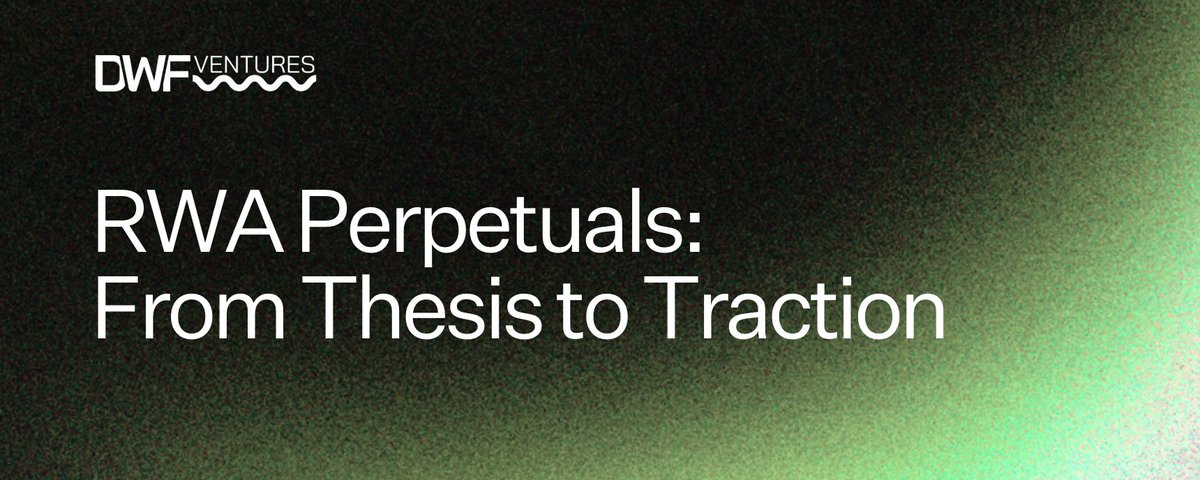
RWA perp volume has been increasing rapidly 📈
we believe that on-chain will remain at the frontier for it and are actively looking for teams building within this sector!
xy retweeted

Seth Klarman went on this podcast and broke down exactly how he turned $27 million handed to a 25-year-old with no track record into one of the biggest value funds on Wall Street.
It will completely change how you think about risk and investing:
1/ Cheap is not a strategy. A stock at a five-year low can just as easily become a ten-year low. Klarman will not buy something simply because it fell. He underwrites the expected return from today's price and demands a clear reason the business turns around inside a year or two. Without a catalyst, cheap is just a trap with a discount sticker.
2/ Value is what a business is worth, not its lowest multiple. A growing company is worth more than a stagnant one, and today's melting ice cubes melt faster than ever. A low-multiple stock whose cash flow is quietly eroding is no bargain. The multiple is the last thing he looks at, not the first.
3/ Every investor has to be a student of history. Even Benjamin Graham, the greatest value investor who ever lived, nearly went broke twice during the 1929 crash and the Depression. The value is not in the war stories. It is in knowing exactly how you would handle yourself in the worst moment before you are standing in it.
4/ Make your money from the bottom up. Klarman treats top-down macro views as weather, not as a reason to position. Build a portfolio of genuinely mispriced individual securities, the out-of-favor stocks, the spin-offs, the bankruptcies converting to equity, and you will probably do fine no matter what the market does.
5/ Hold several inconsistent thoughts at once. Markets careen through cycles as long as humans run them. War until people forget how bad war is, spending until it becomes inflation, debt that feels wonderful until rates rise and it turns pernicious. What seems true today will not be true forever, and a good investor never forgets it.
6/ The best buyers are forced sellers. In 2008 and 2009 Klarman did not make a brave contrarian call. He did the same bottom-up work he does every day, just bigger, buying bonds at 70 he judged covered at par because mandates and downgrades forced other people to dump them. When someone has to sell, price stops mattering to them. That is your entry.
7/ Prepare before you need to. Baupost stress-tests every position against a 1933-scale collapse, and it kept a waiting list of clients for years while closed to new money. That is why, when the crisis came, it raised roughly $4 billion in a single quarter and deployed about $100 million a day. The readiness was built in calm, not in the storm.
8/ Cash is optionality, not a target weight. Klarman runs concentrated 5 and 10 percent positions, so when a few come off, cash naturally swings from almost nothing to 15 or 20 percent. But he admits that holding 30 percent and more for years was a mistake, because with rates pinned to zero the downturn never came and the optionality never paid. Even patience has a cost.
9/ Benchmark to absolute return, not the market. Baupost aims to beat inflation by hundreds of basis points, full stop. It refuses to chase an index concentrated in a handful of overpriced names just to keep up. Beating the market is not the job. Making money you can count on is.
10/ Go where the competition is barely looking. Klarman likes commercial real estate precisely because it looks like a disaster. Offices hollowed out, the wrong buyers got hurt, buildings went obsolete. That mess is the point, because almost no one else is willing to look, and in assisted living an aging population and years of flat rents sit under distressed, half-empty buildings waiting to be bought right.
11/ The book nobody would keep in print became the bible. Klarman wrote Margin of Safety in 1991 at age 34. It printed about 7,000 copies, got no marketing, and went out of print. Competitors quietly bought it up to train their own teams, and it became a cult text worth thousands a copy. The work outlived the launch by decades.
12/ Stay quiet so you get better prices. Part of Klarman's low profile was temperament, but part was strategy. When you are accumulating a position, the last thing you want is the whole street knowing and bidding it up. Silence is not modesty here. It is price discipline.
13/ Buy insurance when nobody wants it. Klarman buys macro hedges when volatility is low and nobody expects trouble, so they are cheap, and sells them into a gain when the storm finally hits. Protection is affordable precisely when it feels unnecessary, which is exactly when you should be buying it.
14/ Avoid the losers before you chase the winners. On AI, Klarman is not trying to pick the champions. He is trying to sidestep the wreckage, and occasionally buy a high-quality business the market has dumped just because it got tagged an AI loser. The market throws out babies with the bathwater, and that discard pile is where he shops.
15/ Big IPOs quietly drain the whole system. Klarman thinks investors miss how much money is sucked out between mega-listings. SpaceX will not be the last, OpenAI and Anthropic are coming, and some endowments already hold 10 to 15 percent of everything in a single name. All of that eventually becomes supply someone has to sell.
16/ Watch for the bell that rings at the top. Klarman calls the SpaceX IPO exactly that kind of bell, an unprofitable business in aggregate at an enormous price, where by one Goldman estimate parts of it would need to grow roughly 100 times over to justify the valuation. Baupost owns none of it, in any form.
17/ Cheap money left too long breeds the blowup. Taking rates to zero after the financial crisis was understandable. Leaving them there for an extra decade after the danger passed stoked speculation and punished caution, and it detonated in 2022 with SPACs, meme stocks, and garbage companies down 50 to 95 percent. The bill for easy money always arrives.
18/ Pick the place, not the paycheck. Klarman's advice to anyone starting out: go somewhere you would happily invest your own money, do not fear the out-of-favor corner, and above all choose patient mentors who will not expect you to make money in your first six months. The early environment shapes the investor more than the early salary.
19/ His biggest regret is being too paint-by-numbers. Looking back over 40 years, Klarman wishes he had understood the engine that Silicon Valley and American creativity really are. He was too strict a value investor to touch venture capital, and he would go back and add it. Even a master can be too rigid about his own doctrine.
20/ You can always find a reason to be afraid, and markets get through most of them. There is always something overvalued, something risky, something that does not add up. Yet 1982 did not feel like a layup either, and it launched a historic bull market. The job is not to predict the storm. It is to own bargains, know your names cold, and stay in the game.
Follow @firesidealpha for more breakdowns of how the best investors actually think.
the financialization of everything, definitely more to come.
wonder if there are similar stats for SG / Asia in general


Wrote a piece on the tokenization stack and where we believe downstream value will flow towards in the near future.
A lot of exciting developments in the space with opportunities in non-USD markets rapidly emerging.


Best WC marketing I’ve seen 🤯

History remembers the winners.
Witness it live.
2 tickets to the final. $1 million prize pool.
kalshi.com/wc
xy retweeted

One of the best essays I've seen on the Pre-IPO and "tokenized startups" scene.
I remember there was a @bgurley quote from not too long ago that the IPO cycle has been "hijacked" by growth equity.
The door is open today to reinvent the IPO, and reinvent what it means for everyday investors to get exposure to the most exciting companies of our era. Tokenization, Pre-IPO perps, SPVs, Closed-End-Funds are all natural market reactions in this directions.
In the last year or so, TGE tokens have been going through an identity crisis. Reinventing the IPO may well become generational mission for tokens. The road is long, but as long as we march with purpose we will get there.

rip raybans

We’re partnering with @Samsung, @_GentleMonster_ and @WarbyParker on new intelligent eyewear.
Here's a sneak peek at two designs from this fall's upcoming collections.
#GoogleIO


