

Human-Centered AI for Software Engineering @google. Formerly @flutterdev & @dart_lang. PhD in HCI from @umsi. Posts and replies represent personal views.
San Francisco Bay Area, USA
Joined March 2007
- Tweets1.2K
- Following875
- Followers916
- Likes1.5K




Tao Dong retweeted

🇺🇸 For a deployed service member, missing family moments adds up. Baby’s first step. The first performance. Sharing a laugh.
In honor of National Day of the Deployed, we’re excited to partner with @USArmy and @The_USO to bring Google Beam to 20 locations so deployed service members can experience lifelike, 3D video connections with their loved ones.
🎥 Watch the docuseries below
Tao Dong retweeted

🚨 MAJOR MOBILE FEATURE 🚨
You can now record up to 1 hour of live audio directly in the mobile app. Capture lectures, team meetings, or your latest mad scientist rants and instantly use them as sources.
Pro tip: Combine your live audio recordings with photos of your handwritten notes to create the ultimate personalized workspace
Tao Dong retweeted

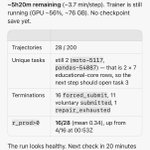
Can we audit how coding agents actually behave in deployment, not just on benchmarks?
We audited 20,574 real-world sessions to find where coding agents fail their users. Our paper is at #EMNLP2026, and I’m presenting today in Budapest! 🧵👇

Tao Dong retweeted

I've been looking into public benchmarks and am astounded by the poor quality vs. how much we rely on them as an industry.
@xeophon pointed me to this excellent site epoch.ai/benchmarks/ which is an independent third party which scrutinizes benchmarks and "looks at the data" 💪
For example, here are some popular benchmarks we all rely on. Before trusting a benchmark its worth running them and inspecting examples the grader failed carefully, to get a sense of the quality.
I'm continuing to look more into this, and will write something up eventually once I've collected more data, but I think this is an important subject.

Tao Dong retweeted

We’re excited to announce the inaugural Human–AI Interaction Conference (HAIC 2027), taking place June 27–30, 2027, in Washington, DC (CFP coming soon at haic.cc). HAIC focuses on translational impact, turning human–AI research into meaningful real-world impact.

Finally! Congrats to the team!

Lots of discussion out there about our next model(!), so I wanted to give an early look as soon as possible. Introducing Gemini 4 Argon!
It shows frontier performance in complex workflows, cyber defense and software engineering. Teams are using it extensively at Google, from coding to quantum computing, great feedback.
Here’s a look at the benchmarks:

Tao Dong retweeted

efficiency, productivity, speed
we keep worshipping these words like they are what we live for
ship faster
merge more
manage more agents
compress every loop
remove every pause
turn every hour into output
but what is the point of endless production if there is no time left to think deeply?
not react
not optimize
not summarize
not clear the queue
think
to sit with a question long enough that your real intention starts to appear
to find the purpose underneath the motion
to ask whether the thing being accelerated should exist at all
ai could be a new canvas
a way to make strange things
personal things
impossible things
tools, worlds, poems, games, interfaces, films, languages, rituals
things that let more people touch the shape of their own imagination
but instead, so much of it is becoming slop factories
more content
more funnels
more tickets
more fake work pretending to be value
you can merge 2000 prs
you can manage 500 agents
you can wake up to dashboards proving that the machine kept moving while you slept
but what is the point if you only sleep 5 hours a day?
what is the point if you stop talking to other humans?
stop learning about the past?
stop playing?
stop wandering?
stop being surprised?
what is the point if your whole life becomes optimizing the system that is consuming you?
speed is not meaning
scale is not wisdom
automation is not freedom if it only makes everyone run faster
and where are we running?
toward what?
a world where every person becomes a manager of machines, and every machine produces more things no one had the time to truly want?
the danger is not that ai makes us lazy
the danger is that ai makes us endlessly busy
that it gives us infinite production before we have found intention
infinite execution before we have developed taste
infinite motion before we have learned how to be still
maybe the real frontier is not more speed
maybe it is discernment
knowing what not to make
knowing when to stop
knowing when the most productive thing is to sleep, read history, call a friend, play with a cat, walk without tracking it, or stare at the ceiling until the false urgency dissolves
tools should give us more life
not turn life into a tool
if ai is going to matter, it should not just help us produce more
it should help us become more human
more imaginative
more free
otherwise, it’s the same old factory
just without humans
Tao Dong retweeted

Take public transit, earn Waymo Cash! Introducing transit rewards 🚆💸
Available to our San Francisco Bay Area riders in the coming weeks.
Read more: waymo.com/blog/2026/09/trans…
I’m totally gonna take @Gemini_Notebook with me on my next trip. Thanks for the tip.

The camera feature in the @Gemini_Notebook mobile app is so transformative for on-the-go research. I was up in the Sierras working on a new project, and I just took photos of everything, like this museum display. Then I asked for a detailed report of all the info in the image. The text below is what I got back. (I fact-checked it myself and it was 99% accurate -- and some of the text it transcribed is so blurry in the image that it was hard for me to read it.)
Next step is to generate documents like this for all the photos I took, and then ask Notebook to highlight all the information that adds something new to the existing knowledge base of sources I've already collected, or is particularly relevant to my latest writing and outline for the project. Truly magical.
Mariposa Museum Exhibit Reference: Mariposa in 1859 & Gold Rush Era
This reference document consolidates all text, photographic captions, historical statistics, newspaper clippings, and exhibit overlays displayed on the Mariposa Museum exhibit panel regarding Mariposa during and after the Gold Rush.
1. Exhibit Overview & Key Headlines
Main Title: "THIS WAS MARIPOSA IN 1859 – ONLY 10 YEARS AFTER THE GOLD RUSH BEGAN."
Historical Context Sub-headline: "PORTIONS OF THE TOWN HAD BEEN REBUILT AFTER THE FIRE OF 1858.. & PARTS OF IT WERE DOOMED TO BE DESTROYED IN 1866"
Display Overview: The exhibit centers on a large 1850s panoramic photograph of Mariposa, annotated with street names, landmark locations, and population statistics, flanked by contemporary hotel advertisements, fire reports, medical artifacts, and photographs of civic buildings.
2. Demographic & Real Estate Statistics (1850s vs. Present)
MetricHistorical Value (1850s Gold Rush Peak)Modern Value
Town Population~3,000 residents~1,800 estimated
Entire Mariposa Diggings Area~15,000 residents—
Commercial Establishments15 to 20 stores & saloons, plus hotels—
Town Lot Prices00 to 00 per lot—
3. Background Photograph & Civic Infrastructure
Background Photo Date: Taken in the 1850s, capturing the rapid growth of the settlement following the initial gold strike.
1854 Mariposa County Courthouse:
Shown in the background panorama prior to the construction of its iconic clock tower.
A separate framed photograph depicts the completed white wood-frame courthouse with a white picket fence and clock tower.
Clock Tower History: The clock mechanism was imported from England and is an 8-day, manually wound instrument. It remains operational today, maintained by the Mariposa Public Works Department.
Annotated Overlay Locations on Panorama:
1854 Courthouse: Located at the upper edge of town on Jones Street.
Jones Street & Bullion Street: Upper residential and civic thoroughfares.
Charles Street (Main Street): Primary commercial artery running through the center of the valley floor.
Schlageter Hotel Site: Positioned along Main Street.
Mariposa Creek: Flowing along the foreground basin of the town diggings.
4. The Fire of 1866: Mariposa's Second Great Conflagration
Below is the complete transcript of the Mariposa Gazette report featured on the panel regarding the disaster of August 25, 1866 (following the earlier destructive fire of 1858):
Article Text: "FIRE! MARIPOSA'S SECOND GREAT FIRE"
A few minutes after 6 p.m. on Saturday, August 25, 1866 Mariposa was again ruined by a disastrous fire (first in 1858). According to the Gazette (the building was damaged but not destroyed), the fire was believed to have started when "a recently imported printer stepped inside the Free Press office and lighted a cigar. The match had evidently been dropped carelessly amongst the papers on the floor. The Free Press office was located near the corner of Main and 7th Streets and by ten minutes the fire had spread through two blocks. The fire crossed Main Street to the Odd Fellows building and the Methodist Church and soon the buildings on the block between 6th and 7th Streets were burning like so much chaff." Seven full blocks, except for four fire-proof buildings, were totally destroyed. "In one hour about 60 buildings and 77,000 worth of property were destroyed."
By early Monday morning the men were clearing away debris and by press time the following Saturday, the Gazette reported that several temporary business structures had already been erected and were open for business.
Inventory of Buildings Destroyed in the 1866 Fire:
Residential & Civic: 14 Dwellings, 1 Church, 1 Odd Fellows and Masons Hall.
Media & Printing: 1 Newspaper Office (Free Press), 1 Newspaper Depot.
Hospitality & Retail: 3 Hotels, 5 Retail Stores, 1 Saddlery Shop, 9 Liquor Saloons (several equipped with billiard tables).
Services & Trades: 2 Livery Stables, 3 Law Offices, 1 Drug Store, 3 Blacksmith Shops, 2 Carpenter Shops, 2 Shoemaker Shops, 1 Tailor Shop, 2 Butchering Establishments.
Outbuildings: Numerous outhouses, private stables, and auxiliary structures.
5. Commercial Hotels & Lodging
Gallison Hotel (1887 Advertisement)
Location: Main Street, Mariposa (center of business district, opposite Odd Fellows' Hall).
Proprietor: Winslow Gallison.
Management: Mrs. Gallison individually superintended all internal departments of the hotel.
Amenities: Newly furnished rooms, first-class table dining.
Mariposa Hotel (1887 Card)
Location: Corner of Main and Fifth Streets.
Proprietor: Charles A. Schlageter.
Target Market: Accommodated general travelers as well as Yosemite tourists on short notice.
Amenities: Family rooms, well-lighted parlors, good table, and bath facilities.
The Schlageter Hotel
Date Built: Built in the 1850s.
Architecture: Prominent two-story wooden structure featuring full upper and lower covered verandas.
6. Medical Artifacts & 19th-Century Therapeutics
Old Mariposa Hospital
A framed historical photograph depicts a two-story wood-frame hospital building with a prominent front porch and side wing (annotated "from Chic Allingham").
Dr. D. Jayne's Family Medicines (1880 Display Broadside)
1. Jayne's Specific for Tape-Worm
Diagnosis: Describes tapeworm infections as widespread, noting that discharging white or yellowish segments ("resembling gourd seeds") is the only positive diagnostic proof.
Pricing & Ordering: .00 per dose, shipped nationwide via mail from 242 Chestnut Street, Philadelphia.
Usage Instructions: Dissolve powder in a pint of boiling water, drink in three equal hourly doses on an empty stomach. Follow with Cathartic medicines if bowels do not operate in three hours.
2. Dr. D. Jayne's Sanative Pills
Formulation: Concentrated, sugar-coated pills. Sold in 50-pill boxes (-bash.25) or 15-pill specimen packets (-bash.10).
Prescribed Ailments: Advertised for liver complaints, gout, jaundice, dyspepsia, rheumatism, kidney affections, fevers, nervousness, skin diseases, melancholy, sick headache, and costiveness (constipation).
3. Exhibit Commentary Note
A small museum card mounted below the broadside reads:
"A man advertises for 'a competent person to undertake the sale of a new medicine' and adds innocently 'It will prove profitable to the undertaker.'"

Tao Dong retweeted

We're hiring an Engineering Manager for our AI developer tools frontend team: goo.gle/4xS84WR


Spreadsheet is fulfilling its original promise as an end-user programming tool, with a little help from the AI.


I found it often hard to understand what my coding agent was trying to explain. And in this particular case, it’s Grok 4.6 in Cursor. What’s the best way to improve the technical communication skill of a coding agent?

Been using this internally. It’s a good model. Congrats to the team on the launch!


Is there a way to comment on specific parts of a plan in Codex? Both Cursor and Antigravity seem to offer a better UX on reviewing the agent's plans.


