

Engineer/Portfolio Manager - Join our newsletter with 19,000+ subscribers - https://xitter.cf/t.co/wnqyNcDDq4
Joined February 2021
- Tweets3.7K
- Following1.2K
- Followers17.1K
- Likes15.7K



Pinned Tweet
We estimate $414 billion in overall AI ARR by the end of this year (ex-China)
1. $187 billion in ARR from Anthropic and OpenAI (split between the labs and clouds who resell their models).
2. We estimate that ad-based ARRs for the two internet giants - Meta and Google - have been boosted by $95 billion over the past 2.5 years thanks to AI (based on the excess of their realized, high ad growth rates vs normalized growth rates). We estimate that this will increase to $108 billion by year end.
3. The various clouds - excluding frontier lab revenue - should be about $66 billion in AI ARR by the end of this year.
4. AI native apps and SaaS are generating $33 billion in AI revenue.
5. Smaller line items such as other frontier AI (Grok, Gemini subscriptions, etc.) and how AI is benefitting other ad networks (such as Amazon, Applovin, Unity, etc.) add another $20 billion in ARR.
Taking reasonable assumptions, such as a 6 year life for the equipment, this should give an overall 12% IRR on the $931 billion in AI capex made over the past 3.5 years.
Link with the details below


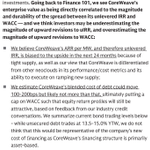
My personal bet is that $NVDA would step in if $CRWV gets into trouble.
Jensen needs a competing neocloud ecosystem that runs on the Nvidia stack. The trend at the hyperscalers and leading frontier labs will be to increasingly shift spend towards custom ASICs over time. Jensen doesn't want Nvidia to become a melting ice cube at some stage.
From Bernstein:


BERNSTEIN: “.. we caught a lot of hate when we initiated $CRWV with a $56 price target seven months ago. Today, it’s a lot harder to find bulls — certainly some of them just don’t call us anymore.”
Reiterate Underweight

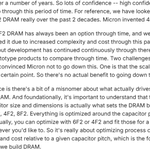
Micron on why it avoids 4F² - 11 days after CXMT's 4F² news knocked SK hynix 10% in a day.
Asked by UBS why rivals are pushing it, Micron CTO Scott DeBoer called the 4F² vs 6F² debate "smoke and mirrors."
His point: DRAM bit density is set by the capacitor pitch. The transistor underneath just has to fit under that capacitor, whether you build it 4F² or 6F². 4F² doesn't magically give you more bits per wafer.
So why is CXMT doing it? No EUV.
Shrinking 6F² further without EUV means stacks of DUV multi-patterning: more steps, more cost, worse yields. A vertical-gate 4F² cell stands the transistor up and moves the hard part from lithography to etch and deposition, which China can increasingly source at home (Naura, AMEC).
DeBoer admits 4F² can be built a few nodes behind the leading edge. Just more complex and more costly. That's exactly where CXMT sits.
At the leading edge, Micron says the 4F² scaling path "is not viable beyond a certain point."
Micron's own path skips 4F² entirely:
1-delta ramps 2H27, mid-20s% bit density gain
1-epsilon adds wafer bonding
1-zeta / 1-eta bring in $ASML High-NA EUV
3D DRAM runs in parallel, slotted between 1-zeta and 1-eta
So, CXMT goes for more deposition & etch as that's available in China. Micron goes for more EUV and high-NA EUV. $ASML $MU


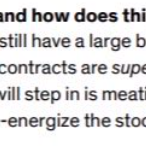
"We are also, frankly, hounded relentlessly by every hyperscaler and by dozens of smaller companies to rent more of our compute. So we could rent out our compute several times over if we said yes to everyone. That's just the situation here."
- Elon $SPCX call
"Our belief is that the value of compute per watt will increase over time, not decrease. And the reason for that, I think it should be obvious to people really is that as you improve the AI software, as the models get better and better, you get more useful intelligence per watt. And the value of that compute is proportionate to the useful intelligence per watt. And that's why you see things like even old computers like H100s renting for more than they rented when they were new. And I think that's likely to continue.
I think we're going to face a shortage of super intelligence compute. And that shortage is going to remain for a long time. So I think the smart move is to do short-term contracts and to and essentially to place the bet on useful intelligence per watt increasing rapidly, which obviously has done. So that's what's happened so far."


China just put the light source of an EUV machine on a trade show floor.
Langdao Silex (Shanghai, founded 2024, spun out of Tsinghua's plasma lab) showed a laser-produced plasma EUV light source. 90% local parts.
Mass production? 3-5 years away. That's their own staff talking.
Now the bar:
ASML production sources: ~600W
ASML demo in Feb: 1,000W, path to 1,500W
Langdao: no power number disclosed
A source that makes EUV light is not a source that runs 24/7 at fab uptime. And the source is one subsystem. The Zeiss optics are the harder moat.

On Anthropic's slowdown:
1. August is the month when most people take a holiday, you would expect token consumption to be lower. However, both OpenAI and Anthropic still produced nice MoM growth.
2. September is the month that OpenAI released Astra. You would expect dollars to shift to Astra to try it out.
I did a large coding project with Astra last month. It's definitely a smart model but overall Opus 5.5 is the far more productive and better model to work with. And now Anthropic will release the new Fable.
We're still very early when it comes to token demand. My bet is that Anthropic will retain a strong market share when it comes to the most advanced workloads, which is where most of the ARR in this industry will be made.
Open-source will be dominant for more commoditized workloads, which is where most of token demand will go, but revenues and margins will be much lower here.


$ASML High NA just crossed from science project to production tool.
Feb 2025: Intel had ~30k wafers through High NA.
Oct 2025: 300k across the fleet.
Today: Intel alone is past 1M, with results matching or beating low NA on the same layers.
Fleet availability: 80% in April. Now close to 90%.
The adoption calendar:
Intel 14A: first node built around it
Samsung: 2028, first High NA in DRAM HVM
TSMC: 2030
The tech is ready, and the ramp will start in the coming years. ~$400M per tool.


Unitree's CEO just shrank his own timeline for robotics' "ChatGPT moment".
August: 2-3 years best case, up to a decade.
Now: 1-2 years.
What changed? GPT-6 Astra.
Independent test, YAM robot arms, zero robot-specific training:
Block into a bowl: 19/20
Puzzle piece into a slot: 2/20
The "brain" for rough pick-and-place is basically here. Precision contact work is not.
Wang's own bar is 80% of tasks in 80% of unfamiliar environments. ChatGPT Astra clears the easy half.
Winners: actuators, reducers, dexterous hands (the exact bottleneck Astra exposed).
Under pressure: robot-specific model startups.
source: SCMP

Theoretically, $GOOG has all the assets to compete at the leading edge in AI - talent, data, strong operating CF to finance training runs and inference capacity. They're even uniquely strong in semis and hardware with the TPU stack. Additionally, they have the best cloud platform in the world with GCP which I use as the back-end for all my apps and tooling.
However, the big problem is that they have become a big, bloated and bureaucratic organization that is unable to move fast. Similar to the companies they outcompeted 20-25 years ago like Microsoft.
At Anthropic and OpenAI there are small teams of talent that can build and ship fast. In comparison, now four years into the AI race, the Gemini web console is extremely buggy, their AI models are mediocre, and they don't have good AI desktop tools or even extensions for top tools used by coders like VS Code.
"Micron to buy back 30-50% of the company in the next 2-3 years" - UBS
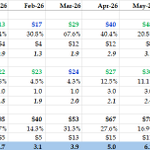
"Given FCF of ~$155B/~$225B/~$205B for C2027/2028/2029E, respectively, this implies the repo here could be in a similar ballpark as NVDA despite having an 80% smaller market cap. Said differently, this now lays the path for MU to buy back ~30% of the company over the next two years and potentially about half through C2029.
Ultimately, we think the market will reward this stock with a much higher P/E multiple as it sees a cycle play out in which MU's gross margins probably don't go below 65-70%, but in the meantime TBV/share should approach $360 by CYE28 - keeping a solid floor under the stock given much higher RoE across the cycle going forward as memory is critically important in an AI world."


