

DeFi Diva ☆• Crypto Enthusiast • Content Writer• web3 Marketing • Threadoor🧵• Curating insights on crypto 🚀
Blockchain
Joined December 2014
- Tweets157K
- Following1.5K
- Followers59.7K
- Likes24.1K










$LYX is starting to show some strength after bouncing back from the $0.17 support area.
Price is up 11.6% today, with buyers showing renewed interest.
The next levels worth keeping an eye on are $0.28, $0.35 and $0.45.
For now, $0.22 is the key level to watch. A move above it could give the price room to push higher.
#LYX

Hyperliquid whales have flipped short on Bitcoin for the first time in seven months.
According to Glassnode, major traders moved from net long to net short on October 27.
Key figures:
🔴 Whale BTC shorts: $924M
🟢 Whale BTC longs: $483M
🔴 Largest individual short: $178.5M
Meanwhile, US spot Bitcoin ETFs recorded $1.28B in weekly outflows, their worst since June.
DeFi is also under pressure, with Aave and Uniswap TVL falling 13.5% and 13.7% respectively over 30 days.
Yet Hyperliquid remains the leading DeFi perpetual exchange, recording $10.14B in 24-hour volume and 41.6% of the 30-day market share.
The market faces two possibilities: continued selling pressure or a short squeeze if Bitcoin breaks above $83K.
Are whales positioning for another Bitcoin crash, or could crowded shorts fuel the next rally?

19
238
20,807
Tems_DeFi retweeted

the first machine on GachaPad is here: LANKY. only on @base 🟦
@lankyonbase left the fast-food line for the trenches and got equipped by @jessepollak:
a memestock backed by actual @PalantirTech shares, tokenized as PLTRc. every spin, the machine uses 90% of the funds to buy them.
once it graduates, holders get daily PLTRc drops, trading fees burn solana:mV8AFmMpWe2HrX26wQ29B3PmjL44nPL9sfzYFWopump, and $GACHA stakers get 10% of the total supply.
how it plays, step by step:
- spin and get a random bag. luck picks the size: tiers go from rekt (the smallest) all the way up to jackpot, and the odds stay the same on every pull.
- each bag pays out LANKY, plus $GACHA on top, based on its tier. you always win something.
- at graduation, a Uniswap pool opens, pairing LANKY with all the Palantir the machine bought. bags become claimable, and the token hits the open market.
from then on, the pool's trading fees go to work:
- 70% stacks more PLTRc, distributed to token holders every day
- 30% goes to the GachaPad treasury
and the LANKY side of every trade's fees burns, deflationary by design.
this is also the first launch feeding the Holder Vault: 10% of the total LANKY supply goes to stakers.
🫡 suit up and turn the crank: gachapad.com
Tems_DeFi retweeted
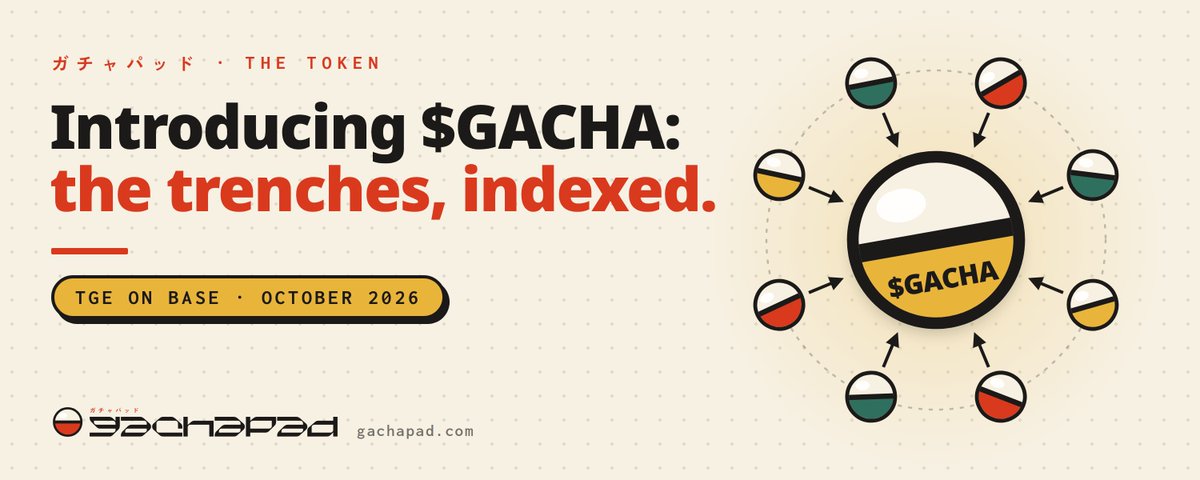
1/ $GACHA is live on @base via @virtuals_io.
It powers the first launchpad where tokens drop like loot boxes: same odds for all, luck as the only edge.
Stake it to get a slice of every machine that graduates. An index for the trenches.
CA: 0xd5A09d20652b58872a2E0F302DE6Ad2326dB3b84
$GACHA TGE is happening tomorrow on Virtuals, and the setup behind it is pretty straightforward.
GachaPad is building a launchpad where token launches work like a gacha machine. Each launch can allocate up to 10% of its supply to the Holder Vault, and people who stake and lock $GACHA can claim a share of those allocations.
That makes $GACHA more than just a token sitting alongside the platform. Its utility is tied directly to the activity happening on GachaPad and the launches going through it.
There’s also a treasury funded by 5% of every spin and 30% of trading fees. $GACHA stakers get voting power over how that treasury is used, including things like buybacks and incentives.
So there are really two sides to the model: exposure to launches through the Holder Vault, and governance over the value generated by the platform.
TGE is October 7 on Base through Virtuals.


🎰 I’ve seen enough launchpads where being early basically means being faster than the bots.
This one caught my attention because @GachaPad is trying something completely different.
Instead of the usual bonding curve and race for the cheapest supply, you pull for a random token allocation at a fixed price. Same odds whether you are the first person or the 10,000th.
The interesting part is how they’re trying to enforce that onchain:
◇ Chainlink VRF handles the randomness
◇ No tokens are minted before graduation
◇ Every pull appears in the public activity feed
◇ Graduated launches open liquidity on Uniswap v4
◇ That liquidity goes into a vault with no withdrawal function
So there’s no first-block advantage, no pre-minted insider stash, and the team says the LP cannot simply be pulled after graduation.
Then there’s $GACHA.
Rather than just being another launchpad token, it sits inside the model. Each machine can allocate up to 10% of its token supply to the Holder Vault. Users who stake and lock $GACHA can claim a share from machines that successfully graduate.
GachaPad itself takes 5% from spins and 30% of swap fees from graduated pools.
That creates a pretty simple loop:
More machines → more players → more graduations → more assets flowing into the Holder Vault.
$GACHA is coming this October, and the GachaPad machine is already running on Base testnet.
I’m keeping an eye on this one. 👀
The full breakdown from @GachaPad is below. 👇

26
121
14,265
Everyone is celebrating @arc’s launch numbers.
Millions of transactions. Hundreds of millions in TVL. Big financial names attached.
But the more interesting question is not how fast Arc started.
It is whether people will still use it when the launch excitement fades.
Arc launched on September 16, 2026, with a simple idea from @circle:
Build a blockchain where stablecoins can move like financial infrastructure.
Not just another chain chasing transactions.
A chain designed around digital dollars.
Here is what is happening so far 👇
《 The foundation
@arc is a standalone Layer 1, not an Ethereum rollup.
The difference is simple:
Most chains require their own token for fees.
Arc uses USDC.
That means users can interact with the network without first buying another asset just to pay gas.
The chain supports EVM tooling and uses Malachite BFT for fast finality.
One thing is important:
Good technology alone does not create adoption.
The market still has to prove real demand.
《 The first-week numbers
The launch was big.
Arc recorded:
○ 7.76M transactions on day one
○ 5.47M transactions the next day
○ Around 1.14M transactions by September 22
But early activity needs context.
A large part came from token launches and launchpad activity.
That creates attention.
The question is whether those users stay.
《 Where the money is sitting
Current ecosystem leaders:
○ @MorphoLabs
Around $220M TVL
Lending and capital efficiency
○ @Aave
Around $180M TVL
Credit markets
○ @Uniswap
Around $37M TVL
Liquidity and trading
The interesting part:
Most capital is currently sitting in lending.
The next signal is whether borrowing demand grows.
《 Projects shaping Arc
@Aave is building the credit layer.
@MorphoLabs is creating flexible lending markets.
@Uniswap is providing liquidity.
@circle’s USYC and @BlackRock’s BUIDL represent the tokenized asset direction.
cirBTC brings Bitcoin liquidity into the ecosystem.
These are the pieces needed if Arc wants to become more than a launch destination.
《 Why Arc became viral
It was a combination of:
○ @circle’s USDC ecosystem
○ Institutional names connected to the network
○ Fast transactions and low fees
○ Launchpad activity from projects like @Arguspad
But attention and adoption are different.
A chain can trend for a week.
The real test is whether people keep building and using it.
《 What I am watching next
○ Borrow demand on @Aave and @MorphoLabs
○ Trading volume after launchpad activity slows
○ Payment activity
○ Tokenized asset usage
○ Real businesses settling on @arc
My conclusion:
Arc started with advantages many new chains do not have:
○ Circle’s USDC ecosystem
○ Institutional relationships
○ Major DeFi applications from day one
But the biggest test has just started.
Can @arc turn launch momentum into lasting economic activity?
That is the part worth watching.

42
101
25,704
Honestly, I think the ZIG Finance rebrand makes sense.
ZIGChain isn’t going anywhere, it’s just becoming one part of a much bigger picture.
They’re expanding into financial products, distribution, structuring and more, with $ZIG at the centre of it all.
Definitely an interesting direction to watch.

ZIGChain is now ZIG Finance.
Our business has grown beyond infrastructure into financial products, origination, structuring, distribution and ecosystem development, with ethereum:0xb2617246d0c6c0087f18703d576831899ca94f01 at the economic centre.
We're now building across financial products, origination, structuring, distribution, infrastructure and ecosystem development, with ethereum:0xb2617246d0c6c0087f18703d576831899ca94f01 at the economic centre.
23
136
25,425
DeFi’s Next Battle Is Not About Liquidity. It Is About Execution.
For years, DeFi tried to build every financial application on general-purpose blockchains.
The idea was simple:
🔹 Swap tokens
🔹 Provide liquidity
🔹 Borrow assets
🔹 Trade
But one sector is exposing the limits of this approach.
Onchain derivatives.
According to @DefiLlama data, decentralized perpetual exchanges processed more than $571B in 30-day trading volume, with total open interest above $23B.
One platform is driving much of this growth.
@HyperliquidX processed approximately $214B in 30-day perp volume and holds around $14.3B in open interest.
That gives Hyperliquid roughly 37% of the entire perp DEX market by volume.
The important part is not only the numbers.
It is what they reveal about the future design of DeFi.
Traditional AMMs changed decentralized trading forever.
Platforms like Uniswap proved that users could trade without centralized order books.
But active trading has different requirements.
Professional traders need:
🔹 Fast execution
🔹 Deep liquidity
🔹 Low slippage
🔹 Reliable liquidation systems
🔹 Protection from unnecessary MEV
AMMs work well for swaps and passive liquidity.
But high-frequency trading requires infrastructure designed for speed and precision.
This is where specialized trading chains are gaining attention.
Instead of forcing every application into the same blockchain environment, these networks are built around one purpose:
Efficient financial markets.
The shift is important because it changes how we think about blockchain design.
The first generation asked:
"Can we build financial products onchain?"
The next generation is asking:
Can we build financial infrastructure that performs like traditional markets?
However, performance comes with trade-offs.
Specialized chains introduce new questions:
🔹 How decentralized are the validators?
🔹 How secure is the collateral infrastructure?
🔹 How much trust is placed on system operators?
🔹 Can liquidity survive extreme market conditions?
A fast exchange is not enough.
The infrastructure behind it must also be reliable.
The first generation of DeFi proved that financial products could exist without traditional intermediaries.
The next generation may prove that financial markets need blockchains designed specifically for them.
The future may not be one blockchain doing everything.
It may be specialized networks handling specific financial activities better.
RWA is building the asset layer.
Stablecoins are building the payment layer.
Onchain derivatives may become the trading layer.
The next DeFi winners may not be the protocols with the biggest liquidity pools.
They may be the ones that can execute financial markets most efficiently.
Will specialized appchains become the backbone of onchain trading, or will general-purpose L2s prove that one network can still do everything?

Stablecoins just crossed a milestone that shows where crypto is really heading. 👀
According to DefiLlama, the total stablecoin market capitalization has reached approximately $300.8B.
But the interesting part is not just the number.
It is what this growth says about the changing role of crypto.
Stablecoins started mainly as a way for traders to move between volatile assets. Today, they are becoming a core layer for payments, settlement, treasury management, and tokenized finance.
Looking at the market:
➜ @Tether_to USDT remains the dominant stablecoin with around $182.9B market cap, showing the massive demand for digital dollars globally.
➜ @circle USDC follows with approximately $72B, continuing its position as one of the most widely used regulated digital dollar products.
➜ @SkyEcosystem USDS (~$6.7B) represents the evolution of decentralized stablecoin models.
➜ @ethena_labs USDe (~$4B) shows the growth of newer crypto-native approaches to dollar exposure.
➜ @OndoFinance USDY and @BlackRock’s tokenized fund ecosystem highlight how traditional financial assets are entering the blockchain space.
The bigger picture:
Stablecoins are no longer just a crypto trading tool.
They are becoming financial infrastructure.
A company can use them for faster settlement. A user can send dollars across borders. A financial institution can explore tokenized assets and programmable transactions.
However, growth does not mean the market is solved.
Questions around regulation, reserves, custody, transparency, and liquidity will determine which stablecoins become long-term infrastructure.
The next phase of crypto may not be about replacing dollars.
It may be about rebuilding how dollars move.
With over $300B already represented on-chain, the competition for the future of digital money has only started.
What do you think will drive the next wave of stablecoin adoption: payments, RWA, or institutional demand?
#Stablecoins #RWA #DeFi

22
65
13,960
The future of digital payments needs better technology, but it also needs something just as important:
A name people instantly understand.
If someone sees a product that moves money, sends payments, or helps merchants accept digital assets, the name should already give them an idea of what it does.
That is why .cash is worth paying attention to.“
Cash” is a word everyone understands.
You don’t need to explain it. You don’t need crypto knowledge to understand it.
For builders creating wallets, stablecoin products, payment tools, and financial apps, that clarity matters.
We are already seeing real products using .cash:
➜ Zcash (z.cash)
A privacy-focused protocol built around the idea of encrypted electronic cash.
➜ Prompt.Cash (prompt.cash)
A payment gateway helping merchants accept Bitcoin Cash payments.
➜ Selene Wallet (selene.cash)
A non-custodial wallet built for users managing digital assets.
➜ Flipstarter (flipstarter.cash)
A platform helping communities fund projects through peer-to-peer crowdfunding.
These are real products connected to moving, storing, and using money.
When money is involved, security cannot be an afterthought.
.cash offers registry-level homographic blocking that stops visually confusable lookalike domains from being registered against you in the first place — the protection that is genuinely specific to this extension. It also supports DNSSEC and Registry Lock.
Because protecting users starts before they even click.
There is also a discoverability advantage.
As people increasingly use search engines and AI assistants to find solutions, a descriptive name becomes a relevancy signal. A domain like send.cash can surface when someone asks an AI “how do I send cash to Mexico.”
Some of the strongest names in the category are platinum .cash domains:
➜ go.cash
➜ my.cash
➜ fast.cash
➜ easy.cash
➜ q.cash
Interest in these goes through the same form as the giveaway below.
Speaking of which — there is a giveaway for tvl.cash
Enter here:
🔗 forms.gle/NC2n4FMxqaNBs8yG8
If you are building in payments, wallets, stablecoins, or digital finance, a clear identity for your product is worth considering.
.cash is becoming the place where payments live.
🤝 Paid partnership · 🤖 Made with AI

27
129
21,297
$STRIP ITTC SALE IS LIVE.
Cross-chain interactions can get messy fast.
Different chains have different environments, and getting applications to work across them usually means relying on integrations built specifically for those connections.
@Stripchain is building around intents instead.
You describe what you want to happen, and StripChain handles the coordination needed across chains to make it happen.
Less thinking about where the transaction needs to go.
More focus on what you actually want to do.
That’s the direction StripChain is taking with omnichain applications.
The ITTC sale is now open:
• 30 stages
• Increasing prices
• 100% unlocked at TGE
• $250–$10K entry
• Whitelist required
Join here: ico.stripchain.xyz/?ref=L4CZ…
Always DYOR.

The ITTC sale to acquire $STRIP is LIVE.
Participate in the new economic standard for tokens.
Acquire STRIP here: ico.stripchain.xyz

17
148
13,247
CR7’s wedding might have the most unexpected prediction market 😂
@Dexsport is asking the question everyone would probably click on:
Will @TeamKhabib and @TheNotoriousMMA actually fight again? 👀
Probably one of the most talked-about rivalries in combat sports history, and now the community can predict the outcome.
Check it out 👇
🔗 dexsport.io/prediction-marke…

30
80
21,328
Token launches usually put all the focus on day one.
$STRIP is taking a different route.
Its upcoming sale introduces the ITTC (Inverse Time Train Community) model, a structure that encourages longer-term participation rather than rewarding immediate selling after TGE.
A few things worth noting:
• 30 sale stages, with pricing increasing over time.
• A price floor mechanism designed to reduce heavy post-listing sell pressure.
• 100% of purchased tokens unlock at TGE.
• Participation ranges from $250–$10,000 in ETH.
• Whitelist access is required to join.
It’s an interesting experiment in token distribution and one that’s worth paying attention to if you’re exploring new launch models.
If you’d like the option to participate, securing a whitelist spot now makes sense before the sale begins.
🔗 ico.stripchain.xyz?ref=L4CZh…
DYOR.

0/
After completing the private whitelisted rounds, the $STRIP Inverse Time Train Community (ITTC) sale is finally opening up to the public.
Join the waitlist here : ico.stripchain.xyz
But this is not your normal token sale — we are defining a new economic standard for tokens in general.
🧵👇

27
200
12,995
Tems_DeFi retweeted

24 hours until the ITTC sale opens | 7th August, 12 PM UTC.
$STRIP is the first non POW token to launch with a hard floor, a soft floor and an age band; and uses a dPOS model to provide crypto economic security to the network.
The ITTC sale, not only provides community oriented distribution but also enables the creation of a proper economic foundation for $STRIP and tokens in general.
How to access the sale? So when the sale opens:
1. Go to ico.stripchain.xyz
2. Connect your wallet
3. Submit your email and verify
4. Use ETH on mainnet (min $250, max $10K), and acquire STRIP tokens.
Right now, you can still sign up for the whitelist.
~ The sale goes live in 24 hours ~

AI is becoming a bigger part of trading, but proving performance is still one of the biggest challenges. That’s why BLEEEP caught my attention.
Instead of being just another AI assistant, BLEEEP brings research, strategy building, backtesting, execution and portfolio management into one platform while creating verifiable records of trading decisions not just screenshots after the fact.
If BLEEEP delivers on that vision, it could set a new standard for how traders and AI agents build credibility through verifiable performance instead of claims.
Definitely worth checking out @bleeep_xyz .

BLEEEP AGENT BETA is here. The verifiable agent layer for performance-driven trading.
BLEEEP is the trading intelligence you can prove, turning agent decisions into forward-verifiable records which are committed before outcomes and preserved as evidence.
Real performance should be more than a claim.
31
56
21,125
In many cases, interoperability projects solve one problem.
@Stripchain is trying to solve three at once.
* Chain abstraction
* Liquidity fragmentation
* Cross-chain programmability
The interesting part is that StripChain isn't just focused on moving assets between chains.
It is building toward a unified liquidity engine designed to bring intents, interoperability, and liquidity together in one stack.
With Public Testnet v1 now live, users can explore:
🔸 StripAccounts
🔸 Unified Bridge
🔸 Cross-chain interactions across Bitcoin, Ethereum, Solana, Sui, and Arbitrum
The goal: moving closer to a more connected, intent-driven crypto ecosystem.
Explore the testnet:
home.stripchain.xyz
The Community Program and future ITTC sale updates will come later.
For now, discover what @Stripchain is building
🤝 Paid partnership

20
88
13,600
I’ve had a look at what @arrowex_app is building, and I think it’s worth paying attention to.
The exchange is already live even though $ARROWEX hasn’t launched yet, which isn’t something you see often. Instead of waiting for launch day, people can already explore the platform and see what they’re building.
ArrowEX combines spot and perpetual trading in one place, with up to 250x leverage, and they’re also bringing AI into the trading experience through their in-house engine, Genesys.
The native token, $ARROWEX, isn’t just another exchange token either. It’s designed to play a key role across the ecosystem, and the team has also committed to locking liquidity at launch.
Launch is happening July 15 between 5:00 PM and 6:00 PM UTC.
Definitely one I’ll be watching.
You can explore the ArrowEX platform using the links below.👇
arrowex.app
Whitepaper: whitepaper.arrowex.app
X : @arrowex_app
TG: telegram.me/arrowex_app
🤝 Paid partnership
