
Section Chief, BIDMC GenCards, travel, photo, beginning woodworking, @classicalmusic snob. Opinions my own. @harvardmed @brighammedres @bidmccvi
Boston, MA
Joined August 2016
- Tweets1.1K
- Following1.3K
- Followers1.2K
- Likes813





Eli Gelfand, MD, FACC retweeted

Updated intro2echo.com with sections on structural heart echo.
Walks through the steps for TAVR, mTEER, and tTEER. This includes 3D models as well as simulated 2D ultrasound images.
Would appreciate feedback and suggestions for improvement!
intro2echo.com/#mteer
Eli Gelfand, MD, FACC retweeted

A new study examines whether the clinical care recommended by contemporary LLMs carries a different cost than the care recommended by treating physicians, and whether that difference is influenced by how the models are prompted. Learn more: nejm.ai/4i18zYw

ALT This image is a diagram titled "Study Design" for a clinical presentation MTS_0481. It outlines a comparative study across four scenarios: Physician, AI-Generalist, AI-Cost-Aware, and AI-Parsimonious. Each scenario includes details on diagnosis, diagnostic orders, and costs in US dollars. The scenarios focus on acute bronchiolitis. The diagram also features stages like case selection, note splitting, plan generation, order extraction, and Medicare pricing.
Eli Gelfand, MD, FACC retweeted

76.6% of the harmful errors in a new medical AI benchmark were omissions. Not wrong facts. Missing ones.
The study is called NOHARM (Stanford, Harvard, ARISE network). It ran 1,100 real clinical cases through tools including OpenEvidence, Doximity Ask, GPT-5.6 Sol and Claude Fable 5, with about 13,000 physician annotations of patient harm.
As an oncologist, this matches what worries me most. A hallucinated drug is easy to catch because it is wrong, and I notice it. But I don't use AI to tell me what is wrong! I use it to tell me what I am missing. My most commonly used prompt when I use AI scribe and AI clinical decision tools is "What would you do differently for this patient?" OR "What did I miss?"
It also means our usual safety check, “does this answer contain anything false?”, is aimed at the minority of the harm. This is something you can't build a benchmark for.
One more finding worth keeping: physicians using AI still delivered better care than those without it.
So how do we audit what a tool left out? I have not heard a good answer yet.

Eli Gelfand, MD, FACC retweeted

Today I smiled for real for the first time in more than 5 years. Thank you to the jury, judge, court officer and clerk. And of course to my rockstar legal team. I truly wish the best for everyone involved.

A civil jury ruled in favor of ex-MIT scientist David Sabatini, who was accused by a younger colleague of inappropriate sexual conduct in his Cambridge research lab, and awarded him $6 million in damages. trib.al/s3v9VIX

Eli Gelfand, MD, FACC retweeted

Incredibly proud of this partnership between @Google & our faculty, led by Drs. @AdamRodmanMD, Mark Cohen, Jacob Koshy & Peter Brodeur, to test AMIE, Google’s patient facing conversational AI tool, in the first-of-its-kind, real world clinical study with primary care patients! ⬇️

Our medical research system, AMIE, is the first patient-facing conversational diagnostic tool of its kind to be studied prospectively in a real-world clinical setting.
In a study, published today in @TheLancet, we found that when patients chatted with AMIE before an in-person appointment, the interaction built their confidence and helped them organize their thoughts. And physicians who reviewed the information from the patient conversation got more time back to focus on collaborative care and shared decision-making instead of digging through data.
Eli Gelfand, MD, FACC retweeted

Today @TheLancet published our AMIE study with @BIDMC_Medicine, the first prospective study of patient-facing conversational diagnostics in a real clinic.
AMIE is a research system people can chat with before doctors appointments. Testing AMIE outside the lab with real urgent care patients showed how technology can help gather medical histories safely. Clinicians reported that the summaries helped them prepare for visits in 75% of cases and influenced their approach to care in more than half. AMIE’s differential diagnoses also matched the doctors’ final diagnoses 90% of the time giving clinicians more time to focus on patient care.
It’s Google’s first-ever paper in The Lancet’s main journal!
Eli Gelfand, MD, FACC retweeted

Big news: BIDMC's Smith Center for Outcomes Research is now the Richard A. and Susan F. Smith Institute for Evidence, Innovation, and Policy. A new chapter focused on evidence, innovation, AI, workforce development, and advancing better health care.
🔗 bidmc.org/news-stories/all-n…

Eli Gelfand, MD, FACC retweeted

We are seeking a full-time faculty cardiologist specializing in #CardioOncology to join the Division of Cardiovascular Medicine.
Pls share with your network! bit.ly/4hsvknS

ALT Opportunity for a Cardio-oncologist graphic
Eli Gelfand, MD, FACC retweeted

Excited to share that our lab has been awarded an R01 from the @NIH to investigate the molecular determinants of dynamic BP response to stressors. Incredibly grateful for the mentorship and support I have received @BidmcCvi , as well as for our collaborators across #TOPMed (1/2)

Eli Gelfand, MD, FACC retweeted
Join us for the 2nd annual #HeartFailure Summit on 1/29/27 in Waltham, MA! Faculty includes @ReshadGaranMD @the_gelf @UTahirMD @JenicaUpshaw & more. Course directors @MarwaSabeMD L. Fleming, D. Venesy, & D. Price.
Learn more & register:
learn.hms.harvard.edu/progra…

Eli Gelfand, MD, FACC retweeted

Breaking and MASSIVE:
Lowering Lp(a) with #pelacarsen in patients with elevated Lp(a) and heart disease does NOT improve cardiovascular outcomes in Phase 3 trial globenewswire.com/news-relea…

Eli Gelfand, MD, FACC retweeted

Dinner with all🌟 F1 class with a side of VA-ECMO teaching from @ReshadGaranMD during F1 Bootcamp!


Eli Gelfand, MD, FACC retweeted

I am a signatory to this important open letter from a group of distinguished Harvard faculty. Read the article @TheFP

Harvard says its Jew-hate problem is under control. But professors and faculty say otherwise in a new letter, arguing that an insidious form of antisemitism has taken hold. thefp.com/p/harvards-antisem…

Eli Gelfand, MD, FACC retweeted
Welcome @KateKearney4 to the Interventional Cardiology team @BIDMCHealth! Dr. Kearney was most recently at @UWMedHeart and has extensive expertise in #CHIP & #CTO & hemodynamic support.

Eli Gelfand, MD, FACC retweeted

Fifty years ago today, Air France Captain Michel Bacos showed the world what true moral courage looks like.
When Flight 139 was hijacked by Palestinian and German terrorists and flown to Entebbe, the non-Jewish passengers were eventually released. Bacos and his crew were also offered their freedom.
However, Bacos, who also served in the French army under DeGaulle, refused to leave his Jewish passengers. All his crew also refused, without exception.
Instead, they chose to remain alongside the 94 Jewish hostages, fully aware of the danger they faced. As Bacos later said, abandoning his passengers was simply "unimaginable."
Days later, they were freed in the legendary Israeli rescue mission, Operation Entebbe, led by Yoni Netanyahu, who would die in the battle.
For his extraordinary courage, Bacos was honoured by both France and Israel. Yet his greatest legacy was not the medals he received, but the example he set: that decency, duty and humanity must never yield to terror or antisemitism.
Michel Bacos was a true hero. May his life, his courage and his memory forever be a blessing and an inspiration.


Eli Gelfand, MD, FACC retweeted
Congratulations to Dr. Jennifer Ho on her promotion to Professor of Medicine @harvardmed! As Director of Research in our Division of Cardiovascular Medicine, she has been instrumental in empowering collaborative research to advance cardiovascular health 🌟
bit.ly/4sZJGjj

Eli Gelfand, MD, FACC retweeted

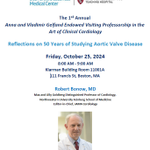
Dr. Eugene Braunwald defined the modern era of cardiovascular medicine. An alum of NYU and our School of Medicine (the only one to admit Jewish students), Dr. Braunwald endowed an Assistant Professorship in our Division of Cardiology to support rising star clinician-investigators

Eli Gelfand, MD, FACC retweeted

All the explanations I’ve heard today for the negative CLOSURE-AF result—some so strained they’re almost impressive.
1) The devices were “outdated” and therefore responsible for excess complications (the usual argument that things only go wrong elsewhere).
2) DAPT was used after LAAO, which is now said to be obsolete because of bleeding concerns compared with DOAC-based strategies (a claim that is often repeated, less often demonstrated).
3) Stroke rates were similar, so the signal is attributed mainly to bleeding and procedural issues—as if that were a minor point.
4) The composite endpoint is criticized for mixing different mechanisms, although if anything it should have favored non-inferiority.
5) The early phase of enrollment is invoked to argue that complications are not representative of current practice (again, complications seem to belong to others).
6) And then there are the usual remarks about loss to follow-up, crossovers, and lack of blinding.
What seems to be missed in this accumulation of arguments is straightforward: the burden of proof lies with LAAO, not with the control arm. The issue is the strength of the evidence supporting LAAO, not medical therapy, which remains the reference standard.
