

Assistant Director of K-12 Curriculum, Hillsdale College | https://teapawt.net/t.co/gx29VwTlOJ |🌲
Hillsdale, MI
Joined July 2018
- Tweets2.4K
- Following1K
- Followers1.8K
- Likes7.2K








Pinned Tweet
Education is almost by definition the formation of a ruling class. You train workers or subjects but you educate citizens and rulers.
The Golden Thread Curriculum (goldenthreadcurriculum.com) opens with an essay with similar reflections. The epigraph for Chapter One is:
"Come on, sons of the Greeks! for the freedom of your homeland, for the freedom of your children, your wives, the temples of your fathers’ gods, and the tombs of your ancestors! Now all is at stake!"
Aeschylus, The Persians 402–5
As an introduction to the first chapter of The Golden Thread, teachers should read this selection aloud, have students read it, and dwell on its context and meaning. The play, which was performed in 472 BC with a young Pericles as choregos—that is, the wealthy Athenian citizen who financed the chorus for the play, the greatest expense of its production, as his “liturgy,” or his duty of service to the city—focused on the defeat of the second Persian expedition at Salamis in 480. This was arguably the most important battle, after the Battle of Marathon, in the history of Western civilization. That civilization, as such, would never have come to the great heights it did if it were not for these Athenian victories; the Greek world would have been absorbed into the Persian East, a distant outpost of a great, despotic empire instead of the center of the Mediterranean world, and a great, enduring cultural force.
Eventually, Greece did become absorbed in empire, first under Alexander, then under the kingdoms of his successors in Asia Minor, and finally under the Romans, but not before it rose to a great height. It passed its cultural and political legacy on to the Romans, and through them, to us. The epigraph sets the tone for the book as a whole, because not only the soldiers described in the play, and Aeschylus’s immediate audience, but we ourselves are “sons of the Greeks” (paides Hellēnōn), who, in gratitude for our inheritance, must strive to retain it, fight for it, and pass it on to subsequent generations.
The epigraph, in which a messenger relates a battlefield speech from a general, introduces the theme of freedom. The teacher should note that the freedom here described is not individual freedom, but freedom for “homeland,” “children,” “wives,” “temples,” and “tombs.” It is a freedom that connects past, present, and future, a freedom that carries with it an obligation to defend the land and burial places of one’s “fathers” and “ancestors.” The Greeks, like all Indo-European peoples, long practiced a tradition of ancestor worship, burying and worshipping their fathers on their own land, and believed that their fathers’ presence was a blessing for them, but if dishonored or abandoned, a great curse —“temples” here is more literally “seats” or “dwelling-places” (hedē)—the land itself was sacred to them. Aeschylus himself fought in the great battles of the Persian War, including at Salamis, and the inscription on his tomb mentioned only his service at Marathon, not his great career as a playwright, though he was truly the founder of the genre of tragedy. In his time, the old civic piety and religion he evokes in The Persians was already in decline, but the great crisis he and his countrymen fought to avert helped to recover that inheritance and build a new sense of Greek and Athenian greatness.
The epigraph also introduces the theme of struggle, a fight: “Now all is at stake” is literally “Now the contest (agōn) is for everything.” This “agonistic spirit” is described in Chapter One as characteristic of the Greeks: it is found not just in war but in games, in the struggle of battle as well as the struggle of politics. Agōn is also the Greek word for a gathering or assembly. The men addressed here are soldiers, but they are also citizens who take part in the rule of their country and are fighting against a people which would subject them to slavery. They are not fighting as conscripted professionals or mercenaries, and not merely for their lives, but as free men for their very way of life. Aeschylus raises the stakes for the Athenians, and, with this epigraph, the text raises the stakes for us. What is at stake in studying the ancient world? Everything.

Rubio's speech on the Greeks and what they have given us is so important. Worth listening to in full.
These are the essential ideas that define the West and civilization itself. These are the ideas we have to teach and protect for civilization to continue.
"Here, in Athens, we found the first full realization of all the essential traits that would come to define the West: fierce individuality and relentless ambition; daring exploration and invention; a yearning for discovery, for adventure, risk and glory. An insatiable curiosity about the world and the principles by which it operates, a hunger to know the mysteries of nature and grasp the secrets of the cosmos. An impatience with the notion of impossibility, chafing at all boundaries and limits, straining to peer into the depths of the unknown.
These were not just the formulas or precepts of a particular school of philosophy. They were the characteristic of a people – expressed in their traditions, their stories, their imagination; in the qualities they demanded of their citizens; in the things they lived and fought and died for.
To know them is to know ourselves."
state.gov/releases/office-of…


My father-in-law is a tweeter. He is insanely gifted. We were looking at the CLT account together years ago and I asked him what it would cost to build it today. I will never forget his answer… 'It's just the same ten posts over and over again.'

3
49
2,001
My real contribution to this "controversy" is that the way SJC/TAC do science is insanely hard, actually, and probably establishes a much better groundwork for advanced graduate study in the hard sciences than anything explicitly oriented to that end.
John Peterson retweeted

History is too often taught as a pile of disconnected units — a week on Greece, a week on Rome, a scramble to reach the twentieth century by May. Students memorize, test, and forget. Teachers are overwhelmed by the prep work and already feeling frustrated mid-year.
The Golden Thread Curriculum, the product of an exclusive partnership between Hillsdale College's K-12 Eduction Office and Golden Thread Academic, takes a different approach.
Anchored in The Golden Thread: A History of the Western Tradition by Allen C. Guelzo and James Hankins, it treats the history of the West as a continuous story — one shaped by enduring themes that students can actually trace from antiquity to the present.
What teachers get:
→ Structured, lesson-by-lesson plans ready for the classroom
→ "The Loom" — interpretive questions that anchor each chapter and drive real discussion
→ Key Concepts and Essential IDs that build historical thinking, not just recall
→ Curated primary sources, assessments, and chapter exams
→ A growing community of educators, with groups, forums, and shared commentary right inside the curriculum
It's designed for high school teachers, schools and networks, and homeschooling parents who want rigor without having to build everything from scratch. Volume I is live now; Volume II follows in October.
If you teach history, humanities, or great books, take a look: goldenthreadcurriculum.com
#Education #Teaching #History #ClassicalEducation #Humanities


John Peterson retweeted

The West is one unbroken conversation, from the agora of Athens to the workshops of Florence, about what is true, what is good, and how a people ought to live.
The Golden Thread Curriculum gives teachers and homeschooling parents what they need to help carry that conversation forward: lesson plans, primary sources, illustrations, and original maps that tell our story.
Built on the celebrated books by Allen C. Guelzo and @JamesWHankins1, from Golden Thread Academic and @Hillsdale.
Volume I, from Greece through the Renaissance, is available now, free of charge for educators and parents at goldenthreadcurriculum.com.


John Peterson retweeted

The National Review names The Golden Thread its Book of the Year. The review by Rich Lowry has an excellent grasp of our reasons for writing it. It mentions also our substack @goldenthread and Hillsdale's wonderful history curriculum based on the book. @ufhamilton @O_TooleKathleen @GreatHeartsAcad @Hillsdale @MemoriaPress @CivitasInst @UNCSCILL @osuchasecenter @ASUCivics @ASU_SCETL @CivicEducation @NASorg @CLT_Exam @JeremyTate41 nationalreview.com/2026/09/t…

I'm the editor on this project and the author of a good portion of the work. It's the product of two years of labor. Check it out.
The Official Golden Thread Curriculum is here.
Developed in exclusive partnership with @Hillsdale College, it brings the story of the Western tradition into the classroom with rigor, coherence, and a commitment to truth.
Volume I is now available—giving teachers the tools to help students encounter the figures, faiths, and ideas that shaped the West.
The thread begins here. 🧵
Learn more: goldenthreadacademic.com

John Peterson retweeted

What has Rome to do with Washington? 🇺🇸🏛️ The Classics with our Republic?
American politics and American education have degenerated in tandem.
No surprise. Over a century ago, there was a conscious effort to overturn both the American constitutional order and the education that prepared young people to be citizens in a republic.
It largely succeeded. On the ruins of the Old Republic, we got the Progressive administrative state. And on the ruins of a classical education that would prepare the next generation to be citizens in a republic, we got K12 progressive schooling and the modern research university.
Which makes the recovery and explosive growth of classical education one of the most promising developments in America today.
Proponents recognize that classical education offers a better chance at happiness and virtue to its students than does the progressive education models of the 20th century ...
... or, for that matter, the rankly anti-Western ideology that has burst onto the scene more recently.
But can classical education also equip graduates to meet the constitutional and civilizational crises of our time?
Should it even try?
@HammillRyan and I think classical education can, and should, do exactly this.
And to do so well, we think we need to MAKE CLASSICAL EDUCATION ROMAN AGAIN.
Our argument is out at @Heritage this week, heritage.org/conservatism/re…
Buckle up. This is a long read. But it's worth your time.

John Peterson retweeted

Classical education is an education in Western civilization. Western civilization is fundamentally ROMAN.
Many thanks to @Heritage for hosting this long report @pleonidasp and I got work on, and extra thanks to @scottyenor for his wise and patient shepherding of this project.

Great review.

The Golden Thread has had the great good fortune to have received three reviews that come close to understanding the ambitions of its authors. (If these ambitions were understood by the left they would be busier trying to destroy the book rather than ignoring it in the usual fashion.) The firsr two were by Spencer Klavan in The Claremont Review of Books and by Daniel Bell in The China Review. A third, by Jaspreet Singh Boparai, a writer of extraordinary elegance, has now appeared in First Things, on the 25th anniversary of 9/11, appropriately enough. firstthings.com/reasons-to-b…

The author of "I'm Smarter than You" and "You Guys are All So Dumb" has written a new piece: "This Thing You Love is Actually Bad." Can't wait to read it!

6
134
John Peterson retweeted
A wonderful review of The Golden Thread vol. 1, by the leading theorist of political Confucianism of our time (though he would never describe himself that way, having the Confucian virtue of humility). Key quote: 'I wish that this book had been published 150 years ago and translated into Chinese. It could literally have changed the course of Chinese history for the better.' One blushes.
muse.jhu.edu/pub/250/article…
My reflection on a great work of (young) children's literature.
One of my favorite children's books is The Little Island by Margaret Wise Brown, illiustrated by Leonard Weisgard.
It's a story about an island, a cat, and a fish, and as my colleague @thejohnpeterson explains, an illustration of way books help parents and teachers show reality to students.
You can read his reflection here, on @Hillsdale's Classical Classroom blog:
k12blog.hillsdale.edu/the-li…


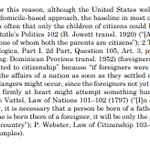
Thomas basically putting the part of my Constitution course on immigration in a footnote (although I would not assign Jowett... come on, man!).
