

American Photographer — publishing one million photographs.
San Francisco, CA
Joined December 2006
- Tweets46.4K
- Following1K
- Followers68.1K
- Likes223K




Pinned Tweet
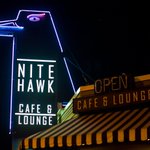
Hawk Bowl. My name, in neon, on a bowling alley in Wisconsin.
I was driving from Chicago to Milwaukee, which is 92 miles straight up I-94, about an hour and a half if you behave yourself. I did not behave myself. I went to Whitewater first, which turned a 92 mile drive into about 150 miles and three hours and fifteen minutes. Fifty five extra miles and an hour and forty five minutes out of my way, plus the time I spent standing in the cold shooting it.
It could have been five hours out of the way and I still would have gone. How do you not go. It says Hawk. I am Thomas Hawk and I shoot neon signs. There was no decision to make.
Whitewater is Warhawk country, University of Wisconsin-Whitewater, so the name made sense there. A bowling alley and a lounge with a green arrow and a giant bowling pin on top, the pin with a red crown painted around its neck, rust running down the panels. Bare trees behind it. Grey sky. Winter light.
Sixteen lanes, opened in the 1960s. Before the university built its own little six lane alley in 1965, students came here. Leagues and traveling teams, kids leagues from age five on up, seniors bowling into March, a lounge and pool tables and darts on the side. That is what a bowling alley was in a college town.
I drive around America like that. Big Joe and Phantom 309 on the radio, town to town, sign to sign. You follow a tip or an old photo to some motel or diner or bowling alley and half the time you get there and the building is just gone. Not closed, gone. The cleanest concrete platform foundation you have ever seen, swept bare, like the place was never there at all. Somebody mopped up after the whole thing.
And then the other times you make it. You get there while the sign is still standing and you get the shot.
Hawk Bowl is gone now. They lit the sign one last time on a November night in 2023 so people could come take final photos, and then they tore the whole place down in early 2024 and put up an Aldi. I cannot find any record of anybody saving the sign.
I made it in time for this one. I do not always. Hawk Bowl RIP. Another little piece of the Americana highway gone for good.

The ad: It is a 30-second spot called "Full of Hate." The voiceover, from a woman whose face is hidden, says: "Today's liberals are full of hate. They hate America. They're obsessed with skin color. I can't even show my face because my skin is white and they'll spew hate at me. Hate leads them to racism. Liberals are the new racists." It names no candidate or specific policy, which viewers noted as well.
Who America Next is: A conservative 501(c)(4) nonprofit based in Baton Rouge, Louisiana, whose stated mission is promoting conservative, free market policy solutions. Because it is a 501(c)(4), it does not disclose its donors. One recent report identifies it as operated by former Louisiana governor Bobby Jindal, and notes that on September 29 it paid $250,000 to a consulting firm called Breakthrough LLC, which shares its Baton Rouge office suite, for "canvassing and influencer marketing" against Abdul El-Sayed, a candidate in Michigan.
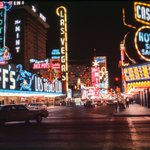
Found slide. Fremont Street at night, Christmas garlands strung across the street. Viva Las Vegas.
The Mint tower is up, so it is after 1965. Biff's is still there, so it is before 1969, when the Dugout took its place. That leaves a small window, and this slide sits right in it.
Biff's. I don't see many photographs of Biff's. For a long time nobody could even say who Biff was. The name was just there in neon, ten feet tall, over Fremont Street.
He was a kid. W.W. "Biff" Naylor, son of W.W. "Tiny" Naylor, who ran a bunch of Googie diners in California. Tiny's boy got his name on the Las Vegas Club around 1957, and the paper said they were known back home for the finest food.
Sean Connery drove past this sign in Diamonds Are Forever. Dean Martin drove past it in Kiss Me, Stupid. Then the sign came down.
The Las Vegas Club closed in 2015. The Mint is Binion's now. Somebody stood on this street with a camera on a Christmas night in the late 60s and shot this. The street is still there. The signs are not.


I found a photograph that stopped me cold.
I swear this is Michael K. Williams. Omar from The Wire. Same eyes, same face, same stare right through the camera.
Except it can't be him. This photograph was taken in the 1940s, twenty years before Michael K. Williams was even born.
It comes from a collection of 240 photographs and pieces of paper I have been working through, a whole life in a box, and I am calling it the Isiah Calloway Collection.
Isiah seems to have been a travelling minstrel performer. There is a photograph of a tent banner in the album that reads "Diamond Tooth Billy Arnte and his Happy Days Minstrels." And there is a newspaper clipping from Oshkosh, Wisconsin, March 1933, that has the Happy Days colored minstrel orchestra playing a dance there.
These were Black entertainers, touring town to town, performing in blackface, because in the 1930s that was the work. That is the complicated, real history in this box. Show posters, portraits, snapshots, a whole troupe of people making a living on the road.
And somewhere in the middle of it is this man in the light colored hat, looking straight at me like he knows something I don't.
There is another portrait in the album, a man in a sharp plaid suit, and I once wrote in the comments that it could be Isiah Calloway himself. I still don't know. I don't know which one of these men he was, or what happened to him, or where the road ended for him.
So I am asking the internet the question I can't answer myself. Who was Isiah Calloway?
The whole album is here. 240 photographs. Somebody out there knows something.
And who was this man who had Michael K. Williams' face 20 years before he was born?
flickr.com/photos/thomashawk…

The mayor of Oakland couldn't keep her own lights on.
Sheng Thao is on trial for bribery, and prosecutors just showed the jury her texts.
December 2022: can't afford rent. PG&E bill over $1,000. Water $800. And that same day her boyfriend is chasing a check from the fixer at the center of the whole alleged scheme.
May 2023: the power gets shut off. $6,000 to turn it back on. By November the bill is $3,000 and she is telling him to turn off the lights.
Read that again. The mayor of a major American city had her power cut off while she was allegedly selling her office to the highest bidder.
And meanwhile the rest of us pay some of the highest electricity rates in America and get bombarded with idiotic PG&E commercials patting themselves on the back for keeping the lights on, like we should thank them for charging us a fortune to do the one job they exist to do.
And Gavin Newsom? He inherited the golden goose. The greatest state in America, the best economy in the nation, handed to him on a silver platter. He didn't build any of it. He just makes everything worse and more expensive, and brags about it the whole time.
And he brags about it all from a $9.1 million mansion in Kentfield, his kids in a private school in Ross that costs over $70,000 a year, while the middle class either gets fleeced or leaves California.
Oh, and the guy on trial for bribing the mayor. Here he is in a photograph with his buddy Gavin himself.


Day 6 of the Sheng Thao trial.
Prosecutors played a 2019 recording of then-Councilmember Sheng Thao talking to Andy Duong about a closed-session discussion on California Waste Solutions. She named names. “Noel, fucking Dan, and Loren kept bringing it up,” she said. “It was mainly Dan.” She told him Rebecca Kaplan was concerned and that Loren Taylor would “shut the fuck up” if Larry Reid stepped in. Then she added, “We don’t need people hearing us talk” and “We don’t want to be seen with you guys.”
The same day the jury heard texts from Thao and Andre Jones about money. In December 2022 she told him to “pay the fucking rent” while PG&E was over $1,000 and the water bill was around $800. In January a check from Mario Juarez hit Jones’s account the same day she pressed him on rent. Later, after she was mayor, she texted that the power had been shut off and reconnection would cost $6,000. By November she was telling him to turn off the lights because she “cannot pay” a $3,000 bill.
Barclay also walked through a roughly 100-page Evolutionary Homes group chat that never included Jones, plus emails and an org chart that left him off the government-relations side. A $35,000 check from the company still went to him in November 2023. On a separate recording Andy Duong told Thao, “You need to get your shit together. If you want to continue for another term, you better start acting right.”
The defense started cross-examination by pointing out that Oakland never bought the housing units and never extended the recycling contract. One juror was excused. Trial continues next week.
Cocktail hour doesn't get much better than Izzy's in the Marina on a Friday night in San Francisco.
The place is named for Isadore "Izzy" Gomez, a Portuguese immigrant who ran a little saloon at 848 Pacific Avenue on the Barbary Coast. During Prohibition he became the city's most beloved bootlegger. He did 30 days in jail for it in 1933, then got a presidential pardon ten years later. He fed starving artists for free, gave away so much that his obituary said his unrecorded charities kept him penniless, and William Saroyan loved the joint so much he set his play The Time of Your Life in it.
The original saloon was torn down in 1952. Sam DuVall opened this steakhouse in his honor in 1987, on what would have been Izzy's 111th birthday.
A cold martini, two olives, and a bar that still feels like old San Francisco. Some places just get a city right and dinner at the bar with Dian is best of all.

Wait, what?
You’re telling me this Andy Duong guy photographed here with @AGRobBonta was not only bribing Mayor Sheng Thao but also had the shit beaten out of some guy, put him in the hospital and stole his watch and chain?
These Duongs are starting to sound straight up gangster.


May 3, 2024 -- a turning point for the alleged pay-to-play scheme for former Oakland Mayor Sheng Thao. This is a photograph taken by Andy Duong and submitted into evidence of the ambulance called for Mario Juarez.
He says a group of men called by the Duongs beat him up, the business relationship had soured that badly. They couldn't get anyone to order their converted shipping containers for the homeless, and Juarez's bills at the plant in Mexico were adding up.
You can see Juarez on the ground, his back to the building, and David Duong standing to the left. Juarez said Andy Duong stole his watch and necklace that day. During the FBI raid June 20th, agents say they found Juarez's watch and necklace at Andy Duong's home. The prosecutor passed the items to the jury today.


The spanking photo.
I bought this archive of negatives out of Maryland a while back and I have been scanning through it a little at a time ever since. Most of it is ordinary stuff, and honestly that is what I love about it. Porches and kids and cars and people standing around in their good clothes on a Sunday.
And then this one shows up.
He is looking right at the camera and grinning. She is across his lap on this floral couch with one leg kicked way up in the air and his hand is halfway down in a blur.
He has got a wedding ring on. Her face is in the cushions so you cannot see if she is laughing but come on, she got to be laughing, right? Nobody falls into a picture like this. Somebody stopped everything and said wait, get the camera, and then they held it together long enough to actually pull it off.
So some night back in the forties, in a living room somewhere in Maryland, this was the photograph they wanted. Not the wedding and not the baby and not the new car. This one. I do not know what the joke was but they wanted it kept.
And now the negative has outlived all of them. There is no name on the sleeve and nothing written on the back and no way to ask anybody. Just the two of them, mid swing and mid laugh, in a box, waiting for some stranger to scan it eighty years later.
That is why I sit there and feed negatives into a scanner one at a time. Ninety nine frames of nothing much and then a room full of people you will never meet lights up, and for a second they are right there.
I've only found a few old photos of spankings but apparently maybe it was a thing back then. Then again I have taken a few photos of spankings myself, but mostly those photos were taken at the Folsom Street Fair.
I still don't know who these people were but I think there are probably clues in this album. flickr.com/photos/thomashawk…

I photographed this at Pier 24 in San Francisco, at Secondhand, a show built entirely out of other people's pictures. Up front was John Baldessari, being more direct than the show might have been otherwise.
"I really don't think imagery should be owned, including my own. If it's part of our world, it's like owning words. How can you own words? It's just stuff to use."
Baldessari was the godfather of conceptual art, and he did not just talk like this. In 1970 he hauled every painting he had made between 1953 and 1966, about a hundred one of a kind canvases, to a crematorium in San Diego and burned them all to ash. The ashes went into boxes and an urn. Some got baked into cookies. He called it the Cremation Project.
Warhol did his version. He took a hibiscus photograph by Patricia Caulfield, poured his colors over it, and made the Flowers paintings. She sued. They settled.
Richard Prince went further. He screenshotted other people's Instagram photos, printed them huge, added a comment underneath, and sold them for as much as $100,000 apiece. Photographers sued, and this time the courts did not side with Prince. In 2024 the judgments landed: $650,000 in damages to photographers Donald Graham and Eric McNatt, plus $250,000 for their legal costs, the infringement found willful.
Robert Frank, in 1989, drilled straight through a stack of his own work prints from The Americans, bound them in wire, and hung the thing like a crucifixion.
I am not burning anything or drilling anything. But here is where I land. Every photograph I publish is Creative Commons non-commercial. Use one for art, a personal project, a classroom, a non-profit, whatever, just not commercially. Commercial is a different conversation, and people can always reach out.
I wrote this years ago and I still believe it. When I take a photograph it belongs to me while it is in the camera, while I process it, while it waits in a folder. Then I upload it and it is like taking a bird, opening the window, and letting it go. Off she goes. Her song is for whoever hears it. It is no longer only mine.
So what would you do with a photograph once it is out in the world? Should imagery be owned at all, or is it just stuff to use?

This man never agreed to be photographed.
His name was Erno Nussenzweig, an Orthodox Jewish man walking through Times Square when Philip-Lorca diCorcia made this portrait, one of a series called Heads. No hello. No permission. No release form. Just a stranger's face caught in a burst of light, every hair of that beard lit like wire.
DiCorcia printed it big, hung it in a gallery, and sold copies for $20,000 to $30,000 apiece.
Nussenzweig found out four years later. He was a Klausenburger Hasid, and his faith forbids graven images. He sued in New York, arguing the photograph violated the state's privacy law and his religion along with it.
The case climbed all the way to the Court of Appeals in Albany, the highest court in New York. And the courts held the line. A photograph made as art is protected expression. Out in public, you do not own your own face. No consent needed to make the picture, hang it, or sell it as art. Consent only enters when somebody uses your face to sell soap. The first judge on the case wrote that she believed his distress was sincere. She ruled against him anyway.
Garry Winogrand, probably the most famous street photographer who ever lived, built his entire body of work on never asking permission. Not once. He just shot, thousands of frames of strangers who never knew his name. And Henri Cartier-Bresson summed up the whole approach in one line: "Aim well, shoot fast, and scram!"
I have made thousands of portraits out on the street myself. Sometimes I ask. Some people you can talk to, get a yes, and the portrait is better for it. But other times there is a moment, a look, a second of somebody being completely themselves, and asking would kill it dead. The face arranges itself, the truth leaves, and you are left holding a picture of nothing. So you take the photograph. The unguarded second is the whole reason to be out there.
None of that means Nussenzweig was wrong to be angry. Both things are true at once. He got to be furious, and the photograph got to exist.
Should a photographer need permission to photograph a stranger in public? I know where I stand. Where do you?


Mayor Daniel Lurie, all talk no action. All hat no cattle. No one is accountable.

I thought @DanielLurie said if people decline services they would be placed into mandatory treatment? What happened to that? Every SF 311 encampment case opened ends with “declined services” and the drug addicts stay camped out setting fires:
No neighborhood in San Francisco has been hit harder by the ILLEGAL Honduran fentanyl dealers than Bilal’s.
They kill and murder with impunity. But Bilal wants to protect them and offer them “sanctuary” rather than work with @ICEgov to deport them out of our country.
The Tenderloin suffers due to Bilal’s virtue signaling. Sons and daughters die every single day in his district because of Bilal’s drug dealers.
We should be celebrating ICE in the Tenderloin not protesting against them. ICE makes us more safe. ILLEGAL Honduran drug dealers make us less safe.

The recent videos and reports about ICE activity in SOMA are scary and unacceptable. This unlawful behavior by federal agents underscores the importance of looking out for one another and staying informed.
Here are resources at your disposal if you see any ICE activity in your area:
RAPID RESPONSE NETWORK SF Rapid Response Network
24-hour hotline: (415) 200-1548
immigrants.sf.gov/help/rapid…
RESOURCES FOR IMMIGRATION LEGAL SUPPORT
San Francisco Immigrant Legal Defense Collaborative (SFILDC)
A collaboration of 16 local organizations providing legal representation to individuals and families facing removal proceedings.
sfildc.org
Attorney of the Day Program
Free phone consultations for unrepresented immigrants provided by the Justice & Diversity Center of the Bar
Association of San Francisco.
Phone: (408) 461-8795
Hours: Monday to Friday, 9 AM-2 PM; 3 PM-5 PM
San Francisco Immigrant Legal & Education Network (SFILEN) A network of 12 organizations offering free legal assistance and education to low-income immigrants.
Website: sfilen.org


Found slide. Date stamped August 1970. The Golden Gate Bridge, dissolving.
Whoever shot this was driving north toward Marin with a camera up to the windshield, and the bridge was doing the thing it does in August. The towers just quit halfway up. The far tower is barely a rumor. There is no city in this picture at all, just the road and the orange and the white and the hills waiting on the other side.
Look at what is not there. No steel net under the rails. No median wall down the middle either. In 1970, six lanes of traffic were separated by a row of little yellow plastic tubes, one of them standing there next to the white Plymouth like it wandered off on its own. That was how it worked back then. Everybody just trusted everybody.
The cars are doing their own quiet work in this frame. A Chevy Apache pickup on the right, APACHE still spelled out in chrome across the tailgate. Black California plates. Ordinary people crossing on an ordinary day, gas around thirty six cents a gallon, the Beatles freshly broken up that spring, and not one driver in this photo knowing the bridge would outlive every single car in it.
I photograph this bridge constantly. From the water, from the headlands, from right where this was taken. But I cannot photograph this. Nobody can anymore. This version of it only exists on a piece of film in a stranger's slide tray, in the fog, in August of 1970.
Car people, what is the sedan on the left?

Straight down over the Port of Oakland.
From up here the ship could be a toy. It is not a toy. It is longer than a couple of football fields and it is carrying thousands of steel boxes, and the two white cranes straddling it are picking those boxes up one at a time and setting them down like eggs.
I can read the STOP signs painted on the asphalt. I can see the little white pickup trucks, the ones that look like ants next to the cranes. Somewhere down there a man in a cab six stories up is moving forty tons with a joystick, smooth as you please, and nobody on the ground is even looking up.
On the ground the port is all noise. Diesel and backup alarms and chain link and hurry. From a few hundred feet up it goes quiet and tidy. Just colors in rows. Red, blue, rust, white. Every box from somewhere else. Every box full of something somebody wants.
Pretty much everything you own rode in on a scene like this. Your phone did. Your shoes did. The coffee you drank this morning did. It got boxed in a factory on the other side of the Pacific, floated for two weeks, and a crane in West Oakland lifted it off the boat while you were asleep. We live on top of this machine our whole lives and almost never actually see it.
I spend most of my time walking streets with a camera at eye level. Some days I put the drone up instead and the same world turns into geometry. Both are true. This one just happens to be the one you can only see from the sky.
What do you think is in the boxes?

This photograph is a lie and I mean that as a compliment.
None of it is real. The desert is a tabletop. The rusting blue Chevy wagon is a few inches long. The oil drums are orange juice cans. The blood red sunset is a light glowing behind a backdrop in a dark room in Oakland.
It is Aristotle's Cage, an installation by the artist Michael C. McMillen, on permanent view at the Oakland Museum of California. He built it between 1983 and 1992, a miniature junkyard of the American West. Dead cars, oil drums, old television sets, train tracks half buried in the sand, all of it under a sky that never changes. You walk in through a screen door with a sign over it that says Elsewhere, and then you just stand there in the dark with it.
McMillen worked in movies, on the sets of Blade Runner and Close Encounters of the Third Kind, and it shows. The whole piece feels like the last shot of a film about the West, after everybody has gone home.
I have spent years driving this country photographing real junkyards and real dead cars rusting in real sun. But sometimes the most honest picture of a place is the fake one, built by hand, small enough to fit in a room. The West we carry around in our heads, the one from the movies and the songs, was always a set. McMillen just admits it.
Have you stood in front of this one? And be honest, how long did it take you to realize it was miniature?

From a negative. Maryland, late 1930s.
A kid washing a car. He is standing on the back bumper in his work boots to reach the roof, garden hose in his hand, undershirt on, jeans rolled at the cuff. Nobody told him to get down off the car. Nobody was worried about scratching the paint. The car was a tool and the kid had a job to do.
Look at the shine on that fender. Look at the house behind him, the porch, the steps, a whole American life sitting there in the sun.
A commenter on Flickr says the car is a 1937 Chrysler Imperial, which was a serious car in its day, the top of the Chrysler line. Car people, confirm it or fight about it. That is half the fun of posting these.
This is one frame out of a whole archive of negatives shot around Maryland. I do not know the photographer's name and I do not know this kid's name either. Somebody's father. Somebody's grandfather. If this is 1937 or 1938, then within a few years gas was rationed, the factories stopped building cars altogether, and a kid his age was very likely in a uniform somewhere. But on this afternoon none of that has happened yet. On this afternoon he is just washing the car.
The rest of the archive is here: flickr.com/photos/thomashawk…
Who was he? And is that really a '37.
