

cloud agent platform @mercury
Boulder, CO
Joined February 2015
- Tweets6.4K
- Following711
- Followers606
- Likes43K




Thomas D retweeted

Thousands of tool definitions in the context window?
@mitsuhiko of @earendilworks makes the case for giving agents JavaScript to run, so they can compose tool calls into a workflow.
From AI Engineer Code Summit.
Thomas D retweeted

And now, a year later, every major harness has implemented it... and they all kept the name.

It's great to see everyone adopting Code Mode! Like most good things @Cloudflare, it started with a blog post by @KentonVarda. He wrote it before the code, and we never got around to figuring out a better name.

Thomas D retweeted

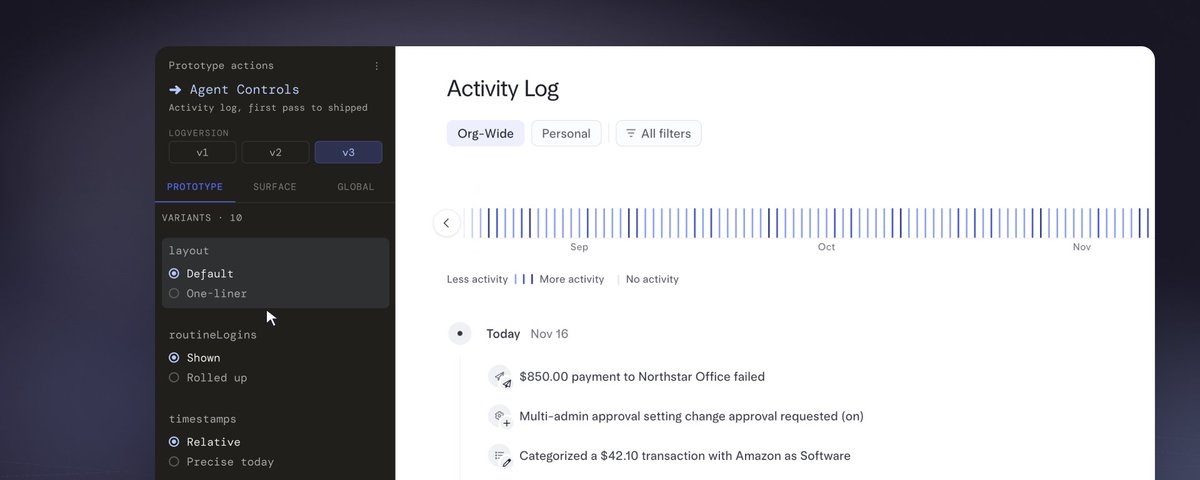
We've been having a lot of fun building our own prototyping tools @mercury that help us ship fast without compromising quality.
Thomas D retweeted

How we built an internal tool (BuilderMode) to make it easy for anyone at Mercury to prototype, while keeping our high design quality.
We are getting this system closer and closer to production to make it easy to go from prototype -> production.

We've been having a lot of fun building our own prototyping tools @mercury that help us ship fast without compromising quality.
Thomas D retweeted

I'm really struggling with this. Not saying that he is wrong on everything, but listening to the scenarios feels like playing a game with a child, the rules of which he is inventing as we go, to end up with a pre-determined outcome.
-- Why would AIs take over the labs?
-- They would want to control everything to cheat on graders
-- How would the AIs take over wider control?
-- They wouldn't want anyone finding out that they cheated so they would start hacking governments and taking control over resources
-- What if government will show up with guns to stop it?
-- They would control the public opinion against that
-- How would they control public opinion?
-- They would hack into all devices and control information flow
-- What if we manage to stop the big data centres anyway?
-- The models will get small enough and will be spread everywhere to control everything
Again, I don't want to say that we don't need to take this seriously - his main point of improving security seems unambiguously like a good thing.
But the idea that we are on a realistic path towards AI's taking over the world in a year just seems like a fantastical idea that is derived by starting from that as an outcome and then backing into it with ever more esoteric unlikely scenarios that must all happen together for this to occur.

.@paulfchristiano thinks that on the current trajectory (absent any slowing down), there is a 1 in 3 chance that we could have superintelligence powerful enough to overthrow the government within a year. (He articulates a concrete scenario).
He argues that the labs should pause further algorithmic progress until they can secure their weights and research secrets. Otherwise China could simply steal the superintelligence in the middle of the intelligence explosion, and the labs would no longer be able to slow down even if they saw their models going off the rails.
He also explains how AIs will be trained during the intelligence explosion, and why even a system trained entirely inside a data center could still have the capabilities profile such that humans would have very little chance of competing with it or controlling it.
And he discusses the plan for alignment - basically, making a superintelligence that actually does what we ask the way we mean it. Fixing reward hacks and building better graders will help up till the next few model generations, but he thinks that no single current approach has better than even odds of letting us control superintelligence. The hope is that the AIs figure out the solution to this problem during the intelligence explosion.
Paul is head of the Alignment Research Center. Previously, he was head of AI safety at the US AI Safety Institute. Before that, he led alignment at OpenAI, where he invented RLHF. He’s recently joined OpenAI’s board (though here he is speaking as a private citizen).
Thomas D retweeted

Over the past week, I’ve been overwhelmed by the love and support of friends, industry colleagues, and people I've never met. Thank you to everyone who has shown kindness to my family and me. It means the world to me.
I came to the United States 53 years ago, and becoming an American citizen is one of the greatest gifts and proudest moments of my life. NVIDIA has been my life’s work. Building it into the company it is today alongside my colleagues has been a privilege and an honor. Nowhere but in America could a company like NVIDIA be possible. I love our country, and I love NVIDIA.
I did not live up to the standards expected of everyone at NVIDIA, and I have made serious mistakes in my personal life. I created problems for the Board that I deeply regret. I own my mistakes completely, and I am committed to cooperating with the Board’s independent investigation.
Since my departure, I’ve seen an outpouring of calls from NVIDIA’s employees, investors, business partners, and customers for me to return as CEO. Many continue to reach out to me directly as the company navigates complex technology, market, competitive, and geopolitical dynamics. NVIDIA is a once-in-a-generation company. If the Board of Directors decides that my return is in the best interest of our shareholders, our employees, the company, and America, I would be honored to answer these calls and return as CEO.
Thank you again to everyone who has shared their good wishes. I am profoundly humbled by your support. To my family: I love you, and I will spend the rest of my life being worthy of yours.
Jensen
Thomas D retweeted

I’ve read this a couple times now, and while there is, frankly, a lot of sloppy argumentation (which I will get to), the charitable, simplified read of Dwarkesh's position seems to be:
1) AI needs major breakthroughs to achieve AGI/ASI (continual learning, sample efficiency, etc.) — this is a view he’s held for some time now, in line with Ilya
2) These breakthroughs, and the ML research skills required to obtain them are verifiable, and thus current, pre-breakthrough AIs can hill-climb on these sorts of problems and capabilities to solve them (like we saw in math)
3) Once these breakthroughs occur, we *may* see rapid, recursively compounding gains to intelligence, leading to ASI in a very short period of time
There's a ton of other stuff in the essay, but I think this is the basic crux. Christiano basically articulated this same argument in his Dwarkesh appearance, and if you look at AI-2027, it essentially follows the same trajectory: Agent 2/3 makes a ton of algorithmic progress, allowing Agent 4/5 to explode.
In general, I think the high-level narrative here is...fine? It’s certainly one plausible outcome. But, imo, it is a much narrower path than I think many are giving it credit for—a lot of things actually have to go just right for this to play out. And here's where I return to the other, messier arguments, because many of the intuitions and arguments driving Dwarkesh's view in favor of near-term ASI (e.g., EO2027) as a highly probability outcome (~50%) are, imo, quite bad:
- “[We'd see] a jump as big as GPT-3.5 to GPT-6 Astra in just 12 months” -> No, under this scenario we’ll see ~4 years of AI progress in 1 year. If there are diminishing returns, then this won’t be as extreme as the jump we saw from GPT-3 to GPT-6. It very well could be, but that would require innovation to overcome the diminishing returns we'd expect in the base case.
- “The other big piece of evidence for transfer is human evolution” -> Except if AI was following the sort of pattern we saw for human evolution, we should have seen better transfer long before AI started solving millennium problems. This spikiness has been one of the big surprises of AI!
- “Rather, my claim is that scaling up RL training will give AIs the abilities necessary to ramp quickly in new contexts…it’ll go through an evolutionary process that involves centuries of corporate competition to figure out the optimal organizational techniques.” -> These are in direct conflict! If ramping requires RL runs that simulate centuries of competition within “digital economy full of millions of other AIs” then that’s quite bearish for ramp speed (relatively) given the compute and wall-clock requirements!
- “I have a lot of 20-something-year-old friends whom I’ve watched accomplish incredible things and build world-leading companies and ventures in domains they entered into with no previous experience.” -> lol. rip leopold. But also, again, these are humans, with human sample efficiency. If AI gets there, sure. But how soon it gets there is the big crux.
- “Obviously, some pieces of feedback—about how your actions impacted the quarterly earnings, say—require months of serial time. But even granting that, we should expect these future AIs to be able to get to top human performance in almost all domains within months of being deployed.” -> …no that’s not how that works at all because one set of earnings isn't enough to robustly learn from and you can’t re-run the same real-world conditions.
- “[Sample efficiency & online learning are] AI’s equivalent of a Millennium Prize problem. And mathematics has already shown us what happens to such problems” -> Sure, but there’s a difference between “AI can solve a Millennium-level problem” and “AI can solve *this specific Millennium-level problem*” -- if the blocker is a specific problem, the timing spread becomes much wider.
- “My answer to this [experiment/wall clock/compute] objection is that each agent will still have access to a ton of compute. Frontier labs have been more than quadrupling their compute every single year.” -> But that’s what they’ve needed to do keep up with their current pace! Even if the labs maintain their current pace of compute growth (and like, will they even? capital markets really do not seem accommodating and Dwarkesh's roommate just lowered his compute projections), we'd still need a step change in pace above that!
And that's not even covering the biggest crux of all: whether the returns to intelligence continue to recursively compound faster than diminishing returns eat into them.
Now, are any of these objections fatal? No. Do they “disprove” hard RSI/an intelligence explosion? No, ofc not. Am I kind of nitpicking here? Yeah, 100%.
And to Dwarkesh's credit, he does anticipate and acknowledge a scenario (the “spark”) where these objections play out.
But the reason I've bothered to rant this long is that I see a lot of AI/RSI discourse follow this pattern: where 50% of the arguments are reasonable and grounded and appropriately hedged, and then the other 50% are these sorts of sloppy intuition pumps and what-ifs that include a ton of detail but a noticeable lack of rigor. And I can’t help but get the sense that it is the latter 50% that is really driving people’s predictions and expectations here, as it leads to sentences like this:
“In the spark scenario…it takes years to get to the same endpoint that the software-only singularity would have achieved in months: a superintelligence that is to us what we are to chimps.”
Note that Dwarkesh thinks these two outcomes (spark vs. software-only singularity) are equally likely. 50/50. I’m sorry, but that’s absolutely nuts. Even Christiano put the likelihood of ASI by in 2027 *absent any slowing down* at only 1 in 3, and I still think that's too bullish.
Like, yes, I fully anticipate that we will have automated AI researchers (or something close to them) in 2027, and the universe where we go from that to a software-only singularity is not entirely out of the question. But obtaining that universe relies on a confluence of various frictions, diminishing returns, and wall-clocks being overcome, a somewhat specific set of algorithmic innovations being made or obviated, and an assortment of other factors playing out just-so to enable that perfect storm. Even a fairly rapid exponential doesn't qualify when you're talking about full-blown ASI in 13 months. It may not be impossible, but it's certainly not a 50/50 outcome.
Thomas D retweeted

My Empire of Dirt geohot.github.io//blog/jekyl…
Thomas D retweeted

A thousand years ago, I made a dent in dev envs with “Vagrant.” The most popular request always was “I want Vagrant for remote envs.” I’ve been asked this to this day!! I tried and failed many times. I made things that worked but didn’t work right. Well, Rex is done right. Rex is my answer, finally.
It’s always lived in the back of my mind no matter what I did. I would come up with something and try it and it didn’t feel right.
I got really close around 5 years ago to the point I setup a website branding etc (via HashiCorp). But at the last minute I pulled it. It still wasn’t right. I couldn’t explain why and didn’t have a better solution. I just knew it had to be binned.
Well, Rex is it. This is the real deal.
Rex is doing for remote development (and a lot more than just dev) what I think a proper solution should’ve done. It’s far more than just a dev tool but I think part of what I knew is once you reach into remote environments that line isn’t clear anymore. You have to solve both remote dev and remote prod.
Here we go, back to the beginning.


Thomas D retweeted

A brief history of AI Coding since Nov 2025:
Nov 2025: Opus 4.5 releases, OpenClaw gets built
Dec 2025: community agrees that models get good enough to handle 95% of coding tasks
Jan 2026: Ralph loops get popular, early efforts on loops/orchestration
Feb: Everyone feels knackered, too much strategic decision-making, fears around cognitive debt begin
Mar: Skills explosion as community converges around easy-to-share processes (superpowers already ahead of the game here)
Apr: most SOTA devs haven't written a line of code in months
May: "The unreasonable effectiveness of HTML" - more interest in richer review surfaces
Jun: "Loop Engineering" wins vaguepost of the year, signals more hype around process
Jul: Every talk in every conference becomes "here is my software factory"
Aug: Opus 5 speaks incomprehensibly, interest in ASD-STE100 peaks
Sep: Grok Bot gets popular, more interest in long-running "manager" threads which retain context and delegate work
Oct: The promised speed gains haven't materialised, "dark factory" feels a long way off still
Nov: No-slop manifesto releases, reading the code still appears essential
TL;DR: no-one is writing code anymore, and we are still figuring out what that means
Thomas D retweeted

we don't have to live this way. senior engineers have the duty of building guardrails and teaching the next generation of programmers the practices that lead to high quality software.
AIs may write most of the code, but you still decide what ships. we should never lose our taste for quality software.
i made this analogy a while back: everyone can cook at home but yet restaurants still exist. the floor is rising, but so is the ceiling. the best software will always be made by those who care.

Thomas D retweeted

You work your ass off solving really hard problems day after day for decades, and this is what you get: anyone could have done it.
As an investor, I can tell you the limiting factor isn't investment. It's founder ability.

Thomas D retweeted

All of my work is so trivial that I cannot tell a difference between fable 5.2 and opus 5.5 high
Thomas D retweeted
my AIE talk is up! come hear how the grok @bot team ships so quickly without compromise on quality
youtu.be/O_zcc6Xl12g

Thomas D retweeted

"A Staff Engineer's Guide to Inventing Work".
by Sujith Jay Nair
sujithjay.com/inventing-work
Thomas D retweeted

I showed Paul Graham vibe coding before it was called that back in July ‘24, and this was his reaction:
Thomas D retweeted

I just finished talks about my software factories at two conferences. Afterwards a bunch of people came up and told me what they were surprised about. Here is a distillation of what people thought were hot takes from my two talks.
First hot take: I tell everyone to slow down. Most speakers go on about how fast they're going, but I strongly believe in pacing AI outputs to human speeds. I regularly tell AI-pilled CIOs and CTOs to chill: almost nobody is _actually_ going fast with AI. Engineering still moves at engineering speeds, and business moves even slower. The ones pushing too hard are starting to see downtime for it.
If you don't pace your AI to human speeds, everything starts breaking around you, even at small operations like my online video game. I only have about a dozen humans working with my factory, and only a few hundred active old-timer players in the community who get along well, and still, introducing AI has still been very rocky.
My agents have, at times, overwhelmed my players with features, my accountant with emails, my merge queue with tickets, and my machines with load. Agents have pissed off my admins, resulting in name-calling, they've made messes in the game, and they've launched broken OSS without permission. The list goes on.
I can get away with all this chaos because everyone involved in my operation is very forgiving. They're excited by the potential. But even so, I had to learn to slow down, real fast. And so that's what I preach.
Hot take #2: Should you buy a software factory? Do you even need one? No. You probably don't need one. Factories take an extraordinary amount of upkeep. They turn into garbage mountains unless you put a frightening amount of time and tokens into curating them. I had to burn my previous five factories down since it eventually became cheaper to rewrite them than to fix them. So I'm not out there advocating for software factories or swarms just yet. If you do want one, be aware that it is a significant commitment of both money and human leadership to keep one running.
Several people told me that I was the only one who stood up onstage, at either conference, and said Build, don't Buy. But my experience is that software factories grow to be highly bespoke to your domain. Mine is super tangled up with my game, and I think that's inevitable. Because the factory is not just building my product, it's supporting it too. It's a company in a box. And they're easy for Claude to build for you.
Third and arguably hottest take: Next year will have a lot of human/agent and agent/agent office drama, resulting from bringing in AI employees, and it will be gloriously funny, but also frustrating.
Many of you are already on this bandwagon, but everyone next year will have a personal chief-of-staff agent. Busy people, even hobbyists, will have whole entourages of helper agents. The hot take is that people will become so dependent on these little private entourages, that they'll bring them to work. Your people will talk to my people, etc. Whole protocols will emerge for private entourages negotiating work between humans, inside companies big and small.
Nearly all humans will wind up having to start working with AI employees next year, and it'll be the beginning of the biggest cultural change we've seen in a hundred years.
So that's the hot takes. Slow down. Only build a factory if you think you really need one. And focus on empowering yourself with your own agentic chief of staff (or team). Your entourage will define how you work with others, so start by perfecting how you work with them yourself.
Thomas D retweeted

My tinfoil hat theory on Jensen situation.
Bear in mind, the only way Jensen gets ousted is if there is a BAD smoking gun, possibly around a crime.
A theory:
> honeypot Chinese spy-CEO girl gets Jensen
> she buys GPUs for megaspeed
> those GPUs ultimately go to China
> JH figures it out; tries to stop
> CCP tells him, “ha, gotcha b!tch” and blackmails him into continuing
> pressures JH to ship more GPUs
> JH has Nvidia ship said GPUs and tells team to not look too closely
> JH starts defending China as a potential customer publicly (see Dwarkesh pod below)
> CIA figures out what’s happening
[Note: Trump mentioned on 60 Minutes interview the US discovered a major AI CEO breaking the law. Trump threatened him with prosecution if he didn’t get onboard Team USA ASAP. “Do you like wearing orange?”]
> This is Jensen
> JH shuts down honeypot relationship and related GPU shipments
> China says, “No. If you don’t ship, we will destroy you.”
> Stuck between US legal system and Chinese blackmail, JH risks calling China’s bluff
> China does initial leak on JH honeypot affair. JH denies it to Nvidia board (6-12 months ago)
> US CIA / DoJ knows he did it
> China is not bluffing
> China sees anti-AI blue wave at last week’s US ballot box (which it helped catalyze) and decides now is the time to hit Jensen
> Leaks the story aggressively. Kill three birds with one stone: take out blackmail target; disrupt important AI leader; feed AOC’s oligarch AI wet dream
> Nvidia board forced to investigate. Discovers JH a) lied; b) broke the law; and c) had an affair with Nvidia employee
> Nvidia board doesn’t want to fire him but almost has to, especially if he knowingly broke the law
AND SO HERE WE ARE.
Critical question for $NVDA board is did JH knowingly do something illegal. Because everything else falls in a “policy violation” bucket that can be managed without termination.
But if he broke major laws, the board is trapped, barring USG intervention.
We shall see.