

Applied Microeconomist. Labour, Family, Gender, Urban. Guest professor @HumboldtUni and researcher at @DIW_Berlin.
Berlin, Germany
Joined September 2012
- Tweets1.5K
- Following790
- Followers514
- Likes2.8K





🚨 New research insight on parental leave, gender inequality, and family policy in Germany 🚨
Recently accepted at The Economic Journal 🎉
Using tax return data, I study what happens when mothers’ parental leave benefits are capped at €1,800/month.
💡 Big picture:
- Family policy can re-shape household roles with lasting effects on gender inequality.
- Very generous benefits may actually discourage female labor force participation among high earners.
- Early father involvement is key to reducing the motherhood penalty.
👉 Read the full paper here (free-access link): academic.oup.com/ej/advance-…
Sevrin Waights retweeted

📢One week to go to apply for a Post Doc position in our #education group @bib_bund.
🗓️Deadline: 5 Feb 2024. 💻Apply now!

📢We are hiring
@bib_bund bietet eine 4-Jahres PostDoc-Stelle in der empirischen #Bildung|sforschung mit #Politik|nähe in unserer Forschungsgruppe "Bildung und Humanvermögen". Freude an Datenarbeit? Erfahrung mit kausalen Methoden oder Experimenten?
👉bib.bund.de/DE/Institut/Stel…

ALT Banner der Stellenausschreibung: "Das Bundesinstitut für Bevölkerungsforschung (BiB) in Wiesbaden sucht eine/einen Wissenschaftliche Mitarbeiterin/wissenschaftlichen Mitarbeiter (Post-Doc) (w/m/d) für den Forschungsbereich „Bildung und Humanvermögen“ Bewerbungsfrist: 05.02.2024 | Entgeltgruppe: E14 TVöD Bund Arbeitszeit: 100% | Befristet auf 48 Monate | Kennziffer 405/23"
Sevrin Waights retweeted

Our IZA WOL article on effects of maternity leave & early childcare on child development is published 🙂
Check the article below for our key insights 👇

UPDATED ARTICLE: Maternity leave versus early childcare—What are the long-term consequences for children? by Nabanita Datta Gupta from @AarhusUni and @jonasjessen from @viadrina wol.iza.org/articles/materni… #childcate #maternityleave
Sevrin Waights retweeted

Glad to see our paper "Gender gaps in early wage expectations" out in the Economics of Education Review.🎉 (@CK_Spiess, @waights, Frauke Peter) 1/4

Our paper on gender gaps in early wage expectations is out, please see authors.elsevier.com/c/1gt6K…, read, and cite 😀 if you find it interesting. @LeibingAndreas @waights Frauke Peter @bib_bund
Sevrin Waights retweeted

Our paper on gender gaps in early wage expectations is out, please see authors.elsevier.com/c/1gt6K…, read, and cite 😀 if you find it interesting. @LeibingAndreas @waights Frauke Peter @bib_bund
Sevrin Waights retweeted

🚨 NEW PAPER ALERT 🚨
How does access to universal early child care affect mothers’ labor supply? We study this question experimentally in a new WP (w/ Marina Krauss, @lergetporer, Frauke Peter & @SimonWiederhold).
A 🧵👇🏻 [1/7]
Link to WP: tinyurl.com/29k5pmmk
#EconTwitter

Sevrin Waights retweeted
Apply to our Conference in Labour Economics in Berlin 🐻 with amazing keynotes!
Likely to be the wildest birthday party an economics research institute has ever had 🎉
(Also a great opportunity for researchers to finally attend a 25th birthday party again)

🎉Celebrating @iza_bonn's 25th Anniversary on July 5-6, 2023 in #berlin.
👥IZA's Conference in Labor Economics | Organized by @BalgovaMaria @BarisicManuela @IngoIsphording @simon_jaeger @AndreasLichter7 @ulfrinne @SimonTrenkle
Info & CfP 👇conference.iza.org/conferenc… #EconTwitter

Sevrin Waights retweeted
Was bleibt nach der #Elternzeit von #Väter|n? Im dritten Lebensjahr des Kindes übernehmen Väter die zwei Vätermonate nahmen genauso (wenig) Familienarbeit wie jene Väter ohne Elternzeit. Partnerschaftlicher wird es ab 3 Monaten Väter-Elternzeit >>> Unsere neue @bib_bund Studie

15 Jahre #Elterngeld – was hat’s gebracht? Nur etwa jeder zehnte #Vater nimmt mehr als die 2 „Vätermonate“ in Anspruch. Die meisten Väter sind zudem parallel mit ihren Partnerinnen in #Elternzeit. bib.bund.de/DE/Presse/Mittei…



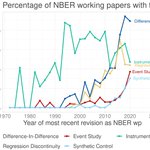
My advice if you want to know the causal effect of a specific X on Y is to either:
(a) use a well-established instrument in that literature, or
(b) find a policy (or something) that affects X and do say a fuzzy DD/RD
Rarely should you attempt to just *think of an instrument*
I definitely understand it because I was exactly in that situation during my PhD. But this is exactly how you end up with, say, trying to estimate the causal effect of income on life satisfaction by instrumenting income with education. Or height.
