
Crypto Data. Building https://teapawt.net/t.co/WYQSOg7PJW. I've gone into the Ethereum rabbit hole and never came back.
Brasil
Joined June 2009
- Tweets2.1K
- Following754
- Followers2.9K
- Likes4.1K





Yule retweeted

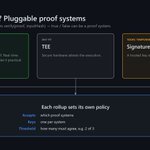
Never ever break an existing contract is not workable. It would mean you cannot change the gas schedule.
You also cannot deprecate signature schemes which we will most likely bave to do in the future.
Instead, we should be clear what kinds of contracts will not break. If you rely on gas schedule or state commitment, for example, you can't expect your contract to work forever and it needs to be upgradable or its users need to be aware that they have to exit under some circumstances.


Before blaming EIP-7702, explain to me how BTC got also hacked, and why we had multiple chains (including non-EVM) affected.
1
149
EIP7702 could even be the solution. If binance used it, it could have the logic of a circuit breaker. It detects that too much funds are trying to move and impose a system delay to any further transactions.

Before y’all panic that EIP-7702 lets random people take over wallets, this was a wallet compromise.
You still need a valid signature from the wallet’s private key to authorize the delegation.
What happened with Binance 14:
→ The attacker somehow gained the ability to sign with the hot wallet’s private key.
→ They pre-signed 50 EIP-7702 authorizations across a range of nonces because the wallet was active and they couldn’t predict its exact nonce when the transaction landed.
→ One authorization matched, delegating the wallet to the attacker’s sweep contract and allowing them to drain its funds.
The critical failure was the attacker’s ability to sign for the wallet.
EIP-7702 was the mechanism used to execute the drain.
So Binance ultimately needs to explain how their private wallet got hacked. And why a single wallet has the ability to perform such a large drain.
Hey @etheconomiczone,
I wrote this thread about your work the other day. Can someone from your team give feedback on it?

1/ I got hooked by this announcement.
Synchronous composability b/w L1-L2 could be the holy grail to fix liquidity fragmentation.
However, L1 can't run L2 code. To L1, an L2 is just a state root.
So I dug deeper to understand this technology.
👇
teapawt.net/eduadiez/status/210715…
158
Yule retweeted

hey TORN holders - 2ish more days to vote FOR on proposal #71 and get new 0.01, 0.03, 0.3, 3, 30 ETH tornado cash pools on ethereum mainnet (exact clones of existing ETH pools)
without a push of new FOR votes it is on track to being defeated
tornadocash.eth.limo/governa…
1/ I got hooked by this announcement.
Synchronous composability b/w L1-L2 could be the holy grail to fix liquidity fragmentation.
However, L1 can't run L2 code. To L1, an L2 is just a state root.
So I dug deeper to understand this technology.
👇
teapawt.net/eduadiez/status/210715…

Atomic synchronous composability is no longer a promise. History made on mainnet: the first atomic cross-chain L1->L2 transaction ever 🔥 And this is only the beginning for EEZ ... 🚀 @etheconomiczone


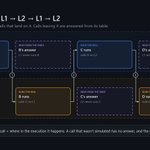
17/ part 2:
- Alice changes calldata after sim. It produces a different call hash, no entry in the table matches, so the call reverts.
- Another tx moved L2 first: State Root pin fails
- Tx lands next block: tables expired
- reality ≠ sim, different exec hash, reverts
1
1
236
18/ The atomic L1→L2 tx in the announcement is a proof of concept, not production yet.
But both pieces are moving fast: real-time zkVM proving, which makes this practical, and EEZ's protocol. If it holds, L1 and L2 liquidity stop being separate pools.
github.com/eez-association/e…

1
37