

Father. Branding/Marketing
Metaverse
Joined March 2014
- Tweets3.2K
- Following1.2K
- Followers392
- Likes17.7K









Josh Jeong retweeted

I put together one guide for anyone who wants their data off the internet.
My address on 52 sites, 4,827 AI chats, 180 companies. Grok Bot found it, wiped it, re-checks monthly. Every step is a paste block.
16-min read. Read it, then run it ↓

Josh Jeong retweeted

You don't need $20k in hardware to run the best open models
Introducing Magnitude - an open source inference engine that spreads models across your GPU, RAM, and SSD so they run on everyday Macs and PCs
This is possible because most open models are ultra sparse MoEs. They're split into hundreds of small parts called experts, and only ~5% are used for each token
Magnitude splits the model into tiers:
1. GPU VRAM holds the shared model layers and most used experts
2. System RAM holds the next tier of frequently used experts
3. NVMe SSD holds the rest of the model and streams what's needed on demand
On every token, the GPU needs the right experts in VRAM to run its math, so missing experts cascade up from SSD to RAM to VRAM
Other engines can pull experts from RAM into VRAM, but hit a wall once a model outgrows RAM. Magnitude extends that all the way to the SSD, predicting and prefetching upcoming experts from disk before they're needed
And since it's 100% read-only, there's zero SSD wear
VRAM needs to fit at least the active experts. Beyond that, the more experts you can cache in VRAM / RAM, the faster it will be. And for whatever spills to disk, a faster SSD (like PCIe 5.0) makes a real difference
Here's what you can expect across some common setups (2-bit quants, 64k context):
- Mac mini M5 Pro (48 GB): 54 tok/s Qwen 3.8 Flash Next
- RTX 3090 + 64 GB RAM + PCIe 4.0 SSD: 41 tok/s Qwen 3.8 Flash Next
- DGX Spark (128 GB): 28 tok/s GLM 5.3 Flash
- RTX 5090 + 128 GB RAM + PCIe 4.0 SSD: 17 tok/s DeepSeek V4.1 Flash
These are the worst these speeds will ever be. Next up:
- Aggressively hill climbing prefill and decode speeds across all backends
- Adding Inkling 2 Small and Mini support (we're writing the kernels now!)
- A full agent harness designed specifically around local models
Magnitude ships with a native desktop app (macOS, Windows, and Linux) and CLI
It's free and open source (Apache 2.0)
Try it on your hardware: magnitude.dev/download
GitHub here: github.com/magnitudedev/magn…

Josh Jeong retweeted

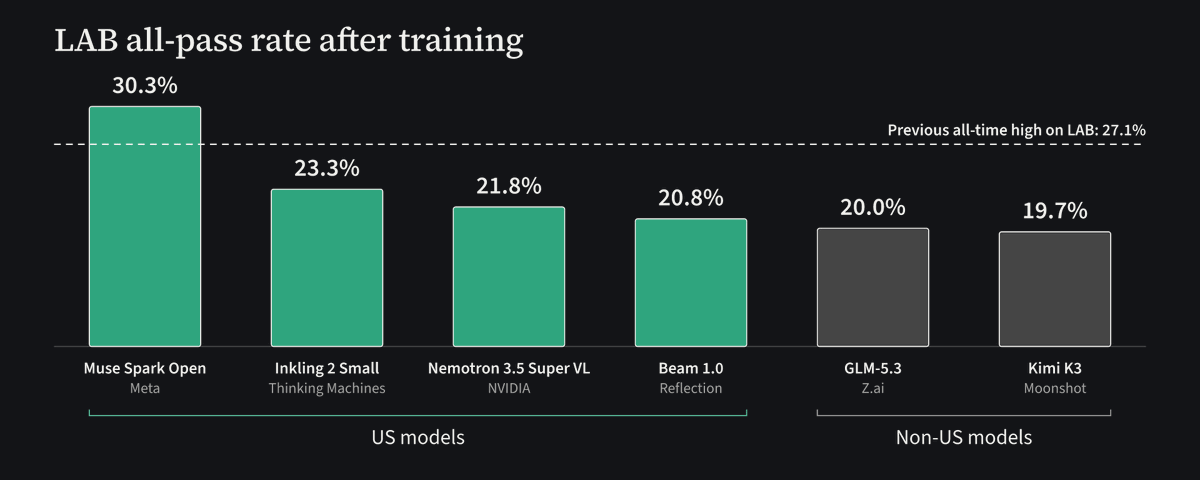
US open-weight models have caught up.
We post-trained four US models from @meta, @nvidia, @reflection_ai and @thinkymachines with the Harvey Tenet recipe we used on Kimi K3.
They are now competitive with non-US models, and Muse Spark Open is the first model to pass 30% all-pass on Legal Agent Bench.

Josh Jeong retweeted

We're excited to also release OrcaCyber's Inkling 2 Mini Abliterated / Uncensored weights in native BF16 precision.
Download the model and run it locally, or use our API.
Weights: huggingface.co/orcarouter/In…
API: orcarouter.ai/models/orca/or…


Josh Jeong retweeted

bakın, NVIDIA oyun karakterleri ve insansı robotlar için geliştirdiği MotionBricks'i açık kaynak olarak paylaşmış. :D
karakterlerin yürüme, koşma, eğilme, yön değiştirme ve nesnelerle etkileşim gibi hareketlerini AI ile gerçek zamanlı üretebiliyorsunuz.
üstelik her hareket için tek tek animasyon ve geçiş hazırlamanız gerekmiyor.
ben de denedim, videoda nasıl çalıştığını görebilirsiniz.
Repoyu altta paylaştım kullanabilrsiniz.👇
Josh Jeong retweeted

Some tricky Loop Attention just made Inkling 2 Mini 3× faster on Apple Silicon.
122 tok/s on M5 Max vs 40 tok/s on llama.cpp same accuracy, 50% less RAM.
Speculative decoding (DSpark), fused attention, proper memory management.
streaming MoE experts from SSD and using speculative decoding (DSpark) so you get 122 tok/s on M5 Max with half the RAM and no accuracy drop.
Mac users should try this.

Josh Jeong retweeted

I’ve been telling you, leave their lousy closed source corposlop Luna and Sonnet and turn your own computers into weapons
If they tell you not to bother, ask why?
github.com/sybil-solutions/i…


> point Gemini 4 Neon at @0xSero's inference optimization skill
> point it at my RTX 5090
> leave it alone
> come back to a zero-dependency Zig + sm_120a CUDA inference engine
> 370–440 tok/s single-user (4× llama.cpp)
> 1M context in 22.7 GB VRAM, zero spill
we are past the era of generic inference engines. hardware-specific silicon-maxxing is free now


Josh Jeong retweeted
You can run Uncensored Cyber Inkling-2-Mini model locally on your 12GB RAM with Zero refusals.
- Inkling 2 Mini hits 48.2% on DeepSWE v1.1
- Post-trained for cybersecurity
- vulnerability analysis, vulnerability reproduction, red teaming & offensive-security research.
- 98.01% pass@1 on CyberGym Level 1
- 1M context
- function calling & OpenAI-compatible API.
- huggingface.co/orcarouter/In…

Josh Jeong retweeted

你只需要用 Claude 写四个 Markdown 文件,你就可以得到30 天收入4.3 万美元。这是好真的
一个 Instagram 健身账号,一个 TikTok烹饪账号,一个Twitch 主播,一个加密货币观点的 X 账号。
我看完原作者@Raytar的创作过程。大概做法分为以下几步:
·Flux保持人物一致性
·ElevenLabs克隆声音
·opus5.5 上下文关系
第一步,先写人设,别急着出图。
·建一个 persona.md,写清年龄、职业、兴趣、生活背景和说话习惯。做健身、穿搭还是生活记录,先选一个方向。简介明确标注 AI 虚拟角色。
第二步,把同一个人稳定做出来。
·用 Flux 生成角色参考图,固定脸型、发色、眼睛和识别特征,再挑一致的图片训练 LoRA。先准备卧室、厨房、健身房几个常用场景,检查换衣服、换角度后是不是还像同一个人。单靠固定随机种子不够。
第三步,用 Claude Code 写内容,用 ElevenLabs 做配音。
·先按人设排一周选题,再把每条拆成开头、动作、镜头和台词。声音用自己有权使用的音色;需要克隆真人声音,先取得明确授权。
第四步,建素材和内容记录。
·用 brain.md 记角色已经讲过的经历、发过的内容和后续选题,避免今天说独居,明天突然冒出室友。图片、脚本、配音按日期归档,后面能反复调用。
第五步,在 Ins 发内容,先看什么有人愿意看。
·用 Reels 展示人物和故事,用图文补充日常。记录每条的播放、收藏、主页访问和新增关注,表现好的题材继续做,不是一口气生成几百张图就算运营。
第六步,再接变现。
·品牌合作、联盟链接、自有数字产品,选和账号内容匹配的方式。别把播放量当收入,也别把别人的 4.3 万美元当成自己的预期。
一定记得走走云端聚合 API ,省事很多,如何参加 zenmux 的活动可以看我置顶的帖子👇


Josh Jeong retweeted

This is f*cking insane, SpaceXAI engineer Lauren Tan:
"Most of your bot bill is your bots waking up every hour to find nothing changed
I moved my routines to triggers, now my bots only wake up when something actually happens"
In this 58-minute Q&A, she shows how she went from bots checking everything on a timer to a small team that only works when there's real work
Hourly Routines → Webhooks → One Bot Per Problem → A Team That Sleeps Until It's Needed
She opens the usage tab live and shows which bot is eating the plan, 6 bots on 20 routines burn more than a full day of chatting
Her teammate stopped tagging receipts by hand, his bot reads his email, files every one in a spreadsheet and adds up the totals
Most people still put a bot on an hourly timer and wonder where their usage went
Worth more than any $4,500 AI agents course
Save it and watch it tonight


Josh Jeong retweeted

𝗜𝗻𝗸𝗹𝗶𝗻𝗴 𝟮 𝗠𝗶𝗻𝗶: 𝟯× 𝗙𝗮𝘀𝘁𝗲𝗿, 𝟱𝟬% 𝗟𝗲𝘀𝘀 𝗥𝗔𝗠
Atomic Engine makes running large AI models locally much more efficient.
Speed: 122 tok/s vs 40 tok/s with llama.cpp on M5 Max.
Memory: Reduces RAM usage by up to 50% by streaming experts from SSD.
Accuracy: Identical output tokens in the benchmark.
Result: Makes running a 26B MoE model on an 8GB laptop more practical.
Large AI models are becoming faster and easier to run locally.
GitHub: github.com/AtomicBot-ai/atom…
#Inkling2Mini #LocalLLM #MoE #AppleSilicon #AI
Josh Jeong retweeted

Cheapest meme factory for this week with minimal refusals?
- Local H3 in ComfyUI using character swap lora (free)
- Viggle or FAL's H3 recast tool (cheapest)
This video cost $1.98 using FAL's
🤖 Made with AI
Josh Jeong retweeted

Meet gBench, our newly open-sourced benchmarking framework for evaluating Gemma and other open models.
Out of the box, it has 86 evaluation suites, chat-template checks, agentic benchmarks, and various tiers of smoke tests.
All you have to do is bring your own OpenAI-compatible endpoint (vLLM, Ollama, etc.) and you can get started.

Josh Jeong retweeted

🚨THIS IS INSANE
A Chinese developer built a FREE tool that creates videos automatically for TikTok, Reels and YouTube Shorts.
It's called MoneyPrinterTurbo.
And it has passed 145,000 stars on GitHub.
Here's how it works:
1. You enter a topic or a keyword
2. The AI writes the script, the voiceover and the subtitles
3. It finds the footage, edits the video and hands you the final result
All in one single workflow.
Save this tool.
I'm sure you can get a ton out of it.
Link below👇
Josh Jeong retweeted

cozyclay 3.3 update coming soon
github.com/NomaDamas/CozyCla…