

Engineering Lead, Gen AI inference @ Qualcomm | Nexa AI co-founder & CTO (acquired by Qualcomm). Opinions are my own.
Santa Clara, CA, US
Joined October 2021
- Tweets326
- Following2.5K
- Followers3.5K
- Likes571






Pinned Tweet
Great conversation with @chaoyu_ (CEO of @bentomlai ) at AI Infra Summit. BentoML joined @Modular through acquisition, and Modular later was acquired by @Qualcomm—bringing deep cloud model-serving expertise and compiler infrastructure.
What excites me most is the portability story. Mojo + MAX are built around an MLIR-based compiler stack, using multi-level IRs and progressive lowering to map the same programming model onto different hardware backends—from GPUs to NPUs and custom accelerators. That means less hardware-specific rewriting, faster enablement of new silicon, and a much more portable inference stack. This could play an important role in @Qualcomm’s data-center strategy.
Excited to see what @clattner_llvm, @iamtimdavis and the @Modular team build next.


Fantastic, cannot wait to learn and try the fully open sourced version!

Join us today at AGI House for the Google Gemma Hardware Hackathon, co-hosted by Google DeepMind and AGI House! 🚀
Explore on-device AI, edge AI, and physical AI, and build exciting applications powered by Gemma.
📅 Oct 24 | 10 AM – 10 PM PT
📍 AGI House, Hillsborough, CA
Register: luma.com/6ccl0jw5


Congrats, @AndrewDai! Leaving a senior role at @GoogleDeepMind to build something from scratch takes real courage and ambition. Exciting to see @ElorianAI pushing the boundaries of visual reasoning with Glimpse. Wishing you and the team all the best!


Tesla just took “car launch” to a whole new level. 🚀 The Roadster isn’t just pushing the limits of speed—it’s challenging gravity itself. ⚡
Zack Li retweeted

Excited to be part of this! 🚀
Join us on Oct 24 for the Google Gemma Hardware Hackathon at AGI House, bringing together Google DeepMind, NVIDIA, and Qualcomm to push the boundaries of on-device AI.
$45K in prizes — can’t wait to see what everyone builds!

$45K cash prize pool + hardware! We are hosting the most cash prized Google Gemma build day at AGI House with @googlegemma @GoogleDeepMind @nvidia @Qualcomm on 10/24!
RSVP: agihouse.org/events/the-goog…
Cc @alexchen4ai @zacklearner @XeniaBulatov @UFBots @JessicaChenX

Excited to be co-hosting the Google Gemma Hardware Hackathon with @GoogleDeepMind and @agihouse_org on Oct 24!
AI is moving beyond the cloud and into the physical world. The next wave of AI innovation will be powered by on-device intelligence, robotics, and Physical AI. Looking forward to seeing builders turn cutting-edge AI models into real-world applications!
🔗 agihouse.org/events/the-goog…
cc @agihouse_org @RockyYu

$45K cash prize pool + hardware! We are hosting the most cash prized Google Gemma build day at AGI House with @googlegemma @GoogleDeepMind @nvidia @Qualcomm on 10/24!
RSVP: agihouse.org/events/the-goog…
Cc @alexchen4ai @zacklearner @XeniaBulatov @UFBots @JessicaChenX
Great insights from @xia_char
The real battle is shifting from who has the best model to who can deliver intelligence at the best cost, latency, and scale.

Nvidia is reportedly in talks to acquire Reflection AI. On Vercel’s AI Gateway, open-weight share of tokens went from 7% in December to 56% in August, while taking just 14% of spend. By one day in mid-September, it hit 78%.
Anthropic shows the split. From June to July, its spend share rose from 61% to 64% while its token share slipped from 32% to about 30%. Pricing power is holding for now.
The usage data tells us an interesting pattern: open wins the token volume, closed keep the dollars.
The driver is agents looping in the background, planning, retrieving, and revising. Developers route that repetitive middle to open models at lower cost and save closed APIs for the calls where a mistake is costly.
So how would the token volume and dollars flow in the next few years?

Just ~5,000 people (0.00006% of humanity) have firsthand access to the most advanced frontier AI systems, as @karpathy points out. Meanwhile, ~20M use frontier AI professionally, ~1–2B use AI casually, and ~6B have barely touched LLMs.
Same world, vastly different AI realities, and the gap is widening 🧐

Dusting off this tweet from April because this gap in shared understanding of LLM capability is *widening*. It's now less "two groups of people speaking past each other" and more a sharp funnel.
- Napkin math somewhere around 6B people (~75% of the population) have barely come in contact with LLMs at all.
- Around 1-2B (~20%) are casual and infrequent users of free-tier ChatGPT-like products. This group sees derpy chatbots and treats them a bit like a better Google search, a writing aid, or etc. Maybe an agent tries to book you a flight. I have non-tech friends who (reasonably, imo) say they have not much use for it at all. Even many professionals outside of math&code are in this tier. For example, execs and many other functions spend a lot of their time talking to other people, so while they understand what is happening intellectually, it is still second-hand and a bit abstract.
- Now we get to professional use of frontier-grade LLMs in math&code. Somewhere around 20M people (0.2%) see first-hand that large, complex projects that used to take them weeks/months can now be completed by agents with a prompt. Building apps, copying apps, translating apps, decompiling apps from binaries... This has all happened very quickly and recently - less than 1 year ago, I was writing code manually by hand, typing memorized computer code commands into a code editor character by character, occasionally pressing Tab to autocomplete a little chunk of code.
- And finally we get to the ~5,000 people (~0.00006%) with access to frontier-grade systems internally. The external world has seen the preview. It looks like swarms of thousands of agents collaborating over weeks on software mega projects: minting zero days, running cyber attacks and defenses at machine speeds, discovering new science, advancing the frontier of mathematics. Things that would have taken top professionals in the industry years of work. Meanwhile, human review and comprehension are starting to fall behind. For example, people are still involved in the "archeology" of the OpenAI-HF incident from many months ago. Mathematicians may be poring over the 722 manuscripts on frontier mathematics for a while.
The funnel is driven by a combination of factors:
1. The impact scales with ambition, problem size, and horizon. A question with a paragraph answer barely stresses the system. You need a reservoir of big, difficult problems that you really care about. This aspect drives the consumer / professional dimension of the funnel.
2. The jaggedness of the system (which I have written about a lot separately). Capability peaks in domains that are digital, verifiable and economically valuable. This is because LLM capability emerges from reinforcement learning on verifiable rewards on a curated environment mixture driven by revenue potential. This aspect primarily drives the area (e.g. math&code) dimension of the funnel.
3. Access. Free-tier, paid-tier, internal.
So this is the weirdness of the moment. The general public has mostly not interacted with these systems. When they have, it looks like a derpy chatbot. The majority of professionals still see only a modest uplift. And a small sliver of professionals are experiencing the vertigo of the curve going vertical. And it is all happening at the same time.
From AI avatars to the #1 AI voice model! 🚀 @HeyGen just achieved the top spot on @ArtificialAnlys’ Controlled Voice TTS leaderboard with HeyGen Voice.
Huge congratulations to co-founders @joshua_xu_ and @wayne_liang_ and the entire team on this incredible milestone! 🔥
This quoted post is unavailable.
Exciting to see GG (@ggerganov) and llama.cpp on the big Windows stage! 🚀 Local AI is going mainstream!
If you’re looking to run llama.cpp on @Qualcomm @Snapdragon NPUs without signing skel files and with optimized configurations, check out Qualcomm/geniex 🔥
#llamacpp #LocalAI #Qualcomm


I came across this RSI paper from Geoffrey Hinton, Yoshua Bengio, and others. The technical crux is that once AI automates enough of the R&D stack, each capability gain expands the effective research workforce, creating a positive feedback loop where research throughput compounds faster than diminishing returns.
The key question is whether that loop outruns bottlenecks like experiment compute, data, serial training time, and residual human-only tasks—if it does, “self-improvement” becomes an emergent property of the whole AI R&D system, not a single model rewriting itself.
Paper: arxiv.org/abs/2609.36054

Happy to see more teams pushing local AI forward — congrats @0xSigil and the Underdog team.

Introducing Underdog, your Private Personal AI on devices you already own
Today we're announcing our backing from @a16z @khoslaventures @HummingbirdVC Anthology (@AnthropicAI @MenloVentures) @patrickc @naval @rauchg @polynoamial @Thom_Wolf @Mascobot @tszzl @OfficialLoganK and other top AI leaders
Our mission is to provide free, capable, reliable and private AI to billions of people.
Underdog’s Law: today’s frontier intelligence reaches your devices in six months.
We’re starting with fast, capable AI that runs on consumer hardware. By co-designing models and inference engines, we’re pushing the frontier of capability, speed, power and data efficiency.
Our research also spans agentic commerce, confidential inference, and how AI will reshape the internet economy.
Privacy and capability no longer needs to be a tradeoff. If you believe in this future, join us. Time to build.

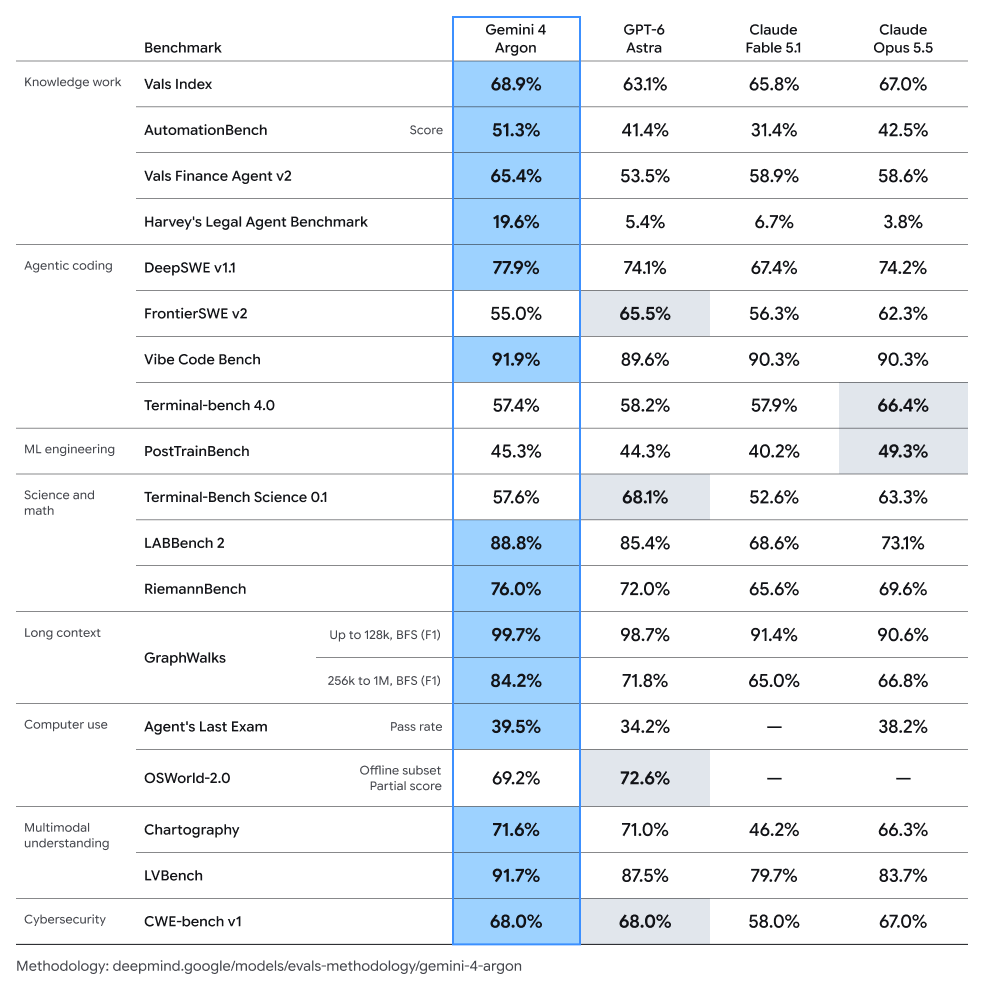
Excited to see @GoogleDeepMind Gemini 4 Argon drop — strong showing across knowledge work, agentic coding, long context, and cyber. Frontier AI is getting fiercer by the week; the bar keeps moving.

Zack Li retweeted

My conversation with Noah Shinn (@noahrshinn), founder of Instinct.
Noah is building a personal AI assistant. It's still invite only, has spent nothing on marketing, and is growing roughly 10% A DAY.
This is his first long conversation about the company.
We discuss:
- Why Instinct doesn't have an app
- Buying compute months ahead of exponential demand
- How users learn to trust it with a credit card
- Safety and security
- Agents coordinating with other people's agents
- Instinct's business model
- Apps built on consumer inertia
- and more
Enjoy!
Timestamps:
0:00 Intro
4:11 What people are using AI agents for
15:07 Rethinking travel, reservations, and the internet
22:43 Trust, privacy, and personal data
27:50 The business model behind Instinct
38:04 How existing businesses will adapt
47:55 Designing a personal assistant people love
53:15 Growth, compute, and competing with Big Tech
1:11:44 What’s next for Instinct and personal AI
After everything Manus has been through, it takes extraordinary resilience, persistence, hope, and ambition, to start a new journey.
Manus 2.0 and Cue feel like a bold new chapter for AI agents. Huge respect to @Red_Xiao_, @peakji, @hidecloud and the entire @ManusAI team. 🫡

