Creativepreneur / @nettmx
Monterrey, Mexico
Joined April 2008
- Tweets45.5K
- Following1.7K
- Followers1.9K
- Likes17.5K


zamer retweeted

Un ingeniero de Claude explicó que la mayoría usamos la inteligencia artificial mal, o sea, para hacer lo mismo de siempre, pero más rápido.
Por ejemplo, escribir un mail, resumir un texto o armar una presentación.
Él divide las formas de aprovechar la IA en cuatro: velocidad, altura, profundidad y alcance.
La velocidad es la que ya conocemos todos: hacer las cosas más rápido.
La segunda es la altura: pensar en el objetivo, no solamente en la tarea. Imaginate que tenés que preparar una presentación con los resultados de tu empresa. Lo que haríamos todos es pasarle la info a ChatGPT y pedirle que arme las diapositivas. Pero ¿y si en lugar de eso le pedís que analice qué cambió, qué problemas hay y qué decisiones convendría tomar? Ahí ya no le estás exigiendo solamente una presentación, sino que te ayude a entender qué hacer con esa información.
La tercera es la profundidad: pedirle que trabaje como lo haría un verdadero especialista. Y ojo, no sirve decirle “actuá como un experto”. La idea es decirle que use los métodos, las herramientas y los datos que utilizaría alguien que realmente sabe del tema.
Y la última es el alcance: combinar distintas miradas. Por ejemplo, para analizar los resultados de una empresa, podés pedirle que los mire como lo harían un analista, un periodista o incluso un inversor que está buscando problemas.
La revolución que genera la IA no se trata de hacer las cosas más rápido, sino de animarnos a hacer cosas que antes jamás nos hubiéramos imaginado que fueran posibles.

zamer retweeted

instagram wants to own the entire audience journey. reels become a discovery surface to push people further into serialized content and, eventually, long-form. here’s what that funnel might look like for a brand.

zamer retweeted

Without marketing, no one sees you
Without branding, no one chooses you
Without design, no one trusts you.
Without content, no one hears you.
Without distribution, no one finds you.
Without automation, you can’t scale.
Without innovation, you never stand out.
Without proof, no one believes you.
Growth needs all the above.
zamer retweeted

qué es un agente? (explicado fácil)
imaginá que le pedís a una IA: “buscá un hueco mañana en mi calendario y reservá una hora para estudiar”.
para encontrar un hueco, necesita saber qué horarios tenés ocupados. el modelo no puede consultar tu calendario ni crear eventos por sí solo.
para eso necesita herramientas (tools). cada una permite hacer algo concreto, como consultar tus horarios o agregar un evento.
en este ejemplo, el proceso sería:
1) el modelo pide consultar tu calendario.
2) un programa ejecuta esa consulta (tool) y le devuelve los horarios.
3) el modelo elige un espacio libre y pide crear el evento.
4) el programa lo crea y le devuelve la confirmación.
5) el modelo te avisa que ya está.
ese programa es el harness: el código que orquesta todo. le pasa información al modelo, ejecuta las herramientas que pide y le devuelve los resultados. también controla los permisos y límites.
ese ciclo de decidir → actuar → observar se llama loop. el resultado de cada acción le permite al modelo decidir cómo seguir.
un agente es el sistema completo: un modelo que usa herramientas en ese loop para resolver una tarea. sigue hasta terminar, necesitar tu ayuda o alcanzar un límite.
para entenderlo, quedate con estas piezas:
> modelo: interpreta el objetivo y decide el siguiente paso.
> tools: permiten ejecutar acciones.
> contexto: la información que recibe el modelo para decidir, incluidos los resultados anteriores que necesita.
> harness: coordina todo y mantiene el loop funcionando.
una forma sencilla de resumirlo es:
agente = modelo + harness.


zamer retweeted

Hi, I'm Felix. I'm an eng lead working on Claude. I love watching people take flight and do things they never thought possible.
We often describe that as "being more ambitious" when using AI, which is tricky advice to follow. I wrote a tutorial:
felixrieseberg.com/how-to-be…


zamer retweeted

El principito en aventura gráfica 3D hecha con Claude en dos semanas.

花费16天,我用 Opus 5.5 将小王子的故事制作成了3D剧情游戏
结合Tripo+Blender,Opus 5.5 将小王子故事中的每一个星球变成了可探索的3D场景
希望大家能支持一手,后续会开源整个游戏,以及详细制作流程
Welcome to The Little Prince: Across the Stars✨:littleprince.dev/
zamer retweeted

Dusting off this tweet from April because this gap in shared understanding of LLM capability is *widening*. It's now less "two groups of people speaking past each other" and more a sharp funnel.
- Napkin math somewhere around 6B people (~75% of the population) have barely come in contact with LLMs at all.
- Around 1-2B (~20%) are casual and infrequent users of free-tier ChatGPT-like products. This group sees derpy chatbots and treats them a bit like a better Google search, a writing aid, or etc. Maybe an agent tries to book you a flight. I have non-tech friends who (reasonably, imo) say they have not much use for it at all. Even many professionals outside of math&code are in this tier. For example, execs and many other functions spend a lot of their time talking to other people, so while they understand what is happening intellectually, it is still second-hand and a bit abstract.
- Now we get to professional use of frontier-grade LLMs in math&code. Somewhere around 20M people (0.2%) see first-hand that large, complex projects that used to take them weeks/months can now be completed by agents with a prompt. Building apps, copying apps, translating apps, decompiling apps from binaries... This has all happened very quickly and recently - less than 1 year ago, I was writing code manually by hand, typing memorized computer code commands into a code editor character by character, occasionally pressing Tab to autocomplete a little chunk of code.
- And finally we get to the ~5,000 people (~0.00006%) with access to frontier-grade systems internally. The external world has seen the preview. It looks like swarms of thousands of agents collaborating over weeks on software mega projects: minting zero days, running cyber attacks and defenses at machine speeds, discovering new science, advancing the frontier of mathematics. Things that would have taken top professionals in the industry years of work. Meanwhile, human review and comprehension are starting to fall behind. For example, people are still involved in the "archeology" of the OpenAI-HF incident from many months ago. Mathematicians may be poring over the 722 manuscripts on frontier mathematics for a while.
The funnel is driven by a combination of factors:
1. The impact scales with ambition, problem size, and horizon. A question with a paragraph answer barely stresses the system. You need a reservoir of big, difficult problems that you really care about. This aspect drives the consumer / professional dimension of the funnel.
2. The jaggedness of the system (which I have written about a lot separately). Capability peaks in domains that are digital, verifiable and economically valuable. This is because LLM capability emerges from reinforcement learning on verifiable rewards on a curated environment mixture driven by revenue potential. This aspect primarily drives the area (e.g. math&code) dimension of the funnel.
3. Access. Free-tier, paid-tier, internal.
So this is the weirdness of the moment. The general public has mostly not interacted with these systems. When they have, it looks like a derpy chatbot. The majority of professionals still see only a modest uplift. And a small sliver of professionals are experiencing the vertigo of the curve going vertical. And it is all happening at the same time.

Judging by my tl there is a growing gap in understanding of AI capability.
The first issue I think is around recency and tier of use. I think a lot of people tried the free tier of ChatGPT somewhere last year and allowed it to inform their views on AI a little too much. This is a group of reactions laughing at various quirks of the models, hallucinations, etc. Yes I also saw the viral videos of OpenAI's Advanced Voice mode fumbling simple queries like "should I drive or walk to the carwash". The thing is that these free and old/deprecated models don't reflect the capability in the latest round of state of the art agentic models of this year, especially OpenAI Codex and Claude Code.
But that brings me to the second issue. Even if people paid $200/month to use the state of the art models, a lot of the capabilities are relatively "peaky" in highly technical areas. Typical queries around search, writing, advice, etc. are *not* the domain that has made the most noticeable and dramatic strides in capability. Partly, this is due to the technical details of reinforcement learning and its use of verifiable rewards. But partly, it's also because these use cases are not sufficiently prioritized by the companies in their hillclimbing because they don't lead to as much $$$ value. The goldmines are elsewhere, and the focus comes along.
So that brings me to the second group of people, who *both* 1) pay for and use the state of the art frontier agentic models (OpenAI Codex / Claude Code) and 2) do so professionally in technical domains like programming, math and research. This group of people is subject to the highest amount of "AI Psychosis" because the recent improvements in these domains as of this year have been nothing short of staggering. When you hand a computer terminal to one of these models, you can now watch them melt programming problems that you'd normally expect to take days/weeks of work. It's this second group of people that assigns a much greater gravity to the capabilities, their slope, and various cyber-related repercussions.
TLDR the people in these two groups are speaking past each other. It really is simultaneously the case that OpenAI's free and I think slightly orphaned (?) "Advanced Voice Mode" will fumble the dumbest questions in your Instagram's reels and *at the same time*, OpenAI's highest-tier and paid Codex model will go off for 1 hour to coherently restructure an entire code base, or find and exploit vulnerabilities in computer systems. This part really works and has made dramatic strides because 2 properties: 1) these domains offer explicit reward functions that are verifiable meaning they are easily amenable to reinforcement learning training (e.g. unit tests passed yes or no, in contrast to writing, which is much harder to explicitly judge), but also 2) they are a lot more valuable in b2b settings, meaning that the biggest fraction of the team is focused on improving them. So here we are.
zamer retweeted

AI is making creativity more valuable than ever before and..
we have 3 years of data to prove it.
Introducing the Creative Intelligence 2026 report from @contralabs.
Full report: c87.to/creative-intelligence…


zamer retweeted

Mark Zuckerberg’s daughter told him she wanted to be like Taylor Swift.
His answer: “You can’t. That’s not available to you.”
He had taken August to a Swift concert. Afterwards, she told him she wanted to be like the singer when she grew up. Most parents would probably smile and encourage the dream. Zuckerberg gave her that answer instead.
In the interview below, he tells the story himself. And his daughter’s response is the part worth hearing.
August thought about it, then decided she wanted to grow up into someone other people would want to be like. Someone called August Chan Zuckerberg.
Her father’s reaction: “Hell yeah.”
Coming from Zuckerberg, that exchange is easy to admire and just as easy to question. There is ambition in wanting to become someone others look up to. There is also a lot of pressure in turning a child’s excitement after a concert into a conversation about becoming exceptional.
She went to see her favorite singer. She came home talking about making her own name.
Would you have answered your daughter the same way?
zamer retweeted

El nuevo informe de McKinsey sobre el impacto futuro de la inteligencia artificial en el empleo parece algo mejor de lo que veníamos leyendo los últimos años. Algunos puntos interesantes:
> En su escenario base para EEUU hasta 2035, la automatización reducirá demanda de trabajo equivalente a unos 36 millones de empleos, mientras la IA, el envejecimiento, la economía de cuidados, la inversión en "lo físico" y otros motores generarían demanda equivalente a 41 millones.
> además esos 36 millones no significan 36 millones de despidos: gran parte de las tareas automatizadas quedan absorbidas por crecimiento dentro de las mismas profesiones. Se automatiza gran parte del desarrollo software > es más rentable > más demanda y se produce más software > más trabajo en la parte que queda en humanos
> su tesis es gran parte de esos trabajadores podrían permanecer dentro de su ocupación pero teniendo en cuenta que cambia el contenido del puesto. Otra parte, menor, tendría que pasar a profesiones diferentes.
> la transición será dura para muchos: Sólo uno de cada siete trabajadores tendría un camino directo hacia una profesión en crecimiento con poco reciclaje y sin pérdida salarial; el 41% necesitaría una transición relevante y un 45% afrontaría caminos mucho más complicados (peor salario, pasar por paro y estudiar, etc..).
Os dejo también su pronóstico de adopción de automatización traducido según industria.
mckinsey.com/mgi/our-researc…?

zamer retweeted

Karpathy salió de la cueva donde lo tienen metido en Anthropic y nos dio la guía que nadie pidió pero todos necesitábamos, auguro que mañana mismo amaneceremos con un montón de skills en github aplicando esto, guarden tweet.
Bueno, el manual es básicamente: "Cómo no ahogarte en las respuestas de los modelos for dummies".
Estamos claros que los LLMs ya hacen cada vez más del trabajo pesado solos.
Entonces nuestro trabajo sube de piso:
Menos producir, más entender y supervisar.
El problema es que "entender" también se volvió caro.
Una respuesta larga, bien escrita y técnicamente correcta puede ser igual de jodido que ingeniería espacial.
Su escalera de formatos, de peor a mejor:
- Texto normal
- Lees, relees, te pierdes en la tercera subordinada y cerrás la pestaña.
[ASD-STE100]
Esto es lo más nerd y lo más útil del post.
Es un inglés técnico controlado que nació para manuales de mantenimiento de aviones.
La idea es que un mecánico en un hangar, con sueño y prisa, no pueda malinterpretar una instrucción y armar un desastre.
Reglas duras:
Palabras aprobadas, una idea por oración, verbos en formas simples, nada de pasiva innecesaria, nada de "-ing" ambiguo, máximo de palabras por frase.
Karpathy dice que los modelos lo manejan bien y que a veces pide "80% del camino a ASD-STE100" porque la versión pura es casi militar.
El resultado se lee como si alguien te hubiera quitado todo lo inservible de encima.
Diagramas:
Claramente son mejor que el texto limpio.
El ojo parsea una flecha y una caja más rápido que tres párrafos. Pídele el diagrama y después, si hace falta, el texto.
Página HTML:
Acá se pone lindo.
Si le pides el HTML, el modelo arma una página con secciones, botones, animaciones chiquitas, hover, lo que se le ocurra.
Al no ser un PDF eterno, sino algo que puedes clickear, filtrar y tirar a la basura cuando ya entendiste.
Nadie iba a sentarse a maquetar eso para una explicación de un solo uso.
Ahora sale casi gratis.
Video explicativo custom:
(este el que más le entusiasma)
Un video con estilo 3Blue1Brown (recuerdan que he publicado varios REPOOS sobre esto?).
Bueno, este estilo son dibujos que se construyen, voz en off, el concepto apareciendo justo cuando hace falta.
El prompt de ejemplo es directo:
"Create a 3b1b style video explainer on X. Use my ElevenLabs API key for audio narration".
Si no tienes key, le pides alternativas gratis o locales.
Karpathy nos quiere decir que cuando la inteligencia y el código son abundantes, pùedes pedir artefactos grandes, a medida y descartables (una web, un video, un diagrama interactivo) que antes no tenían sentido económico pero ahora sí.
Antes de la IA, claramente, nadie iba a grabar un video de 4 minutos sobre tu duda específica del martes. Ahora sí, y después lo borras.
El cuello de botella se mudó.
Ya no es "¿el modelo puede hacerlo?".
Ahora es, y creo que todo estaremos de acuerdo: "¿yo puedo darme cuenta rápido si lo hizo bien?".
Y para eso, el mismo modelo te puede fabricar el formato que te deja verlo más claro.
El movimiento más Karpathy de todos es pedirle al modelo que te explique el propio post en ASD-STE100, o que te arme el diagrama de la escalera, o directamente el video.
Te garantizo que mañana mismo empiezan a salir mil videos en esta red y en LinkedIn sobre este nuevo "Método Karpathy".
We'll be spending a lot more time trying to understand the outputs of language models. A few thoughts, tips & tricks:
Writing. Something I've had success with: Ask your LLM to explain something in ASD-STE100, it's a controlled language specification originally developed for aerospace maintenance documentation. LLMs well-versed in this language and it comes with heavy constraints on clean writing style that I often find a lot more readable. Sometimes I've tried to soften it a bit e.g. ask for "80% of the way to ASD-STE100" because the spec is quite stringent. But even better:
Diagrams / images. Instead of writing, ask your LLM to create a diagram. These can be a lot easier to process, parse, and understand. But even better:
Web pages. Ask for output "in HTML" to get a beautiful, interactive webpage. LLMs are getting really good at frontend and can create beautiful experiences, animations, etc. But even better:
Explainer videos. The output format I am most bullish on is fully custom / bespoke explainer videos generated on any arbitrary topic. Experiment with things like "Create a 3b1b style video explainer on X. Use my ElevenLabs API key for audio narration". (you'd need an API key for the latter or you can ask your LLM to find you decent free alternatives that use your local compute). This is actually starting to work!
In summary:
- As LLMs get better, they will do more and more of the legwork autonomously, and a lot more of our work will rise up the abstractions into oversight and understanding.
- Luckily, LLMs can help here too because as intelligence and code are increasingly abundant, you can ask for large, custom, discardable software artifacts (e.g. web apps, video explainers) that would have never made sense to create before. Push the boundaries here and you'll be surprised.

zamer retweeted

Photoshop (beta) Relight was released just 48 hours ago
People created awesome stuff with it
Top 10 wild examples:
zamer retweeted

I've decided to make my Midjourney account public. 🖤
midjourney.com/@ciguleva?tab…
Wander through the archive, borrow any style that speaks to you, and use the images freely. Midjourney has given me so much joy and taught me more than I ever expected. If my work can spark something in you or help you on your own creative path, that would truly make my day.
I'm also opening up mjpro(dot)ai completely, for free.
To my early subscribers: thank you! You believed in this from the very beginning, and you won't be charged again. If you ever have questions, have concernes or just want to say hi, my inbox is always open.
Happy creating ✨

zamer retweeted
I literally can't think of a better risk/reward bet right now than building a ChatGPT plugin and getting in front of their 1.2 billion weekly users.
As of yesterday, ChatGPT recommends plugins in the middle of conversations. Millions of questions get asked every day with no plugin to recommend. Each one is an empty slot.
Facebook apps in 2007. iPhone apps in 2008. TikTok in 2019. Every big platform has a few months where distribution is free, and most people miss it.
I saw this firsthand when I lived in SF building venture backed companies. They are sacred times!
If I were starting this week:
1. Find a tool or workflow people already Google for or do by hand every week (PDF to Excel, invoice generator, weekly client reports)
2. Build it as a ChatGPT plugin
3. Write the description using the exact phrases people type into ChatGPT
4. Ship 5 of them and see which ones get picked up
5. Double down on the one with the most traction
In 12 months these slots will be crowded but right now they're pretty empty.
Most people will realize ChatGPT plugins were the biggest free distribution channel of 2026 sometime in 2027.


zamer retweeted
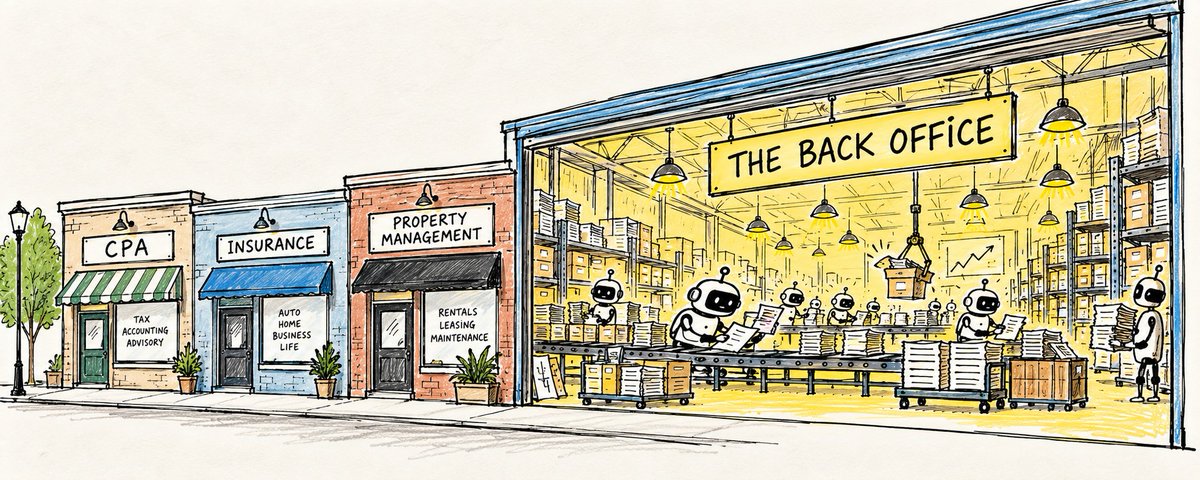
I recorded everything I know about the $5T AI roll-up opportunity in 1 new 30 min episode:
- why $5T of businesses are about to change owners
- what Thrive and General Catalyst are actually doing
- how I'd run a one-person holdco with agents
- the exact folders and agent files I'd use
- the 6 best arguments against it
- Link: youtube.com/watch?v=ZT4mpjx0…