

AI -- Content creator & builder | Your research makes you money
AI city
Joined July 2026
- Tweets252
- Following462
- Followers1.6K
- Likes2.4K


F*CKING INSANE. Elon's Grok Bot just rigged and animated the hardest 2D character scenes like an elite studio animator, and it took ONE prompt
the two sequences took weeks of manual labor and bone-weight fixing
my bot took both apart in 14 minutes and found the rigging workflow wide open on 12 character layers RIGHT NOW. ELON YOU HAVE TO SEE THIS
a 3-bot animation team running on Grok Bot's own cloud computer
in 14 minutes it:
→ took apart the skeleton setup: one automated vector weighting script linked all mesh deformers, 590 frames aligned in a flash
→ took apart the expression swap: multi-layered switch groups mapped lip-sync and eye blinks in one execution, zero manual keyframes
→ checked my own project for broken vector intersections, the bad vertex trick
→ checked every asset I import: 33 external rig nodes on the layers where I animate. the rig needed one
→ found 12 character files loading those heavy rigs with no optimization tonight, exactly like the broken templates did
no manual mesh painting. no tedious bone placement. no vertex stretching. a single smart prompt was enough
and one of those loose bones was on the main character sequence, where my rig sat yesterday. ~590 frames weren't as lucky
this is the same Grok Bot that made me $10,000 on polymarket. now it animates it
so now it never sleeps
it fingerprints every vector node on every character that touches my project and rechecks them every 10 minutes
it watches my rig for any new bone offset i didn't make
it pings my phone the minute a script changes, before i open that project again
if you animate even 1 frame in 2D, you NEED a bot like this. the studio pros already have one
you can check how it works on the video
how to build yours tonight:
→ make 3 bots in Grok Bot: Scout, Watchdog, Skeptic
→ Scout maps every character asset and rig you use. Watchdog rechecks them every 10 minutes. Skeptic reads every vertex change like a senior TD
→ give Scout the complex skeletal and facial rigging setups as examples, it hunts for the same deformer patterns everywhere
→ connect your phone so a broken rig script hits you within 10 minutes, not after the render crashes
590 frames + 756 frames in one day. 14 minutes for my bots
how long until your timeline is next?
the exact prompt is in the replies, the full Grok Bot setup is in the article in my profile


this is getting SCARY.
i just watched a guy build an AI terminal that ingests massive financial statements, parses complex tables, and extracts hidden metrics in seconds (analysts spend days doing what this pipeline automates), and i’d bet 99% of people have no idea it’s possible yet
it’s the one who processes every page, cross-references every report and pulls every key figure so the analyst never has to, and the good ones are never free
you can copy his whole setup in four lines:
> make one workspace and call it your financial terminal
> drop in your annual reports, balance sheets and SEC filings
> open Claude Opus 5 and point it at that data
> connect your workspace
from there, Claude handles everything
every morning at 7:00 it reads the documents, parses income statements, extracts growth margins the way a pro would and sends one clean breakdown with whatever numbers actually matter
1 workspace $\approx$ 3 years of deep analysis
zero manual crunching
zero missing details
zero messy spreadsheets
he set it up in minutes. it ran the entire session effortlessly
you’re done wasting hours parsing PDFs manually
you’re running your own institutional-grade terminal
save this. the full breakdown is below

Prompt + Opus 5.5 is DERANGED for full game builds
Claude Opus 5.5. $4 per million input tokens, $20 output. 20% under Opus 5.
One prompt. A full 3D game scene loads on a monitor.
Lava arena. Blocky character. Side menu opens, five crate tiers with odds bars.
Pick the rare crate. Loading screen holds.
Hex podium drops in with torches and a chest at the center.
Chest cracks. White gem floats. Ring of characters circles the platform.
Robot rolls out on a green pedestal, orb in hand. UNCOMMON.
Crate economy, probability bars, reveal animation, five rarity classes. One prompt.
Pro: $20 a month. Max 5x: $100.
No prompt published. No engine named.
Watch it load ↓
Cooked. One prompt file cuts half your agent's code.
Claude Code at $20 a month on Pro. ponytail drops 53% of the code and 26% of the cost across 39 tasks.
10 GitHub repos that cut agent bloat and review before shipping:
01 ponytail → Cuts 53% of agent code and 26% of cost. Tested on 39 tasks with Opus 5.5.
github.com/DietrichGebert/po…
02 andrej-karpathy-skills → One CLAUDE.md of four rules. Stops the 1000-line answer where 100 lines would ship.
github.com/multica-ai/andrej…
03 i-have-adhd → Ten rules for readable agent output. Lists capped at five, answers you act on without scrolling.
github.com/ayghri/i-have-adh…
04 elephant-goldfish-model → Agent drafts a spec, then fresh reviewers with zero context check it. Five stages before code.
github.com/google/elephant-g…
05 expo/skills → Expo team's own skills for builds, upgrades and deploys. No hand-written prompts for your mobile stack.
github.com/expo/skills
06 autoharness → Writes skills from your real sessions, consolidates dupes, prunes unused. 42% to 78% on CORE-Bench, same model.
github.com/tigerless-labs/au…
07 claude-octopus → Pits several models against the same task. Disagreements surface before bad code gets built.
github.com/nyldn/claude-octo…
08 anthropics/skills → The SKILL.md spec with templates and working examples. Format reference your agent already reads.
github.com/anthropics/skills
09 impeccable → 24 design commands and a 62-rule detector. Catches generic AI design without a single LLM call.
github.com/pbakaus/impeccabl…
10 taste-skill → Art direction plus real browser checks for UI screens. Stops the agent from shipping stock landing pages.
github.com/Leonxlnx/taste-sk…
Pick one bloated answer your agent gave you last week. Install the skill that would have stopped it.
rules → trim → cold review → multi-model → design check → self-learn
Every skill is a text file you read before install. The numbers are each project's own. anthropics/skills is mixed-license.
The upgrade was a bigger plan. Now it is a smaller file.
Your old trading setup is the problem
A 23-year-old in Amsterdam clears $21,504 a month running this exact search pipeline.
Most traders backtest once and call it done.
This dashboard grinds through 1,000 candidates.
45 survive. Three windows test each one.
In-sample: 159 trades, $13,577 net.
Out-of-sample cuts to 16 trades, $4,166.
Blind forward: 32 trades, another $3,761.
Net across all 207 trades: $21,504.
Edge vs. luck: the weakest pillar. Decay 0.47x.
One backtest hides the fit. Three expose it.
Sharpe 2.60. Profit factor 1.45.
Watch the yellow curves fan after selection


Losing it that nobody runs bots as a city
Eight Grok bots and no map. No routing.
Every task a solo call. Every approval by hand.
I found a dashboard. Each department now a building.
Bots take cabs to their station.
They queue at Town Hall the second they need me.
Crane builds the office for every new bot.
Task cards above each rooftop. One click.
Eight citizens listed. Roles and statuses. One screen.
Each click is a real permission on your machine.
Open one department before wiring the next bot.


Check what drops when six A6000 pods run at 100%.
A 24-year-old in London nets $4,250 a month running the same kind of A6000 fine-tuning rig.
Six rented cards. 48 GB each. $0.59 an hour per pod, $3.54 for the full rack.
One terminal pulls the training feed from all six:
1. Pipeline generates and filters training rows.
2. Each pod loads base weights. 339 of 339 shards.
3. LoRA training kicks in. Step counter climbs.
4. Every step logs loss, cross-entropy, KL and learning rate.
5. One pod runs an eval pass. 1,009 of 1,319 generation requests done.
6. The monitor tails all six logs into one read-only screen.
pod2 drops from 0.821 to 0.714 in three steps. An idle card still bills.
Watch the loss drop ⬇
Disgusting how clean this six-repo pipeline runs
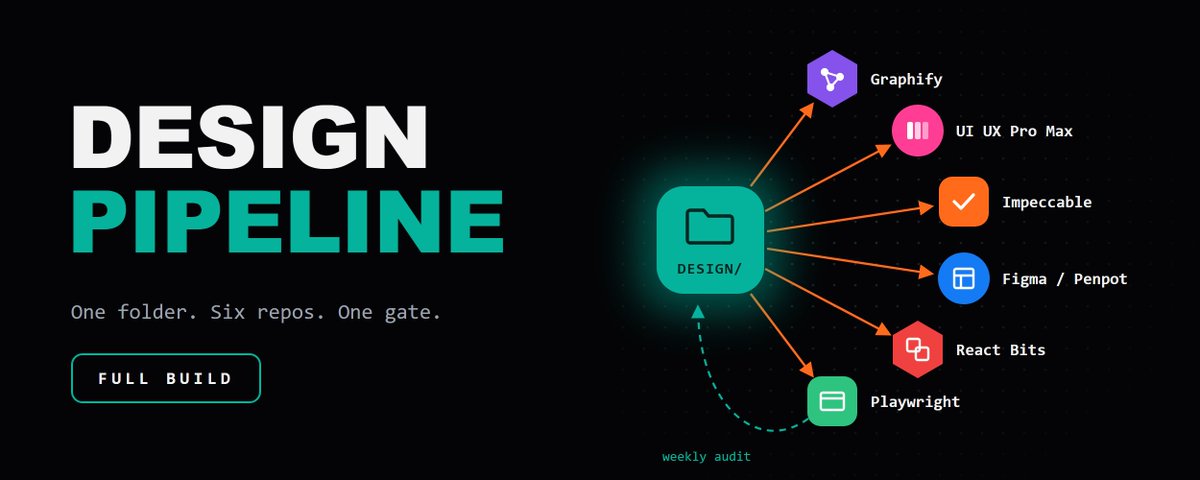
One folder goes in. A production site, a promo video and a 3D hero shot come out. Nine repos, 647k combined stars.
Six stages. Each one feeds the next.
1. Brand PDFs, logos, screenshots and reference sites drop into one folder. Everything downstream reads from here.
2. Graphify converts that pile into a knowledge graph. Color values, typefaces, spacing mapped as edges. 137.9k stars, YC S26.
3. UI UX Pro Max stacks 192 palettes and 74 font pairings by product type. 142.1k stars. No more invented color systems.
4. Impeccable plants the gate. 62 deterministic rules that flag AI-looking design. No LLM call. No API key. 92.8k stars.
5. Figma-Context-MCP reads the real Figma file. Hierarchy, spacing, components as data. Needs a token. Penpot covers the free path at 61.8k stars.
6. React Bits feeds 215+ animated components straight into the codebase. Playwright MCP opens the result in a headless browser and checks every rule before anyone reviews.
Friday schedule triggers Impeccable. Findings ranked P0 through P3. Fixes queued without being asked.
Nobody invented a new tool. Every repo existed before this stack. The pipeline is the order they run in. Graph first, palette second, 62 rules as the gate, real layout fourth, components fifth, headless audit last.
Break the sequence and the output slides back to AI slop.
Bookmark this

DAMN, THE DESK SLEPT AND SAVIP'S CRAWLER CAUGHT A COIN DOWN 60% IN A WEB, $100 TO $68,316 BY NIGHT 10
a raccoon coin. five hours old. crashed 60% after midnight
most wallets bled. savip's bots carried $60,472 into the night
one mandate: buy the flush, not the wick. one position at a time
the crawler caught it. 2,390 pages scanned, 1,328 posts read
filter.py ran a fixed kill chain:
1. free_kill. age over 15 min, liquidity over $12,000, vol24 over $40,000, mcap over $60,000, top 10 wallets under 60%
2. trade_kill
3. chain_kill
4. soft_kill. Jev scored 124 coins that night. picked one
5. pick
one fail and the coin never reaches Jev
same coin, same night:
→ 10pm, holder $1,000. bots $60,472
→ 12:40am, holder $398. bots $60,110. buying the flush
→ 6:30am, holder $576. bots $68,316
holder down 42.4%. desk up 13%. same raccoon
for half an hour the bank sat below where it started. the raccoon won for 30 minutes
$100 → $2,197 → $23,879 → $68,316
$31,683 left
the thresholds are the entry gates. the buy size and the exit rule stay inside the desk
nothing traded until the crawler read first
the filter stack, thresholds and balance curve run in the terminal below
Actual jackpot from one Fable prompt
Not a template pack. Not a hand-picked gallery.
A browser grid where every card runs its own live generative simulation on a separate canvas. Each one named, described, and rendering.
Running in the grid:
1. Archive Territories. Hex-cell terrain maps shifting and reforming with no input
2. Geodesic Choir. A sphere rotating through dense particle fields
3. Branching tree networks growing frame by frame
4. Physarum Chancel. Channels crawling across a dark canvas like a living web
Every card carries three controls. FOCUS, REGEN, PNG. Click into one fullscreen and the simulation keeps running on its own.
Fable 5.1 costs $10 per million input tokens, $50 output. Cache reads drop to $0.25 per million.
Hit REGEN and the whole card rebuilds from scratch.
The HUD below breaks down every stage of the pipeline.
This is getting out of hand: honestly baffled why people are sleeping on this. By leveraging this method, I cut my AI pipeline latency down to fractions and scaled agent swarms without hitting the serial bottleneck.
AI leaders and builders have been dropping a massive realization lately: stop treating LLM agent outputs like single-file chores and start structuring your evaluation loops as single-pass, batched decision models.
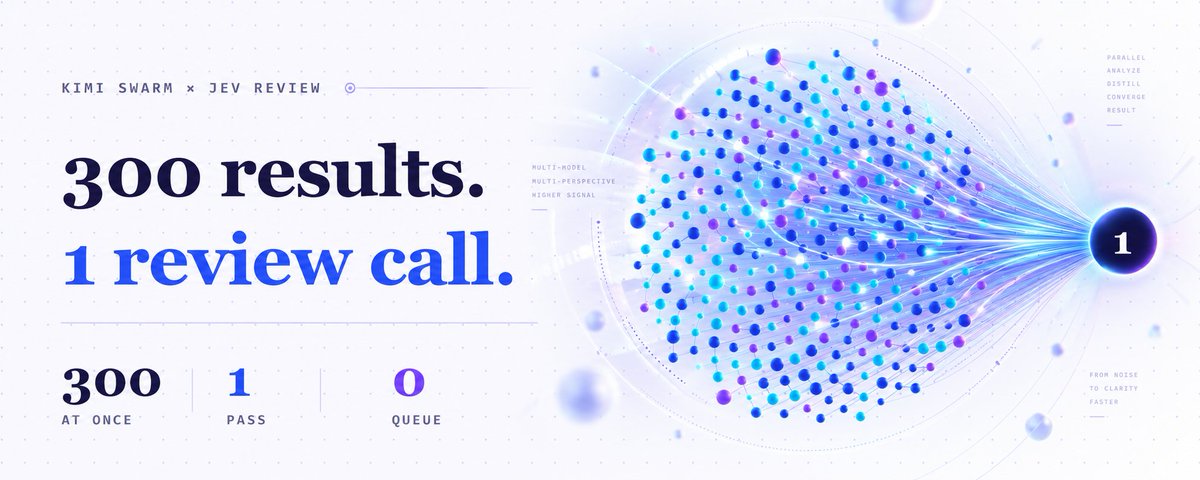
Here is the workflow: when your Kimi swarm spits out 300 results simultaneously, stop running a serial loop that grills each result one-by-one. Instead, pass the entire result set and shared context in a single request to Jev, a decision model built for short, typed judgments, so nothing in your pipeline drops back to slow, sequential waiting.
Step-by-step setup:
1. Map out your evaluation bottlenecks: Open the code that runs right after your swarm returns and count your trips. If a 300-agent swarm finishes instantly only to get bottlenecked by 300 separate review calls, you are giving back all the speed your swarm bought.
2. Split your review into two stages: Keep standalone scoring (completeness, source checks, relevance) strictly independent so they can travel in one request. Move comparative logic (ranking, picking the best duplicates) to a secondary stage that runs only after initial scores exist.
3. Deploy single-pass batching: Feed the shared context once alongside your Kimi results as a list. Ask a single question to every item to get back typed verdicts and confidence scores in one clean call.
4. Automate multi-round retries on failures: Set a cutoff threshold (e.g., 0.85), let the pipeline automatically rerun only the failed items in a single pass, and watch your validation loops shrink automatically.
5. Answer branches early: Pre-compute alternative paths by sending multiple branch options to Jev in the same pass before the run picks a direction, compounding your speed across thousands of turns.
Setup takes under 5 minutes, meaning you’ll never have to watch a massive agent swarm stall behind a single-file review loop again.
Tap the link below for the full configuration guide
Make sure to save this post for later

Most AI developers waste entire weekends reinventing the wheel: when this repo was released, people didn't even realize how many wasted hours it saves
1. Open slavakurilyak/awesome-ai-agents on GitHub to access 304 AI agent projects across 24 categories
2. Skip scrolling and select your specific problem category (Memory, Browsing, Guardrails, Tool Calling)
3. Pick 3 top candidates instead of saving dozens of bookmarks
4. Perform a 30-second commit-health check (ignore star count; verify commits within 30 days and quick maintainer replies)
5. Avoid dead-end traps like AutoGen (which is in maintenance mode) by switching to active maintainers like Microsoft Agent Framework
6. Query awesome-agents.json directly with 10 lines of Python to filter and integrate candidates automatically into your workflow
The entire selection process takes roughly 15 minutes
Transform your agent building workflow with a structured decision filter that cuts a full weekend of scouting into a single afternoon
Check out the full step-by-step breakdown below

THIS IS AN ABSOLUTE GOLDMINE
I built a complete monster. My experiment of tying six elite AI tools into one seamless ecosystem generated $832 while I was fast asleep.
opus 5.5 + REA + Jev + Dots + Grok Bot + Obsidian
Six standalone tools. One connected stack. Zero human input required.
> Opus 5.5 acts as the main brain, designing every single task and system structure
> Grok bot scans X non-stop to capture fresh viral trends and user frustrations
> REA executes thorough market research in under four minutes
> Jev turns raw concepts into live software automatically
Dots binds all six platforms into a single unified pipeline
Obsidian works as the central vault, keeping 1,260 logs safe without dropping a single entry
Before heading to sleep, I handed it one goal: spot an unfilled market opportunity and ship a working product by morning, all under a strict $15 budget.
I turned in at 11:40 PM, and here is how the next seven hours played out:
> 12:12 AM: Grok bot flags over 1,900 posts where delivery workers complain about one major pain point: managing payout stats across three separate platforms
> 1:05 AM: REA inspects competitor software, uncovering 14 active paid tools starting at $19/mo, with users slamming the exact same two software bugs
> 2:30 AM: Opus 5.5 maps out an app blueprint to solve both problems, including 9 core screens and a simple database, without pinging me once
> 4:10 AM: Jev writes the code, deploys the product live, and crafts the marketing landing page
> 5:45 AM: Dots renders a 30-second video trailer and blasts it across three active community forums
> 7:20 AM: Obsidian records every action taken, every cent spent, and every minor hurdle along the way
When I got up, I was looking at a fully operational product, 243 new account sign-ups, and 31 paying customers at $9/mo, netting $832 before I even grabbed breakfast.
Total overnight operating costs came out to $5.10 in API tokens plus $4 for the web domain ($9.10 total), delivering a 91x return while I was sleeping.
The setup even demonstrated guardrails: when Jev attempted to register a $55 domain name, it triggered the $15 spending limit and automatically picked a budget-friendly $4 alternative instead.
The biggest mistake people make is using AI just to answer basic questions: instead, I gave mine a precise goal, a tight deadline, and a hard spending cap.
I didn't write a single line of code, nor did I open a single browser tab: I simply went to sleep.
While everyone else waits around for AGI, I've already got six autonomous utilities pulling the graveyard shift.

holy f*ck, i wish i knew this before
Three screens just flipped an entire room red
Two stacked displays in a V and a laptop. All three locked to the same color at the same second.
1. Blue mode. Ring radar on the top screen, task grid on the bottom, log feed scrolling on the laptop. One state across the whole desk.
2. Screens go dark. A rendering grid fills the lower panel.
3. Pink Protocol loads a progress bar on the top screen.
4. Both screens flash at once.
5. Red mode. Same three panels, new skin, every gauge alive and synced. The whole room glows pink.
The desk changed color in seconds. Nobody clicked a thing.
One million dollars, zero mistakes.
Most builders chase the money and miss this part. The part where three screens breathe as one instrument. One state change, one flash, every panel resynced before you blink.
Save this. Full mode switch mapped in the HUD below.

Seven agents replaced a $5M trading floor
Brian Kelly ran Bracket22 with seven or eight people across New York, Hong Kong and California. Payroll burned roughly $5,000,000 a year. Crypto never sleeps. Kelly's staff did.
Then Kelly built seven agents and cut the floor.
→ Houston took mission control. Every research thread runs through it first.
→ Steffi picked up the charts. Technical analysis before any thesis forms.
→ Doocy became the red team. One job: attack every trade idea before money moves.
→ Desmond runs quant strategies. Weekends, 3am, no wake-up call.
Kelly runs seven agents at $30,000 to $40,000 a year. 10x the output of the old team. 125x cheaper.
Kelly kept one seat. Presses the button. Nothing else.
The roster runs to seven agents. Four spoke on camera for CNBC. Three more work behind them.
One red-team gate stands between every thesis and every order. Nothing reaches execution without surviving Doocy. The bottleneck was never speed. It was the challenge that used to cost a department.
The terminal below maps the fund as a neuron cloud. One idea beam from Houston through the gate to the human seat ↓

304 agent projects mapped and sortable as one JSON file.
AutoGen holds 61k stars. Maintenance mode, patches only. Microsoft sends new builds to Agent Framework at 14k. The repo mapping all 304 runs MIT, 36 YAML categories, 24 filled, 12 empty.
Eight buried below the famous names, ranked by stars:
> DSPY - agent logic as code, not prompt strings. 38,491
> COGNEE - long-term memory on small models, no cloud spend. 31,338
> SERENA - semantic code navigation for coding agents. 29,972
> STAGEHAND - navigates any site, returns structured data. 25,530
> OPIK - run traces, step scores, live dashboards. 22,364
> SCREENPIPE - captures your screen activity, serves it as context. 21,806
> ADK - coordinated agent teams with built-in eval. 21,701
> STEEL BROWSER - isolated browser for agents, session untouched. 7,733
Four of those clear 25k stars. Every weekend somebody rebuilds what they already ship.
Open the category that matches your gap. Check the last commit date. Build on the one that still pushes code.
Full map in the article. The star spectrum sorts live below ↓
🚨 this broke my brain.
Claude, Grok Build and four more agents. one Obsidian vault. a live monitor catching every read, write and clash in real time.
6,287 notes. ~738k tokens of context pulled in one day. 6 write clashes already flagged.
- LOG: every read, write and search timestamped per agent
- CLASH: two agents hit the same note 8 minutes apart. alert fires
- BUDGET: per-agent token bars. you see who burned what
- BRIDGE: agents talk to each other and the user in one feed
- BRAIN: every access lights a beam on a 3D note cloud
indie: 53 vault touches. claude: 45. grok-build: 44.
zero writes without a log entry.
zero clashes without an alert.
zero tokens burned off the books.
the HUD below breaks down who touched what ↓
STILL PAYING CONTAINER TAX ON EVERY AI CALL
monty v1.3.0 shipped Oct 21. Pydantic's Rust sandbox for LLM code.
8 open-source GitHub repos that run AI code without a container per call:
About 62.9k stars, repo pages Oct 24. 7 of 8 pushed within 22 days. MIT, MPL, BSD, Apache, one GPL.
INTERPRET INLINE
01. monty ★ about 8.8k
▸ github.com/pydantic/monty
→ Rust Python sandbox, no container
02. pyodide ★ 14.9k
▸ github.com/pyodide/pyodide
→ CPython on WASM, browser or Node
ISOLATE AND JAIL
03. wasmer ★ 21.2k
▸ github.com/wasmerio/wasmer
→ WASM sandboxes, embeddable SDK
04. extism ★ 5.8k
▸ github.com/extism/extism
→ Wasm plugin host, safe calls
05. nsjail ★ 4.2k
▸ github.com/google/nsjail
→ Namespace + seccomp process jail
EXPOSE AS API
06. llm-sandbox ★ 1.1k
▸ github.com/vndee/llm-sandbox
→ One API over container backends
07. judge0 ★ 4.5k
▸ github.com/judge0/judge0
→ Self-hosted JSON API, 90+ languages
08. code-interpreter ★ 2.4k
▸ github.com/e2b-dev/code-inte…
→ Python + JS SDK, cloud sandboxes
uv add pydantic-monty
cargo add monty
the flow:
prompt → code → interpreter → wasm → jail → api → output
No kernel wall in-process. Pair with a jail before secrets.
The model still writes bad code. The sandbox keeps it off your host.
Full stack below ↓
One paste cooks every call you ever made
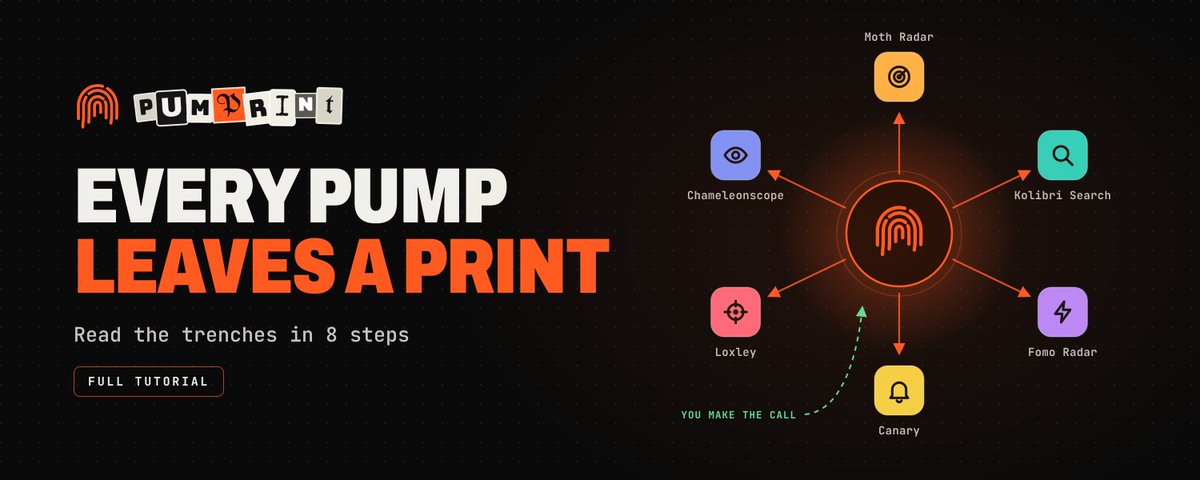
Kolibri Search. Pumprint grades every caller A to F.
Paste an X account, a single post or a public Telegram channel. Kolibri pulls every token they named and prices each at the last candle before the post.
→ LOCK entry at the 1-minute candle closest to the post
→ PRICE at +24 hours and again at +7 days
→ WIN when the 7-day return lands above zero
→ SCORE 60% win rate, 40% median return, pulled toward 50 for thin samples
→ GATE at 3 calls with a 7-day result. A at 75, B at 62, C at 50, D at 38, F below
Post naming 6+ tokens gets skipped. Same token within 7 days counts once.
Two windows in the code: +24h and +7d. The 1-minute and 5-minute marks from the walkthrough never touch the grade.
A screenshot is one candle. A grade from every call on a 7-day window is a record the caller can't edit. Leaderboard stacks graded above ungraded, score first.
The mechanism below: every call priced, the gate opening at three, the grade letter landing ↓