

Husband, Father and former minor leaguer- High School Baseball Coach. Lawn aficionado. Sports teach much more than just a game!
Atlanta, GA
Joined January 2024
- Tweets863
- Following808
- Followers250
- Likes3.2K


Coach Russ Bayer retweeted

I don't think most people truly understand just how GOOD you have to be to play college baseball.
And I'm not just talking about Division I.
I'm talking about D2. D3. NAIA. Junior College.
...And I wish more young players and families understood...
There are some REALLY good baseball players at EVERY level of college baseball.
Consider a few examples.
⚾ J.D. Martinez - NCAA Division II
Played at Nova Southeastern University before becoming a six-time MLB All-Star and World Series champion.
⚾ Jordan Zimmermann - NCAA Division III
Pitched at Wisconsin-Stevens Point. Became a second-round MLB Draft pick, two-time All-Star, and threw a Major League no-hitter.
⚾ Ben Zobrist - NAIA
Played at Olivet Nazarene before transferring to Dallas Baptist. Went on to become a three-time MLB All-Star, two-time World Series champion, and 2016 World Series MVP.
⚾ Albert Pujols - Junior College
Played at Maple Woods Community College before becoming one of the greatest hitters in baseball history.
⚾ Bryce Harper - Junior College
Hit .443 with 31 home runs at the College of Southern Nevada before becoming the No. 1 overall pick in the MLB Draft.
Now, I'm not suggesting every level of college baseball is equal.
It's not.
There are significant differences in roster depth, resources, competition, and the concentration of high-end talent.
But I think we've reached a point where too many people associate the VALUE of a college baseball opportunity with the division attached to it.
And that's unfortunate.
Think about this.
The Division III shortstop might have been the best player in his high school conference.
The Division II pitcher might have been an All-State selection who dominated his competition.
The NAIA roster might be loaded with experienced, physically mature players who can flat-out play.
And that junior college team? It might have multiple arms throwing 90+ mph, future Division I transfers, and legitimate professional prospects.
I've spent enough time evaluating players to know that talent doesn't always follow the labels we attach to it.
Some players develop earlier. Others develop later.
Some are overlooked. Some choose a smaller school for academics, finances, opportunity, or simply because it's the right fit.
And some become significantly better baseball players AFTER they arrive on campus.
Here's what I want young players and their families to understand.
Playing college baseball at ANY level is an accomplishment.
You don't have to play in the SEC to be an outstanding baseball player.
You don't have to wear a Power Four uniform to have a meaningful college career.
And you certainly don't have to play Division I to prove that you belong in this game.
If you have an opportunity to continue your education, develop as a player, compete alongside teammates, and represent a college baseball program, that's something worth being proud of.
Because the truth is, the overwhelming majority of high school baseball players will never get that opportunity.
And one final thought.
Never confuse the level someone plays at with the limits of what they can become. ⚾️
Coach Russ Bayer retweeted

I was talking to an MLB team doctor I know well. He strongly recommends youth players take a couple months off from baseball each year. Repetitive throwing and swinging can lead to fatigue and injuries. Let the body recover, play another sport, and use different muscles. Makes sense.
21 years with my best friend and the love of my life! Happy Anniversary to the best wife and mom there is @JessicaBayer20


6
32
839

Coach Russ Bayer retweeted

A great Sunday of work 🔥
#BeDifferent | #HootyHoo
Coach Russ Bayer retweeted
Interesting observation. The Brewers (almost without exception), seemed to stay within the team colors for all their added gear.
There’s a reason it’s called a UNIFORM. In baseball, your cleats, batting gloves, sliding mitts, elbow guards, and sleeves should reflect your TEAM colors, not draw attention to yourself.
The name on the front matters more than the name on the back.
Look like a team. Play like a team. Win as a team.
WE over ME.


Coach Russ Bayer retweeted
The Brewers are being celebrated like they invented baseball.
They are doing things that have become unusual.
They have an old school tough manager who players love playing for.
They focus on basic easy to understand basic fundamentals.
They have a hitting coach that was an overachieving player for skill that played in the big leagues.
They hit the ball the other way.
They value putting the ball in play.
They adjust their approach based on situation and count.
They are not addicted to exit velocity and launch angle bullshit.
They bunt and steal bases.
They do not have selfish superstars that need to be treated like celebrities.
The Brewers simply play the game how it was meant to be played.

Coach Russ Bayer retweeted
Love the HR as much as the next guy… but 10-0 with zero bombs. Two out and two strike hitting clinic!!! Magical… it works!!!! It’s winning baseball and it beats anyone!!!!
And the hustle play to beat force at 2B was huge!!!!
🤖 Made with AI

Coach Russ Bayer retweeted
The best baseball coaches in the world do not pay for and or have baseball certifications hanging on their wall.
Their certification is called experience and track record.


College Recruiting and development is changing dramatically. Being realistic is paramount when committing- and understanding where you truly “fit” if you are fortunate enough to get an opportunity to play at the next level

1
5
241
Coach Russ Bayer retweeted

If I could go back and do my college baseball recruiting all over again, I’d do just about everything differently.
The only reason I even got a chance to play college baseball was because there happened to be a professional scout at a random high school game.
Why was he there?
Because his buddy was the coach of the opposing team.
That’s it.
It was completely random. And I was incredibly LUCKY.
That scout eventually helped open a door for me to play junior college baseball, which ultimately led to a Division I scholarship.
But think about that for a second.
My entire college baseball career might not have happened if some guy hadn’t decided to go watch his buddy coach a high school baseball game.
Knowing what I know now, here’s what I’d do differently.
1. I’d figure out where I actually stood as a player.
I’d get my metrics tested, have honest conversations with people who understood college baseball, and figure out what level of baseball I was realistically capable of playing.
2. I’d build a list of 50–100 schools.
Not just schools I’d heard of. I’d research programs at every level that fit me academically, financially, geographically, and athletically.
3. I’d contact every single one of them.
I’d introduce myself, share my video and metrics, and explain why I was interested in their program.
And I’d follow up. A lot.
4. I’d spend less money trying to get discovered.
I’d only attend camps and showcases where coaches from schools I was genuinely interested in were going to be.
And I’d make sure those coaches knew I was coming.
5. I’d build a development plan around my weaknesses.
I’d figure out the 2–3 things keeping me from playing at the next level and get to work improving them.
6. I’d track EVERYTHING.
Every school, every email, every conversation, every response. I’d treat recruiting like a process instead of a bunch of random events.
7. Most importantly, I’d take ownership of my recruiting.
I wouldn’t wait for my high school coach, summer coach, or some random professional scout to create an opportunity for me.
I’d go create those opportunities myself.
I wouldn’t trade my college baseball experience for anything. Junior college was one of the best things that ever happened to me.
But I got lucky.
And the more I learn about college recruiting, the more I realize just how lucky I was.
If I could do it all over again, I’d still work my ass off to become a better baseball player.
I’d just work equally hard to make sure college coaches knew who I was.
Coach Russ Bayer retweeted

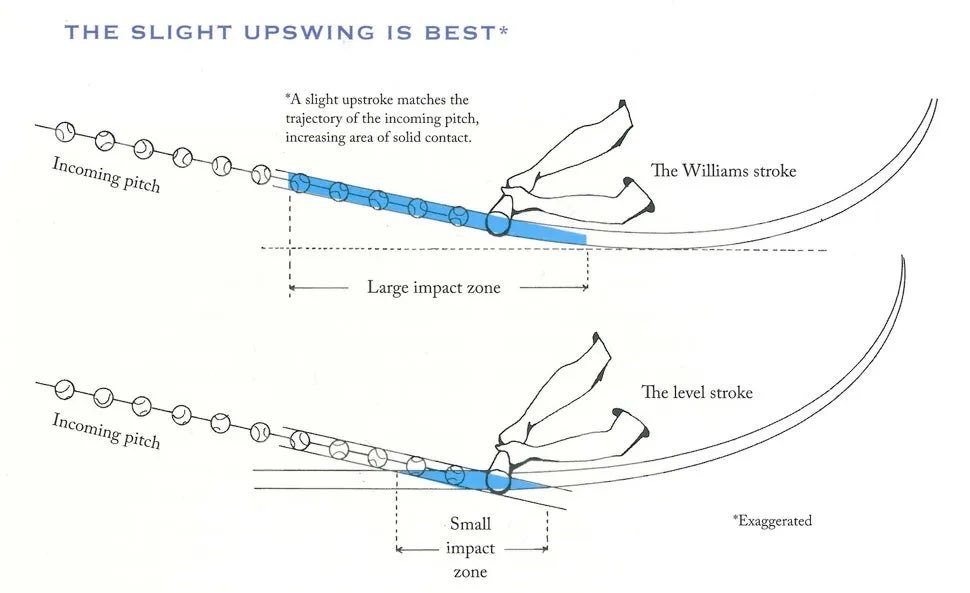
Swing down comes from the feel of the lands at launch. Look at the right side of the graphic, the arc is going down. The barrel planes out behind the hands working down. That’s where the “feel” part comes into play.
When you tell a kid to swing “up” or dump the barrel behind him, that creates an exaggerate barrel drop that then becomes loopy, dippy path. The kid will drop his shoulders trying to artificially produce that result.
If you notice on the Ted Williams graphic, the barrel doesn’t begin to increase
in plane angle until the barrel is more out in front.
Launch angle is created by contact point out in front, not by swinging up at launch or dumping barrel behind your head early.
Watch Albert’s hands first move below. Down, knob to ball, and barrel follows plane of shoulders. Back shoulder dips early, and a barrel drop when that happens.

I interpret Ted Williams' famous "slightly upward stroke as the optimal way to swing" as hitting gold. But I believe there's a little nuance before that stroke happens. Getting in the zone too early pigeonholes the stroke to the angle that was committed to and requires elite pitch recognition. Think Juan Soto. He's in the zone early and late and leads the league in walks often. Elite pitch recognition and plate discipline. Another way to hit, and how I interpret Ted's quote, is to delay barrel application to further out front of the body. Then apply the barrel however you please, based on the pitch and approach. (In the image below, notice the arms are out in front of the body.)
Being in the zone as long as possible is the method for the most room for error. But for the feel people (swing down), they believe that if the barrel stays close to the body and above the hands until out front, the arms can get extended and the barrel can work further and longer out front with adjustable direction. It allows one to let the ball travel while delaying the decision to apply the barrel, giving you adjustability and, hopefully, more game-time power.
Pitchers are literally creating pitches in a lab to attack hitters with long swings. Late movement. More deception. Set-up pitches that mimic the early trajectory of their breaking pitches and offspeed. In-zone early swings (without elite pitch recognition) leave the hitter as one that can hit mistakes, which absolutely has a place in baseball, but when a pitcher is locating or not giving in, the swing down crew has a chance to come through with a knock.
There's a million ways to hit, and doing it against pitchers that also practice (or get paid) requires one to make adjustments, however possible, to succeed and put the team in a position to win. Bruce Lee (iconic martial artist and creator of Jeet Kune Do) famously stated that he didn't like "styles" because they were a crystallization. A style is an unbending way of thinking that fails to bend in the heat of battle. What does a boxer do in a street fight when his opponent uses only kicks? In competition we must be living, breathing opponents that make it difficult to attack.
Swing on deck. Hit in the game.
Coach Russ Bayer retweeted

#CHEMISTRY — Its Under Rated and Under Valued!!! …. Talent wins games, but chemistry, teamwork and intelligence wins championships.

Coach Russ Bayer retweeted
Read between the lines. I hear the game needs baseball veterans teaching and managing.

Willson Contreras: "It's not enough when you have talent, or you have data, or you have computers telling you what to do, because this is baseball. The data is here to help us, but at the end of the day, you need experience and veteran guys to win games. There's a lot of stuff I would like to say, but I'll state it like that."
(Via: @SNYYankees)
Coach Russ Bayer retweeted
A message from every professional baseball scout to every high school and college potential baseball prospect.
We're always watching!
EVERY. SINGLE. LOOK.
Pregame work. I/O. BP. Bullpens. Intrasquads. Scrimmages and regular season games. Every one of those is a look — and every look is being written down.
How you run to first base… or do you run to first base. How you move on the field and off the field. How you throw between innings. How you take BP when you think no scout is watching. How you execute pitches in a side session or between innings warming up. How you handle or process a poor at bat. Whether you’re coachable or whether you’re not. And how you treat your teammates.
First one on the field?
Last one off the field?
It’s ALL being noted.
All of it.
Get to the Big Leagues first—before trying to act like those in the TV league. You’re not.
Scouts aren't just evaluating your tools. We're evaluating everything: your habits, your effort, your work ethic, and your character. The player who gives effort every rep stands out — because so few do it consistently.
Newsflash…Scouts don’t care about your “ranking” or what publications write about you (positive or negative). Scouts don’t care how much NIL money you’re getting, or if you’re getting any at all. We’ll make our own evaluations and our own decisions.
Be intentional. Play hard. No matter the setting, the score, the competition or who's in the stands. When you don't, you're only hurting yourself, and you’re to blame.
There is not much you can control in this game — but the one thing you can control is your effort, your work ethic, and your hustle.
Because when you least expect it, someone is ALWAYS watching, and you never know which look is the one that matters.
Winners Win!
Make. Every. Look. Count.
Coach Russ Bayer retweeted

A father wrote to me this week and gave me permission to share his son's story, because families in this exact spot need to hear it.
In June his son was offered by a power conference program. The degree program fit. He was ready to commit. The staff told him to focus on his summer tournament, and they would connect the following week.
Then the portal took the program's starter at his position, along with several others. The staff went quiet. Eventually they told him the class was on hold until the roster landscape cleared. Other four-year schools went silent at the same time.
The young man sent one text worth framing: Do you still have an interest in me, because I am trying to figure out my fall plan. He was promised a personal call. He gave his availability. Four weeks of silence and counting.
Meanwhile, the family visited the junior colleges that had been recruiting him all along. He committed to one. Playing time, development, and a coaching staff that answered the phone. The father says they could not be happier , and that the lesson was never the ghosting. It was where the interest was real.
Two things I want every family to take from this. The rules, rosters, and economics of college baseball have changed drastically. Basic communication has not. A coach who cannot send one honest text about where your son stands has told you something important about the program.
And the second: go where you are wanted. This family did. That is not settling. In today's game, it is the plan.