




Sp🅰️cer15 retweeted

Rakuten and AST SpaceMobile are launching Rakuten AST, a joint venture to build a D2D satellite network in Japan🚀
With $1B in support from Japan’s MIC, Rakuten AST will build disaster-resilient, uninterrupted communications infrastructure for Japan.
global.rakuten.com/corp/news…

Going back to this one. Have we gone down/chopped long enough to start the journey up? @thekookreport

This is pretty crazy. @tuff_4r
I truly hate when history repeats, but I'll be in a forgiving mood if this pattern holds again.
$ASTS

8
“Congrats” on what now? How does this news today affect the @blueorigin relationship long term? $ASTS
1
4
820

Ngl. Today was brutal. Two things I won’t be doing over the next year. 1. Buying on margin & 2. Buying anything that elon is involved in.
3
81
I would love for @spacanpanman & @thekookreport to do a joint space. I always feel better after those
10
359
Sp🅰️cer15 retweeted

Democrats, don't fuck this up. Focus on the economy & ending wars
Don't go back to bringing men into women's bathrooms and DEI racism
Let Americans be able to take care of their families based on meritocracy & hard work
Voted D down the line today. My hope is that the senate and house don’t waste this chance with 2 years of revenge hearings. Lead by example, make some good change, balance the budget & start to build something.
12

Sp🅰️cer15 retweeted

Dr. Abdul El-Sayed was endorsed by Vice President Kamala Harris.
Dr. Abdul El-Sayed was endorsed by President Barack Obama.
Dr. Abdul El-Sayed was endorsed by Michigan Senator Gary Peters.
Dr. Abdul El-Sayed was endorsed by Michigan Senator Elissa Slotkin.
Dr. Abdul El-Sayed was endorsed by Michigan Governor Gretchen Whitmer.
Repost this everywhere. Take the narrative back.
Sp🅰️cer15 retweeted

The Vikings are wasting a historic defense on Kyler Murray.
Bring back Kirk Cousins.
I'm not even kidding. Would be a great move.
Cousins is EXACTLY who they need.

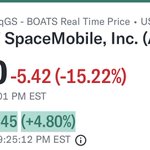
After hearing the $SPCX news about pausing launches for 6 weeks, I’m really wondering what the last raise of $ was for? I thought we were prepaying additional launches. $ASTS @Defiantclient2 @spacanpanman
8
20
7,038
Sp🅰️cer15 retweeted

🔴 Today , they released the first edition of the book "Princes and Thieves: Jared Kushner's and Mohammed bin Zayed's Secret Conspiracy to Reshape the Middle East." These are the most important points from its first chapter, where investigative journalist Matthew Cole reveals details of a secret meeting that brought together Sheikh Mohammed bin Zayed and Jared Kushner in New York in December 2016, just before Trump's inauguration as president.
This chapter outlines how the UAE leadership bypassed the Obama administration to reach directly into the inner circle of the president-elect, leveraging its network of financial and investment ties. Most crucially, the book uncovers what was discussed during the meeting regarding Qatar, Iran, the Muslim Brotherhood, and Israel, along with the priorities that Abu Dhabi wanted the new administration to adopt. It also traces the role Kushner played in opening unconventional channels of communication, and how that meeting, according to the author's account, laid the foundation for a political relationship whose effects extended into subsequent years.
🔷 The book reveals a meeting that brought together Jared Kushner and Mohammed bin Zayed in the presidential suite at the Four Seasons Hotel in Manhattan, after Trump's election victory and before his inauguration. Bin Zayed arrived with a delegation that included dozens of people, among them armed individuals. The meeting came after he decided to cancel a farewell banquet that had been scheduled with President Barack Obama at the White House.
🔷 The Emiratis offered no explanation for canceling his meeting with Obama, and the U.S. administration only learned of his New York visit after the State Department received notifications of his diplomatic travel itinerary. The author describes this action as a clear circumvention of diplomatic norms and a signal of the UAE leadership's shift in focus from the outgoing administration to the personal circle of the president-elect.
🔷 Mohammed bin Zayed enlisted the help of a New York-based hedge fund manager with financial ties to the UAE and a personal friendship with Kushner to arrange the meeting. This serves as an indication of how the UAE uses its investment network to access influential American political figures.
🔷 Kushner informed bin Zayed that the Middle East would be the top priority of the Trump administration's foreign policy, and that he would personally take charge of the diplomatic file on the Israeli-Palestinian conflict. Trump had selected him to handle these matters despite his lack of traditional diplomatic experience. Meanwhile, bin Zayed laid out his grievances to Kushner about U.S. policy over the previous eight years, viewing Obama's support for the Arab Spring uprisings—particularly the protests that toppled Egyptian President Hosni Mubarak—as a betrayal of a key U.S. strategic ally. He explained that Washington's abandonment of Mubarak had heightened Gulf regimes' concerns about the reliability of American guarantees.
🔷 He further argued that the Obama administration's decision to end the U.S. war in Iraq had created a strategic vacuum that enabled the Islamic State to expand and control vast territories in Iraq and Syria. He presented this outcome as evidence of the weakness in U.S. policy in the region. He also told Kushner that the UAE faces two enemies threatening its existence: the Muslim Brotherhood and Iran. He viewed the first threat as political Islam, while the second stemmed from Iran's regional influence and its network of armed groups linked to Tehran.
🔷 He accused Qatar of providing significant funding to the Muslim Brotherhood and using Al Jazeera to stoke regional tensions and support extremist Islamist currents, according to his narrative. He informed Kushner that he hoped the new U.S. administration would address the Qatari problem. This passage reveals that the Qatar file was already on the table in UAE communications with the Trump in Dec. 2016.
