

Chief DCF manipulator, market investigator and fundamental chartist. ACCA, CISI. Dynamic asset allocation. Not financial advice.
quickfs.org
Joined January 2016
- Tweets6.5K
- Following365
- Followers2.9K
- Likes5.1K




Pinned Tweet
My Free Substack subscription offer:
* Full valuation workings with traceable assumptions and the math behind every figure
* Access to my own portfolio performance and holdings
* Discuss my thoughts on the market
* Share my knowledge with subscribers who wish to learn investment analysis
* Daily undervalued stock charts with analysts' consensus
Link: compoundinglab.substack.com/…
For some companies it takes years, but Lockheed adjusted to intrinsic value in just 4 months! Easy money.

Everyone wants the next exciting growth stock. My $LMT Lockheed Martin's valuation asks a different question: what if a boring defense contractor is being mispriced?
Key assumptions:
* Explicit average 5Y/5Y growth @ 5%/4%
* Long-term growth in perpetuity @ 2.5%
* EBITDA margin gradual improvement from 12% in Y1 to 14.8% inY10
* WACC @ 7.2%
* Adj. EBITDA exit multiple of 12.7
* Tax rate 18%
* The input that drives reinvestment is Sales to Capital ratio = 2.5


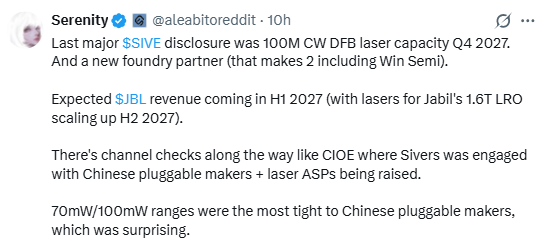
Dude still can't settle with $SIVE after squeezing subscribers with this hype nonsense at 100. Yes, still 4x on 1Y, but those who bought at 100? Minus 75%, close to complete wipeout.
Kremlin will not stop any time soon. It is also not ready for negotiations. Their army is losing 30k per month in wounded/killed, roughly 5x more than Ukrainians. But they still have the capacity to continue. Here is why.
They are recruiting new men at a rate of 30k per month.
At this recruitment rate, Russia is not in a situation where its army is likely to simply “run out” within a few months. But the margin of safety has narrowed considerably.
The key constraint is not Russia’s total male population. It is its ability to keep finding tens of thousands of people every month who are willing to sign military contracts, and then turn those recruits into effective combat replacements.
In September 2026, according to Janis Kluge’s calculations based on Russian regional budget payments, roughly 29,900 people were recruited. Total recruitment for January–September was around 263,000, versus approximately 292,000 during the same period in 2025.
That implies recruitment is down by roughly 10% year over year, despite substantially higher financial incentives. The average regional cost of attracting one contract soldier has risen to approximately RUB 1.9 million, around 30% higher year over year.
At the same time, estimates of Russian battlefield casualties are of roughly the same magnitude or higher.
CSIS estimated Russian casualties during the first half of 2026 at approximately 30,000-34,000 per month, compared with recruitment of around 27,000 per month.
However, this comparison needs an important qualification: casualties include killed, wounded and missing personnel. Some wounded soldiers eventually return to service, so you cannot simply subtract total casualties from recruitment.
A potentially more useful estimate comes from Kluge’s analysis of Russian military compensation payments. He estimated roughly 21,000 permanent departures from the contract force per month between mid-2024 and mid-2025, including soldiers killed, seriously wounded or otherwise no longer receiving combat-related payments.
His estimate implied that Russia was replacing almost 45% of its contract-force personnel every year, although Kluge himself stresses that there is substantial uncertainty around this calculation.
The basic arithmetic therefore looks approximately like this:
Result
* 20–25k/month permanent losses -> Recruitment of ~30k/month -> Force size still grows
* 30k/month permanent losses -> Recruitment of ~30k/month -> Roughly stable manpower
* 35k/month permanent losses -> Recruitment of ~30k/month -> About −60k personnel/year
* 40k/month permanent losses -> Recruitment of ~30k/month -> About −120k personnel/year
These figures are not forecasts. They simply illustrate how close Russia may be getting to the point where recruitment only replaces permanent losses rather than expanding the force.
Will the Russian army be “ground down”?
In purely numerical terms, probably only slowly. In qualitative terms, potentially much faster.
Russia's force deployed against Ukraine remains very large. Budget-based estimates have suggested roughly 550,000 contract personnel plus fewer than 170,000 remaining mobilized soldiers, implying a total force of around 700,000.
Therefore, even if the force were shrinking by 5,000-10,000 personnel per month, that would not produce a sudden collapse.
The more serious issue is quality.
Replacing hundreds of thousands of soldiers every year means continuously losing experienced infantrymen, junior officers, NCOs, specialists and accumulated battlefield experience. Newly recruited soldiers may replace the headcount, but they do not immediately replace the experience of soldiers who have already spent one or two years fighting.
There have also been signs that maintaining recruitment is becoming increasingly difficult. Russian authorities have repeatedly increased signing bonuses and expanded the categories of people eligible for military service.
That matters because roughly the same recruitment rate is now costing the state considerably more money.
A recruitment pace of around 1,000 men per day in 2026 therefore appears harder and more expensive to sustain than the same pace was several years earlier.
How long can this continue?
The current voluntary-contract recruitment system appears capable of supporting the war for many more months, and the available evidence does not point to an imminent manpower collapse.
But extrapolating the same system unchanged for another 3–5 years is much more uncertain.
The most important indicator I am watching going into 2027 is therefore not simply headline casualty numbers. It is the relationship between:
Recruitment ÷ permanent manpower losses
If Russia continues recruiting around 30,000 people per month while permanent losses remain below that figure, it can broadly maintain or even expand its force.
If recruitment begins falling while permanent losses stay high, the situation changes.
For example, if monthly recruitment were to fall:
30k → 25k → 20k
while battlefield intensity remained broadly unchanged, that would be a much stronger indication of manpower exhaustion than another large headline casualty estimate.
At that point, Russia would increasingly face three broad options:
* Reduce the intensity of military operations, lowering manpower losses.
* Increase financial incentives and recruitment pressure further to attract enough contract soldiers.
* Expand compulsory mobilization again to compensate for insufficient voluntary recruitment.
So the Russian army is unlikely to suddenly “run out” of soldiers. The more realistic risk is a gradual deterioration: recruitment becomes increasingly expensive and difficult, troop quality declines, and eventually the government has to choose between lower military intensity, much stronger recruitment measures, or additional mobilization.
That is why I am tracking monthly recruitment. A sustained decline from around 30,000 recruits per month toward 20,000-25,000, combined with unchanged battlefield losses, would be one of the clearest indicators that the current manpower model is starting to come under serious strain.
polymarket.com/event/russia-…

First 100 USD made. That's 10% in less than 2 months. This war will only stop if one of the parties falls. Ukraine will not fall any time soon, because they have Western support. Russia will not fall because, in a war of exhaustion, they still have capacity.
I look at it as high risk / high reward bet. Very similar to the stock market, where we are placing bets on companies. Will bring it to 10% of the portfolio by the end of the year.

Compounding Lab retweeted

BREAKING: The number of active home sellers in the US rose +1.2% MoM in September, or +17,276, to 1,510,784, the highest since March 2020.
At the same time, the number of active homebuyers fell -2.4%, or -23,161, to 928,892, the lowest on record.
This lifts the gap between active sellers and homebuyers to a record 581,892.
As a result, there were +62.6% more home sellers than buyers last month, the largest difference on record.
This percentage has more than doubled since November 2024.
By comparison, the 2021 low was -35.7%, when buyers outnumbered sellers by 633,854.
Hundreds of thousands of homebuyers have been priced-out.

$PG VALUATION MODEL
Procter & Gamble has raised its dividend for 70 years in a row. Tide, Pampers, Gillette, Oral-B - chances are you used one of its brands before breakfast. It is about as close to a bond with a logo as the stock market gets. At USD 151, my DCF says investors are paying roughly 14% more than the cash flows are worth. Great company. Wrong price? Let's run the numbers.
KEY ASSUMPTIONS:
* Explicit average 5Y/5Y revenue growth @ 2.6%/2.8%
* Long-term growth in perpetuity @ 2.5%
* Adj. EBITDA margin expanding from 26.3% to 28.5% by Year 10
* WACC @ 7.4%
* Adj. EBITDA exit multiple of 14.8x
* Tax rate 20.85%, the marginal rate
* The input that drives reinvestment is the marginal Sales to Capital ratio of 2.63, held constant through Year 10

Wells Fargo double-downgraded $ADBE from Overweight to Underweight, citing concerns about slowing growth and increasing AI competition.
Previous price target $270
New price target $225
Analyst: Michael Turrin | Target reduction: 16.7%
Portfolio update – September 2026
CL Sept - 2.28%
SP500 Sept - 0.35%
CL YTD - 1.2%
SP500 YTD +12.7%
My portfolio slightly underperformed S&P index in September. The main laggards were a few growth stocks (Eose, Jobe, OCGN) which I bought earlier this year because I thought they could deliver decent returns. This unfortunately didn’t happen yet, however the impact on portfolio was limited since I gave those positions only a small fraction. TLT and SPHD were also down -3% and -4% respectively, and this had larger impact on underperformance. TLT and SPHD declined in September 2026 largely because US Treasury yields rose sharply. This illustrates an important portfolio-construction risk: long-duration government bonds and defensive dividend stocks are not necessarily good diversifiers against each other. Both can suffer substantially when long-term real yields or term premiums rise. For my portfolio, this is also a reason why I keep short-duration government bonds such as $SHY, PRAB and BIL - they behave differently. They have much lower duration risk and is therefore less vulnerable to the same bond-market repricing.
Transactions
➖ Disposed $NVO, $BTDR, $PDD, SYM, RZLV, BETS as part of a portfolio de-risking. Accumulated losses on these positions were locked in, and proceeds reinvested into more conservative stocks.
➕ New entry in IMB, STZ, HONA, AZO, BKNG, FICO. Those are visibly more prominent names and based on my DCF models they seem to be undervalued at the moment.
Stress test
I have built a portfolio that is designed to endure a market collapse of any size, including a depression similar to 1929.
If S&P500 collapses by 50%, my portfolio is expected to drop by 24%. A mix of low-risk assets, such as government bonds, along with undervalued defensive stocks, will provide the necessary cushion while still generating decent returns to preserve purchasing power. When a bear market kicks in, I want to go shopping instead of leaking wounds. This opportunity unfortunately comes at a cost. If I had kept 100% in an S&P index fund, my return would be 14% higher YTD. I do acknowledge this cost, but at the same time I do not plan to make any changes in my strategy. I feel more comfortable with buying government bonds at a 5% yield than buying the S&P 500 at 40 CAPE.
Holdings as of 10/10/2026
BIL 16%
PRAB13%
Cash7%
SHY7%
TLT 4%
FTSL4%
BKLN4%
IEI 3%
BKNG3%
USMV3%
VGT3%
SPHD3%
LQD3%
NVDA2%
WKL2%
AZO2%
PYPL2%
MSFT2%
Other 18%
What is my portfolio trying to achieve?
Capital preservation
The 45% allocation to cash and short/intermediate Treasuries ($BIL, $SHY, PRAB) provides liquidity and relative stability. It also gives me the flexibility to increase equity exposure after a market correction.
Income generation
FTSL, $BKLN, $LQD and $SPHD aim to generate income. FTSL and BKLN provide floating-rate corporate loan exposure, but they carry credit risk, particularly during recessions.
Selective capital appreciation
$BKNG, $MSFT, $META, $NVDA, $AZO, WKL and FICO provide exposure to businesses with competitive advantages and long-term compounding potential. PYPL, LULU and OTIS introduce more turnaround, recovery or valuation-re-rating exposure.
Asymmetric growth opportunities
OCGN, EOSE, IONQ and JOBY together represent just 4%. I retain exposure to potentially transformative technologies without making the entire portfolio dependent on speculative outcomes.
So yes, capital preservation is my highest priority right now. I hope to achieve this by combining systematic exposures (USMV, VGT, SPHD, MVOL) with individual stock selection (core-and-satellite philosophy, although the fixed-income and liquidity positions are effectively my largest core).
The main trade-off is the possibility of underperforming during a prolonged equity bull market, as we are already witnessing in 2026.
Breakdown by sector/asset class
Cash and equivalents – 42%
Bonds ETF – 18%
Technology – 8%
Low volatility ETF – 7%
Industrials – 7%
Consumer Cyclical – 7%
Consumer Defensive – 4%
Healthcare – 2%
Financial – 3%
Communication – 2%
This wraps up the September performance.
Thanks for reading.
CL.

Most modern finance theory originated a few centuries ago.
For example, consider valuation multiples. High multiples almost always have a reason. When you see an extremely high multiple, that doesn't necessarily mean shares are overvalued.
Everything is relative. That is why P/E is called relative valuation. However, you should compare not just the plain number, but the mathematics behind it.
Adam Smith explicitly argued that capital naturally flows toward its most profitable uses. This is one of the central ideas in The Wealth of Nations (1776), and it is the exact reason why certain stocks trade at very high multiples.
1. Capital seeks the most advantageous employment
In The Wealth of Nations, Book I, Chapter X, Smith wrote:
"Stock and labour naturally seek the most advantageous employment."
Here, stock means capital. Smith was explaining why capital and labour migrate toward activities offering superior economic rewards.
2. Investors allocate capital to maximize returns
In Book IV, Chapter II, Smith wrote:
"Every individual is continually exerting himself to find out the most advantageous employment for whatever capital he can command."
Smith argued that individuals direct capital toward opportunities that serve their economic interests, and that this process can also benefit society.
3. Capital flows eventually reduce excess profits
Smith also described something particularly important for modern investing: competition causes unusually high returns to decline over time. This is where the concept of Moats comes into play.
In Book I, Chapter X, he explained that when an occupation or activity becomes especially profitable, competitors enter, gradually eliminating its exceptional advantages.
This implies the following economic mechanism:
Industry earns unusually high returns on capital -> Capital flows into the industry -> Competition and investment increase -> Excess profits and ROIC tend to decline.
How this relates to modern investing
Smith's argument is especially relevant to fundamental valuation work.
Consider the semiconductor industry:
* Strong AI demand creates expectations of attractive revenue growth and high returns on invested capital.
* Investors and companies direct more capital toward semiconductor businesses.
* Existing competitors expand capacity, while new participants enter.
* Over time, greater competition and supply can put pressure on returns.
However, the important distinction is that Smith emphasized profitability rather than growth itself. A rapidly growing industry does not necessarily attract capital indefinitely if its returns are inadequate relative to risk.
For my DCF workings, his insight helps explain why assuming a company's ROIC will remain substantially above WACC forever can be dangerous. Competition tends to erode excess returns unless a sustainable competitive advantage protects them.
One further distinction: buying existing shares on the stock market does not necessarily provide new productive capital to the underlying business, although valuations can influence its ability to raise capital.
A useful modern paraphrase of Smith's argument would be:
Capital naturally gravitates toward industries offering the most attractive returns, but the resulting competition gradually erodes those returns.
And it captures a fundamental investing principle: high industry growth attracts capital, but high growth does not guarantee high long-term returns on capital.
What is the expected growth rate for Brazil?
What will happen to margins in ROIC?
Equity risk premium - still high. Why should we expect it to decrease?
People try to find patterns in places where they might not exist.
There are, of course, chances that Brazil will do well, but adding an additional layer of analysis is always helpful rather than just dumping a chart.
Charts are just history. For valuation, future prospects matter more.


Realistically, what are significant areas where AI is affecting our lives?
I hear about AI in office, on social medias, TV shows. But I barely see it impacting my daily activity other than as writing and research assistant. So I challenge myself - does this truly deserve the hype?
This is a genuine question, for me to understand. Not to criticise anyone.
List down 👇 other important areas which I am missing.
(Don't mention travel or YouTube videos selection, please. Only important critical areas where AI adds value).
Read this. Eventually, over the long period, AI will probably do well, likewise tech stocks did well after 2001 collapse. But not all of them and not immediately.

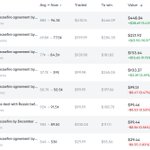
Full list of my Polymarket positions. Current stage: accumulating.
Today, Trump is saying once again that Ukraine-Russia war will end soon.
The reason why he is saying this is a mix of real diplomatic activity + deliberate pressure/optimism, rather than because there is public evidence that a full ceasefire is already close.
Trump has been saying versions of this for months. On July 6 he said the war was “getting closer than people realize,” after speaking separately with Putin and Zelenskyy. Reuters noted at the time that Trump gave no specific reason for that confidence.
Then at the UN on September 22 he again said he thought an end would come “more quickly than people understand.”
There are nevertheless a few concrete reasons why he may genuinely think the situation is moving.
First, US diplomacy restarted in September after roughly six months of stagnation. Witkoff and Kushner visited Moscow and Kyiv, and Washington has been discussing a new “peace package.” Russia, Ukraine and the US have also accepted in principle the idea of another trilateral round of talks.
Second, Trump seems to believe that both sides are under increasing pressure. Ukraine has inflicted serious damage on Russian energy infrastructure, while Ukraine itself faces another difficult winter and remains heavily dependent on Western military and financial support. That creates incentives on both sides to explore at least limited agreements. Trump has explicitly been pushing an energy ceasefire as a possible first step.
Third, Trump appears to think he has leverage over Russia economically. His administration is simultaneously discussing sanctions, energy issues and potentially substantial future US-Russia commercial relations. The Kremlin itself said Trump told Putin that ending the war could open the way to a major restoration of US-Russian economic ties.
Recent reporting also says US-Russia discussions have touched on a multibillion-dollar oil transaction.
But there is a major contradiction: Putin's public and reported private positions don't currently look like those of someone preparing to sign a general ceasefire immediately.
Reuters reported in July that people close to the Kremlin said Putin was rejecting compromise and still wanted control of the remainder of Donbas; one source said he had rejected advisers' suggestions for a ceasefire along the existing front. And as recently as 1 October, Putin rejected the proposed exchange of limits on long-range/energy attacks, while saying Russia still preferred an eventual negotiated end.
Today, October 6, Ukraine is also warning that Russia appears to be preparing another major aerial attack.
Therefore, we should interpret Trump's wording approximately like this:
~40% genuine belief based on private conversations that there is a negotiable landing zone;
~30% negotiating tactic - publicly saying agreement is close can put pressure on Putin and Zelenskyy to behave as though it is;
~20% domestic politics/economics - Trump badly wants lower energy prices and a visible foreign-policy success;
~10% Trump's normal tendency to express very optimistic timelines.
Those percentages are my judgment.
For my Polymarket ceasefire-agreement positions, I don't treat Trump's statement alone as strong evidence that a qualifying agreement is imminent. I would become much more bullish on YES if we saw one of these concrete developments: Russia accepting the principle of a general ceasefire, a Putin-Zelenskyy/Trump summit with an actual ceasefire text under discussion, negotiators beginning work on a dated frontline-wide halt, or Kremlin language shifting from “root causes first” toward “ceasefire first.”
At the moment, Trump's rhetoric is noticeably more optimistic than the observable Russian negotiating position. That gap is the most important thing I keep in mind.
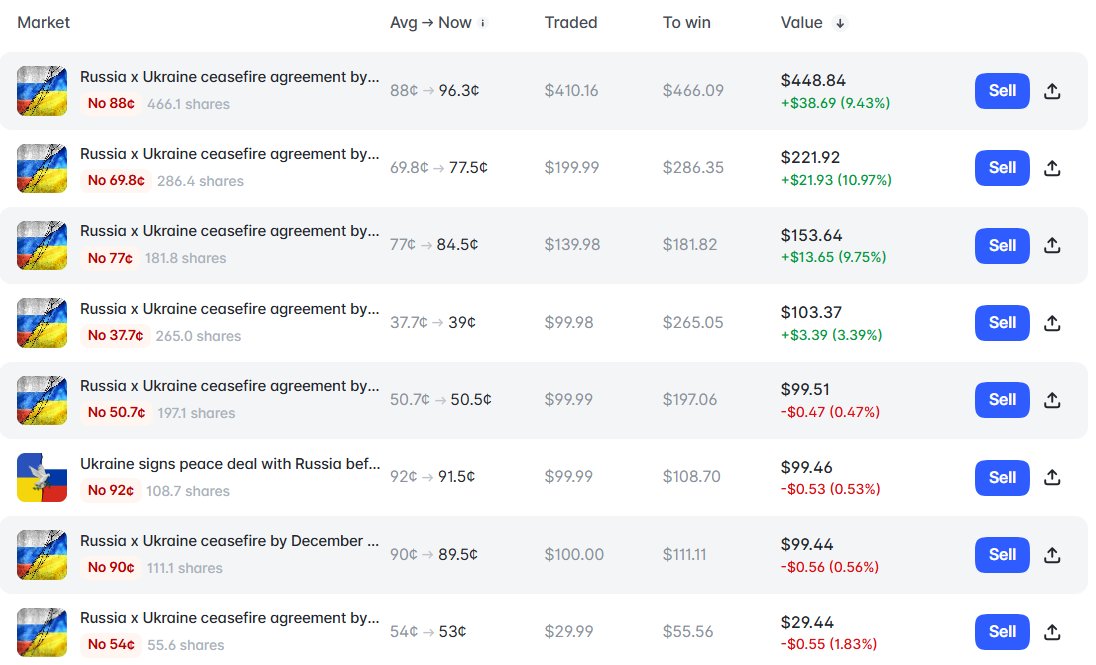
17% in just one month. I do not believe in a quick ceasefire between Ukraine and Russia. To evaluate my position, I check how many new contract soldiers Russia recruits monthly, and this trend tells me they do not have any intention of stopping anytime soon. I can be wrong - it's politics and everything can change fairly quickly. Therefore, do not copy my trades. It is a very small share of my total portfolio.


Marvell Technology $MRVL is up sharply today, primarily because of its Investor Day. Management now giving much stronger long-term AI/data-center targets than the market expected. Shares have been roughly +6–8%, after rising as much as 11% intraday.
Here are some numbers that moved the stock:
- FY2028 revenue target: $20B, versus Wall Street around $18.2B.
- FY2031 revenue target: 70-90B, with an $80B midpoint. Consensus had been only about $46.9B -> projected business almost 70% larger than analysts were modeling.
- Marvell increased its FY2029 custom-AI silicon revenue expectation to $12B, from $10B previously.
- By FY2031, management sees roughly $30B from custom compute/chips and around $37.5B from interconnect/connectivity.
- Management is targeting >$30 adjusted EPS in FY2031 and a roughly 56–59% gross margin.
This isn't simply generic “AI enthusiasm.” Investors had been worried that Marvell was too dependent on a small number of hyperscaler customers and that $AVGO could dominate custom AI ASICs. Today's presentation strengthened the opposite thesis:
* Marvell claims it now has a broader set of hyperscaler design wins, with growth not only in custom AI accelerators but also in optical DSPs, networking and high-speed interconnects. Analysts specifically highlighted that diversification away from excessive reliance on Amazon.
This comes on top of already strong fundamentals: in Q2 FY2027, Marvell's revenue grew 37% YoY, while Data Center revenue grew 46%, with management saying AI bookings were exceptionally strong.
In short, today's jump is due to a huge upward revision to the market's 2028–2031 earnings/revenue expectations.