Cosmic Watch retweeted
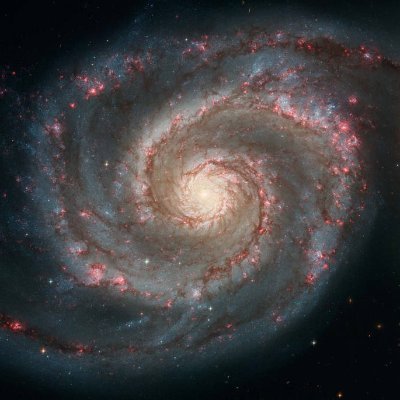
'Hubble Spots Chaotic Secret in Galaxy'
nasa.gov/image-article/hubbl…
Image Credit: ESA/Hubble & NASA, D. Thilker, the MAUVE-HST Team
#astronomy #space
Cosmic Watch retweeted
AstroBin's Image of the Day: "M6_The Butterfly Cluster" by Marius
astrobin.com/uxvf5p/
#astrophotography
Cosmic Watch retweeted
カシオペヤ座のNGC457。
2つの明るい星が目玉のようにみえるため、フクロウ星団とかトンボ星団とかE.T.星団とかバルタン星人とか呼ばれているようです。
妻に見せたら「なににも見えない。なにを言っているのか分からない。」と言われました。
R200SS+ExPH
ASI183MCP
3分×20枚
※北を下にしています
Cosmic Watch retweeted
Beautiful atmospheric shot—dramatic clouds surrounding a bright, detailed full moon, with warm amber tones breaking through the cool blue-gray sky. 🌕☁️
Cosmic Watch retweeted
Supernova in NGC 7331, shared on AstroBin by Michael Gehrisch, who used a telescope from AstroBin sponsor @TeleskopService: TS-Optics 200mm/8" ONTC f/4 Newtonian (carbon tube).
More: astrobin.info/ts-optics
Image: astrobin.com/2etk4k/D
Total: 8h 20′
Thanks for looking!
S.
Cosmic Watch retweeted
"Tortoise" as a field.
I see many eyes, wheels, wings, hands, eggs, toruses and more. What do you see?
Details in post below👇
🟡The Mother of all Symbols!
A few weeks back, after many iterations of the fractal torus model, I created an algorithmic artwork called Tortoise, made in tandem with AI. As part of the Nameless ( nurecas.com/nameless?o ) framework, I had landed on the Hopf fibration as an important structure for defining physical reality. I took an artistic leap after this... overlaying two oppositely rotated Hopf fibre bundles, then repeating the whole structure again and again at the interstices formed by their intersections, to form a fractal torus. This differs from other torus visualisations I've seen, not only in its use of Hopf fibres, but in the fractal arrangement, which produces that "many, many eyes" quality or the "wheels within wheels" quality.
Studying it from different angles, I realised, to my shock, that this structure had many many connections to scientific concepts, myths and symbols across the world and across history:
Science: the black hole and white hole paradigm, wormholes
Sacred geometry: Flower of Life, Lotus of Life, Triskelion, Yin Yang
Religious symbols: Sri Yantra on Kurma, Shatkona, Swastika, Tree of Life, Thousand Petalled Lotus, Reclining Vishnu, Samudra Manthan, Shivlingam, Avalokiteshvara, Ezekiel's Wheel, the Celtic Cross,
Sacred architecture: Muqarnas and Islamic geometric patterns, Rose windows
Visionary art made in altered states, such as @alexgreycosm 's
Contemporary design: even the @OpenAI logo
To show how all these might derive from one source, I built a system that varies the parameters of the same root Tortoise artwork until it matches each symbol. Then I made a visualiser where you can click any symbol, read about the connection, and study the match visually.
I'm not claiming these are all derived from this single structure. Each connection is pattern-matched at this stage, and the scientific ones especially are speculative. I claim only the visual match, not an actual connection. But there are too many to ignore. Perhaps what the ancients meditated upon is the same structure science is reaching towards, and the same structure seen in altered states of consciousness. If the universe is sound based, perhaps the wave-structure formed by the primordial sound corresponds to a similar fractal torus structure?
Many of these connections already exist in literature and in esoteric theory. Some were abstract, some pointed directly to a torus, though not, as far as I know, to this particular variation. The visualiser is therefore a synthesis of many people's work over millennia, seen through the lens of my own. I'm assembling it with humility and respect, hoping we notice that we are all telling the same story through different lenses...
I have made 26 connections so far, and I hope to add more. I'm giving equal weight to each tradition, so if you spot flaws or biases in the text or visual, they aren't intentional, and I hope to improve these over time.
Find the artwork “Tortoise” and the visualiser at: nurecas.com/tortoise?o
Music credits: Music by DELOSound from Pixabay
#generativeart #creativecoding #sacredgeometry #mathart #proceduralart
Cosmic Watch retweeted
AstroBin's Image of the Day: "Centaurus A Hydrogen Jet Velocity Map" by Mathew Ludgate
astrobin.com/u6sbbz/
#astrophotography
Cosmic Watch retweeted
¿Qué sucede cuando dos manchas enormes se cruzan en la superficie del Sol?
Este impresionante video muestra un par de manchas solares polares unidas por un puente de plasma incandescente, capturando el preciso instante en que el magnetismo solar desata su furia.
Lo que estás 👇
Cosmic Watch retweeted
BOOM!
I happened to be shooting this galaxy when a star decided to explode. Pretty lucky!
You can see it appear close to the galactic core. I’ll be shooting it every night for a while to watch it change brightness!
This is comparing photos captured 10 days ago vs 5 min ago.
Cosmic Watch retweeted
I captured 3 hours on Galaxy NGC 7331 this month, which shows a new supernova SN 2026aaiv. I then compared it to the same galaxy I captured a year ago in July, which shows supernova SN 2025rbs (which has since faded and can no longer be seen in the new data).
Cosmic Watch retweeted
1/2
Here is another Hubble gem!
This image, released in 2023, features Z 229-15, one of the most interesting cosmic objects due to its multifaceted nature.
In fact, it is defined as a ring galaxy, as an active galactic nucleus (AGN), as a quasar, and as a Seyfert galaxy...all at once.
This makes Z 229-15 a very uncommon galaxy in scientific terms: it is about a celestial object that defies single classification, offering a unique window into the complexity and diversity of astrophysical events at the heart of galaxies.
Located about 390 Mly away in the constellation Lyra, its particular nature continues to be the subject of study and discussion among astronomers.
Let's look at its characteristics in more detail.
Z 229-15 has been identified as a ring galaxy, a type of galaxy that displays a circle-like appearance, due to collisions or interactions with other galaxies.
It is thought to contain an Active Galactic Nucleus (AGN). An AGN is a very bright region at the center of some galaxies: the brightness is caused by the presence of a supermassive black hole that attracts material towards itself, heating it and making it shine across the entire electromagnetic spectrum.
If we consider Z 229 -15 like a quasar we are talking about an extremely luminous AGN, one of the brightest objects in the universe. Quasars are very distant: their distance is on the order of billions of light years. In early 2021, the quasar QSO J0313–1806, with a 1.6-billion-solar-mass black hole, was reported at redshift = 7.64, meaning that its origin dates back to about 670 million years after the Big Bang.
The classification of Z 229-15 as a quasar is interesting because it would be one of the closest quasars to us, making it a subject of study to understand these phenomena.
A Seyfert galaxy is a galaxy that hosts an AGN and is characterized by very bright emission lines in its spectra, indicating intense activity in the galactic nucleus.
Z 229-15 may indeed fall into this category due to its nuclear activity.
In summary, Z 229-15's nature challenges our understanding of galaxy evolution and the behavior of supermassive black holes at their cores.
Image credit: ESA/Hubble & NASA, A. Barth, R. Mushotzky
#blackhole #galaxy #quasar #Hubble
Cosmic Watch retweeted
My latest #Moon drawing was a challenge! This is a 40th birthday gift; the Moon on the day they were born. At moonset there was just 0.3% illumination. The majority of this drawing is representing #earthshine, with just a tiny bit of illumination on the right side! #SpaceArt
Cosmic Watch retweeted
AstroBin's Image of the Day: "Saturn from 2018 to 2026" by Niall MacNeill
astrobin.com/9l7brv/
#astrophotography
Cosmic Watch retweeted
If you want to bake a cake, you might have to crack a few… comets? 🥚
The shattered remains of comet C/2025 K1 as seen by @GeminiObs North
📸 @GeminiObs/NOIRLab/NSF/AURA/B. Bolin, J. Miller & M. Rodriguez, T.A. Rector, M. Zamani
B. Bolin, C. Ingebretsen, M. MacGregor
Cosmic Watch retweeted
The stellar remnant known as pulsar J0002 is hurtling through space at nearly 2.5 million miles per hour away from the expanding debris of the supernova that created it. It's traveling so fast that it will eventually leave our galaxy. #MondayMotivation

ALT The ghostly bubble of supernova remnant CTB 1 is captured in observations from the VLA (Very Large Array) and the Dominion Radio Astrophysical Observatory’s Canadian Galactic Plane Survey. The golden curved rim of the remnant’s shell is near the center of the image, with the straight, glowing trail from pulsar J0002+6216 pointing toward the lower left. The image is filled with hazy blue clouds and dotted with off-white orbs of varying sizes and brightness. This image is watermarked with “Credit: Composite by Jayanne English, University of Manitoba, using data from NRAO/F. Schinzel et al., DRAO/Canadian Galactic Plane Survey and NASA/IRAS.”
Cosmic Watch retweeted
Nice WSA-Enlil model run with 4 separate CMEs here, showing a respectable impact Friday morning. The timing lines up just behind the peak of the CH CIR. If these two features can hit us at the same time, that would help us reach that G2 potential the SWPC has highlighted.
1/6
In 2019, a Warsaw research team presented the first 3D map of the Milky Way in the journal Science.
The map is based on direct distances to thousands of Cepheids.
A pioneering achievement, still widely cited. 🔭
#galactic #astronomy #universe