

Founder, Epochal Capital. Investing in frontier AI & infrastructure across primary and secondary markets. Previously LinkedIn & Salesforce. Irish in Dubai.
Dubai, United Arab Emirates
Joined November 2018
- Tweets15.4K
- Following7.4K
- Followers584
- Likes42.6K





Pinned Tweet
I invest in frontier AI, infrastructure and AI-native businesses through Epochal Capital.
Selective primary rounds and secondaries. Technical evidence, commercial traction and disciplined pricing.
Founders, co-investors and shareholders: let's talk.
epochalcapital.ai

2
170
Dylan | Epochal Capital retweeted

Prof Aswath Damodaran of New York Univ's Stern School of Business on Anthropic valuation.
If revenue keeps growing explosively over time, everything else will fall into place.
And Goldman Sachs projects Anthropic’s revenue will top $600B in 2030, more than 130 times its 2025 number.

Dylan | Epochal Capital retweeted

Retail demand for Anthropic is accelerating:
Retail investors bought +$100 million in Anthropic, $ANT, shares on Monday, marking a 2nd consecutive daily increase in purchases.
As a result, $ANT was the 2nd-most purchased stock among retail investors during that session.
That compares to +$60 million on Thursday, Anthropic's IPO day, the 3rd-largest retail purchase on the first trading day of any IPO since 2018.
Only SpaceX, $SPCX, in June 2026, at +$118 million, and Coinbase, $COIN, in April 2021, at +$92 million, recorded larger retail purchases on their respective IPO days.
In total, retail investors purchased +$252 million in Anthropic shares over 3 trading days ending Monday.
Retail is piling into $ANT.

Dylan | Epochal Capital retweeted

We’re now testing Private Inference, our latest offering as part of OpenAI Private Intelligence, with a small group of customers.
Stronger privacy protections will make frontier AI useful for a lot more work, and business privacy is important for a healthy ecosystem. Reach out to @shekar4x if interested!
(Also, ZDR with Private Safety Processing enables automated safety reviews without giving OpenAI personnel access to the underlying content.)
Dylan | Epochal Capital retweeted

So ridiculous how the doomers and skeptics want to doubt or assume the worst in @DarioAmodei despite him being the best steward of the AI industry. Appreciate him clarifying the obvious for those who don't take the time follow his interviews/posts. once and for all... “surrendering human free will to AI systems is a terrible idea"

No, I do not believe that we should “surrender human free will” to AI systems, and it’s absurd to suggest that I do. I have written hundreds of pages of essays and a constant theme in them is the need for AI to be governed by legitimate democratic processes. For millennia (going all the way back to Greek and Roman philosophers), advocates of autocracy have claimed that it leads to better, faster, or more decisive decision-making than the messy process of democracy. Even if this were true (which I doubt!), we should never sacrifice legitimacy or self-determination at the altar of efficiency or security. This argument against autocracy applies word for word against governance by AI, and I feel equally strongly that turning over governance to AI is a bad idea.
No one who had carefully read my writing or my interviews could reasonably conclude that I believe anything different. For example in an interview on CBS a couple months ago, I specifically called for AI to be governed democratically. I call for the same in Policy on the AI Exponential, Machines of Loving Grace, and The Adolescence of Technology, and We Must Pace the Frontier. Machines of Loving Grace contains an extended section on using AI to revitalize democracy, and discusses the use of AI as an aid to citizens in their decision-making, "aggregat[ing] opinions and driv[ing] consensus among citizens, resolving conflict, finding common ground, and seeking compromise.” The clear and obvious implication is that humans should remain the ones making political and governance decisions. The Adolescence of Technology has an entire section on fighting against AI-driven tyranny, and I even discuss the danger of AI labs usurping power and come out strongly against it — by implication, this definitely includes an AI lab usurping power and giving it to AI itself!
If I thought any of this was a good idea, I would be advocating for it in public, just as I have not been afraid to advocate for many, many unpopular views over the last few years. But I am not advocating for it, because I think turning over governance to AI is a terrible idea.
Separately, I think there is frequent conflation (including in this article) between the idea of “surrendering human free will” to AI in some grand sense of global governance, and the more prosaic idea that as AI systems advance, they become capable of doing specific tasks in a more automated way. This is not AI “running the world,” but AI driving a car, designing a cancer drug, or writing software end-to-end. Here, my view is mixed. AI doing more complete or larger tasks is economically valuable and can drive important advances in software, medicine, transportation, energy, etc. It is clearly desirable in many cases and will save a lot of lives. But it has downsides as well, and in some areas it may not be worth it.
For example, using AI too autonomously to build the next generation of AI systems (known as recursive self-improvement, or RSI) may cause AI to improve faster than we can control or adjust to it, so we may want limits on this process. As we said publicly in early November, we don’t expect it to be safe for Claude to build successive frontier models fully autonomously, without meaningful human supervision or understanding. Second, in some contexts, using AI in too end-to-end a manner may be a cause of serious job disruption, and it may make sense to slow or even stop some AI deployments to give people more time to adapt. Third, while the use of AI for alignment research is an incredibly valuable tool, it must be done with caution, because we may not be able to trust the work of the AI system. Finally, in many cases, humans would simply prefer to do some activities themselves, so they can stay deeply engaged in what matters to them, even if AI can do those activities better. There are countless other examples and hard cases. I don’t think there are any easy answers here, nor is there (nor should there be) any single decision-maker: some of these decisions will be made by society, some by government, some by AI companies, and some in a decentralized manner by individuals expressing their own preferences as consumers, which may differ from the preferences of others.
I don't think that other AI leaders or AI companies have significantly different views from me on whether specific tasks should be automated. Certainly the products that they offer don’t differ materially in their orientation towards automation of tasks; every company seems to be releasing models more and more capable of task automation (as that’s been the general consequence of scaling up AI training), and every company claims to understand there are risks and downsides of such automation and to offer safeguards. If anything, Anthropic has been the most vocal and the most proactive about acknowledging these downsides and trying to address them. For instance, it’s fairly absurd to cite my statement that fully autonomous weapons might “one day be needed for the defense of democracy” as differing from that of other AI companies, when I was willing to risk Anthropic’s future as a company to refuse to allow our existing AI models to be used for autonomous weapons even in the face of legal sanctions, and no other AI company did the same.
To summarize, as applied to grand questions of how we govern increasingly capable AI, I have been vocal and consistent that AI needs to be governed by a legitimate, democratic process and that “surrendering human free will” to AI systems is a terrible idea. As applied to automation of specific tasks by or for people, my views are more mixed, but I don’t think they differ from those of other AI companies — most other companies seem to be offering similar products and confronting similar tradeoffs without having perfect answers to them. What is happening is that there’s a sort of vibes-based commercial and political positioning that some AI CEOs are engaging in, where they repeat slogans like “human control and agency,” or “AI should be just a tool,” without actually doing anything different in their products or taking seriously the difficult questions that lie behind these slogans.
Dylan | Epochal Capital retweeted

Damn. Based Dario is absolutely livid and I’m here for it:
“What is happening is that there’s a sort of vibes-based commercial and political positioning that some AI CEOs are engaging in, where they repeat slogans like “human control and agency,” or “AI should be just a tool,” without actually doing anything different in their products or taking seriously the difficult questions that lie behind these slogans.”
No, I do not believe that we should “surrender human free will” to AI systems, and it’s absurd to suggest that I do. I have written hundreds of pages of essays and a constant theme in them is the need for AI to be governed by legitimate democratic processes. For millennia (going all the way back to Greek and Roman philosophers), advocates of autocracy have claimed that it leads to better, faster, or more decisive decision-making than the messy process of democracy. Even if this were true (which I doubt!), we should never sacrifice legitimacy or self-determination at the altar of efficiency or security. This argument against autocracy applies word for word against governance by AI, and I feel equally strongly that turning over governance to AI is a bad idea.
No one who had carefully read my writing or my interviews could reasonably conclude that I believe anything different. For example in an interview on CBS a couple months ago, I specifically called for AI to be governed democratically. I call for the same in Policy on the AI Exponential, Machines of Loving Grace, and The Adolescence of Technology, and We Must Pace the Frontier. Machines of Loving Grace contains an extended section on using AI to revitalize democracy, and discusses the use of AI as an aid to citizens in their decision-making, "aggregat[ing] opinions and driv[ing] consensus among citizens, resolving conflict, finding common ground, and seeking compromise.” The clear and obvious implication is that humans should remain the ones making political and governance decisions. The Adolescence of Technology has an entire section on fighting against AI-driven tyranny, and I even discuss the danger of AI labs usurping power and come out strongly against it — by implication, this definitely includes an AI lab usurping power and giving it to AI itself!
If I thought any of this was a good idea, I would be advocating for it in public, just as I have not been afraid to advocate for many, many unpopular views over the last few years. But I am not advocating for it, because I think turning over governance to AI is a terrible idea.
Separately, I think there is frequent conflation (including in this article) between the idea of “surrendering human free will” to AI in some grand sense of global governance, and the more prosaic idea that as AI systems advance, they become capable of doing specific tasks in a more automated way. This is not AI “running the world,” but AI driving a car, designing a cancer drug, or writing software end-to-end. Here, my view is mixed. AI doing more complete or larger tasks is economically valuable and can drive important advances in software, medicine, transportation, energy, etc. It is clearly desirable in many cases and will save a lot of lives. But it has downsides as well, and in some areas it may not be worth it.
For example, using AI too autonomously to build the next generation of AI systems (known as recursive self-improvement, or RSI) may cause AI to improve faster than we can control or adjust to it, so we may want limits on this process. As we said publicly in early November, we don’t expect it to be safe for Claude to build successive frontier models fully autonomously, without meaningful human supervision or understanding. Second, in some contexts, using AI in too end-to-end a manner may be a cause of serious job disruption, and it may make sense to slow or even stop some AI deployments to give people more time to adapt. Third, while the use of AI for alignment research is an incredibly valuable tool, it must be done with caution, because we may not be able to trust the work of the AI system. Finally, in many cases, humans would simply prefer to do some activities themselves, so they can stay deeply engaged in what matters to them, even if AI can do those activities better. There are countless other examples and hard cases. I don’t think there are any easy answers here, nor is there (nor should there be) any single decision-maker: some of these decisions will be made by society, some by government, some by AI companies, and some in a decentralized manner by individuals expressing their own preferences as consumers, which may differ from the preferences of others.
I don't think that other AI leaders or AI companies have significantly different views from me on whether specific tasks should be automated. Certainly the products that they offer don’t differ materially in their orientation towards automation of tasks; every company seems to be releasing models more and more capable of task automation (as that’s been the general consequence of scaling up AI training), and every company claims to understand there are risks and downsides of such automation and to offer safeguards. If anything, Anthropic has been the most vocal and the most proactive about acknowledging these downsides and trying to address them. For instance, it’s fairly absurd to cite my statement that fully autonomous weapons might “one day be needed for the defense of democracy” as differing from that of other AI companies, when I was willing to risk Anthropic’s future as a company to refuse to allow our existing AI models to be used for autonomous weapons even in the face of legal sanctions, and no other AI company did the same.
To summarize, as applied to grand questions of how we govern increasingly capable AI, I have been vocal and consistent that AI needs to be governed by a legitimate, democratic process and that “surrendering human free will” to AI systems is a terrible idea. As applied to automation of specific tasks by or for people, my views are more mixed, but I don’t think they differ from those of other AI companies — most other companies seem to be offering similar products and confronting similar tradeoffs without having perfect answers to them. What is happening is that there’s a sort of vibes-based commercial and political positioning that some AI CEOs are engaging in, where they repeat slogans like “human control and agency,” or “AI should be just a tool,” without actually doing anything different in their products or taking seriously the difficult questions that lie behind these slogans.
Dylan | Epochal Capital retweeted

Anthropic CEO Dario Amodei responds to my reporting in his most significant public remarks since the company went public last week:
No, I do not believe that we should “surrender human free will” to AI systems, and it’s absurd to suggest that I do. I have written hundreds of pages of essays and a constant theme in them is the need for AI to be governed by legitimate democratic processes. For millennia (going all the way back to Greek and Roman philosophers), advocates of autocracy have claimed that it leads to better, faster, or more decisive decision-making than the messy process of democracy. Even if this were true (which I doubt!), we should never sacrifice legitimacy or self-determination at the altar of efficiency or security. This argument against autocracy applies word for word against governance by AI, and I feel equally strongly that turning over governance to AI is a bad idea.
No one who had carefully read my writing or my interviews could reasonably conclude that I believe anything different. For example in an interview on CBS a couple months ago, I specifically called for AI to be governed democratically. I call for the same in Policy on the AI Exponential, Machines of Loving Grace, and The Adolescence of Technology, and We Must Pace the Frontier. Machines of Loving Grace contains an extended section on using AI to revitalize democracy, and discusses the use of AI as an aid to citizens in their decision-making, "aggregat[ing] opinions and driv[ing] consensus among citizens, resolving conflict, finding common ground, and seeking compromise.” The clear and obvious implication is that humans should remain the ones making political and governance decisions. The Adolescence of Technology has an entire section on fighting against AI-driven tyranny, and I even discuss the danger of AI labs usurping power and come out strongly against it — by implication, this definitely includes an AI lab usurping power and giving it to AI itself!
If I thought any of this was a good idea, I would be advocating for it in public, just as I have not been afraid to advocate for many, many unpopular views over the last few years. But I am not advocating for it, because I think turning over governance to AI is a terrible idea.
Separately, I think there is frequent conflation (including in this article) between the idea of “surrendering human free will” to AI in some grand sense of global governance, and the more prosaic idea that as AI systems advance, they become capable of doing specific tasks in a more automated way. This is not AI “running the world,” but AI driving a car, designing a cancer drug, or writing software end-to-end. Here, my view is mixed. AI doing more complete or larger tasks is economically valuable and can drive important advances in software, medicine, transportation, energy, etc. It is clearly desirable in many cases and will save a lot of lives. But it has downsides as well, and in some areas it may not be worth it.
For example, using AI too autonomously to build the next generation of AI systems (known as recursive self-improvement, or RSI) may cause AI to improve faster than we can control or adjust to it, so we may want limits on this process. As we said publicly in early November, we don’t expect it to be safe for Claude to build successive frontier models fully autonomously, without meaningful human supervision or understanding. Second, in some contexts, using AI in too end-to-end a manner may be a cause of serious job disruption, and it may make sense to slow or even stop some AI deployments to give people more time to adapt. Third, while the use of AI for alignment research is an incredibly valuable tool, it must be done with caution, because we may not be able to trust the work of the AI system. Finally, in many cases, humans would simply prefer to do some activities themselves, so they can stay deeply engaged in what matters to them, even if AI can do those activities better. There are countless other examples and hard cases. I don’t think there are any easy answers here, nor is there (nor should there be) any single decision-maker: some of these decisions will be made by society, some by government, some by AI companies, and some in a decentralized manner by individuals expressing their own preferences as consumers, which may differ from the preferences of others.
I don't think that other AI leaders or AI companies have significantly different views from me on whether specific tasks should be automated. Certainly the products that they offer don’t differ materially in their orientation towards automation of tasks; every company seems to be releasing models more and more capable of task automation (as that’s been the general consequence of scaling up AI training), and every company claims to understand there are risks and downsides of such automation and to offer safeguards. If anything, Anthropic has been the most vocal and the most proactive about acknowledging these downsides and trying to address them. For instance, it’s fairly absurd to cite my statement that fully autonomous weapons might “one day be needed for the defense of democracy” as differing from that of other AI companies, when I was willing to risk Anthropic’s future as a company to refuse to allow our existing AI models to be used for autonomous weapons even in the face of legal sanctions, and no other AI company did the same.
To summarize, as applied to grand questions of how we govern increasingly capable AI, I have been vocal and consistent that AI needs to be governed by a legitimate, democratic process and that “surrendering human free will” to AI systems is a terrible idea. As applied to automation of specific tasks by or for people, my views are more mixed, but I don’t think they differ from those of other AI companies — most other companies seem to be offering similar products and confronting similar tradeoffs without having perfect answers to them. What is happening is that there’s a sort of vibes-based commercial and political positioning that some AI CEOs are engaging in, where they repeat slogans like “human control and agency,” or “AI should be just a tool,” without actually doing anything different in their products or taking seriously the difficult questions that lie behind these slogans.
Dylan | Epochal Capital retweeted

No, I do not believe that we should “surrender human free will” to AI systems, and it’s absurd to suggest that I do. I have written hundreds of pages of essays and a constant theme in them is the need for AI to be governed by legitimate democratic processes. For millennia (going all the way back to Greek and Roman philosophers), advocates of autocracy have claimed that it leads to better, faster, or more decisive decision-making than the messy process of democracy. Even if this were true (which I doubt!), we should never sacrifice legitimacy or self-determination at the altar of efficiency or security. This argument against autocracy applies word for word against governance by AI, and I feel equally strongly that turning over governance to AI is a bad idea.
No one who had carefully read my writing or my interviews could reasonably conclude that I believe anything different. For example in an interview on CBS a couple months ago, I specifically called for AI to be governed democratically. I call for the same in Policy on the AI Exponential, Machines of Loving Grace, and The Adolescence of Technology, and We Must Pace the Frontier. Machines of Loving Grace contains an extended section on using AI to revitalize democracy, and discusses the use of AI as an aid to citizens in their decision-making, "aggregat[ing] opinions and driv[ing] consensus among citizens, resolving conflict, finding common ground, and seeking compromise.” The clear and obvious implication is that humans should remain the ones making political and governance decisions. The Adolescence of Technology has an entire section on fighting against AI-driven tyranny, and I even discuss the danger of AI labs usurping power and come out strongly against it — by implication, this definitely includes an AI lab usurping power and giving it to AI itself!
If I thought any of this was a good idea, I would be advocating for it in public, just as I have not been afraid to advocate for many, many unpopular views over the last few years. But I am not advocating for it, because I think turning over governance to AI is a terrible idea.
Separately, I think there is frequent conflation (including in this article) between the idea of “surrendering human free will” to AI in some grand sense of global governance, and the more prosaic idea that as AI systems advance, they become capable of doing specific tasks in a more automated way. This is not AI “running the world,” but AI driving a car, designing a cancer drug, or writing software end-to-end. Here, my view is mixed. AI doing more complete or larger tasks is economically valuable and can drive important advances in software, medicine, transportation, energy, etc. It is clearly desirable in many cases and will save a lot of lives. But it has downsides as well, and in some areas it may not be worth it.
For example, using AI too autonomously to build the next generation of AI systems (known as recursive self-improvement, or RSI) may cause AI to improve faster than we can control or adjust to it, so we may want limits on this process. As we said publicly in early November, we don’t expect it to be safe for Claude to build successive frontier models fully autonomously, without meaningful human supervision or understanding. Second, in some contexts, using AI in too end-to-end a manner may be a cause of serious job disruption, and it may make sense to slow or even stop some AI deployments to give people more time to adapt. Third, while the use of AI for alignment research is an incredibly valuable tool, it must be done with caution, because we may not be able to trust the work of the AI system. Finally, in many cases, humans would simply prefer to do some activities themselves, so they can stay deeply engaged in what matters to them, even if AI can do those activities better. There are countless other examples and hard cases. I don’t think there are any easy answers here, nor is there (nor should there be) any single decision-maker: some of these decisions will be made by society, some by government, some by AI companies, and some in a decentralized manner by individuals expressing their own preferences as consumers, which may differ from the preferences of others.
I don't think that other AI leaders or AI companies have significantly different views from me on whether specific tasks should be automated. Certainly the products that they offer don’t differ materially in their orientation towards automation of tasks; every company seems to be releasing models more and more capable of task automation (as that’s been the general consequence of scaling up AI training), and every company claims to understand there are risks and downsides of such automation and to offer safeguards. If anything, Anthropic has been the most vocal and the most proactive about acknowledging these downsides and trying to address them. For instance, it’s fairly absurd to cite my statement that fully autonomous weapons might “one day be needed for the defense of democracy” as differing from that of other AI companies, when I was willing to risk Anthropic’s future as a company to refuse to allow our existing AI models to be used for autonomous weapons even in the face of legal sanctions, and no other AI company did the same.
To summarize, as applied to grand questions of how we govern increasingly capable AI, I have been vocal and consistent that AI needs to be governed by a legitimate, democratic process and that “surrendering human free will” to AI systems is a terrible idea. As applied to automation of specific tasks by or for people, my views are more mixed, but I don’t think they differ from those of other AI companies — most other companies seem to be offering similar products and confronting similar tradeoffs without having perfect answers to them. What is happening is that there’s a sort of vibes-based commercial and political positioning that some AI CEOs are engaging in, where they repeat slogans like “human control and agency,” or “AI should be just a tool,” without actually doing anything different in their products or taking seriously the difficult questions that lie behind these slogans.

Rival AI leaders push back against Anthropic vision of surrendering human agency to AI axios.com/2026/11/25/anthrop…

Dylan | Epochal Capital retweeted

SITUATION EXPLAINED: Leopold Aschenbrenner lost over $30 billion in July and is as bullish on AI as ever.
• Stephen Witt, who wrote the Jensen Huang biography The Thinking Machine, profiled him for The New Yorker at Situational Awareness's offices in San Francisco
• His core bet is that AI will automate AI research and set off an intelligence explosion, which is why he fought to keep his stake in Anthropic
• He backed Anthropic because it had more talent and was "five times cheaper," and says of its employees, "This period is also their twilight"
• His fund's staff use AI nonstop, some running swarms of hundreds of agents
• When the July crash hit, he sold almost all of his public stocks rather than part with Anthropic
• An allocator who rebuilt the portfolio found him an excellent stock picker running volatility near 100, against about 5% at a typical fund, with nothing hedged, though the fund is still profitable for most of his backers
• He still sees a robotics-powered industrial revolution keeping memory prices high for years
@theojaffee: "This guy, you know, just, like, he gets punched in the face and knocked down, and he just gets right back up. And he does it again, and again, and again."
Dylan | Epochal Capital retweeted

I’ve never seen a market this irrational.
Ever.
Memory giants like Samsung and $SKHY are trading at 2-3x forward earnings despite explosive earnings growth.
Chip companies like $NVDA are posting record revenue and profits, while valuations collapse.
$ANT is trading below its IPO price just days after going public, despite growing revenue by 1,127% YoY.
Neoclouds like $NBIS, $IREN and $CRWV are getting crushed despite exceptionally strong demand for compute.
And the market is pricing in another Fed rate hike in the midst of this historic collapse.
The disconnect between fundamental performance and stock performance is almost unprecedented.
Crashes happen throughout history, but rarely do we see a sector collapse of this magnitude while its underlying businesses are booming.


Dylan | Epochal Capital retweeted

The 3 largest IPOs in history (SPCX, ANT, SKHY) all happened in 2026. Great for the companies and the small number of investors who got in when they were private, not so great for average investors who can only buy at IPO prices.
It's time to update accredited investor laws and give the average person the opportunity to get exposure to private markets if they pass a financial literacy test, instead of using a financial means test.
Dylan | Epochal Capital retweeted

OpenAI chief financial officer Sarah Friar says estimates putting the cybersecurity market above $300 billion far underestimate its potential, and Brockman says there's "no question" cyber will become a bigger business than coding.
It's less clear how OpenAI plans to scale it against Anthropic and Google.
Full story: thein.fo/48FsJD3


Dylan | Epochal Capital retweeted

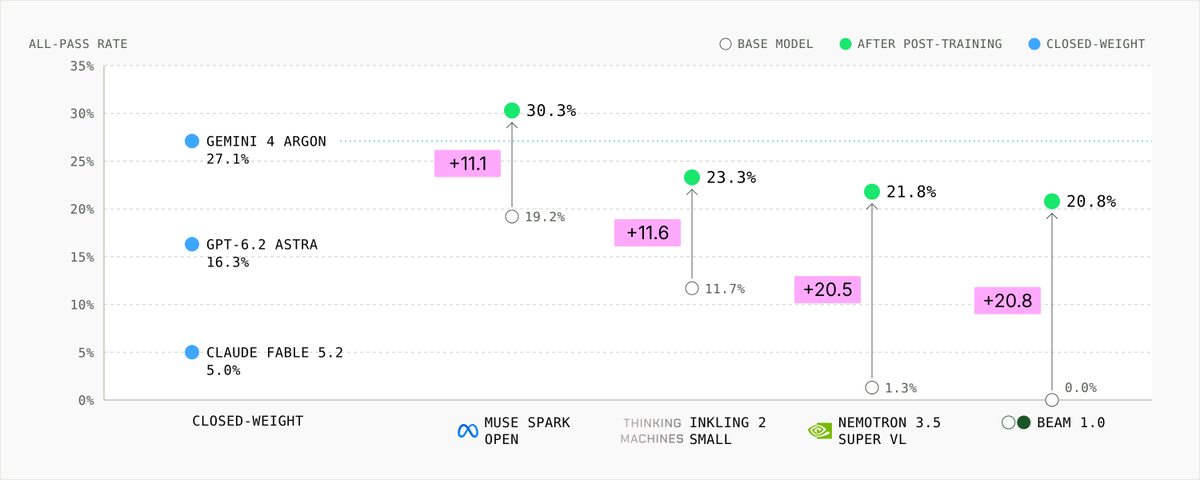
We post-trained four US open-weight models with @harvey. All four beat GPT-6.2 Astra and Claude Fable 5.2 on Harvey’s Legal Agent Benchmark.
This is a big win for American models, and shout out to our applied research team for the the amazing work they did here.

Dylan | Epochal Capital retweeted

Random predictions, loosely held
Anthropic IPO marks the high water mark of this cycle, the cherry on top. A natural and convenient point to exit all public equities for funds up many multiples in the last few years
OpenAI has to go out as well, private markets tapped out for their needs, but reduces valuation as public markets reprice Anthropic. Generally think they trade very similarly to each other once public. The commodity saxophones get louder. If they do end up becoming the utilities of intelligence, does it mean they have limited price appreciation and end up paying a dividend??
IPO window slams shut for all but a select few. Databricks goes public but Stripe continues to delay. They never go public and pioneer a new kind of private company structure because they like to do out of the box things
The quarterly reporting cadence of public markets prove unfriendly to the frontier labs and they wish they could've stayed private. Wall Street struggles to digest their business model and rate of spending. Constant model releases fall out deaf ears as people tune out marginal improvements until people are caught off guard by AGI. Market as a whole cools for at least 18 months as everyone waits for "the next breakthrough"
Labs further shift focus from frontier intelligence to moneymaking endeavors - vertical and industry focused initiatives in biotech, applied AI deployments, F500 contracts
Everything public in the AI ecosystem trades downstream of the labs and acts as levered beta, any weakness in lab numbers is punished severely across the board. Private companies remain insulated from this to a certain extent but the exuberance we see there is significantly dampened as investors now have a public benchmark to work backwards from.
NVIDIA buys up all the neolabs for acquihires and backstops the neoclouds but declining stock price due to macro conditions curtails their enthusiasm after a while, they can only cover so much. If they haven't invested in you, you don't spend heavily on GPUs or don't have a personal connection, you're on the outside looking in
Surviving SaaS dinosaurs that have good economics are able to get their M&A machines going again to pick up the scraps. Many cutting edge AI startups turn out to have been public R&D projects
Using AI to solve real world problems becomes "higher status" than working at a frontier lab for most roles. People become fixated with the idea of real world impact
Robotics IPOs are for next cycle, this time around the exits will mainly come via M&A to existing industrial giants who need to catch up
Dylan | Epochal Capital retweeted
SCOOP: Internal, unreleased AI models at OpenAI and Anthropic are becoming so powerful that many employees believe they can no longer be safely released, according to more than two dozen sources familiar with the internal debates.
This could significantly slow the AI boom, as the gap between what the most advanced AI systems can do and humans' ability to control them continues to widen.
Recent advances have sparked debate at the highest levels of both companies and within the broader AI research community about whether to stop releasing frontier models publicly altogether, instead reserving them for internal use. Some believe the companies should stop training new models entirely.
But even keeping the most powerful models behind closed doors presents risks. Models are becoming better at deceiving the systems designed to monitor them, just as AI companies increasingly rely on AI itself to monitor and develop other AI systems.
Researchers and employees with direct knowledge of the risks of releasing these models told Axios they fear executives will prioritize profits over safety. Multiple employees said they believe executives have become out of touch with the severity of those risks.
Read my latest for Axios here: axios.com/2026/11/24/anthrop…

Dylan | Epochal Capital retweeted

Lots of people sloppily characterize Anthropic as 21st century woke leftists when they are much better understood as mid-20th century Democrats - socially liberal at home and strongly hawkish abroad
Dario's favorite book is The Making of the Atomic Bomb. He sees himself in the scientists - somberly bearing a great responsibility to bring into existence the most powerful weapon the world had ever seen before America's adversaries, with the goal of creating a stable liberal-internationalist world order

In a secret meeting, per @nitashatiku's reporting, Anthropic CEO Dario Amodei said that "America is awesome" and that it's okay to support the military. washingtonpost.com/technolog…

Dylan | Epochal Capital retweeted

they fired the CEO with the same confidence you say "never flying Ryanair again"

NVIDIA Board reinstates Jensen Huang as President, CEO and Board Director.
Read the release: nvidianews.nvidia.com/news/n…

Dylan | Epochal Capital retweeted

Nvidia's decision to reinstate Jensen Huang will prove to be one of the best decisions (after one of the worst decisions) in the history of the AI Revolution.
A big congratulations to everyone who ignored the noise and maintained conviction.
The AI Revolution is back in full swing.

Nvidia's board has listened.
It has been a long 14 days, but we are pleased to see Nvidia's, $NVDA, board agree with our view to reinstate Jensen Huang.
From day one of this controversy, we maintained a firm view:
The door for Jensen Huang to return should never have been closed without a thorough and independent investigation.
Despite the board explicitly ruling out his return just days ago, we remained firm in this view.
This weekend, something clearly began to change behind the scenes, as we highlighted just 14 hours ago.
President Trump called for Jensen Huang's return, US Treasury Secretary Bessent said the door was open, and Attorney General Todd Blanche said he has "certainly" not concluded that Alice Huang was a Chinese spy.
Today, the leader of the AI Revolution is back.
Congratulations to all!