

Obsessed with all things Energy; Data guy; $EOSE is my retirement plan (I study it); $1.50 DCA; $100 target for 2030;
Joined May 2021
- Tweets25.1K
- Following407
- Followers2.2K
- Likes32.7K


Pinned Tweet
$EOSE Roadmap to $40+ – Redbird Unlocked, Catalysts Loading!
Ultra-bull PT $40+ in sight.
News drought shattered TODAY: Bimergen advances Redbird to Ready to Build (RTB) stage with JDA approval + Eos Z3 selection (permitting & interconnection cleared, financing next).
Milestones I believe drive us there:
☑️ Bimergen gets JDA approval & permit advancement for the 400 MWh Redbird project (announced TODAY – Eos Z3 selected, milestone‑based capital now flowing!)
⬜ Bimergen publicly places a firm order for the Redbird project
⬜ Q4 earnings — Q4 revenue ~$95mm
⬜ Backlog exceeds $1B
⬜ 2026 guidance $500mm–$750mm
⬜ Frontier makes it through the next gate (early spring) with all 11 GWh intact
⬜ The 2.4 GWh NYC Navy Pier project is announced
⬜ NextEra announces they are going to use a significant amount of $EOSE BESS starting immediately
⬜ IEP announces the Robena Data Center project has achieved FID (tenants + full funding secured)
⬜ A large Z3 Indensity order is announced
⬜ Q1 earnings (early May) — ~$125mm for Q1
⬜ Line 2 imminent SAT at Marshall
⬜ Line 3 announcedUltra-bull PT $40+ in sight.
⬜ Backlog exceeds $3B
Redbird box checked — next one incoming? $EOSE to $40+ feels inevitable if these hit.
#EOSE #BESS #ZincBattery #EnergyStorage

$EOSE
I think we can see the radioshuttle based racking system reported in June in yesterday's picture.
It is on the back wall and the materials in storage look like large black boxes.
Looks to be 25-30ft tall to me and 150-200ft wide.
Or in terms of lanes: 5 lanes tall and ~35 lanes wide.
We can't tell how deep, but even just 10 deep would be enough to hold over 1500 pallets.


$EOSE 🚨Racking system from Sweden 🇸🇪?🚨
Delivered on 6/19/2026
@bert_gilfoyle
@philroberts
@thejefflutz
empacksthlm.se/en/products/r…


$eose
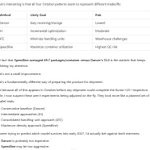
The spear fisher thinks the special project is at least in part JNTG moving felt from Korea to a Custom Bonded Warehouse in CA.
Very possible.
Same for Speedline? ATC Logistics?
Does the puzzle have 3 different answers?
===
Rebuttal
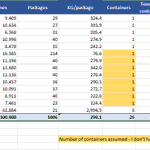
Eos has $50mm in raw materials inventory. For weeks I have said some of that $50mm is likely graphite felt inventory sitting in Korea, possibly at JNTG.
If the "special project" as I have designated it is felt being moved to a custom bonded warehouse, then I argue it is Eos owned felt and it was already on Eos books as an asset at the end of Q2.
The varying package weights and container weights don't look like a simple inventory relocation.
On the other hand, the special project could be about package and container loading, but Eos wasn't ready to pay the tariff on the felt yet. Thus Eos has ownership of that felt, but is keeping it legally outside of the US in a custom bonded warehouse.
@grok what do you think of that theory?


$EOSE FELT
Same policy. Dancer only.
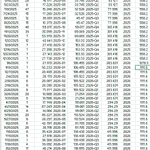
But, I can't help but wonder how and when that "yellow" bar makes it into normal inventory?
And I am very surprised to see October Dancer deliveries exceed 120 tonnes.
Recall it takes time for felt to get from LA to Pittsburgh. Those Dancer shipments are almost certainly meant for Line 2 consumption. Great to see Eos is at a minimum planning on consuming 120 tonnes of felt via Line 2 production. Or at least that is my presumption.


$EOSE 🚨 FELT DELIVERED 🚨
33,378 KG of felt delivered to EOS on 10/29/2026.
(Dancer logistics / Hi-Power)
@philroberts
@FreemyerGreg


🔋Greg🔋💎🤲 retweeted

$EOSE
A core part of my Eos thesis is now grid security under the AI/superintelligence era.
Bad actors + advanced AI create real risks of sophisticated cyberattacks on the bulk power system and grid. Domestic, trusted hardware + software is becoming a national security priority.
Key alignments
EO 14420 (Aug 2026) declares a national emergency on the bulk power system. It restricts foreign-produced equipment tied to Covered Foreign Entities (including China). Explicitly covers battery energy storage systems. Implementing rules due ~Dec 24, 2026.
Fortress America (DoW/Hegseth): Major military bases to generate their own power, independent of the civilian grid, with microgrids + battery storage for extended resilience (reports of 90-day off-grid capability).
DawnOS: Eos’s US developed software/controls/analytics platform (module level intelligence, AI features). Board appointment of Haiyan Song (cybersecurity/software veteran from NetApp CloudOps, Splunk, F5, HPE) in July 2026 directly supports this. She bought 15k shares open-market in September.
Eos already has:
DOE loan facility (hundreds of millions drawn/supporting PA manufacturing scale-up
DOE warrants
Golden Dome contract with DoW (Z3 LDES prototype at critical defense installation 91% domestic content, NDAA/FEOC compliant; highlighted by Trump)
Deployments/orders at military sites (Naval Base San Diego, Camp Pendleton, etc.)
Multiple government agencies are natural future customers for American-made, non flammable zinc LDES that meets domestic content and cybersecurity requirements. The policy window is open and accelerating
(This also has potential read-through to $TE — more work needed there.)
🔋Greg🔋💎🤲 retweeted

SpaceX no longer needs NASA. This isn’t a bad thing, it’s the best era yet for commercial spaceflight.
SpaceX has told NASA it will stop flying Crew Dragon to the ISS by or before 2030. It has stopped selling commercial Falcon 9 launches after 2028, and is no longer bidding on new U.S. Space Force contracts or certain lunar payload services.
This means SpaceX no longer relies on government budgets to survive. Starlink and its AI business are already generating their own cash flow. The flood of government contracts is now opening real opportunities for Blue Origin, Relativity Space, Stoke Space, and others.
Imagine if SpaceX were still dependent on NASA contracts, most other rocket companies wouldn’t have a chance to survive.
Now SpaceX is flying on its own and leaving the sky open for everyone else.
It’s not walking away. It’s flipping the entire era.

I’ve spent a lot of time thinking about, and talking to people about a post-Falcon world. Why sunset the world’s best rocket? Can Starship replace it? What about Artemis? Why are SpaceXers flocking to Memphis? Grab a coffee, this is a long one.
arstechnica.com/space/2026/1…

🔋Greg🔋💎🤲 retweeted

@JoeMastrangelo8
My direct message to you ahead of next week’s earnings call.
I am incredibly frustrated with backlog conversion heading into 2027. That’s an understatement.
2025 ended with $702M in backlog. After nearly $208M in revenue through Q3 we’re sitting at $765M. Just 9% in net expansion.
We’re essentially replenishing the order book as production scales without demonstrating sustained growth. FPUSA created a lot of initial noise that has now gone severely quiet.
We are heading into Q4 ER in FY’27 with a declining backlog.
Where and when is the inflection?
To be clear, manufacturing progress is real. Shipments are increasing and margins are improving. My frustration is strictly with commercial conversion.
We’re discussing 4 GWh of annual nameplate capacity with just 3.2 GWh in total backlog across future delivery periods. The pipeline continues to expand while visibility into late-stage opportunities has largely disappeared.
With these industry tailwinds and years of manufacturing investment we should be discussing a path toward billions in backlog heading into 2027. Instead we’re still below $1B with zero visibility into the next meaningful conversion.
Frankly it’s incredibly disappointing. Something needs to change quickly.
2027 is being positioned as a volume growth year. Where is the order book to support it?
As a well respected investor, I’m growing old and impatient. This cadence needs to change, now.
Continue to be arrogant to the public markets & you will be right back to raising expensive capital. That is the point, and the problem.
J
$EOSE felt
Thoughts on the "special project" in the image are from Co-Pilot.
I think Dancer deliveries are orders from the normal production team and are not part of the special logistics project.
300 tonnes of felt for the special project will almost certainly have a meaningful amount of scrap.
I also have said before I think Eos maintains a stock of felt they own in Korea. These deliveries I suspect were from that inventory as opposed to newly purchased felt.
For one thing, I doubt JNTG could manufacture almost 400 tonnes of felt in one month.
===
This begs the question:
Will Eos continue to move its felt inventory from Korea to Thornhill? How much inventory do they have in Korea?
Or will they establish a new Thornhill target inventory and a separate Korea target inventory?
===
Felt shipments were always confusing and this set of non-Dancer shipments just makes them more so!


$EOSE felt
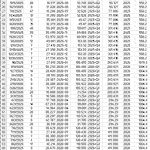
I have become convinced the non-Dancer delivered felt was delivered to Eos, but that it is a special project and at least for now that felt should not be lumped in with the above.
I have shown that "special project" felt on my quarterly felt deliveries chart below.
Other than that, these charts only show the Dancer shipments. I will reply to this post with a table that lists all October shipments.
$EOSE 🚨 Felt delivered 🚨
51,567 KG of felt was delivered to EOS on 10/26/26.
(A larger volume of graphite felt was shipped by JNTG on this vessel than what’s shown in the screenshots. While the material specs (including the 750 mm width) match what EOS has historically imported, the consignees listed are logistics intermediaries, so the ultimate end recipient isn’t confirmed. I don’t want to post it in a way that could mislead people into assuming it’s all destined for EOS when that hasn’t been verified.)

In this very short video you see a tease of America's domestic battery manufacturing jewel!
$eose was busting out of the seams a year ago, so they leased this spacious building.
The equipment you see looks large, but in 3 months they will double the amount of equipment in the building as they continue their move in!
In just 3 more short months Eos will have one of the most state-of-the-art manufacturing facilities in the US of A!

🔋Greg🔋💎🤲 retweeted

SpaceX vise 10 000 lancements de Starship par an depuis la Louisiane. Soit 27 lancements par jour. Pour réussir ça il faudrait une énorme quantité d’ergols. Oxygène liquide (LOX) : 36 millions de tonnes par an.
Méthane liquide (CH₄) : 10 millions de tonnes par an
Pour produire ce carburant de manière neutre en carbone SpaceX prévoit d'utiliser la réaction de Sabatier combinée à l'électrolyse de l'eau.
•Production de méthane : Synthétiser 1 kg de méthane à partir de CO₂ capturé et d'hydrogène issu de l'eau demande environ 22 à 25 kWh d'électricité.
•Le bonus de l'oxygène : Ce procédé chimique rejette naturellement 4 kg d'oxygène pour chaque kilo de méthane produit. Le besoin en oxygène de la fusée (3,6 kg) est donc intégralement couvert par la fabrication du méthane.
•Liquéfaction cryogénique : Le refroidissement des gaz à des températures extrêmes consomme une énergie supplémentaire d'environ 0,8 kWh par kg.
Il faudrait donc environ 250 Térawattheures (TWh) d'électricité par an pour fabriquer et liquéfier les ergols de ces 10 000 lancements.
Cela représente plus de la moitié de la consommation électrique annuelle de la France. Il faudrait dédier l'équivalent de 25 à 30 réacteurs nucléaires (ou des milliers de kilomètres carrés de panneaux solaires) uniquement à la fabrication du carburant de la flotte spatiale.

Are you not following the news?
2 major US Govt Battery projects announced today.
Last week it was a $5B loan to flyover country to upgrade their grid and add batteries.
Then there is the 90 days of off grid capacity for every US military installation that was just announced.
Then there is Fortress America
And Golden Dome
The US government is going onto war mobilization footing and batteries are in the middle of it all!
🔋Greg🔋💎🤲 retweeted

Today's dual announcement from the DoE directly reinforces the federal policy tailwinds, manufacturing roadmap, and non-lithium supply chain moat of $EOSE.
Coming less than 24hrs after Deputy Secretary of Energy Alex Fitzsimmons walked Thorn Hill's factory floor.
🇺🇸🔋🇺🇸


An interesting 3 minutes from a US freight data expert.
Consumer goods freight has been falling (that's volume as in cubic feet of goods).
But industrial goods has been increasing. He claims the best industrial expansion in at least a decade!

The U.S. Economy Is BOOMING and SLOWING At The Same Time
Please ❤️like, bookmark🔖, and 🔁share with fellow investors
In this Short video, Craig Fuller @FreightAlley and @AdamTagart discuss a growing divergence in the U.S. economy that traditional economic indicators may be failing to capture.
While consumer demand for physical goods is weakening, manufacturing and industrial activity are experiencing what could be their strongest expansion in at least a decade.
Freight transportation data reveals a tale of two economies, with consumer-related shipments slowing even as industrial freight volumes continue to expand.
*
For years, the American consumer was the primary engine of economic growth.
During COVID and the subsequent recovery, households purchased enormous quantities of goods, fueling demand across retail, logistics, and transportation.
But that dynamic is changing.
Freight data now suggests consumers are buying fewer physical products, raising concerns that the long-awaited consumer slowdown may finally be materializing.
*
Why does freight data matter?
Because it measures the actual movement of goods rather than the dollars consumers spend.
Traditional retail sales figures can appear resilient even when underlying consumption is deteriorating.
Inflation can push spending higher despite consumers purchasing fewer products, while continued spending by wealthier households can mask financial stress across much of the population.
*
This helps explain why headline retail sales have remained surprisingly strong even as many Americans struggle financially.
Higher-income consumers have continued spending, supporting aggregate figures, but that doesn't necessarily translate into growing physical goods volumes.
*
Meanwhile, the industrial side of the economy tells a dramatically different story.
Manufacturing activity is expanding at a pace Craig describes as potentially the strongest in a decade.
Massive capital expenditures, government stimulus, energy investment, and infrastructure development are driving demand for industrial materials, equipment, and transportation services.
The manufacturing renaissance that began emerging earlier in 2026 is not fading. In several areas, it is actually broadening.
*
This creates an unusual economic environment: consumer-related freight is weakening while industrial freight is strengthening.
The two sectors are moving in opposite directions, making it increasingly difficult to assess the economy through headline statistics alone.
*
Importantly, weaker goods consumption does not necessarily mean consumers are cutting back on travel, hotels, restaurants, or other services.
Freight data primarily captures physical merchandise, not the entire consumer economy.
The bigger question is whether this industrial boom can continue supporting economic growth if household demand for goods deteriorates further.
*
So, the U.S. economy isn't simply booming or slowing. It's doing both simultaneously.
Consumer spending figures may be concealing weakness in physical goods demand, while an extraordinary wave of industrial investment is powering a manufacturing renaissance.
Understanding this divergence could be critical to identifying where the economy and financial markets are headed next.
*
💡 Get access to notes with the key takeaways from this interview by visiting Thoughtful Money Substack (link in the @AdamTaggart 's bio)
🔋Greg🔋💎🤲 retweeted

The Pnyx Cyclopean Wall of Athens 🤯
This massive megalithic wall is comprised of HUGE polygonal stones, some weighing 40TONS! It is one of the most impressive feats of ancient engineering in Greece, yet relatively few are even aware of its existence. In fact, I visited this wall twice while in country, and literally NOBODY else was there either time.
For perspective, the largest stones used to create the Parthenon are only 5Tons. This incredible wall stands apart from the most notable sites in Athens that receive all the attention.
Pictures do not do this behemoth justice. Notice how large they are compared to me (I’m 5’10). This wall gave me Baalbek vibes…


🔋Greg🔋💎🤲 retweeted

Many of you don't understand how serious this is, so let me break it down.
In computer science there is a famous kind of puzzle called 3-SAT. You are given a long list of yes-or-no switches and a set of rules about how they must be arranged, and you have to find a combination that satisfies every rule. The obvious way to solve it is to try every combination, but each new switch doubles the number of possibilities, so a puzzle with a few hundred switches would take longer than the age of the universe to brute force.
For decades, the smartest people in the field found clever tricks that made this a little faster, but every trick still hit the same wall: the time required kept exploding as the puzzle grew.
About 25 years ago, two computer scientists, Russell Impagliazzo and Ramamohan Paturi, working with Francis Zane, turned that wall into a formal idea.
They proposed the Exponential Time Hypothesis, which says this explosion is not a failure of human cleverness but a law of nature. No algorithm, however brilliant, will ever solve 3-SAT without the time blowing up exponentially. Nobody could prove it, but almost everyone believed it, and it became one of the foundations of modern computer science.
Researchers used it as a measuring stick. If you could show that solving some other problem quickly would also crack 3-SAT quickly, you had shown that problem was hopelessly hard too. Hundreds of papers, across scheduling, graphs, logic and much more, rest on this one assumption.
Now an internal AI model at OpenAI claims to have broken it. It says it found an algorithm that solves these puzzles meaningfully faster than the hypothesis allows, and it has checked the proof in a computer verification system called Lean.
And here is the remarkable part: the very people who proposed the hypothesis, Impagliazzo and Paturi, along with MIT's Ryan Williams, are now leading the public review of whether a machine has disproved their own idea.
So what happens next? If the disproof holds, a large part of theoretical computer science has to be revisited.
Every result that said "this problem cannot be solved faster, assuming ETH" loses its foundation, and researchers will have to work out which of those walls were real and which were simply where we stopped looking. It does not mean everything becomes easy. The new algorithm is still slow in absolute terms and this is not the famous P versus NP problem being solved.
But it means our map of what is possible was wrong in a place we were very confident about, and it was an AI that redrew it. If the disproof fails, the hypothesis survives and the field breathes out, but we will still have watched an AI produce serious, checkable work on one of the deepest questions in the discipline, closely enough that the founders of the idea had to take it seriously. Either way, something has shifted.


$eose
A 1.2MWh battery?
If that is 1 cube, that is above the 0.8MWh I have been using, but this is a 10 hr duration application. And the longer the duration the higher the MWh for Z3 cubes.
On the other hand, if that is for both cubes combined it is a disappointment.
This project was formally detailed by the U.S. Army on October 22, 2026.
usar.army.mil/News/News-Disp…
$EOSE 🇺🇸🔋🇺🇸


