
“Il faut cultiver notre jardin”
Joined April 2018
- Tweets56K
- Following1.6K
- Followers698
- Likes51.8K







Pinned Tweet
No matter what MMT tries to claim the real tax is paid when gov spends, by transfer of goods and service from private to public.
The rest is just funding.
If gov issue money and the money gets its value from taxation then its the tax payer.
If the issue more, then devaluation.
Henric retweeted

With brilliant minds like Ricky’s, it’s amazing the UK is going broke. MMT is not modern and has never worked. It’s currency debasement that weakens the country and makes the average person poorer. It has the Cantillon effect, which makes the rich richer.
The Uk is energy and food insecure, has no AI frontier models or strategy, and unfettered immigration without assimilation. MMT will be the stick that breaks the UK’s back.
Henric retweeted

This is the MMT mindset.
They are totally oblivious to the enormous gains of capitalism. They take wealth for granted as though it’s the default state of life.

Henric retweeted

With all the respect you are due, this retelling of MMT is so frightfully muddled it risks saying nothing at all! If the core of MMT is 'real supply shocks dictate a rise in the price level' then you have landed yourself right back into the middle of neoclassical theory.

Tbh I think MMT has been reasonably well borne-out? it’s not a theory that says you never get inflation. It says inflation is driven by real-economy shortages and/or gluts of their version of the money supply. COVID produced real supply shocks and the MMT version of the money supply has exploded over the last decade.
Henric retweeted

The real problem with MMT is not what it says, but the fact that it serves politicians in power as economic fundament for the BS they do.
Henric retweeted

MMT tells you a monetarily sovereign nation can issue all the currency/debt it wants and nothing will happen, claiming that currency and market volatility can easily be eliminated by cancelling the capital account.
This nonsense can only be promoted by someone that does not understand that the currency collapse and creditworthiness slump are driven by domestic citizens and savers rejecting the local currency; it is not an evil conspiracy of foreign investors.
Furthermore, no nation is monetarily sovereign. It always depends on demand. Try to force use or restrict flow, and the currency is worth nothing.
And local citizens are the first to reject an increasingly worthless currency issued by an irresponsible government.
You are welcome
Henric retweeted

Think Clint is alone? No, the MMTers are all the same. They can't find the highlighted words in a screenshot. Even less understand them.

Henric retweeted

Most of the MMTers I have encountered on Twitter are authoritarians who hate the private sector and are in complete denial about its ability to vote with its feet to flee any jurisdiction where it gets control.
Henric retweeted

#MMT has no wealth creation mechanism. As you can see in the post, the poor MMTer doesn't even know how to define value. It's something magical to him that simply appears.
Unbelievable!
People get conned when they want something for nothing. MMT is a perfect example.

Henric retweeted
MMTers' attempts at gotchas tend to be based on ignorance of very basic economics. They are not embarrassed by this (but I am on their behalf, because it's terribly embarrassing).


Henric retweeted
I wonder if not a main reason MMTers go wrong on (all) economic matters is that they have no conception of value that is not simply currency. Yet, as they also assert, currency is simply something the State creates at will. So the point is that value is created only by the State?
Henric retweeted

MMT is a movement not an idea. None of them offer testable predictions. They speak in tautologies as if their ideas follow from first principles. In contrasted economics is increasingly empirical.
Henric retweeted

Is it always better to have someone producing something rather than nothing?
Chapter 8: "Is It 'Better to Produce Anything than Nothing'? Job Guarantees Versus Idleness" by Lucas M. Engelhardt.
One of MMT's signature policy proposals is a federal job guarantee. The government would offer employment at a fixed wage to anyone willing and able to work. They say that this would eliminate involuntary unemployment, put idle resources to work, and help stabilize the economy.
But Dr. Engelhardt asks: "Why are resources idle in the first place?" - p. 190
Drawing on W. H. Hutt's The Theory of Idle Resources, Dr. Engelhardt explains that apparent "idleness" isn't necessarily wasteful.
A machine might sit unused because its owner expects more valuable opportunities in the future. Someone might remain unemployed while searching for a better job. Students forgo employment while in school. Some people simply prefer leisure to the available employment opportunities.
Hutt called some of these situations pseudo-idleness. What appears to be wasted productive capacity is actually in the factor owner's best interest. If anyone else has a better idea on how to use the "idle" machine or labor, they are free to bid for it and employ it.
Simply observing that a resource isn't currently being used doesn't establish that putting it to work would improve economic welfare.
But there's another problem with the job guarantee: "very few jobs rely on labor alone." - p. 203
Suppose the government hires unemployed workers to paint murals. They'll need paint, brushes, ladders, transportation, etc. Other government jobs require computers, office space, and other equipment.
All these complementary resources have alternative uses.
And here's where the calculation problem enters (once again--noticing a theme in this book?): "Without accounting for profit and loss, it is impossible to say whether the cost of these workers is worth the value of the services they provide." - p. 204
Dr. Engelhardt points out that even if job guarantee wages are comparable to unemployment benefits, the additional costs of employing workers could make the program substantially more expensive.
Anyone (even government bureaucrats!) can find something for unemployed workers to do. The trick is finding something for them to do where the value of what they produce exceeds the opportunity cost. Only the profit and loss system of the market can do that.
Henric retweeted

💯Yep. Been there, done that.

Another one tries. And another one replies. And he will be ignored. What will come from MMT is something like "but he didnt read right" or "he didnt read the right paper". All the time, its goalpost shifting.
I shared tons of papers that people wrote on problematic parts of the theory and all I got was that: goalpost shifting. The MMT crowd is infuriating this way and its why people disengage (which led them to say -- we're being ignored). That Jon spent time engaging shows insane generosity given the pattern shown to other non-MMT scholars before.
Jon is going to get that goalpost shifting in 5, 4, 3, 2, 1 ... and 0.
Henric retweeted

Another one tries. And another one replies. And he will be ignored. What will come from MMT is something like "but he didnt read right" or "he didnt read the right paper". All the time, its goalpost shifting.
I shared tons of papers that people wrote on problematic parts of the theory and all I got was that: goalpost shifting. The MMT crowd is infuriating this way and its why people disengage (which led them to say -- we're being ignored). That Jon spent time engaging shows insane generosity given the pattern shown to other non-MMT scholars before.
Jon is going to get that goalpost shifting in 5, 4, 3, 2, 1 ... and 0.

Henric retweeted
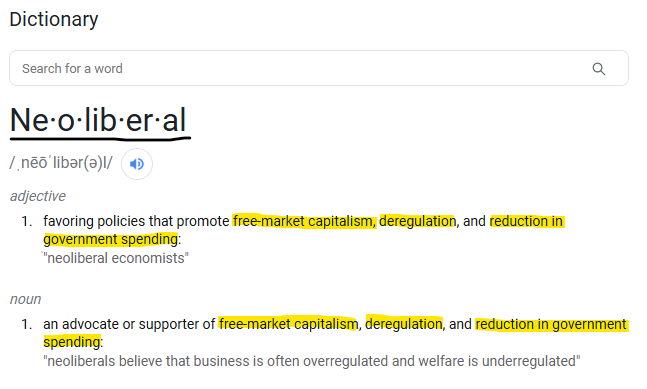
Anything less than communism to an #MMT er is "neoliberalism."
MMT is about Soviet Economics. The state funds us, guarantees "jobs," burns down our huts, is the Monopolist price setter, gives healthcare, housing, punishes the rich etc..
It's all about the "STATE!"
Henric retweeted
MMTers need to check their privilege.
Chapter 7: "'Check Your Privilege': MMT's Privilege Position and Economic Destructionism," by Joshua Mawhorter.
MMTers point to the United States as the monetary sovereign par excellence. Kelton: "When a country issues its own nonconvertible (fiat) currency and only borrows in its own currency, that country has attained monetary sovereignty."
But Mawhorter asks a question MMTers rarely consider: How did the US achieve this privileged position in the first place?
"MMT gained intellectual traction in wealthy countries—wealthy in production, with a stronger record of respecting free trade, property rights, and sound money." - p. 166
Mawhorter argues that the US attained this status through centuries of capital accumulation, private investment, and relatively sound money—not by following MMT's prescriptions.
And there's another problem. MMT's chartalist theory claims that money originates with the state, particularly through taxation. But American colonial "governments could only get people to accept paper money substitutes because there was a preexisting link between the paper and the commodity money." - p. 168
MMT takes for granted the very economic institutions and accumulated wealth that its policies would undermine.
This brings us to the Mawhorter's most important point: capital doesn't automatically sustain itself.
As Mises put it, "Capital does not reproduce itself." - quoted on p. 172
Capital goods must be maintained, replaced, and accumulated through saving and investment. Diverting resources toward present consumption (see Patrick Newman's chapter) can create the appearance of prosperity while actually consuming the economy's capital stock.
Mises called this economic destructionism.
MMTers pay lip service to the fact that the government cannot print real resources. But they ignore how monetary expansion, taxation, and government spending can distort economic calculation, discourage capital accumulation, and waste productive resources.
MMT "is a theory of unacknowledged privilege built atop foundations it would destroy." - p. 183
What happens to the dollar's privileged position if those foundations are gradually eroded?
Read the full chapter here: mises.org/library/book/anti-…

Henric retweeted

Your final paragraph nailed it. That's how I've always thought of MMT, for example: a political agenda dressed up as economic theory. As far as I can tell, you won't find an MMT proponent who is not an ardent leftist. In contrast, "orthodox" (sorry) economists come from all over
Henric retweeted

MMT enthusiasts have this religious-like zealotry that they've stumbled onto some hidden truth that will blow away anyone who wishes to "get educated" - when they've really just pieced together a few tautological accounting identities with long-discredited inflation theories.